Centrifugal force is the apparent outward force felt by an object moving in a circle, and it exists only in a rotating reference frame. It is not a real force, because nothing pushes the object outward. Its magnitude equals mass times speed squared divided by radius, the same size as the inward centripetal force.
Your car swings into a roundabout and you slide toward the door. Something shoved you outward — you felt it in your shoulder, in your stomach, in the coffee that just left the cup.
Except nothing did. That phantom shove is one of the most argued-about ideas in first-year mechanics, and it trips up more students than any other topic in circular motion. Get it right and the whole subject clicks.
What Is Centrifugal Force?
Centrifugal force is the outward force that appears to act on an object when its motion is described from a rotating reference frame. It always points directly away from the axis of rotation.
Physicists call it a fictitious force — also known as an inertial force or pseudo force. That label is not an insult. It means the force has no physical source: no rope, no magnet, no hand, no contact. Search the outside world for whatever is doing the pushing and you will come up empty.
Richard Feynman put centrifugal force in exactly this category in his lecture on the characteristics of force, alongside the sideways tug you feel when a bus pulls away. Both are the same trick: your frame of reference is accelerating, and your body is reading that acceleration as a force.
Why “Fictitious” Does Not Mean “Imaginary”
The sensation is completely genuine. Your organs really do press against one side of your body, and a bucket of water really does stay put when you swing it overhead.
What is fictitious is the explanation, not the experience. In the ground frame there is no outward force — there is only inertia, your body’s stubborn insistence on carrying straight on while the car curves away beneath you.
The Centrifugal Force Formula
For an object turning with the frame at radius r, the centrifugal force has the same magnitude as the centripetal force but points the opposite way:
Every symbol, with its SI unit:
- F — centrifugal force, in newtons (N), directed radially outward
- m — mass of the object, in kilograms (kg)
- v — speed measured in the non-rotating ground frame, in metres per second (m/s)
- r — radius of the circular path, in metres (m)
The same force is often written using angular velocity instead of speed, which is more convenient for anything that spins at a fixed rate:
- ω — angular velocity, in radians per second (rad/s)
- r — radius, in metres (m)
- m — mass, in kilograms (kg)
The two forms are identical because v = ωr for anything carried round by the frame. Substitute that into mv2/r and the r cancels down to mω2r.
One consequence deserves flagging: the force scales with the square of speed. Double the speed of a bend and you quadruple the force needed to hold the turn — you can put your own numbers in with the Centripetal Force Calculator and watch how brutally that v2 term bites.
Centrifugal Force vs Centripetal Force: What Is the Difference?
The difference is direction and reality: centripetal force is a real inward force with a physical source, while centrifugal force is an apparent outward force that only exists in a rotating frame. They are never both present in the same description of the same object.
| Property | Centripetal force | Centrifugal force |
|---|---|---|
| Real or fictitious | Real — it has a physical agent | Fictitious — no agent exists |
| Direction | Toward the centre of the circle | Away from the axis of rotation |
| Where it appears | Any frame, including the ground | Only in a rotating frame |
| Typical source | Tension, friction, gravity, a normal force | The frame’s own rotation |
| Magnitude | mv2/r, or mω2r | mv2/r, or mω2r — the same size |
| Third-law partner | Yes — an equal outward pull on the rope or road | None — fictitious forces have no partner |
| Effect on the object | Produces genuine inward acceleration | Balances the books so the object looks still |
Four Quick Tests to Tell Them Apart
When a problem starts to blur, run these four checks in order. They resolve almost every case in seconds.
- Which frame am I in? Standing on the ground or watching from outside, only centripetal force exists. Sitting inside the spinning thing, centrifugal force appears.
- Can I name the agent? Point at the rope, the road, the wall, the planet. If you can name what is pushing, the force is real. If you cannot, it is fictitious.
- Which way is the object actually accelerating? Anything on a circular path accelerates toward the centre. Always. No exceptions.
- What happens if I cut the constraint? The object leaves along the tangent, not along the radius. An outward force would send it straight out — and it never does.
How Centrifugal Force Works: It All Comes Down to Your Frame
Centrifugal force appears because Newton’s laws only hold in non-accelerating frames, so a rotating observer has to invent an extra force to make the maths balance. That invented term is the centrifugal force.
Start on the ground, watching a ball whirl on a string. The ball is not travelling in a straight line, so by Newton’s first law a net force must be acting. That force is the string tension, and it points inward.
There is no outward force in this picture at all. The ball’s tendency to fly off is not a force — it is inertia, which is the absence of a force.
Now Ride Along With the Ball
Climb into a frame that spins with the string. From here the ball is stationary. It sits at a fixed distance and does not accelerate at all.
But the tension is still there, still pulling inward. A stationary object with a real inward force on it should be accelerating inward — and it is not. Newton’s second law appears to be broken.
The repair is to add a term equal to the frame’s own acceleration, multiplied by mass and pointed the other way. In this rotating frame the equation of motion becomes:
- a’ — acceleration measured in the rotating frame, in m/s2
- Freal — the genuine forces (tension, friction, gravity), in newtons (N)
- Fcentrifugal — mω2r outward, in newtons (N)
- FCoriolis — an extra term, only non-zero if the object also moves within the rotating frame
For the whirling ball, a’ is zero and the Coriolis term vanishes. The inward tension and the outward centrifugal term cancel exactly, and the ball’s stillness is explained.

The same ball, described twice. The outward arrow exists only on the right-hand side.
Drag the sliders below and watch the inward force respond to speed and radius. Then press Release: the ball leaves along the tangent, never straight out along the radius.
Real-World Examples of Centrifugal Force
Rotating frames are everywhere once you start looking, and in each of these the outward description is the useful one.
1. The Spin Cycle
A washing machine drum spins fast enough that water cannot follow the curve. The fabric is held in by the drum wall; the water is not, so it carries straight on and exits through the perforations.
Notice the drum does not throw the water out. It simply stops holding it in.
2. Laboratory Centrifuges
Spin a blood sample at 12,000 rpm and heavier components settle outward far faster than gravity alone could manage. Lab technicians quote the effect as relative centrifugal field, or RCF — the outward acceleration expressed in multiples of g.
An 8 cm rotor at 12,000 rpm delivers roughly 12,900 g. That is why a five-minute spin does what days of settling could not.

3. The Rotor Fairground Ride
You stand against the wall of a drum, the drum spins, and the floor drops away. You stay put because the wall presses inward hard enough to hold you on the circle, and friction against that pressing wall holds you up against gravity.
From inside, it feels exactly like being pinned by a giant hand. From outside, the wall is merely doing what a road does on a bend.
4. Artificial Gravity in Space
A rotating space station has no gravity, so it borrows the sensation instead. Spin a ring habitat and the outer wall becomes a floor: it pushes crew inward, and inside their rotating frame that push feels like weight.
The engineering constraint is comfort, not physics. Spin too fast and head-versus-feet differences plus Coriolis effects make crew nauseous, which is why realistic designs are enormous — hundreds of metres across.
5. The Shape of the Earth
Our planet is not a sphere. It bulges at the equator by about 21 km because the equatorial surface is furthest from the spin axis, and over geological time the rock adjusted to that rotation.
You can weigh the effect. At the equator the centrifugal term removes about 0.034 m/s2 from your apparent weight — roughly 0.35% of g, before the bulge itself is even counted.
Common Misconceptions About Centrifugal Force
Misconception 1: It Is the Newton’s Third Law Reaction to Centripetal Force
This is the most common error, and it is subtly wrong rather than obviously wrong. Third-law pairs act on different bodies: the string pulls the ball inward, and the ball pulls the string outward.
The centrifugal force acts on the same body as the tension — the ball itself. That alone disqualifies it as a third-law partner. The genuine outward pull on the rope is sometimes called the reactive centrifugal force, and it is a real, ground-frame force acting on a different object entirely.
Misconception 2: Cut the String and the Ball Flies Outward
It does not. It leaves along the tangent, in a straight line, exactly as Newton’s first law demands for an object with no net force.
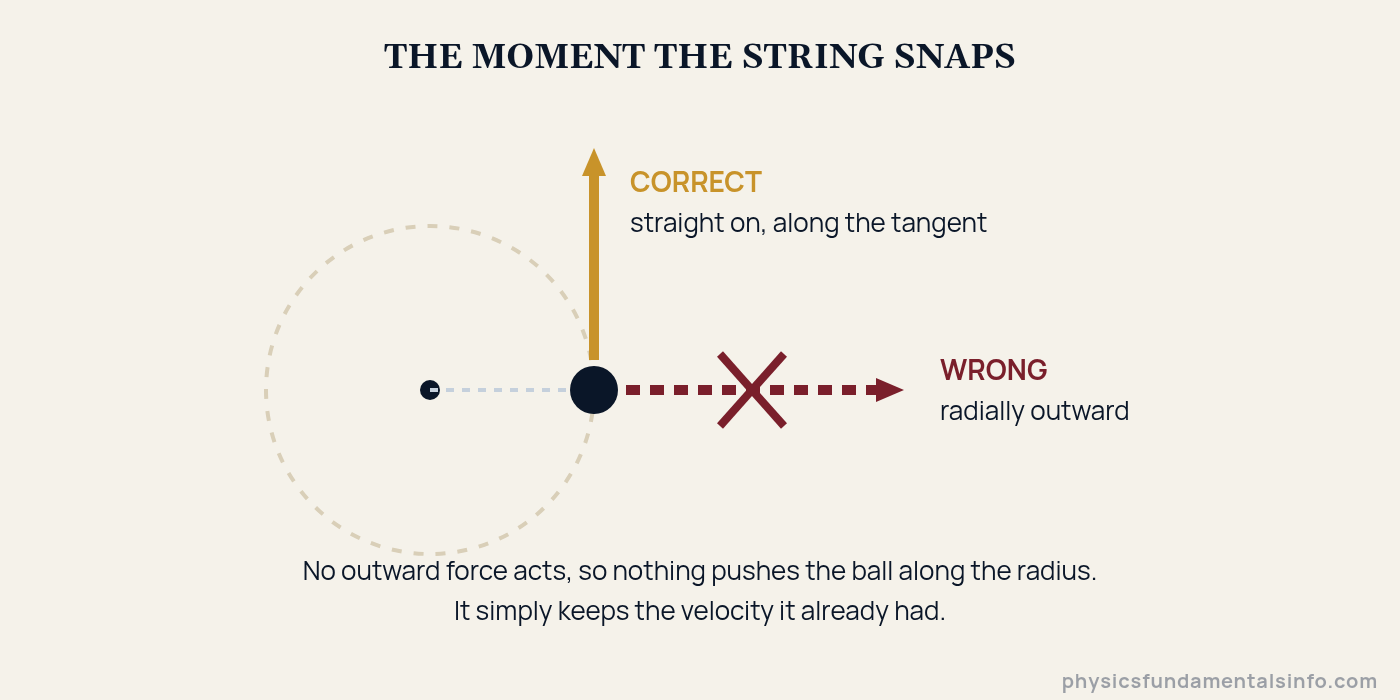
The tangent test is the fastest way to prove no outward force was ever acting.
Misconception 3: It Is Fake, So You Can Ignore It
Try telling that to anyone who designs a turbine rotor, a centrifugal pump or a spin dryer. Working inside the rotating frame is often far easier than tracking everything from outside.
Fictitious forces are legitimate tools. They are simply the price of using a frame in which Newton’s laws do not hold on their own.
Misconception 4: Both Forces Act on the Ball at Once
They never do. Pick the ground frame and you get centripetal force alone; pick the rotating frame and you get centrifugal force balancing the real inward force.
Drawing both on the same free-body diagram is the classic exam slip — it produces zero net force on an object that is visibly accelerating.
How Centrifugal Force Relates to Coriolis, Banked Curves and Artificial Gravity
Centrifugal force is one of three inertial forces that appear in a rotating frame, the others being the Coriolis force and the Euler force. Each shows up for the same reason: the frame itself is accelerating.
The Coriolis Force
Centrifugal force acts on everything at radius r, whether it moves in the rotating frame or not. The Coriolis force is different — it only appears when something moves within that frame, and it acts sideways to the motion.
On the spinning Earth this is what curves winds and ocean currents, deflecting them right in the Northern Hemisphere and left in the Southern. NOAA has a clear walk-through of why the deflection happens, and it is the same frame logic at work.
Banked Curves
Tilt a road and the normal force gains an inward component, so a vehicle can hold the bend with less friction — or none at all at the design speed. The banked curve condition is tanθ = v2/(rg).
Race tracks, velodromes and railway curves all exploit it. A car on a perfectly banked bend still has no outward force on it, however strongly the driver feels otherwise.
Circular Motion and Rotational Quantities
Everything here sits inside the broader framework of circular motion, where a = v2/r governs the acceleration and ω, period and frequency describe the rate of turning.
Master that relationship and centrifugal force stops being a separate mystery. It becomes a bookkeeping entry you add when you choose to sit inside the spin.
Worked Problems
Show Solution
Solution:
Step 1: The required inward (centripetal) force is F = mv2/r.
Step 2: Substitute with units: F = (0.20 kg)(4.0 m/s)2 / (0.50 m) = (0.20)(16) / (0.50) N.
Step 3: Solve: F = 3.2 / 0.50 = 6.4 N, directed toward the centre.
Answer: 6.4 N inward.
Show Solution
Solution:
Step 1: With no net force the ball obeys Newton’s first law and travels in a straight line along the tangent at 4.0 m/s.
Step 2: Distance along the tangent: d = vt = (4.0 m/s)(0.30 s) = 1.2 m.
Step 3: The tangent is perpendicular to the radius, so the distance from the centre is sqrt(r2 + d2) = sqrt(0.502 + 1.22) = sqrt(0.25 + 1.44) = sqrt(1.69).
Answer: 1.3 m from the centre, on a straight tangential path — not along the radius.
Show Solution
Solution:
Step 1: Required inward force F = mv2/r = (1200 kg)(12 m/s)2 / (45 m).
Step 2: F = (1200)(144) / 45 = 172,800 / 45 = 3840 N.
Step 3: Friction must supply this, so μmg is at least mv2/r, giving μ at least v2/(rg) = 144 / (45 × 9.81) = 144 / 441.45.
Answer: 3840 N inward; minimum μ = 0.33 (2 s.f.).
Show Solution
Solution:
Step 1: Ground frame — the passenger travels on the same circle, so a net inward force is required: F = mv2/r = (70)(144)/45 = 224 N.
Step 2: That 224 N comes from the seat and door pressing inward. No outward force appears anywhere in this description.
Step 3: Car frame — the passenger is stationary, so the books must balance. A centrifugal force of mv2/r = 224 N outward is added, cancelling the 224 N inward contact force.
Answer: 224 N inward contact force in the ground frame; 224 N inward contact force plus 224 N outward centrifugal force, net zero, in the car frame.
Show Solution
Solution:
Step 1: The wall supplies the inward force, so N = mω2r. Friction must hold the rider’s weight, so μN is at least mg.
Step 2: Substitute: μmω2r is at least mg. The mass cancels, giving ω at least sqrt(g / (μr)).
Step 3: ω = sqrt(9.81 / (0.40 × 3.0)) = sqrt(9.81 / 1.20) = sqrt(8.175) = 2.86 rad/s. In rpm: (2.86)(60) / (2π) = 27.3 rpm.
Answer: ω = 2.9 rad/s, about 27 rpm, giving a rim speed of 8.6 m/s.
Show Solution
Solution:
Step 1: Convert rpm to rad/s: ω = 2π(12,000) / 60 = 1256.6 rad/s.
Step 2: Outward acceleration a = ω2r = (1256.6)2(0.080 m) = (1.5791 × 10⁶)(0.080) = 1.263 × 10⁵ m/s2.
Step 3: RCF = a / g = 126,331 / 9.81 = 12,878.
Answer: 1.26 × 10⁵ m/s2, about 12,900 g.
Show Solution
Solution:
Step 1: Apparent gravity comes from the wall supplying ω2r, so we need ω2r = g.
Step 2: Convert the spin rate: ω = 2π(2.0) / 60 = 0.2094 rad/s, so ω2 = 0.04386 rad2/s2.
Step 3: r = g / ω2 = 9.81 / 0.04386 = 223.6 m.
Answer: radius 224 m — a habitat about 450 m across, with a rim speed of 47 m/s.