Resonance physics is what happens when a system is driven at its own natural frequency and responds with its largest motion. For a mass on a spring that frequency is f0 = (1/2pi) sqrt(k/m), set by the spring and the mass alone. At resonance the amplitude is Q times the static deflection, and Q is fixed by the damping.
You already know how to do this. Push a child on a swing and you do not shove harder and harder; you give one small push per swing, timed to go with the motion rather than against it, and the arc grows on its own. Mistime those pushes and the same effort does almost nothing.
That is the whole of resonance, and the physics only sharpens it. Every object with springiness and mass has one frequency it answers to, and driving it at that frequency turns a gentle push into a large motion. The interesting question is not whether the motion grows but how far it grows before something stops it — and the answer to that has nothing to do with how hard you pushed.
What Is Resonance in Physics?
Resonance is the large response a system gives when it is driven at or near its own natural frequency. The natural frequency is the rate at which the system would swing if you displaced it once and let go. Drive it slower or faster and the response shrinks; drive it in step and the motion builds, cycle after cycle.
The system this page works with is the simplest one that shows the whole effect: a block of mass m on a spring of stiffness k, with a damper that resists motion in proportion to speed, pushed back and forth by a force of fixed size. Everything that follows is measured on that oscillator. Its own free motion — the displacement, the speed, the acceleration cycle by cycle — belongs to simple harmonic motion, and this page takes it as read.
Three rules carry the whole topic, and the rest of this article is the evidence for them.
- Rule 1. The natural frequency depends on the stiffness and the mass, and on nothing else — not on how hard you push, not on the damping, not on the frequency you drive at.
- Rule 2. How big the response gets at the natural frequency is decided by the damping alone. It is exactly Q times the deflection the same force would produce if you simply leaned on the spring.
- Rule 3. The frequency of the largest response is not quite the natural frequency. Damping pulls the peak below it, and past a certain amount of damping there is no peak at all.
Rule 1 is the one every textbook states. Rules 2 and 3 are the ones that decide whether a real machine survives, and they are where most of the confusion lives.
The Resonance Frequency Formula
The natural frequency of a mass on a spring is one square root and one division by 2π. Write the stiffness in newtons per metre and the mass in kilograms and the answer comes out in hertz.
The same relation in angular form drops the 2π, and the two are connected by the notation w = 2πf that runs through all oscillation work.
Four more quantities turn that frequency into a prediction about size. Two of them are dimensionless, which is why they travel between a spring, a tuning fork and a tuned circuit without changing form.
- f0 — the natural frequency, the rate the system swings at when nothing is driving it. Unit: hertz (Hz).
- w0 — the same thing in angular measure, 2π times f0. Unit: radian per second (rad/s).
- k — the spring constant, the force needed per metre of stretch. Unit: newton per metre (N/m).
- m — the mass that moves. Unit: kilogram (kg).
- c — the damping coefficient, the resisting force per unit of speed. Unit: newton second per metre (N s/m).
- zeta — the damping ratio, usually printed as the Greek letter zeta. Dimensionless, and the only thing that decides how tall resonance gets.
- Q — the quality factor, one over twice the damping ratio. Dimensionless.
- f and r — the frequency you drive at, in hertz, and the ratio of that to the natural frequency. r is dimensionless, and r = 1 means you are driving exactly on resonance.
- M — the magnification: the steady amplitude divided by the static deflection F0/k. Dimensionless.
Put numbers through it once and the shape of the answer sticks. A 2.0 kg block on a 200 N/m spring gives k/m = 200 / 2.0 = 100.0 1/s2, so w0 = 10.00 rad/s and f0 = 1.592 Hz. If you would rather not run the square root by hand for every spring, our Resonance Frequency Calculator solves this relation in any direction — frequency from k and m, or the stiffness or mass you would need for a frequency you want — and prints the damping ratio, Q and the response at your drive frequency beside it.
The spring constant is an input here, never a result. If you do not have a figure for the spring you are holding, the spring constant calculator gets it from a load and the extension that load produces, and then this formula takes over. Confuse the two and you will solve the wrong problem entirely.
One comparison worth making and then leaving alone: a simple pendulum obeys a formula of the same shape, with a length and the strength of gravity in place of a stiffness and a mass, which the pendulum period formula works through. Same algebra, different physical ingredients. Nothing in this article transfers to it unchanged.
How Resonance Builds Up: Push in Time With the Swing
Resonance builds because a well-timed force adds energy on every single cycle instead of taking some of it back. A force does positive work when it points the same way the object is already moving. Keep that true for the whole cycle and the energy in the oscillator rises steadily.
Here is the timing that makes it work, and it is sharper than “push when it is at the top”. The driving force has to lead the motion by a quarter of a cycle, so that the force is at its largest exactly when the block is moving fastest through the middle. Then the force and the velocity point the same way the whole time, and no part of the cycle is spent cancelling what another part achieved.
Drive it at the wrong frequency and the timing drifts. The force now spends part of every cycle opposing the motion, so most of what it puts in comes straight back out, and the oscillation settles at a much smaller size. That is why the response falls away so sharply on either side of the natural frequency when the damping is light.
What stops the growth is the damper. Over one cycle the force adds an amount of energy proportional to the amplitude, while the damper removes an amount proportional to the amplitude squared. The two match at exactly one amplitude, and that is where the motion settles. Make the damper weaker and that balance point moves higher, which is Rule 2 in one sentence.

The simulator below is the same oscillator with the sliders exposed. Set the mass and the spring, choose a drive frequency, and the drawing answers in two stacked panels: the block is already at its steady swing in the upper one, and the response curve underneath shows what every other drive frequency would have given.
How Big Does It Get? Damping Decides
At the natural frequency the magnification is exactly Q, which means the amplitude is Q times the deflection the same force would produce if it were simply held steady. Set r = 1 in the magnification formula and the first bracket vanishes; what is left is 1/(2 zeta), and that is the definition of Q. No force appears in the result at all.
Read that again, because it is the sentence this whole topic turns on. The size of the push sets the static deflection, and the damping sets the number you multiply it by. Double the force and you double both; halve the damping and the response doubles with the same push.
Take the block from the formula section — 2.0 kg on a 200 N/m spring — with a damper of 2.0 N s/m, pushed by a force whose peak size is 2.00 N. Lean on that spring with 2.00 N and it moves 10.00 mm. Push it back and forth at 1.592 Hz instead and it swings 100.0 mm, because the damping ratio is 0.05000 and Q is therefore 10.00.
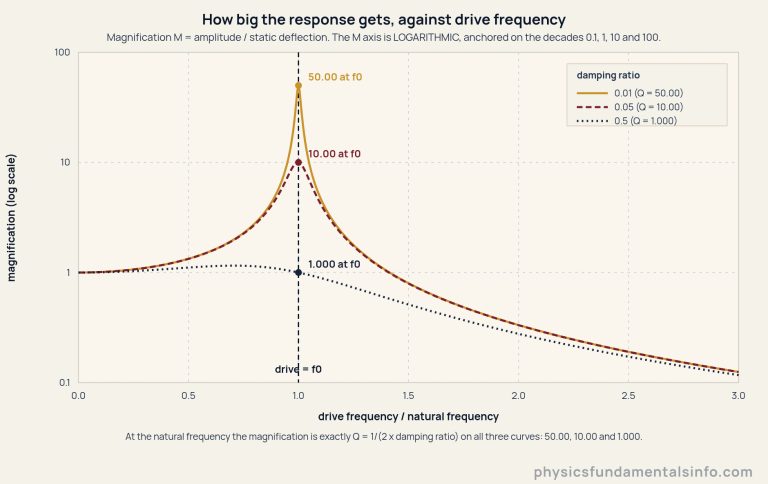
No table can make the point those curves make. The two lightly damped ones lie on top of each other everywhere except close to the dashed line, where the 0.01 curve reaches 50.00 and the 0.05 curve reaches 10.00 — their two quality factors. Heavy damping barely lifts its curve at all, and past a ratio of about 1.8 all three fall away together.
Seven settings of that same oscillator are tabulated below, and the pair to compare is the second and third rows. Same spring, same mass, same natural frequency, same drive — only the damper changes, and the amplitude goes from 500.0 mm to 10.00 mm, a factor of 50.00.
| Setting | m (kg) | k (N/m) | c (N s/m) | Natural frequency | Damping ratio | Q | Amplitude | Peak at |
|---|---|---|---|---|---|---|---|---|
| Driven exactly at f0 | 2.0 | 200 | 2.0 | 1.592 Hz | 0.05000 | 10.00 | 100.0 mm | 1.588 Hz |
| Light damping: a tall, narrow peak | 2.0 | 200 | 0.4 | 1.592 Hz | 0.01000 | 50.00 | 500.0 mm | 1.591 Hz |
| Heavy damping: the peak flattens | 2.0 | 200 | 20.0 | 1.592 Hz | 0.5000 | 1.000 | 10.00 mm | 1.125 Hz |
| Just inside the threshold | 2.0 | 200 | 28.0 | 1.592 Hz | 0.7000 | 0.7143 | 7.143 mm | 0.2251 Hz, and already invisible |
| Past the threshold: no peak at all | 2.0 | 200 | 28.4 | 1.592 Hz | 0.7100 | 0.7042 | 7.042 mm | none |
| Driven well below f0 | 2.0 | 200 | 2.0 | 1.592 Hz | 0.05000 | 10.00 | 13.30 mm | 1.588 Hz |
| Stiffer spring: f0 doubles | 2.0 | 800 | 2.0 | 3.183 Hz | 0.02500 | 20.00 | 50.00 mm | 3.181 Hz |
Every amplitude in that table comes from the same 2.00 N push, and six of the seven rows are driven at their own natural frequency. The exception is Driven well below f0, which has the same spring, mass and damper as the first row but is driven at half the natural frequency, 0.7958 Hz rather than 1.592 Hz — and that alone takes the swing from 100.0 mm down to 13.30 mm. The last row is Rule 1 on its own: four times the stiffness, the same mass, and the natural frequency doubles from 1.592 Hz to 3.183 Hz while nothing about the damper has been touched.
In practice Q is also the number engineers quote, because it has a second meaning that falls out of the same algebra. A lightly damped system is sharp as well as tall: for light damping the width of the response at its half-power points is about f0/Q. High Q buys you a big response and a narrow band in one purchase, which is exactly what a radio tuner wants and exactly what a bridge does not.
Where the Peak Actually Sits
The largest response is not at the natural frequency once there is any damping at all. It sits at f0 times sqrt(1 – 2 zeta2), which is always below f0, and the gap widens as the damping grows. At a damping ratio of 0.05000 the shift is too small to see; by 0.3162 the peak has moved 10.56% below the natural frequency.
Push the damping further and something more dramatic happens than the peak moving. It dies. Once the damping ratio reaches 1/sqrt(2) = 0.7071 the response has no maximum anywhere: it simply falls away from its static value as the drive speeds up.
The approach to that threshold is a lesson in reading formulae honestly. At a damping ratio of 0.7000 the algebra still reports a peak, at 0.2251 Hz for our block — but the magnification there is 1.000 to four figures, the same as the static response. By the time the damping is that heavy the peak is already gone in any measurable sense; at 0.7071 it formally disappears.
| Damping ratio | Q, and the magnification at the natural frequency | Peak sits at this fraction of the natural frequency | Magnification at the peak |
|---|---|---|---|
| 0.01000 | 50.00 | 0.9999 | 50.00 |
| 0.02500 | 20.00 | 0.9994 | 20.01 |
| 0.05000 | 10.00 | 0.9975 | 10.01 |
| 0.3162 | 1.581 | 0.8944 | 1.667 |
| 0.5000 | 1.000 | 0.7071 | 1.155 |
| 0.7000 | 0.7143 | 0.1414 | 1.000 |
| 0.7100 | 0.7042 | none | none |
So if the peak wanders, what is the exact signature of the natural frequency? The phase. However light or heavy the damping, the motion runs exactly a quarter of a cycle — 90.00 degrees — behind the driving force when the drive sits on f0, and nowhere else. That is the timing described in the building-up section, and it is exact, with no approximation anywhere in it.
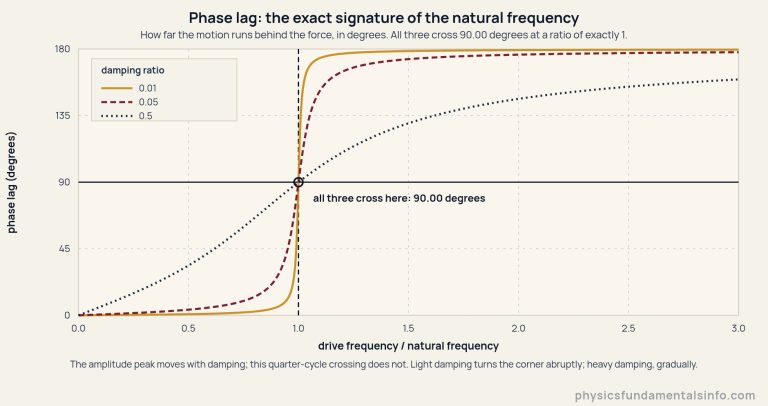
A lightly damped system turns that corner violently: almost exactly in step with the force below the natural frequency, half a cycle behind it above, with the whole transition squeezed into a narrow band. Heavy damping spreads the same transition across the entire range. The crossing point never moves.
Everyday Examples of Resonance
Resonance is everywhere once you know what to look for, and the examples divide neatly into the ones we want and the ones we design against.
- A playground swing. The classic. One small push per cycle, timed with the motion, and the arc grows until air resistance and friction at the pivot take as much as each push delivers.
- A wine glass answering a voice. The rim has a natural frequency of its own. Sing that note and the rim flexes further on every cycle, and because the glass is lightly damped the magnification is large.
- A radio or a phone picking one station. The same mathematics describes a tuned electrical circuit, where a capacitance and an inductance take the roles of the mass and the spring. Tuning means moving the circuit’s natural frequency onto the one you want and letting its sharpness reject the rest.
- Magnetic resonance imaging. Nuclei in a magnetic field respond strongly to radio waves at one particular frequency and ignore everything else. The scanner is built around that selectivity.
- A washing machine on its spin cycle. The drum passes through the frame’s natural frequency on the way up to speed, which is why a machine can shake alarmingly for a few seconds and then settle once it is spinning faster than the resonance.
Notice what the useful cases have in common. Light damping is the asset when you want selectivity, and the liability when something structural has to survive the response. Most engineering around resonance is a choice about where to sit on that trade.
Clamp a string at both ends instead and it answers at a whole series of frequencies rather than one, which is the subject of standing waves. Our oscillator has a single mode, and that is the only case this page measures.
Where Resonance Breaks Down: 4 Common Mistakes
Four beliefs about resonance survive a surprising distance into physics courses, and each one is corrected by something already on this page.
Mistake 1: resonance means the amplitude grows without limit. It does not. At the natural frequency the magnification is Q, a finite number, for every real system — 10.00 for the block above, 50.00 when the damper is weakened. The formula only diverges at a damping ratio of exactly zero, which no real object has.
Mistake 2: a bigger push is what makes resonance dramatic. Push twice as hard and you get twice the swing, exactly as you would by leaning on the spring. The drama comes from the multiplier, and the multiplier is the damping’s business. A 2.00 N push producing a 100.0 mm swing on a spring that the same 2.00 N bends by 10.00 mm is the whole topic in one line.
Mistake 3: the resonance frequency is where the response peaks. Those are two different frequencies whenever the damping is not zero, as the table above sets out. The natural frequency is where the phase lag is 90.00 degrees; the peak sits slightly below it and moves as the damping changes.
Mistake 4: the 1940 Tacoma Narrows bridge collapse is the textbook case of resonance. It is the textbook case of the textbooks getting it wrong. As Wikipedia’s account of the 1940 Tacoma Narrows Bridge sets out, the event is presented in many physics textbooks as elementary forced mechanical resonance, but the collapse is attributed to aeroelastic flutter: a self-exciting oscillation driven by the structure’s own motion rather than by a driving force at a fixed frequency. The correction is usually credited to a 1991 American Journal of Physics paper by Billah and Scanlan, titled “Resonance, Tacoma Narrows Bridge Failure, and Undergraduate Physics Textbooks”.
There is a fifth caveat, and it is about the model rather than about anyone’s misunderstanding. Everything here assumes one mass, one spring, one mode, and a damping force proportional to speed.
Real objects break every one of those assumptions. A bridge deck or a turbine blade has many natural frequencies rather than one; springs stiffen or soften at large deflections, so the natural frequency starts to depend on the amplitude; and real losses — friction, air drag, internal heating — are rarely proportional to speed. Treat the single-mode result as the first and clearest case, not as the last word.
One more boundary worth stating plainly: every number on this page is a steady-state figure. How long an oscillator takes to build up to its steady swing is a different calculation, and nothing here makes it. Amplitude itself, as a quantity with its own energy rule, belongs to amplitude in physics, and the hertz-and-seconds bookkeeping behind f and T belongs to the frequency formula.