Dispersion of light is the splitting of white light into its constituent colours when it passes through a transparent medium such as a glass prism, because the refractive index — and therefore the speed and bending of light — depends on its wavelength. Shorter wavelengths (violet) slow and bend the most; longer wavelengths (red) bend the least.
Look at a rainbow arcing over wet fields, or the buried flash of colour deep inside a cut diamond, and you are watching one quiet rule of physics at work. White light is not a single thing — it is a bundle of colours travelling together, and the right piece of glass or water can pull them apart.
That unbundling is dispersion. It is why a cheap glass prism throws a spectrum across your wall, why the sky answers a rainstorm with colour, and why the lens in a phone camera has to fight faint coloured fringes. Once you understand the mechanism, you start to see it everywhere.
What Is Dispersion of Light?
Dispersion of light is the separation of white light into its component colours as it passes through a medium, caused by the refractive index of that medium changing with wavelength. Because each colour bends by a slightly different amount, they emerge fanned out into a spectrum instead of staying blended.
Isaac Newton settled the question in the 1660s. Passing sunlight through a prism, he saw the familiar band of red, orange, yellow, green, blue and violet. The clever part came next: a second prism recombined the colours back into white light. That proved the prism was not adding anything — the colours were inside the white light all along, waiting to be spread out.
The visible spectrum runs from roughly 400 nm (violet) to 700 nm (red). Each of those wavelengths corresponds to a colour your eye reads, and — crucially — to a slightly different refractive index inside glass. Hold that one idea and the rest of dispersion follows.
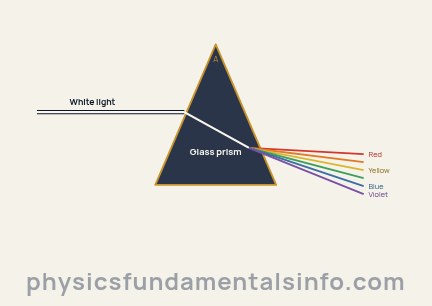
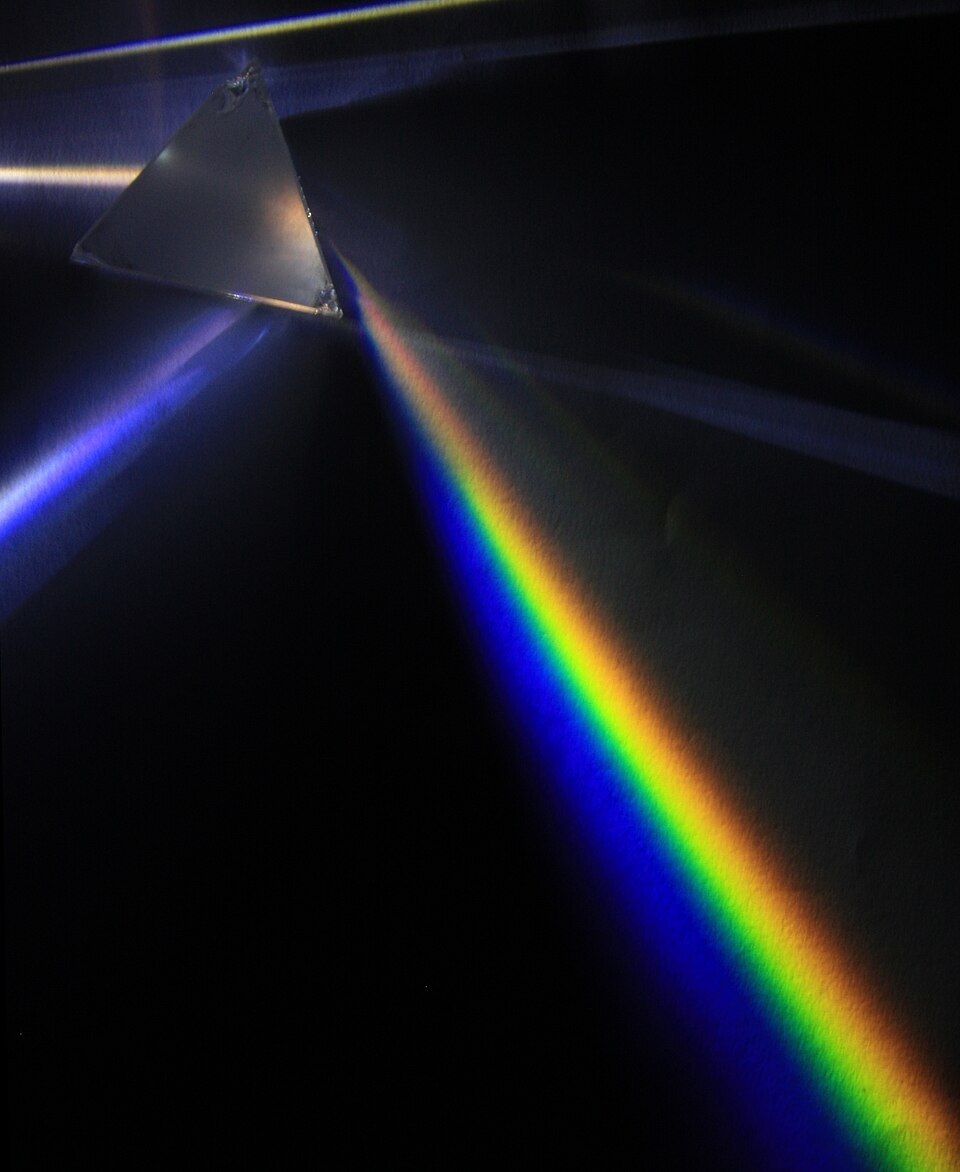
White light entering a prism is bent twice. Violet is deviated most and red least, so the beam leaves fanned into a spectrum.
The Formulas Behind Dispersion of Light
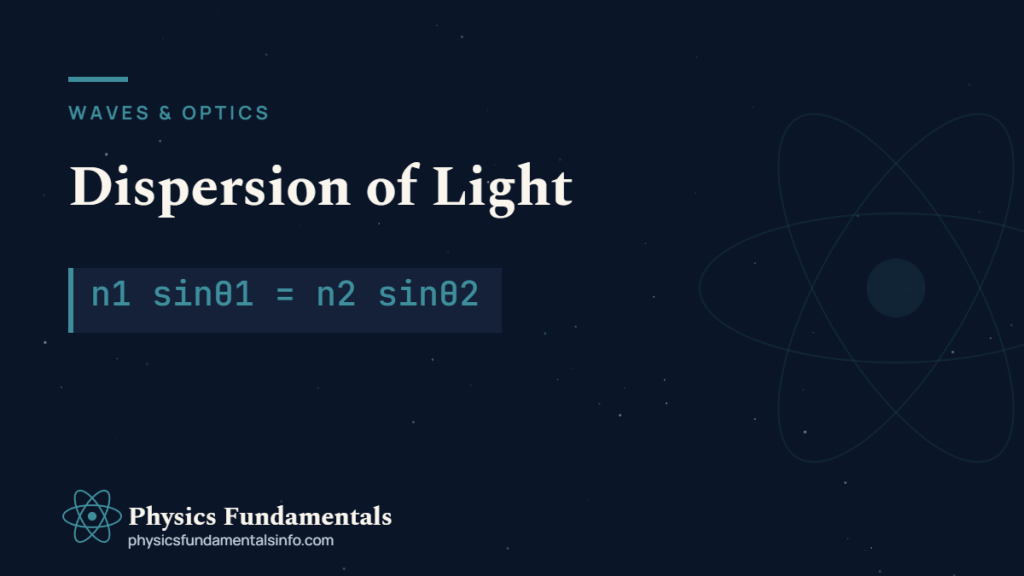
Dispersion has no single master equation — it emerges from the law of refraction fed by one fact: the refractive index n is a function of wavelength. Start with Snell’s law, which governs how any ray bends at a boundary.
- n1, n2 — refractive indices of the first and second media (dimensionless)
- θ1 — angle of incidence, measured from the normal (radians in SI; usually quoted in degrees)
- θ2 — angle of refraction, from the normal (radians or degrees)
Because n2 is slightly different for each colour, θ2 comes out different for each colour. That single line contains the whole of dispersion in miniature. You can test any pair of media with our Snell’s Law Calculator.
Why does n differ between colours? It comes back to speed.
- n — refractive index of the medium (dimensionless)
- c — speed of light in vacuum, 299,792,458 m/s
- v — speed of light in the medium (m/s)
A larger n means light crawls more slowly through the material. Violet light has the highest n in glass, so it is the slowest colour inside a prism — and, by Snell’s law, the most sharply bent.
The wavelength dependence itself is captured well by Cauchy’s empirical relation, which describes normal dispersion across the visible range.
- n(λ) — refractive index at wavelength λ (dimensionless)
- A, B — constants unique to the material (A is dimensionless; B has units of length2, usually μm2)
- λ — wavelength of the light (metres in SI; normally quoted in nm or μm)
As λ falls toward the violet end, the B/λ2 term grows, so n rises. That is the mathematical fingerprint of “violet bends more than red.”
For a whole prism, the practical relationship is the angle of minimum deviation — the workhorse of the optics bench, and the “prism rule” that lets you measure a glass’s refractive index directly.
- n — refractive index of the prism for that colour (dimensionless)
- A — the refracting (apex) angle of the prism (degrees or radians)
- δmin — angle of minimum deviation for that colour (degrees or radians)
Measure the smallest deviation a prism produces for each colour and you can read off that colour’s refractive index. Since δmin is larger for violet, this returns a larger n for violet than for red — the numbers agree with the physics.
Two more quantities matter for how wide the spectrum spreads. For a thin prism, one colour is deviated by δ = (n – 1)A, so the angular dispersion between violet and red is (nV – nR)A. The material’s dispersive power ω = (nV – nR) / (nY – 1) then tells you how strongly a glass fans the colours relative to how much it bends light overall.
How Dispersion of Light Works
Dispersion works because light of different wavelengths travels at different speeds inside a medium, and speed controls the amount of bending. Everything else is the story of why the speed depends on colour.
Light is an electromagnetic wave — a travelling ripple of electric and magnetic fields. As it enters glass, its oscillating field pushes and pulls on the bound electrons of the atoms, which vibrate and re-radiate their own tiny waves. Those re-radiated waves interfere with the original, and the net result is a wave that advances more slowly than it would in empty space. That slow-down is exactly what the refractive index measures.
Here is the key twist. How strongly the electrons respond depends on how close the light’s frequency is to the material’s own natural resonances, which for ordinary glass sit in the ultraviolet. Violet light, with its higher frequency, sits closer to those resonances, so it interacts more strongly, is slowed more, and ends up with a higher refractive index. Red light, further from resonance, is slowed less. The colours therefore travel at genuinely different speeds inside the glass.
Why does violet light bend more than red?
Violet bends more than red because most transparent materials have a higher refractive index for shorter wavelengths. A higher index means a slower speed, and Snell’s law turns that slower speed into a larger deflection angle at the surface. Red, at the long-wavelength end, has the lowest index and bends least — which is why red always sits on the outer edge of a spectrum and violet on the inner.
The size of the effect is small but real. In a typical crown glass the index shifts by only about one part in a hundred across the visible band, yet that is enough to smear white light into a clean spectrum.
| Colour | Approx. wavelength (nm) | Refractive index n (typical crown glass) |
|---|---|---|
| Red | ≈ 660 | 1.513 |
| Yellow | ≈ 590 | 1.517 |
| Green | ≈ 530 | 1.519 |
| Blue | ≈ 490 | 1.522 |
| Violet | ≈ 410 | 1.530 |
Values are approximate for a typical crown glass and vary with composition. The trend — n rising steadily toward violet — is the point.
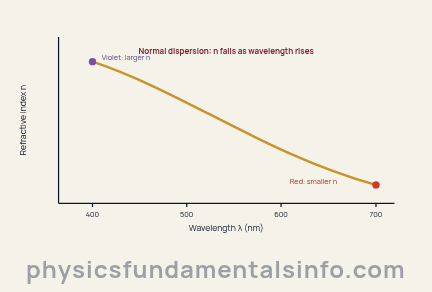
A dispersion curve for a typical glass. Short wavelengths have the highest index, so they slow and bend the most.
A single flat window would refract all the colours and then un-refract them at the parallel far surface, so they leave recombined — no visible spectrum. A prism is different. Its two faces are tilted relative to each other, so the second refraction adds to the first instead of cancelling it. That is why a prism, and not a flat pane, throws a rainbow.
One practical detail worth knowing: as you slowly rotate a prism, the total bending of a given colour dips to a minimum when the ray passes symmetrically through the glass. That symmetric geometry is the angle of minimum deviation used in the “prism rule” above, and it is where lab measurements are taken.
Real-World Examples of Dispersion of Light
Dispersion is not a lab curiosity — it paints the sky, cuts fire into gemstones, and quietly limits the cameras and telescopes we build. Here are seven places it shows up.
Rainbows. Each raindrop acts as a tiny prism-plus-mirror: sunlight refracts on the way in, reflects off the back of the drop, and refracts again on the way out, emerging spread into colours. Because red is bent least and violet most, the primary bow shows red at about a 42° angle and violet near 40°, with red on the outer edge — exactly as described by NOAA’s SciJinks. A fainter secondary bow, formed by a second internal reflection, appears higher up at around 50° with its colours reversed, a geometry laid out by the US National Weather Service.
The glass prism. The triangular prism is the textbook icon of dispersion for good reason — it is the cleanest way to turn a beam of white light into a visible spectrum, and it is exactly what Newton used to prove that colour lives inside white light.
Diamond and gemstone “fire.” Diamond combines a very high refractive index (about 2.42) with strong dispersion (a spread of 0.044 across the spectrum). Light bends sharply on entry, bounces around inside the cut stone by total internal reflection, and fans into colours on the way out, so a diamond throws flashes of red, blue and green. Moissanite disperses even more strongly (0.104), which is why it can look almost too colourful to a trained eye.
Chromatic aberration. A simple lens is a curved piece of glass, so it disperses too — it focuses blue light slightly closer than red, leaving coloured fringes around edges in cheap binoculars and older cameras. The fix is an achromatic doublet: a low-dispersion crown-glass element cemented to a high-dispersion flint element, engineered so two wavelengths land at the same focus.
Spectrometers. Spread starlight or a flame’s glow with a prism or grating and you get a spectrum crossed by dark or bright lines — the fingerprints of individual elements. Dispersion is the reason we can measure what distant stars are made of without ever leaving Earth.
The green flash. Right as the Sun dips below a clean horizon, the atmosphere disperses its image into faintly overlapping coloured discs. With the blue scattered away, the last visible sliver can briefly flash green — a rare, genuine piece of atmospheric dispersion.
Sundogs and haloes. High, thin cloud full of hexagonal ice crystals turns each crystal into a miniature prism. The result is the 22° halo around the Sun or Moon and the bright “sundogs” beside it, often tinged red on their sunward edge.
Notice what these share: colour spreading from a change in speed. The stronger a material disperses, the wider it fans the spectrum.
| Medium | Refractive index n (≈ 589 nm) | Abbe number Vd | Dispersion |
|---|---|---|---|
| Air | 1.0003 | — | Negligible |
| Water | 1.333 | ≈ 55.6 | Low |
| Fused quartz | 1.458 | ≈ 67.8 | Very low |
| Crown glass (BK7) | 1.5168 | ≈ 64.2 | Low |
| Flint glass (F2) | 1.620 | ≈ 36.4 | High |
| Dense flint (SF10) | 1.728 | ≈ 28.4 | Very high |
The Abbe number Vd is the standard optical measure of dispersion — a higher number means colours spread less. Crown glasses sit above about 55; flints fall below.
Common Misconceptions About Dispersion of Light
A few stubborn misunderstandings trip up almost everyone the first time. Clearing them makes the physics click.
“A prism adds colour to white light.” It does not. White light already contains every visible colour; the prism only separates what was there. Newton’s proof was to recombine the spectrum with a second prism and recover plain white light.
“Red light bends the most.” The opposite is true in ordinary materials. Violet has the highest refractive index, so it is slowed and bent the most, while red bends the least. A common exam slip is to picture red on the inside of the spectrum — it belongs on the outside.
“All colours travel at the same speed in glass.” Inside a medium each colour has its own refractive index and therefore its own speed, v = c/n. Violet is the slowest, red the fastest. They only share a single speed — c — when they are back in a vacuum.
“Dispersion and refraction are the same thing.” Refraction is the bending of light at a boundary; dispersion is the fact that the amount of bending depends on wavelength. A single laser colour refracts without dispersing. You need a spread of wavelengths, plus an index that varies with wavelength, to get dispersion.
How Dispersion Relates to Refraction, Wavelength and the Speed of Light
Dispersion sits at the meeting point of several ideas you may already have met, which is what makes it such a satisfying topic to pin down.
It is refraction with a wavelength label attached. Every colour obeys Snell’s law; dispersion is simply the observation that the law gives a slightly different answer for each wavelength. The reason is speed: light of different colours travels at different rates in a medium, and the speed of light in a material is what the refractive index encodes through n = c/v.
Colour, in turn, is wavelength. Whether a wave reads as red or violet to your eye is set by its wavelength and frequency, linked by the wave relationship c = fλ. Dispersion is only possible because white light is a mixture of many wavelengths rather than one.
And it all rests on light being a wave in the first place. Light is a transverse electromagnetic wave, and it is the interaction of that oscillating wave with a material’s electrons that makes speed depend on frequency. In fact, any wave whose speed depends on wavelength can disperse — a broader idea you can also see in wave phenomena such as the Doppler effect, where wavelength and frequency again take centre stage.
Worked Problems
Work through these in order — they build from a one-line speed calculation to a full two-surface prism trace. Carry units and keep to sensible significant figures. Take c ≈ 3.00 × 10⁸ m/s throughout.
Show Solution
Solution:
Step 1: Use n = c/v, rearranged to v = c/n.
Step 2: Red — v = (3.00 × 10⁸ m/s) / 1.513 = 1.98 × 10⁸ m/s.
Step 3: Violet — v = (3.00 × 10⁸ m/s) / 1.532 = 1.96 × 10⁸ m/s.
Answer: red ≈ 1.98 × 10⁸ m/s, violet ≈ 1.96 × 10⁸ m/s. Red travels faster because it has the lower refractive index.
Show Solution
Solution:
Step 1: Apply Snell’s law, sin θ2 = (n1 sin θ1) / n2, with n1 = 1.00 and sin 40° = 0.6428.
Step 2: Red — sin θ2 = 0.6428 / 1.513 = 0.4249, so θ2 = 25.1°. Violet — sin θ2 = 0.6428 / 1.532 = 0.4196, so θ2 = 24.8°.
Step 3: Angular separation = 25.1° – 24.8° = 0.3°.
Answer: red refracts at 25.1°, violet at 24.8°, separated by ≈ 0.3°. Violet sits closer to the normal, confirming it bends more.
Show Solution
Solution:
Step 1: For a thin prism, deviation δ = (n – 1)A.
Step 2: Substitute — δ = (1.52 – 1) × 5° = 0.52 × 5°.
Step 3: δ = 2.6°.
Answer: 2.6°.
Show Solution
Solution:
Step 1: Angular dispersion for a thin prism = (nV – nR)A.
Step 2: = (1.532 – 1.513) × 8° = 0.019 × 8° = 0.152° ≈ 0.15°.
Step 3: Dispersive power ω = (nV – nR) / (nY – 1) = 0.019 / (1.517 – 1) = 0.019 / 0.517 = 0.037.
Answer: angular dispersion ≈ 0.15°; dispersive power ω ≈ 0.037.
Show Solution
Solution:
Step 1: Use the prism formula n = sin[(A + δmin) / 2] / sin(A / 2).
Step 2: (A + δmin) / 2 = (60° + 39.0°) / 2 = 49.5°, and A / 2 = 30°.
Step 3: n = sin 49.5° / sin 30° = 0.7604 / 0.5000 = 1.52.
Answer: n ≈ 1.52, a typical value for crown glass.
Show Solution
Solution:
Step 1: The critical angle satisfies sin θc = 1/n (diamond to air).
Step 2: Red — θc = arcsin(1 / 2.407) = arcsin(0.4155) = 24.6°. Violet — θc = arcsin(1 / 2.451) = arcsin(0.4080) = 24.1°.
Step 3: Difference = 24.6° – 24.1° = 0.5°.
Answer: red 24.6°, violet 24.1°, differing by ≈ 0.5°. Colours reach total internal reflection at slightly different angles, which helps create a diamond’s fire.
Show Solution
Solution:
Step 1: At the first face, sin r1 = sin 45° / n. Then r2 = A – r1, and at the second face sin i2 = n sin r2. The deviation is δ = i1 + i2 – A.
Step 2: Red — sin r1 = 0.7071 / 1.513 = 0.4674, r1 = 27.9°, r2 = 32.1°; sin i2 = 1.513 × sin 32.1° = 0.8048, i2 = 53.6°; δred = 45° + 53.6° – 60° = 38.6°.
Step 3: Violet — sin r1 = 0.7071 / 1.532 = 0.4616, r1 = 27.5°, r2 = 32.5°; sin i2 = 1.532 × sin 32.5° = 0.8234, i2 = 55.4°; δviolet = 45° + 55.4° – 60° = 40.4°.
Answer: red deviates 38.6°, violet 40.4°, so the spectrum spans ≈ 1.8°.