Pendulum period is the time a pendulum takes to complete one full swing — out and back again. For small swings it depends on only two things: T = 2π√(L/g), where L is the pendulum’s length and g is the local gravitational acceleration. On Earth, a 1.00 m pendulum has a period of about 2.0 seconds, whatever its mass.
Legend has it that in 1583 a young Galileo Galilei sat in Pisa Cathedral, watching a lamp swing on its chain. Using his own pulse as a stopwatch, he noticed something odd: as the swings died down, each one still took the same time.
Four centuries on, that observation runs grandfather clocks, metronomes, gravity surveys and a famous museum exhibit in Paris. The rule behind it is startlingly simple — the swing time is set by just two numbers, and neither of them is the mass.
What Is the Pendulum Period?
The pendulum period is the time taken for one complete oscillation: the bob swings from its release point, across to the far side, and all the way back again. It is measured in seconds and given the symbol T.
Watch out for a classic slip here. One swing across is only half a cycle — the period is the full round trip, out and back. Count “over-and-back” as one, or your measured period will be half the true value.
Closely related is the frequency, f = 1/T, the number of complete swings per second, measured in hertz. If you want the full story on that relationship, our guide to the frequency formula covers it in depth. Physicists model all this with a “simple pendulum”: a small, heavy bob on a light string that doesn’t stretch.

A simple pendulum: length L runs from the pivot to the centre of the bob, and gravity supplies a restoring force of mg sin θ.
The Pendulum Period Formula
The pendulum period formula is T = 2π√(L/g): the period equals two pi times the square root of the length divided by the gravitational acceleration. It holds for small swings, and it is one of the tidiest results in mechanics.
Each symbol has a precise meaning:
- T — the period, in seconds (s): the time for one complete out-and-back swing.
- L — the length, in metres (m), measured from the pivot to the centre of mass of the bob, not just to the top of it.
- g — the local gravitational acceleration, in metres per second squared (m/s2). On Earth this is about 9.81 m/s2; the internationally agreed standard acceleration of gravity is defined as exactly 9.80665 m/s2. Real values vary from roughly 9.78 to 9.83 m/s2 with latitude and altitude.
Notice what is missing. There is no mass in the formula, and no amplitude either — a heavier bob or a wider swing changes nothing, provided the angle stays small. Since f = 1/T, a longer pendulum also means a lower frequency.
How Do You Calculate the Pendulum Period?
To calculate the pendulum period, divide the length by the gravitational acceleration, take the square root, then multiply by 2π. In full:
- Measure L in metres, from the pivot down to the centre of the bob.
- Divide L by g (use 9.81 m/s2 on Earth). The result has units of seconds squared.
- Take the square root, giving seconds.
- Multiply by 2π, which is about 6.283.
Try it for a 1.00 m pendulum: 1.00 / 9.81 = 0.1019 s2, the square root is 0.3193 s, and multiplying by 6.283 gives T = 2.01 s. You can check any of these steps instantly — or rearrange the formula to solve for length or gravity — with our Pendulum Period Calculator.
The table below gives a feel for the numbers on Earth:
| Length L | Period T (g = 9.81 m/s2) |
|---|---|
| 0.10 m | 0.63 s |
| 0.25 m | 1.00 s |
| 0.50 m | 1.42 s |
| 1.00 m | 2.01 s |
| 2.00 m | 2.84 s |
| 3.00 m | 3.47 s |
Spot the pattern? Going from 0.50 m to 2.00 m — four times the length — only doubles the period. That square-root behaviour catches many students out, so here it is drawn:
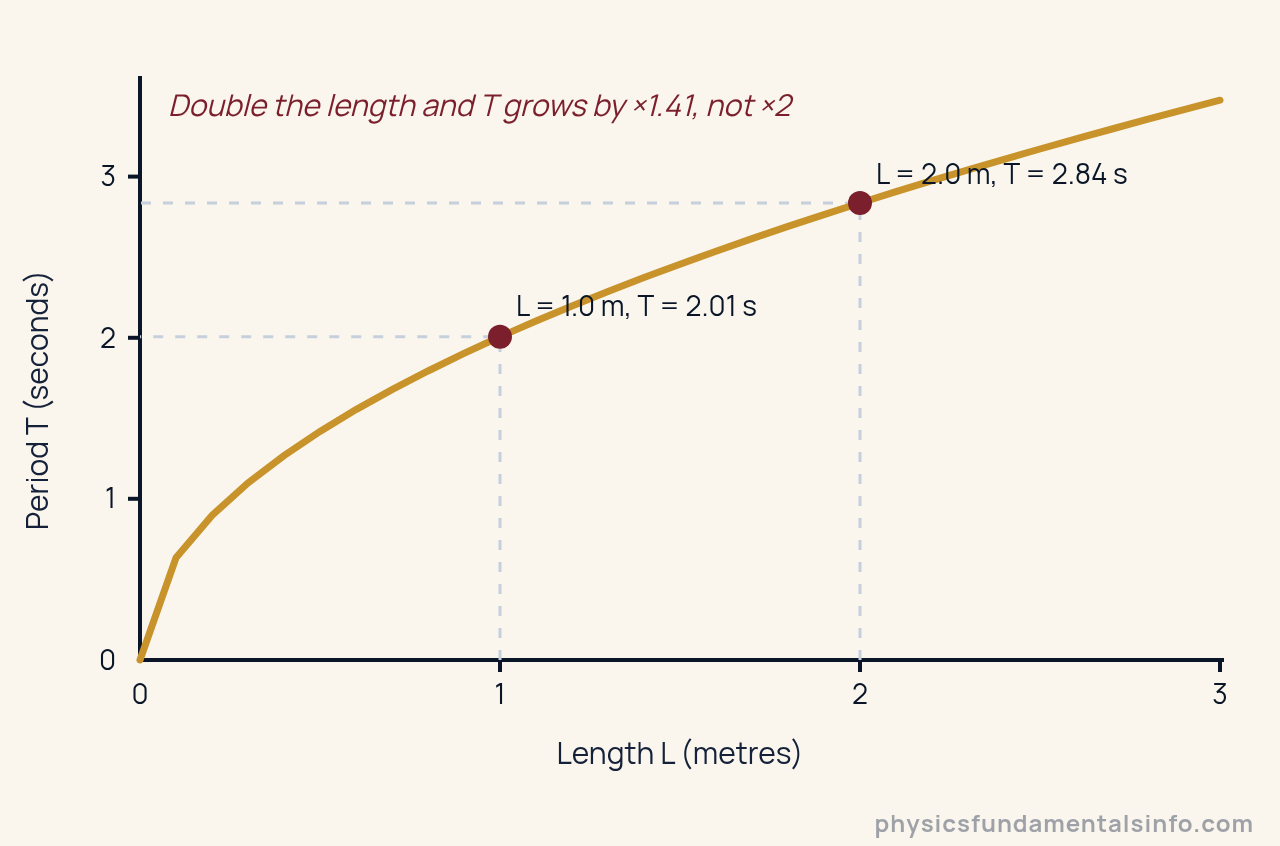
Period grows with the square root of length: you must quadruple the length to double the period.
In practice, a quick sanity check saves marks: any pendulum around a metre long should give a period of roughly 2 seconds on Earth. If your answer comes out as 0.2 s or 20 s, a unit slipped somewhere. Better still, test the formula yourself — drag the length and gravity sliders in the lab below and watch the period respond, then nudge the angle slider and notice how little it matters.
Why Doesn’t Mass Affect the Pendulum Period?
Mass cancels out: a heavier bob is pulled back towards equilibrium by a proportionally larger force, but it is exactly that much harder to accelerate, so every bob keeps the same rhythm. Double the mass and you double both the restoring force and the inertia — the two effects wipe each other out.
You can see the cancellation in Newton’s second law, a = F/m. The restoring force on the bob is mg sin θ, so its acceleration is g sin θ — the mass has vanished before the motion even starts.
Sound familiar? It is the very same cancellation that makes a hammer and a feather fall together in a vacuum, as our guide to free fall explains. A pendulum is really just free fall on a leash. In air, a very light bob does lose amplitude faster to drag — but its period barely shifts.
What Happens to the Pendulum Period on the Moon?
On the Moon a pendulum swings about 2.5 times more slowly: with lunar gravity of 1.62 m/s2, a 1.00 m pendulum’s period stretches from 2.01 s to 4.94 s. Weaker gravity means a weaker restoring force, so each swing takes longer.
The formula makes the dependence precise — the period varies as one over the square root of g. NASA’s Moon facts page notes that lunar surface gravity is one-sixth of Earth’s, and the slow-down factor is the square root of the gravity ratio: √(9.81 / 1.62) = 2.46. Here is the same 1.00 m pendulum on different worlds:
| Location | g (m/s2) | Period of a 1.00 m pendulum |
|---|---|---|
| Earth | 9.81 | 2.01 s |
| Mars | 3.71 | 3.26 s |
| Moon | 1.62 | 4.94 s |
| ISS (orbit — free fall) | 0 (effective) | No swing — the bob just drifts |
The last row is the strangest. An orbiting station is in continuous free fall, so the effective gravity inside is zero — release a pendulum bob and there is no restoring force to bring it back. The formula agrees: as g heads towards zero, T heads towards infinity.
When Does the Simple Formula Break Down?
The formula T = 2π√(L/g) is only exact in the limit of tiny swings — keep the amplitude below about 15° and the error stays under 0.5%, which is why that is the usual rule of thumb. It comes from the small-angle approximation, sin θ ≈ θ (in radians), used to derive the formula.
Push the amplitude higher and the real pendulum falls behind the prediction. The true period is always longer than the simple formula says. A first correction captures most of the effect:
Here T0 is the small-angle value 2π√(L/g) and θ0 is the release angle in radians. The exact numbers tell the story: the period is 0.05% long at 5°, 0.43% at 15°, 1.7% at 30°, 7.3% at 60° and about 18% at 90°.
A common student slip follows directly. Release the pendulum with big, dramatic swings in a lab, and your measured period runs long — so the g you calculate comes out a few percent low. Small swings, accurate g.
What Are Real-World Examples of Pendulum Period?
Pendulum period sets the tick of clocks, the rhythm of playground swings, the tempo of metronomes, the stately sweep of Foucault pendulums and the classic school method for measuring g. Five examples show its range.
Pendulum clocks
Christiaan Huygens built the first pendulum clock in 1656, and the design kept the world’s best time for nearly 300 years. The famous “seconds pendulum” is 0.994 m long: its 2.00 s period means one tick every second, each way. Because length controls the period, even thermal expansion of the rod makes a clock drift — a problem we quantify in the worked problems below.
Playground swings
A swing is a pendulum with a person as the bob. Chains about 3.0 m long give a period of roughly 3.5 s, whoever is sitting on the seat — which is why an adult and a toddler swing side by side in the same rhythm. Pumping your legs in time with that natural period feeds in energy at just the right moment: resonance in action.
Metronomes
A mechanical metronome is a compound pendulum with an adjustable sliding weight on its arm. Slide the weight up, and the centre of mass moves further from the pivot: the effective length grows and the beat slows. Musicians are tuning a pendulum period every time they set a tempo.
The Foucault pendulum
Hang a pendulum long enough and its swing becomes hypnotic. The Foucault pendulum in the Panthéon in Paris hangs from about 67 m of wire, giving a period of 16.4 s — and over hours its swing plane slowly turns, direct proof that the Earth rotates beneath it. The turning is a separate effect; each individual swing still obeys T = 2π√(L/g).

Measuring g
Flip the formula around and a pendulum becomes a gravity meter: g = 4π2L/T2. Nineteenth-century surveyors mapped the Earth’s gravity field this way using Kater’s reversible pendulum, and the same rearrangement is still the classic school experiment for measuring g — timed with a phone instead of a pocket watch.
What Are Common Misconceptions About the Pendulum Period?
The most common misconceptions are that mass changes the period, that bigger swings take much longer, that L is just the string length, and that the bob moves at a steady speed. Each one trips up exam answers, so let’s put them right.
Myth: a heavier bob swings slower (or faster). It does neither — the period is identical for any mass, because the extra weight and the extra inertia cancel exactly. The confusion usually comes from mixing up weight and mass, which are related but different quantities.
Myth: a bigger push makes each swing take longer. Below about 15° the period changes by less than half a percent — the property Galileo noticed, called isochronism. Only genuinely large swings stretch the period noticeably, as the correction formula above shows.
Myth: L is the length of the string. L runs from the pivot to the centre of mass of the bob, so a large bob adds its own radius to the length. Measuring only to the top of the bob is one of the most frequent sources of error in the measure-g experiment.
Myth: the bob moves at a constant speed. In fact it is fastest at the bottom of the arc and momentarily stationary at each end, endlessly trading kinetic energy for gravitational potential energy and back. The period stays fixed even though the speed never does.
How Does the Pendulum Period Relate to Simple Harmonic Motion?
For small angles, a pendulum is simple harmonic motion in disguise: the restoring force is proportional to the displacement, which is the defining condition for SHM. That is precisely why the swing follows a smooth sinusoidal pattern with a constant period.
Here ω is the angular frequency. Compare the mass–spring oscillator, whose period is T = 2π√(m/k): there the mass does matter, because a spring’s force depends on stretch, not on the mass it pulls. Gravity’s force scales with mass; a spring’s doesn’t — that single difference decides whether m appears in the formula.
The full SHM framework — displacement equations, energy graphs and why the motion is sinusoidal — lives in our complete guide to simple harmonic motion. This article stays with the pendulum; that one covers the general theory.
Worked Problems
Seven problems, easiest first. Work each one before reading the solution — and keep the units on every line.
Show Solution
Solution:
Step 1: Use the pendulum period formula, T = 2π√(L / g).
Step 2: Substitute the values: T = 2π√(1.00 m / 9.81 m/s2) = 2π√(0.1019 s2).
Step 3: The square root is 0.3193 s, and multiplying by 2π (= 6.283) gives T = 2.006 s.
Answer: T = 2.01 s (3 s.f.)
Show Solution
Solution:
Step 1: Convert the length to metres: L = 25.0 cm = 0.250 m.
Step 2: Apply T = 2π√(L / g) = 2π√(0.250 / 9.81) = 2π√(0.02548 s2) = 2π × 0.1596 s = 1.003 s.
Step 3: The frequency is the reciprocal: f = 1 / T = 1 / 1.003 s = 0.997 Hz.
Answer: T = 1.00 s and f = 0.997 Hz, or about 1.00 Hz (3 s.f.)
Show Solution
Solution:
Step 1: Rearrange T = 2π√(L / g) for length: L = g·T2 / (4π2).
Step 2: Substitute: L = (9.81 m/s2 × (2.00 s)2) / 39.48 = (9.81 × 4.00) / 39.48 m.
Step 3: Evaluate: L = 39.24 / 39.48 m = 0.994 m.
Answer: L = 0.994 m — just under one metre
Show Solution
Solution:
Step 1: Find the period from the timing: T = 38.0 s / 20 = 1.90 s. Timing many swings reduces the reaction-time error.
Step 2: Rearrange the formula for gravity: g = 4π2L / T2.
Step 3: Substitute: g = (39.48 × 0.900 m) / (1.90 s)2 = 35.53 / 3.61 m/s2 = 9.84 m/s2.
Answer: g = 9.84 m/s2 — within 0.4% of the accepted 9.81 m/s2
Show Solution
Solution:
Step 1: Apply the formula with lunar gravity: T = 2π√(1.00 m / 1.62 m/s2) = 2π√(0.6173 s2).
Step 2: The square root is 0.7857 s, so T = 6.283 × 0.7857 s = 4.94 s.
Step 3: Compare with Earth: 4.94 s / 2.01 s = 2.46, which equals √(9.81 / 1.62) — the slow-down is the square root of the gravity ratio.
Answer: T = 4.94 s, about 2.46 times slower than on Earth
Show Solution
Solution:
Step 1: Since T is proportional to √L, a small fractional change in length gives half that fractional change in period: ΔT/T = 0.5 × ΔL/L.
Step 2: Substitute: ΔT/T = 0.5 × 0.040% = 0.020% = 2.0 × 10⁻⁴. Each swing now takes slightly longer, so the clock runs slow.
Step 3: Over one day of 86 400 s, the lost time is 86 400 s × 2.0 × 10−4 = 17.28 s.
Answer: the clock loses about 17 s per day
Show Solution
Solution:
Step 1: Find the small-angle period first: T0 = 2π√(1.00 / 9.81) = 2.006 s (Problem 1).
Step 2: Convert the amplitude to radians: θ0 = 60° = 1.047 rad, so θ02 / 16 = 1.096 / 16 = 0.0685.
Step 3: Apply the correction: T = 2.006 s × (1 + 0.0685) = 2.006 × 1.0685 = 2.14 s. The exact result (from the full elliptic-integral solution) is 2.15 s, so the simple formula would have been about 7% low.
Answer: T = 2.14 s by the first-order correction (exact value 2.15 s)