Wavelength is the distance between two identical points on consecutive cycles of a wave — crest to crest, or compression to compression. It is written as the Greek letter lambda (λ) and measured in metres. Wavelength equals wave speed divided by frequency, so faster waves and lower frequencies both mean longer wavelengths.
Stand near the speaker stack at a festival and you feel the bass in your chest long before you pick out the cymbals. That is not loudness alone. It is wavelength.
A 20 Hz kick drum rolls out in waves roughly 17 metres long, so it bends around walls and bodies like water around pebbles. The hi-hat at 10 kHz arrives in ripples about 3 cm across — step behind a pillar and it disappears. Same air, same speed, wildly different lengths.
What Is Wavelength?
Wavelength is the distance over which a wave’s shape repeats itself, measured along the direction the wave travels. Drop a stone in a still pond and freeze the ripples in your mind: the gap between one ring and the next is the wavelength.
More precisely, it is the distance between two consecutive points that are in phase — points doing exactly the same thing at the same instant. Two neighbouring crests qualify. So do two neighbouring troughs, or any two matching points one full cycle apart.
That “one full cycle” part is where marks get lost. Crest to trough is only half a wavelength.
Where You Measure It on Different Waves
On a transverse wave — a guitar string, a water ripple, light — the particles move at right angles to the travel direction, so there are visible crests and troughs to point at.
On a longitudinal wave such as sound in air, the particles jostle back and forth along the travel direction. There are no crests at all, only squeezed regions (compressions) and stretched ones (rarefactions). You measure compression to compression instead. If the distinction is hazy, our guide to transverse and longitudinal waves sets out both cases side by side.
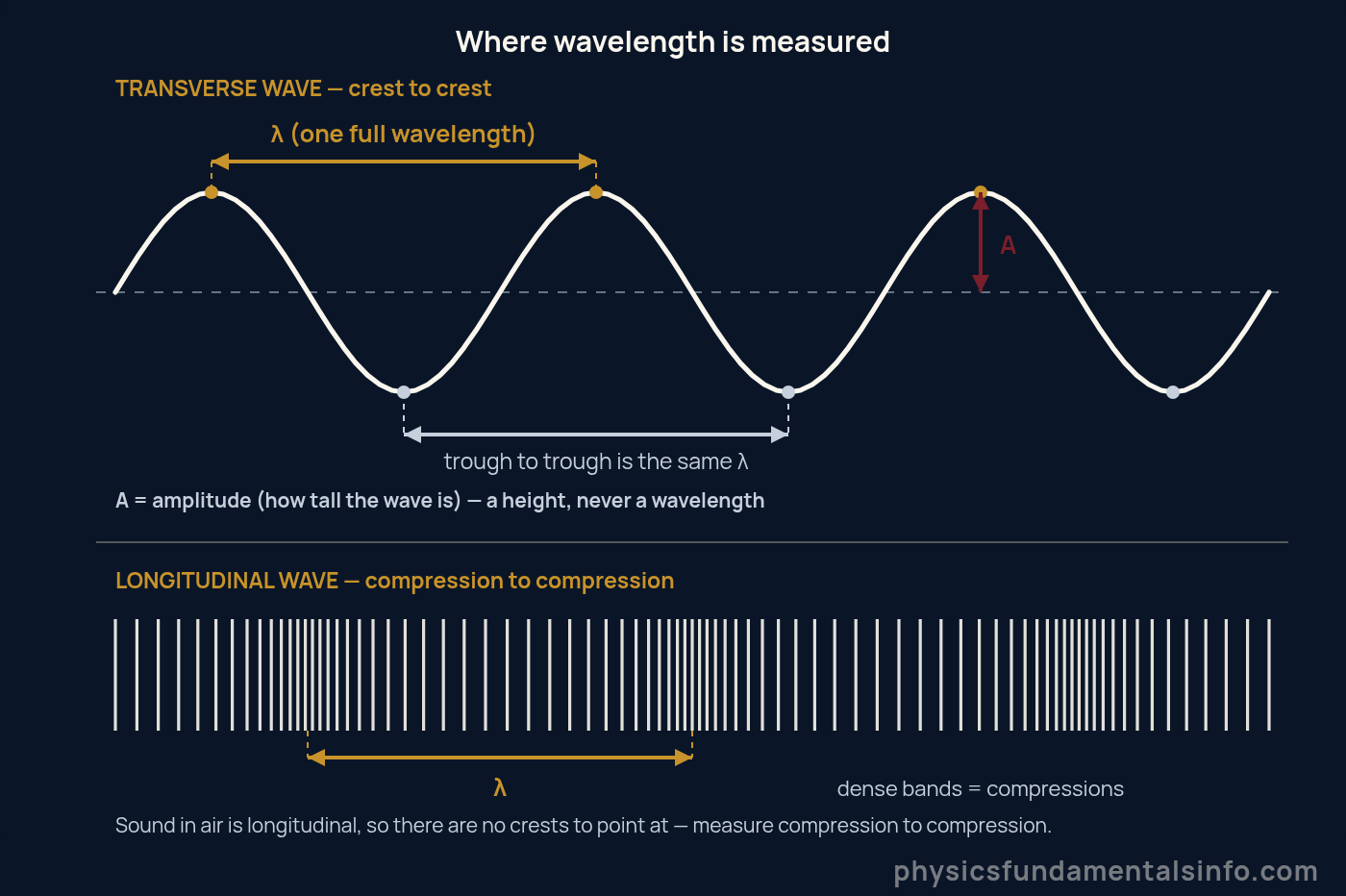
Wavelength is measured between matching points one full cycle apart — never crest to trough, and never confused with amplitude.
The Wavelength Formula: λ = v / f
The wavelength formula is λ = v / f — wavelength equals wave speed divided by frequency.
Each symbol carries its own SI unit, and mixing them up is the fastest route to an answer that is wrong by a factor of a billion:
- λ (lambda) — wavelength, in metres (m)
- v — the speed of the wave in its medium, in metres per second (m/s)
- f — frequency, in hertz (Hz), meaning cycles per second
The same relationship rearranges two other ways, and exams ask for all three:
For light and every other electromagnetic wave travelling through a vacuum, the speed is fixed at c = 299,792,458 m/s, so the formula simplifies:
Once the numbers get awkward — gigahertz on one side, nanometres on the other — it is worth checking your arithmetic against our Wave Speed Calculator, which solves λ = v / f for whichever of the three quantities you leave blank.
Wavelength Units: Metres, Nanometres and Ångströms
The SI unit of wavelength is the metre (m), because wavelength is simply a length. The metre itself is now defined from the speed of light, which is why wavelength and frequency measurements are so tightly linked in modern metrology — see the NIST definitions of the SI base units.
In practice nobody quotes green light as 0.00000055 m. Each part of the spectrum has a working unit:
- kilometres (km) — long-wave and AM radio
- metres (m) — FM radio, sound, water waves
- centimetres (cm) and millimetres (mm) — microwaves and radar
- micrometres (μm) — infrared; 1 μm = 10-6 m
- nanometres (nm) — visible and ultraviolet light; 1 nm = 10-9 m
- ångströms (Å) and picometres (pm) — X-rays and atomic spacing; 1 Å = 0.1 nm = 10-10 m
In practice, the single most common slip in exam papers is leaving wavelength in nanometres while frequency sits in hertz. Convert to metres first, every time.
How to Calculate Wavelength in 4 Steps
To calculate wavelength, find the wave speed in that medium, convert the frequency to hertz, divide speed by frequency, then check the size of your answer against the type of wave.
- Find the wave speed v for that medium. Sound in air at 20 °C is about 343 m/s. Light in a vacuum is 299,792,458 m/s, usually rounded to 3.00 × 10⁸ m/s.
- Convert the frequency to hertz. 1 kHz = 103 Hz, 1 MHz = 106 Hz, 1 GHz = 109 Hz.
- Divide. λ = v / f, working entirely in metres and seconds.
- Sanity-check the magnitude. Radio should land in metres, microwaves in centimetres, visible light in hundreds of nanometres. An answer of 500 m for green light means a unit slipped.
Try it on a 2.4 GHz Wi-Fi signal. Speed is 3.00 × 10⁸ m/s, frequency is 2.4 × 10⁹ Hz, so λ = 0.125 m — about 12.5 cm, roughly the length of a phone. That is why a router antenna is a few centimetres long rather than a few metres.
How Wavelength Works: Where λ = v / f Comes From
The formula is not something to memorise blindly — it falls out of one observation. In exactly one period T, a wave advances exactly one wavelength.
That is the whole derivation in a sentence. Distance equals speed multiplied by time, so:
Period and frequency are reciprocals, T = 1 / f. Substitute it in and you get λ = v / f. Nothing else is needed.
Why Frequency and Wavelength Trade Off
Keep a wave in one medium and its speed barely changes. A middle-C note and a top-C note both cross a room at about 343 m/s.
So if v is fixed and you double the frequency, the wavelength must halve — the two are inversely proportional. Think of it as the same length of ribbon being folded into twice as many pleats. Our companion piece on the frequency formula works the same relationship from the other direction.
Change the medium, though, and v itself changes — which is where most of the confusion in this topic starts.
Drag the wavelength and frequency sliders and watch the speed readout: hold one, change the other, and λ = v / f does the rest.
Wavelength Across the Electromagnetic Spectrum
Radio waves, visible light and gamma rays are the same phenomenon at different wavelengths — all of them travelling at c in a vacuum. NASA’s overview of the electromagnetic spectrum lays out how each band is used, and our own guide to the electromagnetic spectrum goes band by band.
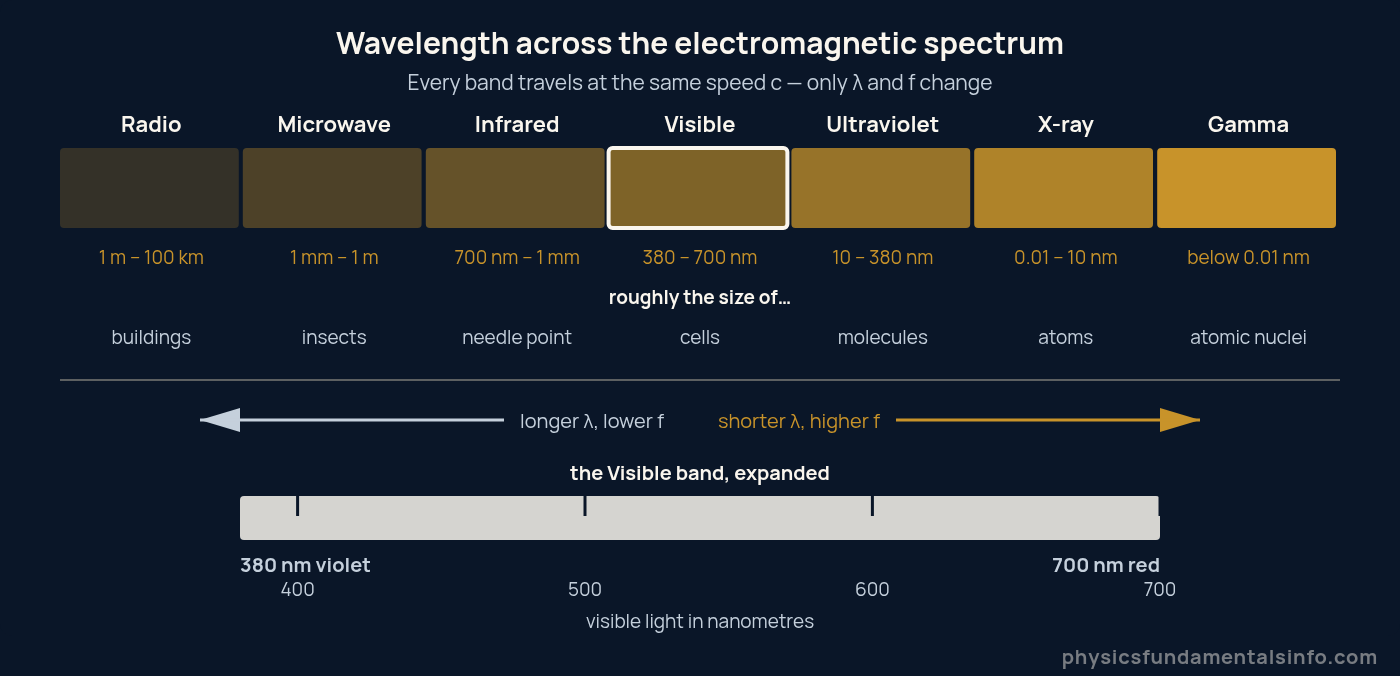
Wavelength spans fourteen orders of magnitude across the spectrum, yet every band obeys the same λ = c / f.
Put sound alongside light and the range becomes concrete. Every wavelength below is calculated from λ = v / f:
| Wave | Frequency | Speed | Wavelength | Roughly the size of |
|---|---|---|---|---|
| Deep bass note | 20 Hz | 343 m/s (air) | 17 m | An articulated lorry |
| Concert A note | 440 Hz | 343 m/s (air) | 0.78 m | An arm’s length |
| Upper hearing limit | 20 kHz | 343 m/s (air) | 1.7 cm | A fingernail |
| FM radio | 98.5 MHz | 3.00 × 10⁸ m/s | 3.04 m | A small car |
| Wi-Fi signal | 2.4 GHz | 3.00 × 10⁸ m/s | 12.5 cm | A smartphone |
| Green light | 5.45 × 10¹⁴ Hz | 3.00 × 10⁸ m/s | 550 nm | A bacterium |
| Medical X-ray | 3 × 10¹⁸ Hz | 3.00 × 10⁸ m/s | 0.1 nm | An atom |
5 Real-World Examples of Wavelength
1. The Bass That Travels Through Walls
Your neighbour’s music always reaches you as thumping bass, never as crisp vocals. A 40 Hz bass note has a wavelength near 8.6 m, far larger than a doorway or a stud wall, so it diffracts around obstacles and passes through easily.
The 5 kHz consonants ride on 7 cm waves. Those get absorbed and reflected long before they arrive.
2. Your Wi-Fi Router’s Dead Spots
At 2.4 GHz the wavelength is about 12.5 cm. Reflections from walls and appliances can arrive half a wavelength out of step — roughly 6 cm — and cancel each other out.
That is why moving a laptop a hand’s width along a desk sometimes restores a signal. You have stepped out of a null.
3. The Cold Spots in a Microwave Oven
A microwave oven runs at about 2.45 GHz, giving a wavelength near 12.2 cm. The waves bounce off the metal walls and form a standing pattern with hot spots about 6.1 cm apart — half a wavelength.
The turntable exists purely to drag your food through those peaks and troughs. Without it, one corner of a lasagne boils while another stays frozen.
4. Why a Leaf Looks Green
Colour is wavelength made visible. Chlorophyll absorbs strongly in the blue (around 430 nm) and red (around 660 nm) but reflects the middle of the visible band near 550 nm, which your eye reads as green.
Change nothing but the wavelength and you change the colour. Nothing else about the wave needs to differ.
5. X-rays That See Bone
Medical X-rays have wavelengths near 0.1 nm — about the spacing between atoms in a solid. A wave can only resolve detail on the scale of its own wavelength, which is exactly why visible light (550 nm) cannot image an atom but X-rays can.
The same principle drives electron microscopes, which push the wavelength smaller still.

Common Misconceptions About Wavelength
“Wavelength Is How Tall the Wave Is”
It is not. Height is amplitude, measured from the rest position to a crest, and it relates to energy and loudness. Wavelength is a horizontal distance along the direction of travel.
Two waves can share a wavelength exactly while one is ten times taller than the other.
“A Wave Keeps the Same Wavelength Everywhere”
This is the big one. When a wave crosses into a new medium, its frequency stays the same but its speed changes — and since λ = v / f, the wavelength must change with it.
Light entering water slows from 3.00 × 10⁸ m/s to about 2.25 × 10⁸ m/s, so its wavelength shrinks by the same factor. The frequency cannot change, because the source is still shaking the field at the same rate. Our article on wave speed in different media follows this through in detail.
“Longer Wavelength Means a Faster Wave”
Within a single medium, no. The speed is set by the medium’s properties, not by the wave.
A 20 Hz note and a 20 kHz note both travel through air at 343 m/s. Long wavelength simply means the crests are spread out, not that they arrive sooner.
“Colour Changes When Light Enters Glass”
Look through a window at a red bus. It is still red. Since colour is set by frequency — which is unchanged — the light keeps its colour even though its wavelength inside the glass is genuinely shorter.
This is the practical reason physicists usually quote a “wavelength of light” as its vacuum value unless a medium is stated.
How Wavelength Relates to Energy, Refraction and Matter Waves
Wavelength is the hinge between wave behaviour and quantum behaviour, which is why it turns up in so many other formulae.
Photon Energy
Shorter wavelength means a more energetic photon, with h the Planck constant:
This is why ultraviolet burns skin and radio waves do not, despite both being light. The photon energy formula covers the calculation properly.
Refraction
In a medium of refractive index n, the wavelength contracts while frequency holds:
Because different wavelengths bend by slightly different amounts, white light fans out into a spectrum — the mechanism behind a prism and a rainbow alike.
Matter Waves
Every moving particle has a wavelength too, given by the de Broglie relation with m its mass and v its speed:
For everyday objects the result is absurdly small and unmeasurable. For an electron it is comparable to atomic spacing, which is why electrons diffract — see the de Broglie wavelength for the full treatment.
Wave Number
In more advanced work you will meet the wave number k, which counts radians of phase per metre:
Worked Problems
Show Solution
Solution:
Step 1: Use the wavelength formula, λ = v / f.
Step 2: Substitute with units, λ = 343 m/s ÷ 440 Hz.
Step 3: Solve, λ = 0.7795 m.
Answer: λ = 0.78 m (2 s.f.)
Show Solution
Solution:
Step 1: Convert the frequency to hertz, f = 98.5 MHz = 9.85 × 10⁷ Hz.
Step 2: Apply λ = c / f = (3.00 × 10⁸ m/s) ÷ (9.85 × 10⁷ Hz).
Step 3: Solve, λ = 3.045 m.
Answer: λ = 3.04 m (3 s.f.)
Show Solution
Solution:
Step 1: Rearrange to f = c / λ.
Step 2: Convert the wavelength to metres, 550 nm = 550 × 10−9 m = 5.50 × 10⁻⁷ m.
Step 3: Solve, f = (3.00 × 10⁸ m/s) ÷ (5.50 × 10⁻⁷ m) = 5.45 × 10¹⁴ Hz.
Answer: f = 5.45 × 10¹⁴ Hz
Show Solution
Solution:
Step 1: Frequency is cycles per second, f = 12 ÷ 20 s = 0.60 Hz.
Step 2: Use the rearranged formula, v = f λ = 0.60 Hz × 1.5 m.
Step 3: Solve, v = 0.90 m/s.
Answer: v = 0.90 m/s
Show Solution
Solution:
Step 1: Speed in the medium is v = c / n = (3.00 × 10⁸ m/s) ÷ 1.50 = 2.00 × 10⁸ m/s.
Step 2: Frequency is set by the source and does not change, f = c / λ = (3.00 × 10⁸) ÷ (6.00 × 10⁻⁷) = 5.00 × 10¹⁴ Hz.
Step 3: Wavelength in glass, λ = v / f = (2.00 × 10⁸) ÷ (5.00 × 10¹⁴) = 4.00 × 10⁻⁷ m. Equivalently λ = 600 nm ÷ 1.50.
Answer: v = 2.00 × 10⁸ m/s, f = 5.00 × 10¹⁴ Hz (unchanged), λ = 400 nm
Show Solution
Solution:
Step 1: In the fundamental there is a node at each fixed end and one antinode between, so the string holds half a wavelength: λ = 2L.
Step 2: Substitute, λ = 2 × 0.650 m = 1.30 m.
Step 3: Apply v = f λ = 196 Hz × 1.30 m = 254.8 m/s.
Answer: λ = 1.30 m and v = 255 m/s (3 s.f.)
Show Solution
Solution:
Step 1: Use E = h c / λ.
Step 2: Substitute with the wavelength in metres, E = (6.626 × 10⁻³⁴ J s × 3.00 × 10⁸ m/s) ÷ (4.50 × 10⁻⁷ m).
Step 3: Solve, E = 4.414 × 10⁻¹⁹ J. Convert by dividing by 1.602 × 10⁻¹⁹ J/eV, giving 2.755 eV.
Answer: E = 4.41 × 10⁻¹⁹ J, or 2.76 eV (3 s.f.)
Show Solution
Solution:
Step 1: Use the de Broglie relation, λ = h / (m v).
Step 2: Find the momentum first, m v = 9.11 × 10−31 kg × 2.50 × 106 m/s = 2.278 × 10⁻²⁴ kg m/s.
Step 3: Divide, λ = (6.626 × 10⁻³⁴ J s) ÷ (2.278 × 10⁻²⁴ kg m/s) = 2.909 × 10⁻¹⁰ m.
Answer: λ = 2.91 × 10⁻¹⁰ m, or 0.291 nm — comparable to atomic spacing, which is why electrons diffract through crystals.