Standing waves are fixed patterns that appear when a wave is confined between two boundaries, because a length accepts only wavelengths making a whole number of half waves. That condition, L = n lam / 2, lets a string or air column sound at a whole-number ladder of frequencies, f = n v / (2L), and nothing between them.
Press a finger onto a guitar string and the note jumps. Lift it and the note drops back. Nothing about the string itself has changed — only how much of it is free to vibrate between two fixed points.
A trapped wave is choosy. Between its two ends a string will not sound at any pitch you ask it for: it accepts a short list, set by its length, and refuses everything else. Working out that list is what this page is about.
What Is a Standing Wave?
A standing wave is a vibration pattern that stays in one place: it is built from a wave reflecting back along its own path, and the result has points that never move at all. Nothing travels along the length, and no net energy is carried from one end to the other.
Send a pulse down a rope tied to a post and it comes back at you. Keep sending, and the outgoing wave and its own reflection add together all along the rope. At certain frequencies they add into a shape that simply sits there, swinging in place.
The points that never move are called nodes. Halfway between each pair of them the medium moves furthest, and those places are the antinodes. Away from the nodes every point of the medium traces simple harmonic motion of its own, swinging about the position it rests at; how far it swings depends on where along the length it sits, and that arrangement of large and small swings never shifts.
Some syllabuses call it a stationary wave. Same object, same mathematics — the word is simply making the point that the thing does not go anywhere.
Hold on to that, because everything below follows from it. A travelling wave hands a crest from one place to the next; a standing wave hands nothing along its length. The two ends are what make the difference, and they are what the formula is built out of.
The Standing Wave Formula: L = n Lambda / 2
The standing wave condition is L = n lam / 2: the length between the two ends must hold a whole number of half wavelengths. Rearrange it and the wavelength of mode n is lam = 2L / n, which fixes the frequency of that mode at f = n v / (2L).
| Symbol | What it is | SI unit | A 0.800 m string at 400 m/s, mode 1 |
|---|---|---|---|
| L | Length of the vibrating string or air column, measured between the two ends | metre (m) | 0.800 m |
| v | Wave speed in the medium — an input here, and a property of the medium rather than of the mode | metre per second (m/s) | 400 m/s |
| n | Mode number, also called the harmonic number. A whole number, never a fraction | dimensionless | 1 |
| lam_n | Wavelength of mode n, fixed by the length and the mode number alone | metre (m) | 1.60000 m |
| f_n | Frequency of mode n — how many times a second the whole pattern completes a cycle | hertz (Hz) | 250.000 Hz |
| f_1 | Fundamental frequency: mode 1 of the same length and speed, whichever mode you happen to be looking at | hertz (Hz) | 250.000 Hz |
| node spacing | Half the wavelength of the mode, whatever the two ends are; where two or more nodes exist, that is the distance between adjacent ones | metre (m) | 0.800000 m |
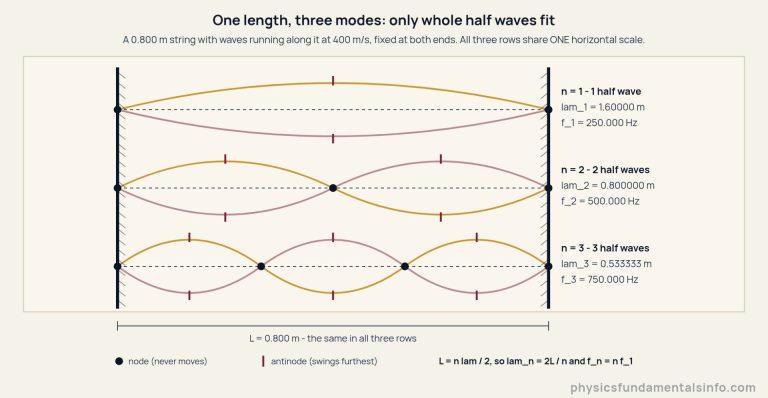
Put real numbers in and the condition does the rest. A 0.800 m string along which waves run at 400 m/s has a fundamental wavelength of 2 x 0.800 m = 1.600 m, or 1.60000 m at the six significant figures the simulator below prints its readings to, and a fundamental frequency of 400 / 1.600 = 250.000 Hz. Type the same two boxes into the standing waves calculator and it will run the relation backwards too, returning the length a wanted pitch needs or the wave speed a measured mode implies.
One slip accounts for most wrong answers here, and it is the 2. Half a wavelength fits a fundamental, not a whole one, so the fundamental wavelength is twice the length and never equal to it. Get that factor wrong and every frequency on the page is out by two.
Here is the same idea as something you can push around. Set the length, climb the mode number, change the medium, then switch what the two ends are and watch which numbers move and which refuse to.
Nodes and Antinodes: How Many and Where
A node is a point of the medium that never moves; an antinode sits midway between two nodes, where the movement is greatest. On a string fixed at both ends in mode n there are n + 1 nodes and n antinodes, and neighbouring nodes always sit half a wavelength apart.
The counts depend on what the two ends are, and on nothing else. Fixed at both ends puts a node at each end. Free at both ends puts an antinode at each end instead, so the counts swap over: n nodes and n + 1 antinodes. One end fixed and the other free gives n of each.
Positions are easier than they look. Take a 1.200 m string along which waves run at 240 m/s, in its fourth mode. The wavelength is 2 x 1.200 m / 4 = 2.400 m / 4 = 0.600000 m, so the node spacing is half of that: 0.300000 m.
Measure from one end and the five nodes fall at 0, 0.300, 0.600, 0.900 and 1.200 m. The four antinodes sit exactly between consecutive pairs, at 0.150, 0.450, 0.750 and 1.050 m. Count the nodes including both ends — in practice, forgetting the two ends is the commonest way to come out one short.
That half-wavelength spacing earns its keep in the laboratory. Because it holds whatever the ends are doing, the distance between two still points on a real vibrating object hands you the wavelength on the spot, and the wavelength then gives you the frequency as soon as the wave speed is known.
Harmonics: the Whole-Number Ladder
The modes of a string fixed at both ends are whole-number multiples of its fundamental: f_n = n f_1. A 0.800 m string at 400 m/s has a fundamental of 250.000 Hz, so its first four modes are 250.000, 500.000, 750.000 and 1000.00 Hz.
| Mode number n (= half waves) | Name | Wavelength lam_n | Frequency f_n | Nodes and antinodes |
|---|---|---|---|---|
| 1 | Fundamental, or first harmonic | 1.60000 m | 250.000 Hz | 2 nodes, 1 antinode |
| 2 | Second harmonic, or first overtone | 0.800000 m | 500.000 Hz | 3 nodes, 2 antinodes |
| 3 | Third harmonic, or second overtone | 0.533333 m | 750.000 Hz | 4 nodes, 3 antinodes |
| 4 | Fourth harmonic, or third overtone | 0.400000 m | 1000.00 Hz | 5 nodes, 4 antinodes |
The whole table is written in hertz on purpose, rather than switching the last row to kilohertz, because the point of it is the 1 : 2 : 3 : 4 running down the frequency column. Two things in it are worth a second look.
The wavelength column falls as 1, then a half, then a third, then a quarter of 1.60000 m, while the frequency column climbs in equal steps of 250.000 Hz. That reciprocal pairing is exactly what f = v / lam demands of a fixed wave speed. The node count, meanwhile, just shadows the mode number, always one more than it.
The ladder itself does not shift when you climb it. Take a 1.200 m string along which waves run at 240 m/s: its fundamental is 240 / (2 x 1.200) = 240 / 2.400 = 100.000 Hz, and that figure is the same whether you are looking at its fourth mode (4 x 100.000 = 400.000 Hz) or its fifth (5 x 100.000 = 500.000 Hz).
Where does the wave speed itself come from? It is a property of the medium rather than of the mode, and this page takes it as given — what sets the wave speed in different media is a subject of its own, and for a string it involves quantities that appear nowhere here. The relation tying a speed to a frequency and a wavelength belongs with the travelling waves that make a standing one possible.
Change what the two ends are, though, and the ladder moves bodily. Free both ends instead of fixing them and not one number changes — same wavelength, same frequency, same fundamental — while the picture turns inside out and the counts swap over. Fix one end and free the other and something stranger happens, which is the next section.
Why a Pipe Closed at One End Sounds an Octave Lower
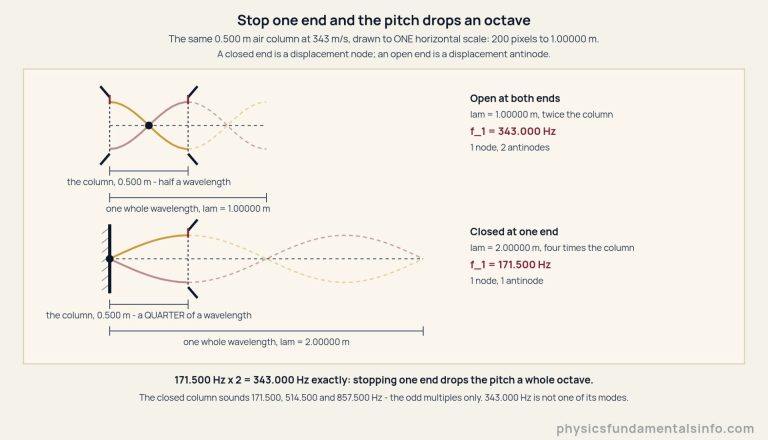
A pipe closed at one end sounds an octave below the same pipe open at both ends, because a closed end must be a node and an open end an antinode, so a quarter of a wavelength fits where half of one did before. A doubled wavelength halves the frequency.
Run the numbers on a 0.500 m air column carrying sound at 343 m/s. Open at both ends, the fundamental wavelength is 2 x 0.500 m = 1.000 m, giving 343 / 1.000 = 343.000 Hz. Stop one end and it becomes 4 x 0.500 m = 2.000 m, giving 343 / 2.000 = 171.500 Hz — exactly half the pitch, from the same pipe.
That 343 m/s is the speed of sound in air at 20 C, the figure this site publishes for that medium.
The second surprise is what the stopped pipe leaves out. Its modes are the odd multiples only — 171.500, 514.500 and 857.500 Hz for that column — so the 343.000 Hz the open pipe gives as its fundamental is not a mode of the stopped one at all. The even-numbered rungs are not faint on a stopped pipe. The boundary never lets them in.
| What the two ends are, and what it covers | Mode condition | Wavelength of mode 1 | Fundamental | Nodes and antinodes, mode 1 | First four modes |
|---|---|---|---|---|---|
| Fixed at both ends — A string clamped at both ends | L = n lam / 2 | 1.60000 m | 250.000 Hz | 2 nodes, 1 antinode | 250.000, 500.000, 750.000, 1000.00 Hz |
| Free at both ends — A pipe open at both ends, or a bar free at both ends vibrating lengthwise rather than in bending | L = n lam / 2 | 1.60000 m | 250.000 Hz | 1 node, 2 antinodes | 250.000, 500.000, 750.000, 1000.00 Hz |
| One end fixed, one free — A pipe closed at one end | L = (2n-1) lam / 4 | 3.20000 m | 125.000 Hz | 1 node, 1 antinode | 125.000, 375.000, 625.000, 875.000 Hz |
Those three rows are one 0.800 m length at 400 m/s, with only the ends changed. Read the first two side by side: fixing both ends and freeing both ends give exactly the same wavelength, the same frequency and the same fundamental, and only the node and antinode counts swap, because one pattern is the mirror image of the other.
The third row is the odd one out in two ways. Its fundamental is exactly half the other two — 125.000 Hz against 250.000 Hz — and its ladder climbs in odd multiples, 125.000, 375.000, 625.000, 875.000 Hz, with every even rung missing. That is the same octave drop and the same missing harmonics as the 0.500 m column above, stated for a different length.
Why the Shape Does Not Care How Fast the Wave Travels
Changing the medium changes every frequency and leaves the shape untouched, because lam = 2L / n has no v in it at all. The length and the mode number set the picture; the medium only sets how fast it runs.
A one metre column, free at both ends, makes the point cleanly. Fill it with water, where sound runs at 1482 m/s, and the fundamental wavelength is 2 x 1.000 m = 2.000 m with a pitch of 1482 / 2.000 = 741.000 Hz. Take the same one metre length in steel, where sound runs at 5960 m/s, and the wavelength is still 2.000 m while the pitch climbs to 5960 / 2.000 = 2980 Hz, which is 2.98000 kHz.
Same wavelength, same node positions, the same 1.00000 m node spacing, the same single node with an antinode at each end. The only thing the medium touched was the pitch.
Sound travels far further through water than radar or light does, which is the whole premise of sonar and the reason the sea floor is surveyed with sound rather than light. That is a fact about how far each kind of wave penetrates, and lam = 2L / n has no bearing on it either way. What the 1482 m/s above does account for is why a water-filled column sounds so much higher than an air-filled one of the same length.
Where Standing Waves Break Down
The mode condition is exact arithmetic, so what fails is never the sum. What fails is a boundary that is not really there, a medium that is not uniform, or a geometry being asked a question it cannot answer.
- It needs a reflection. A wave running along an endless medium never settles into a standing pattern; it is the return from a boundary that does. One boundary is enough for the pattern but not for the ladder: with only one end there is no L, so L = n lam / 2 has no length to fix and no shortlist of frequencies follows from it.
- It is a geometry, not an excitation. L = n lam / 2 says which modes fit. It says nothing at all about how a mode is set going, how strongly it answers, or how long it keeps sounding after you stop — those are separate questions with separate physics, and no figure on this page addresses any of them.
- The wave speed must be the same all along the length. A string of varying thickness, or an air column whose temperature changes from one end to the other, has no single wavelength and so no clean ladder. Use a length over which the medium really is uniform.
- The ideal ladder assumes a perfectly flexible medium. A real string resists being bent as well as being stretched, which pushes its short-wavelength modes slightly above exact whole-number multiples. That follows from what the model leaves out rather than from a measurement, and no figure for the size of it on any particular instrument is published on this site, so none is given here — verify before use.
- A real open end is not exactly an antinode. The air just outside an open mouth is dragged into the motion, which puts the true displacement antinode a short way past the opening. A real pipe therefore behaves as though it were a little longer than the L you measured, and sounds slightly flat against v / (2L), or against v / (4L) when one end is stopped. Same rule: the mechanism is sound, the size of the correction is not published here, so no number for it appears — verify before use.
- The formula is arithmetic, so it reaches states nothing can hear. Push the length down and the speed and mode number up, and a mode walks straight past the top of human hearing. Pull the other way and it drops below the bottom: a five-metre column stopped at one end, with the wave speed wound down to 10 m/s — the floor of the simulator’s speed slider rather than any real medium — sits at 0.500000 Hz.
Those last two limits have numbers attached, and this site publishes them: roughly 20 Hz to 20,000 Hz for a healthy young ear. Below 20 Hz a mode is infrasound. Above 20,000 Hz it is ultrasound, the band medical imaging probes work in — above the threshold of human hearing, and in practice far above it.
Common Misconceptions About Standing Waves
“A standing wave travels”
It does not, and the name is the clue. The pattern sits still and carries no net energy from one end to the other, which is precisely what separates it from a travelling wave, where a crest really does move along.
“The nodes drift along the medium”
Nodes are fixed points. On the 1.200 m string in its fourth mode they sit at 0, 0.300, 0.600, 0.900 and 1.200 m and stay there for as long as that mode is sounding. Watch a node rather than a crest and the stillness is obvious.
“The second harmonic has twice the wavelength of the first”
It has half. Climbing the ladder means squeezing more half waves into the same length, so lam_2 = L while lam_1 = 2L. On the 0.800 m string those are 0.800000 m against 1.60000 m, and the frequency doubles rather than halves.
“Any frequency will set up a standing wave”
Only the frequencies that fit will. The 0.800 m string at 400 m/s has modes at 250.000, 500.000, 750.000 and 1000.00 Hz, and nothing between 250.000 Hz and 500.000 Hz is a mode of it at all. There is no partial mode and no n = 2.7.
“A closed pipe sounds higher because less of it is open”
It sounds lower, by an octave. Stopping one end turns that end into a node facing the antinode still at the mouth, and a node-to-antinode run is a quarter of a wavelength rather than a half. The same length therefore holds a quarter wave instead of a half, the wavelength doubles and the pitch halves: 171.500 Hz where the open pipe gave 343.000 Hz.