A mass on a spring has one frequency of its own, f0 = (1/2pi) sqrt(k/m), and the spring and the mass are the only two things that set it. Push the mass back and forth at that frequency and the swing grows far larger than the same push would ever manage held steady — by a factor of exactly Q, which is a damping question and not a force question. This free resonance frequency calculator solves that relation for the natural frequency, the spring constant or the mass, and prints the damping ratio, Q, your drive as a ratio, the magnification at it, the phase lag and the frequency the response really peaks at.
Load a real oscillator
Every button writes all five boxes in their default units, so whichever quantity the Solve for menu is pointing at, the remaining four already agree with it. The line underneath quotes back whatever the widget works out from that, so nothing in it is stored text.
Pick an oscillator above, or type your own numbers.
What Is the Resonance Frequency Calculator?
The resonance frequency calculator is a free online tool for the one frequency a mass on a spring has of its own. The stiffness pulls the mass back and the mass resists being accelerated, and the balance between the two fixes an angular frequency of sqrt(k/m), which divided by 2 pi is a frequency in hertz. Give the tool any two of the natural frequency, the spring constant and the mass and it returns the third, in whichever of the unit menus that box was set to.
The damping coefficient and the drive frequency are the two boxes that never leave the form, because both are inputs in every mode and neither is ever one of the three unknowns. Neither of them touches the headline: only the stiffness and the mass appear in the formula, so moving the damping leaves the natural frequency byte for byte where it was. What they change is the six readings beside the answer.
Those six are the damping ratio c / (2 sqrt(mk)), the quality factor Q, your drive frequency as a ratio of the natural one, the magnification at that drive, the phase lag in degrees, and the frequency at which the response is actually largest. All six are worked out from the complete state with the solved value substituted back, which is what makes them the same six readings whichever quantity you asked for. That matters most in the direction the page opens in, where there is no natural frequency among the inputs at all.
The quality factor is the claim the tool exists for. Drive the oscillator exactly at its natural frequency and the magnification is exactly Q, for every damping ratio, with no force anywhere in that statement: how big a resonance gets is a damping question rather than a force question. Halve the damping and the swing doubles. The magnification is dimensionless, so it is a multiplier and not a distance: multiply it by the deflection your own steady push would give to turn it into millimetres.
The frequency at which the response actually peaks is not the natural frequency. It is the natural frequency multiplied by sqrt(1 - 2 zeta squared), always a little lower, and it slides further down as the damping grows. Past a damping ratio of 1 / sqrt(2), about 0.7071, there is no peak at all and the reading prints the word none instead of a frequency. What does stay exactly at the natural frequency, for every damping ratio and with no approximation in it, is the 90 degree phase lag, which is why the phase reading is the honest signature of resonance.
Two things are approximations and are labelled as such. The half-power width quoted in the working as about the natural frequency divided by Q is a light-damping result, low by roughly half a per cent at a damping ratio of 0.05 and far less than that at 0.01; and the defaults cannot be one exact state, because pi is in the relation. A 200 N/m spring on a 2 kg mass has a natural frequency of 1.5915494 hertz, so the four-figure 1.592 hertz in the box is a whisker above it, and since the stiffness goes as the square of the frequency the stiffness direction returns 200.1 N/m rather than 200. The page publishes that residual rather than hiding it, and its first preset carries the frequency to eight figures so the three directions agree.
The drive frequency is entered in hertz here while the matching simulator takes it as a ratio of the natural frequency on a slider. That difference is deliberate: a slider has to be able to land exactly on a ratio of one for any mass and spring, which no sensible hertz grid does, while a reader at a calculator has a real drive frequency in hertz and no way to know the ratio until the page tells them. Both surfaces print both numbers, so nothing is lost moving between them.
Five kinds of entry are declined rather than answered. A zero or negative mass, a zero or negative spring constant, and a zero or negative natural frequency in the two back-solve directions have no finite answer behind them; a zero damping coefficient would make Q and the magnification at resonance genuinely infinite, which nothing real is; and a zero or negative drive frequency has no ratio to the natural one. In each case the page says so in words instead of printing an infinity or a NaN.
What the page does not do, it says. There is no force box and no amplitude box, and no displacement is printed anywhere. Nothing here describes the transient: every reading is the steady state the oscillator settles into under a sustained drive, and how many cycles it takes to build up to that is a separate calculation this tool does not make. The model is a single linear mode with viscous damping, so an object with many modes, a spring that stiffens as it deflects or a loss that is not proportional to speed needs a measurement rather than this formula. A pendulum and a tuned circuit obey the same algebra with different ingredients and are left to their own pages, with no figure quoted for either.
| Symbol | Quantity | Default unit | Also accepts | Example value |
|---|---|---|---|---|
| f0 | Natural frequency | Hz | kHz | 1.592 |
| k | Spring constant | N/m | kN/m | 200 |
| m | Mass | kg | g | 2 |
| c | Damping coefficient | N s/m | — | 2 |
| f | Drive frequency | Hz | kHz | 1.592 |
How to use the resonance frequency calculator
- Choose the unknown. The Solve for menu opens on Natural frequency, and the other two choices are Spring constant and Mass. Any two of the three fix the third.
- Type the spring constant. It takes N/m or kN/m and opens on 200 N/m. This page asks you for the stiffness rather than deriving it from a material or a coil geometry.
- Type the mass. It takes kg or g and opens on 2 kg. Count only the part that actually moves, not the frame it is mounted on.
- Type the damping coefficient. It is in N s/m and opens on 2 N s/m. It is an input in every mode, so it never leaves the form — and it never touches the headline.
- Type the drive frequency. It takes Hz or kHz and opens on 1.592 Hz. This is the frequency something outside is pushing at, and it is an input in every mode too.
- Read the answer. The headline always carries four significant figures, with trailing zeros dropped, in the unit that box was showing — switching to scientific notation outside the range 0.0001 to 10,000,000. Set the unit while the quantity is still an input and then point Solve for back at it.
- Read the damping ratio and Q first. At the defaults they read
0.05000and10.00, and neither moves when you change the drive.Qis how many times the static deflection the swing reaches when the drive sits on the natural frequency. - Read the ratio, the magnification and the phase lag. These three describe your drive, not the oscillator. A phase lag of exactly
90.00 degreesmeans the drive is exactly on the natural frequency, whatever the damping. - Read the peak response. It is always a little below the natural frequency, and past a damping ratio of about
0.7071it prints the wordnonebecause there is no peak left to report. - Open Show working. The steps rearrange the relation, then give the damping ratio,
Q, the drive ratio, the magnification, the phase lag, the peak frequency, the approximate half-power width and your figures in every unit the boxes offer.
This page exists for the one step that turns a spring and a mass into a frequency, and then says how big the response at that frequency gets. The resonance in physics guide is the prose half of it, with the mechanism, the worked problems and the misconceptions set out in full. What the mass is doing once it is moving — the sinusoid, the peak speed, the peak acceleration — is simple harmonic motion, a separate story told on its own page, and the simple harmonic motion calculator is the tool for it.
Three mistakes account for most wrong answers here. The first is expecting the damping box to move the headline: it cannot, because neither c nor the drive frequency appears in f0 = (1/2pi) sqrt(k/m). The second is reading the magnification as a distance — it is a multiplier, and you need your own static deflection to turn it into millimetres. The third is treating the peak response reading as “the resonance frequency”: the peak moves with the damping while the 90.00 degrees phase lag does not.
The spring constant is an input here and the page never measures it. If you do not have a figure for it, the spring constant calculator works it out from a force and an extension, and the amplitude guide is where the height of a vibration belongs as a subject in its own right — on this page the amplitude is only ever an output, and a dimensionless one.
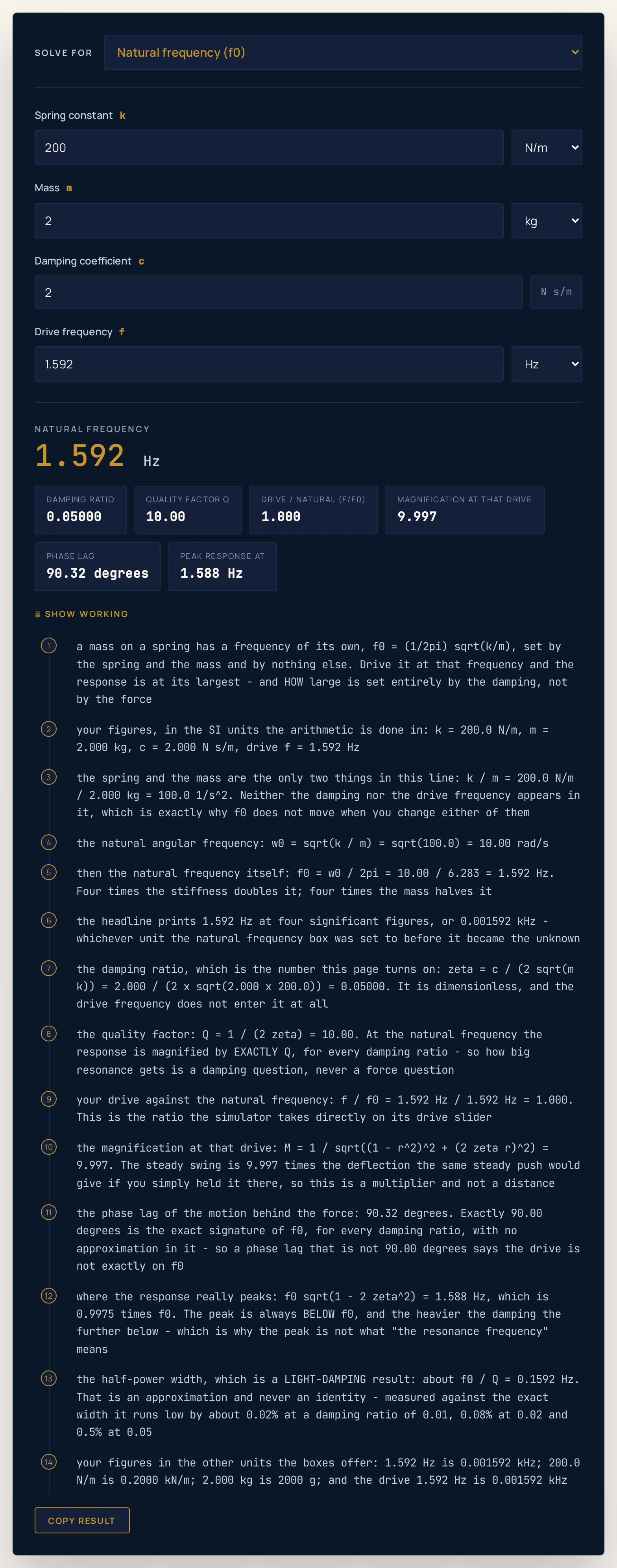
1.592 Hz. Note the magnification: 9.997 rather than 10.00, and the phase lag 90.32 degrees rather than 90.00 — the rounded 1.592 Hz in the drive box is a whisker above exact resonance, and the phase lag is what tells you so.Worked example: change one thing at a time
The table starts at the defaults, moves the unknown through all three quantities, then loads each preset in turn, walks every unit menu, and finally reaches the entries the calculator declines. Rows 1 to 3 are one set of boxes solved three ways; rows 4 to 6 are the same thing once the drive carries eight figures instead of four. Every answer and reading cell was read out of the running widget rather than worked out by hand, so where a cell and the tool ever part company, believe the tool.
| Step | Solving for | What you type | Headline answer | Damping ratio | Quality factor Q | Drive over natural | Magnification | Phase lag | Peak response at |
|---|---|---|---|---|---|---|---|---|---|
| The page as it opens | Natural frequency | k 200 N/m, m 2 kg, c 2 N s/m, drive 1.592 Hz | 1.592 Hz | 0.05000 | 10.00 | 1.000 | 9.997 | 90.32 degrees | 1.588 Hz |
| The same boxes, solved for the spring | Spring constant | f0 1.592 Hz, m 2 kg | 200.1 N/m | 0.04999 | 10.00 | 1.000 | 10.00 | 90.00 degrees | 1.588 Hz |
| The same boxes, solved for the mass | Mass | f0 1.592 Hz, k 200 N/m | 1.999 kg | 0.05001 | 9.997 | 1.000 | 9.997 | 90.00 degrees | 1.588 Hz |
| Driven exactly at f0 | Natural frequency | the same spring and mass, drive 1.5915494 Hz | 1.592 Hz | 0.05000 | 10.00 | 1.000 | 10.00 | 90.00 degrees | 1.588 Hz |
| The same preset, solved for the spring | Spring constant | f0 1.5915494 Hz, m 2 kg | 200 N/m | 0.05000 | 10.00 | 1.000 | 10.00 | 90.00 degrees | 1.588 Hz |
| The same preset, solved for the mass | Mass | f0 1.5915494 Hz, k 200 N/m | 2 kg | 0.05000 | 10.00 | 1.000 | 10.00 | 90.00 degrees | 1.588 Hz |
| Light damping: a tall, narrow peak | Natural frequency | c 0.4 N s/m instead of 2 N s/m | 1.592 Hz | 0.01000 | 50.00 | 1.000 | 50.00 | 90.00 degrees | 1.591 Hz |
| Heavy damping: the peak flattens | Natural frequency | c 20 N s/m instead of 2 N s/m | 1.592 Hz | 0.5000 | 1.000 | 1.000 | 1.000 | 90.00 degrees | 1.125 Hz |
| Just inside the threshold | Natural frequency | c 28 N s/m instead of 2 N s/m | 1.592 Hz | 0.7000 | 0.7143 | 1.000 | 0.7143 | 90.00 degrees | 0.2251 Hz |
| Past the threshold: no peak at all | Natural frequency | c 28.4 N s/m instead of 2 N s/m | 1.592 Hz | 0.7100 | 0.7042 | 1.000 | 0.7042 | 90.00 degrees | none |
| Driven well below f0 | Natural frequency | drive 0.79577472 Hz instead of 1.5915494 Hz | 1.592 Hz | 0.05000 | 10.00 | 0.5000 | 1.330 | 3.814 degrees | 1.588 Hz |
| Driven well above the natural frequency | Natural frequency | drive 3.1830989 Hz instead of 1.5915494 Hz | 1.592 Hz | 0.05000 | 10.00 | 2.000 | 0.3326 | 176.2 degrees | 1.588 Hz |
| Stiffer spring: f0 doubles | Natural frequency | k 800 N/m, drive 3.1830989 Hz | 3.183 Hz | 0.02500 | 20.00 | 1.000 | 20.00 | 90.00 degrees | 3.181 Hz |
| A heavier mass: the frequency halves | Natural frequency | m 8 kg, drive 0.79577472 Hz | 0.7958 Hz | 0.02500 | 20.00 | 1.000 | 20.00 | 90.00 degrees | 0.7953 Hz |
| The spring that sits at 1.500 Hz on a 0.5066 kg mass | Spring constant | f0 1.5 Hz, m 0.5066 kg, drive 1.5 Hz | 45 N/m | 0.2094 | 2.387 | 1.000 | 2.387 | 90.00 degrees | 1.433 Hz |
| The mass that sits at 4.000 Hz on a 157.9 N/m spring | Mass | f0 4 Hz, k 157.9 N/m, drive 4 Hz | 0.25 kg | 0.1592 | 3.141 | 1.000 | 3.141 | 90.00 degrees | 3.897 Hz |
| Retuning the default spring down to 1.000 Hz | Mass | f0 1 Hz, k 200 N/m, drive 1 Hz | 5.066 kg | 0.03142 | 15.92 | 1.000 | 15.92 | 90.00 degrees | 0.9990 Hz |
| The mass typed in grams | Natural frequency | 2000 g instead of 2 kg | 1.592 Hz | 0.05000 | 10.00 | 1.000 | 9.997 | 90.32 degrees | 1.588 Hz |
| The spring typed in kilonewtons per metre | Natural frequency | 0.2 kN/m instead of 200 N/m | 1.592 Hz | 0.05000 | 10.00 | 1.000 | 9.997 | 90.32 degrees | 1.588 Hz |
| The drive typed in kilohertz | Natural frequency | 0.001592 kHz instead of 1.592 Hz | 1.592 Hz | 0.05000 | 10.00 | 1.000 | 9.997 | 90.32 degrees | 1.588 Hz |
| The natural frequency box set to kilohertz | Spring constant | 0.001592 kHz, m 2 kg | 0.2001 kN/m | 0.04999 | 10.00 | 1.000 | 10.00 | 90.00 degrees | 1.588 Hz |
| A zero mass is declined | Natural frequency | m 0 kg | no answer | - | - | - | - | - | - |
| A negative mass is declined | Natural frequency | m -2 kg | no answer | - | - | - | - | - | - |
| A zero spring constant is declined | Natural frequency | k 0 N/m | no answer | - | - | - | - | - | - |
| A negative spring constant is declined | Natural frequency | k -200 N/m | no answer | - | - | - | - | - | - |
| A zero damping coefficient is declined | Natural frequency | c 0 N s/m | no answer | - | - | - | - | - | - |
| A negative damping coefficient is declined | Natural frequency | c -2 N s/m | no answer | - | - | - | - | - | - |
| A zero drive frequency is declined | Natural frequency | drive 0 Hz | no answer | - | - | - | - | - | - |
| A zero natural frequency is declined in the spring mode | Spring constant | f0 0 Hz, m 2 kg | no answer | - | - | - | - | - | - |
| A negative natural frequency is declined in the mass mode | Mass | f0 -1.592 Hz, k 200 N/m | no answer | - | - | - | - | - | - |
Rows 1 to 3 are the rounding trap, caught in the act. The boxes open on 1.592 Hz, 200 N/m and 2 kg, and those three cannot all be exactly true at once because pi is in the relation: 200 N/m on 2 kg is 1.5915494 Hz, and the four-figure 1.592 Hz is 0.02831 per cent above it. Stiffness goes as the square of the frequency, so that doubles, and row 2 returns 200.1 N/m rather than 200. Row 3 goes the other way to 1.999 kg. Nothing is wrong: a frequency typed to four figures simply does not pin a stiffness to four figures.
Rows 4 to 6 remove it. The first preset writes the natural frequency and the drive as 1.5915494 Hz, eight significant figures, and all three directions then agree — 1.592 Hz, 200 N/m, 2 kg — with the magnification at a clean 10.00 and the phase lag at 90.00 degrees. That is the state the whole cluster quotes, and it is one click away from the one the page opens in.
Rows 7 to 10 change the damping and nothing else. The headline does not move from 1.592 Hz in any of them, which is the first claim of the page in four rows. What does move is the magnification: 50.00, 1.000, 0.7143, 0.7042, a range of 71 from the same spring, the same mass and the same push. Rows 9 and 10 differ by 0.4 N s/m and sit either side of the threshold: at 0.7000 there is still formally a peak, at 0.2251 Hz, but its magnification is 1.000 — the same as the static response, so there is nothing a reader could see. At 0.7100 the reading becomes the word none.
Rows 11 and 12 move the drive alone. At half the natural frequency the magnification is 1.330 and the phase lag 3.814 degrees: the mass follows the push almost in step and barely amplifies it. At twice the natural frequency the magnification is 0.3326 and the lag 176.2 degrees: the mass moves the opposite way to the push and less than a steady push would move it. Between those two sits the factor of 10 at resonance.
Rows 13 and 14 are the two scalings. Four times the stiffness doubles the frequency to 3.183 Hz; four times the mass halves it to 0.7958 Hz. Both leave the damping coefficient at 2 N s/m, yet the damping ratio halves to 0.02500 in each case and Q doubles to 20.00 — because the ratio is c divided by 2 sqrt(mk), and both changes raise sqrt(mk).
Rows 15 to 17 are the two back-solves and a retune. A 0.5066 kg mass needs a 45 N/m spring to sit at 1.500 Hz; a 157.9 N/m spring needs a 0.25 kg mass to sit at 4.000 Hz. Row 17 is the practical one: to pull the default oscillator off 1.592 Hz down to 1.000 Hz on the same spring takes 5.066 kg, so you add 3.066 kg — and the frequency ratio 1.592 is exactly the square root of 5.066 over 2.
Rows 18 to 21 change nothing but the units. 2000 g is the same 2 kg, 0.2 kN/m the same 200 N/m and 0.001592 kHz the same 1.592 Hz, and all three return the identical 1.592 Hz with identical readings. Row 21 shows the other half of the rule: the answer comes back in whichever unit the target box was showing, so the spring reads 0.2001 kN/m there rather than 200.1 N/m.
Rows 22 to 30 sit outside the domain and are declined there rather than answered. A zero mass makes the frequency infinite and a zero spring makes it zero; a negative mass or spring puts a negative number under the square root. A zero damping makes Q and the magnification at resonance infinite, which is the one place this subject invites a wrong answer, so it is refused. A zero drive frequency has no ratio to the natural one, and a zero or negative natural frequency cannot be squared into a stiffness. In every case the widget says so in words instead of printing an infinity or a NaN.
Formula and symbol reference
One relation does the first half of the work. A spring pulls back in proportion to how far it is stretched and a mass resists being accelerated, and the balance between them gives an angular frequency of sqrt(k/m). Divide by 2π to get a frequency in hertz: f0 = (1/2pi) sqrt(k/m). Rearranged the other two ways that is k = m(2πf0)2 and m = k / (2πf0)2, and those are the three positions of the Solve for menu.
The second half is what happens when something drives the mass. Two dimensionless numbers settle it: the damping ratio ζ = c / (2 sqrt(mk)), and the frequency ratio r = f / f0. The magnification is then M = 1 / sqrt((1 - r2)2 + (2ζr)2) and the phase lag is atan2(2ζr, 1 - r2). Put r = 1 into the first and everything but the damping term cancels, leaving M = 1 / (2ζ), which is Q exactly.
The spring constant is the k of the force-extension relation, and the Hooke's law calculator is where that relation itself lives. For a reader who arrives with a period rather than a frequency, the frequency formula guide is the conversion — the period of the default oscillator is 0.6283 s. And the same shape of formula with different ingredients describes a swinging pendulum, where the length and gravity replace the spring and the mass: the pendulum period calculator is that tool, and no figure crosses between the two pages.
One oscillator, one resonance — and that is a restriction worth naming. A stretched string has a whole ladder of resonances rather than one, which is why the standing waves and harmonics guide reads so differently from this page; the standing waves simulator draws that ladder. A tuned electrical circuit obeys the same mathematics again with an inductance and a capacitance in place of the mass and the spring. Neither has a box here and neither is given a figure.
| Symbol | Meaning | SI unit | Values used on this page |
|---|---|---|---|
| f0 | Natural frequency — the frequency the mass and spring oscillate at on their own, with nothing driving them. The quantity the page opens solving for | hertz | Boxes take Hz or kHz: 1.592 Hz is the default, which is 0.001592 kHz. 3.183 Hz on a four-times-stiffer spring, 0.7958 Hz on a four-times-heavier mass. |
| k | Stiffness of the spring that holds the mass, the k of the force-extension relation. An input here and never derived from a material or a geometry | newton per metre | Boxes take N/m or kN/m: 200 N/m is the default, which is 0.2 kN/m. The presets also use 800 N/m, and the table reaches 45 N/m and 157.9 N/m. |
| m | The mass that actually moves, taken as one rigid body. Not the frame, not the base, and not anything bolted to the ground | kilogram | Boxes take kg or g: 2 kg is the default, which is 2000 g. The table reaches 8 kg, 5.066 kg, 0.5066 kg and 0.25 kg. |
| c | Damping coefficient of the dashpot, the constant in a resisting force proportional to speed. An input in every mode and never one of the three solve targets | newton second per metre | One unit, N s/m, so the engine renders no menu: 2 N s/m is the default. The presets walk 0.4, 20, 28 and 28.4 N s/m. |
| f | Drive frequency — the frequency something outside is pushing the mass at. An input in every mode, and the only quantity on this page that is not a property of the oscillator | hertz | Boxes take Hz or kHz: 1.592 Hz is the default. The presets also use 0.79577472 Hz and 3.1830989 Hz, which are half and twice the natural frequency. |
| zeta | Damping ratio, the damping expressed as a fraction of the amount that would just stop the oscillation. Dimensionless, and independent of the drive | dimensionless | A reading: 0.05000 at the defaults, 0.01000 at 0.4 N s/m, 0.5000 at 20 N s/m, 0.7000 at 28 N s/m and 0.7100 at 28.4 N s/m. |
| Q | Quality factor, one divided by twice the damping ratio. The magnification the response reaches when the drive sits exactly on the natural frequency | dimensionless | A reading: 10.00 at the defaults, 50.00 at 0.4 N s/m, 1.000 at 20 N s/m and 0.7042 at 28.4 N s/m. |
| r | Drive frequency divided by natural frequency. The simulator takes this directly on its drive slider; here it is a reading rather than a box | dimensionless | A reading: 1.000 at the defaults, 0.5000 and 2.000 on the two off-resonance presets. |
| M | Magnification — how many times the steady swing exceeds the deflection the same steady push would give if you simply held it there. A multiplier, not a distance | dimensionless | A reading: 9.997 as the page opens, 10.00 driven exactly on resonance, 50.00 at light damping, 1.330 at half the natural frequency and 0.3326 at twice it. |
The physics: why the damping decides how big resonance gets
Push the mass at the wrong frequency and you spend half of every cycle fighting the motion you created in the other half. Push it at its own frequency and every push arrives while the mass is already moving the way you are pushing, so the work you do accumulates instead of cancelling. The swing then grows until the energy the damping removes each cycle equals the energy you put in — and that balance, not the size of the push, is what fixes the final amplitude.
That is why the magnification at the natural frequency comes out as exactly Q = 1 / (2ζ) and contains no force at all. Halve the damping and the swing doubles. Load the light damping and heavy damping presets one after the other: the headline stays at 1.592 Hz byte for byte while the magnification goes from 50.00 to 1.000, a factor of 50 from the same spring, the same mass and the same push.
Three things on this page respond to three different inputs, and the readings are arranged so you can see it one change at a time. Move the spring or the mass and the headline moves and so does the damping ratio. Move the damping and the headline does not move at all while the damping ratio, Q and the magnification do. Move the drive and only the last four readings move. The free, undriven version of this oscillator is worth watching alongside: the simple harmonic motion simulator shows the same mass and spring with nothing pushing it, and the spring constant simulator shows where the k in the box comes from.
The last claim is the awkward one. The frequency at which the response is largest is not the natural frequency: it is f0 sqrt(1 - 2ζ2), always a little lower, and it slides further down as the damping grows — 1.591 Hz at a damping ratio of 0.01000, 1.588 Hz at 0.05000, 1.125 Hz at 0.5000. Past 1/sqrt(2), about 0.7071, there is no peak at all. What does stay exactly at the natural frequency, for every damping ratio and with no approximation anywhere in it, is the 90.00 degrees phase lag. That is the honest signature of resonance, and it is the reading to trust.
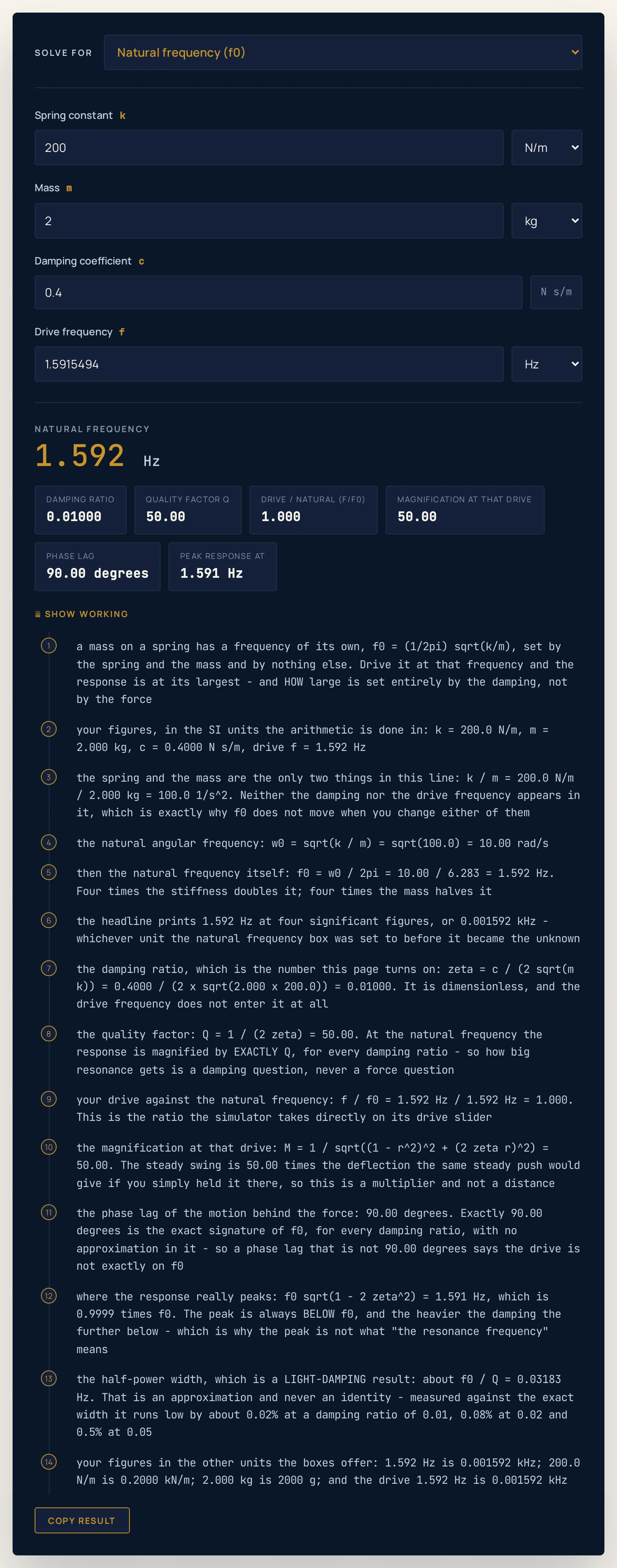
1.592 Hz as the default state, while the magnification has gone from 10.00 to 50.00 — and the peak has crept up to 1.591 Hz, almost onto the natural frequency, because a lightly damped peak sits very close to it.Where the resonance frequency calculator breaks down
The arithmetic here is exact to the last digit a double can hold. What still goes wrong is physical: an object that has many frequencies rather than one, a spring that is not linear, a loss that is not proportional to speed, and a question about the build-up put to a calculation that only describes the steady state.
- Real objects have many modes, and this page describes exactly one
- A mass on a spring is the simplest oscillator there is: one coordinate, one frequency. A beam, a panel, a shaft or a casing has a whole series of them, each with its own shape and its own damping, and driving such an object sweeps through one after another. Use this page for the mode you can isolate — one lump of mass on one obvious flexibility — and treat anything more complicated as needing a measurement rather than a formula.
- The spring has to be linear, and real springs are not for ever
f0 = (1/2pi) sqrt(k/m)assumes the restoring force is strictly proportional to displacement. A coil spring compressed until its turns touch, a rubber mount squashed flat, or a beam bent far enough to stretch its fibres all stiffen as they deflect, and a stiffening spring has a natural frequency that rises with amplitude. At resonance the amplitude is exactly where it gets large, so this is the assumption most likely to fail in the very state the page is about.- Viscous damping is a model, not a measurement
- The damping coefficient box assumes a resisting force proportional to speed, which is what a dashpot or a thin oil film gives. Dry friction, internal losses in a metal and acoustic radiation obey different laws, and a single
cfitted to one amplitude will not predict another. Where you have a measuredQinstead, work backwards from it: the damping ratio is1 / (2Q), andcfollows as2ζ sqrt(mk). - Nothing here says how long the build-up takes
- Every reading on this page is the steady state, the swing the system settles into after being driven for a while. A lightly damped system takes many cycles to get there — which is exactly why a brief pass through a resonance is survivable when sitting on it is not — but how many cycles, and what the motion looks like on the way, is a separate calculation and this page makes none of it. No figure for a ring-up or ring-down time appears anywhere here.
- The magnification is a multiplier, so it needs your own static deflection
- There is deliberately no force box and no amplitude box: the whole point is that a small force gives a large response, and a force slider would let you get a big number the boring way. To turn a magnification into a distance, work out the deflection your own steady push gives — the force divided by
k— and multiply. A 2 N push on the default 200 N/m spring bends it 10 mm held steady, so a magnification of10.00is a 100 mm swing. - The half-power width is an approximation and is labelled as one
- The working prints the half-power width as about
f0 / Q, and the hedge is not politeness. Against the exact width that approximation runs low by about 0.02 per cent at a damping ratio of 0.01, about 0.08 per cent at 0.02 and about 0.5 per cent at 0.05. For a sharp resonance that is far better than anything you could measure; once the damping is heavy the quantity stops meaning anything at all, because there is no peak to be half the power of. - A peak that formally exists is not a peak you can see
- Load the just inside the threshold preset: the peak reading says
0.2251 Hz, which looks like a real answer. Its magnification, though, is1.000to four figures — identical to the static response — so there is nothing there to find. By the time the damping ratio reaches 0.70 the peak is already gone in any measurable sense; at1/sqrt(2)it formally disappears and the reading becomes the wordnone. - The textbook bridge story is not forced resonance
- The 1940 collapse of the Tacoma Narrows bridge is the example every introduction reaches for, and it is the wrong one. The failure is attributed to aeroelastic flutter — a self-exciting oscillation driven by the structure's own motion, feeding on a steady wind rather than on a periodic push at a natural frequency. Billah and Scanlan made the correction in the American Journal of Physics in 1991, and it has been in the literature ever since. Nothing on this page models flutter, and no wind speed, date, frequency or dimension for that bridge is quoted here.
- A refusal is an answer, not a fault
- A zero or negative mass, a zero or negative spring constant, a zero or negative damping coefficient, a zero or negative drive frequency and a zero or negative natural frequency in the two back-solve directions are all declined in words rather than answered with an infinity or a NaN. The zero damping case is the one worth understanding: it would make
Qand the magnification at resonance genuinely infinite, and no real system has it. - The calculator measures nothing — you supply the numbers
- Two quantities and two auxiliaries go in, one relation is rearranged, and the answer describes the oscillator you described. The preset names are shorthand for the five figures behind them and are not claims about any particular machine, mounting or installation.
Where the resonance frequency calculator is actually used
- Checking whether a machine will sit on its own resonance
- This is the forward question and the reason the page opens where it does: a mass you know on a mounting whose stiffness you know, and the frequency to keep the driving machinery away from. Enter the drive frequency you expect and read the magnification. At the default spring and mass a drive at
1.592 Hzis magnified10.00times, while the same oscillator driven at3.183 Hzis magnified only0.3326— less than if you pushed and held. - Retuning a mounting by changing the mass
- Point Solve for at the mass and the question inverts: a spring you cannot change and a frequency you want to move to. Dropping the default oscillator from 1.592 Hz to 1.000 Hz on the same spring takes
5.066 kginstead of 2 kg — 3.066 kg of added ballast — because the mass goes as one over the square of the frequency. Adding mass is usually cheaper than fighting the amplitude. - Choosing a mounting stiffness for a mass you already have
- Point Solve for at the spring constant and you are designing rather than checking. A 0.5066 kg mass that must sit at 1.500 Hz needs a
45 N/mspring; a 0.25 kg mass at 4.000 Hz needs157.9 N/m. Remember that the stiffness goes as the square of the frequency, so this is the direction in which a sloppy frequency does the most damage. - Working out how much damping you actually need
- Load the five damping presets from the lightest damper to the heaviest and watch one reading:
50.00,10.00,1.000,0.7143,0.7042. That is the whole design trade in five clicks, and nothing but the damper moved between them. It is also where the law of diminishing returns shows up: going from 0.4 to 2 N s/m removes a factor of 5, while going from 20 to 28.4 N s/m removes almost nothing, because by then there is no resonance left to suppress. - Reading a measured resonance backwards
- If you have shaken something and found where it responded most, you have the peak rather than the natural frequency, and the two differ by a factor of
sqrt(1 - 2ζ2). For a sharp resonance the gap is negligible —1.591 Hzagainst1.592 Hzat a damping ratio of 0.01000. For a heavily damped one it is not: at 0.5000 the peak sits at1.125 Hzwhile the natural frequency is still1.592 Hz, a gap of nearly 30 per cent. The phase lag is the better measurement, because it crosses90.00 degreesat the natural frequency whatever the damping. - Recognising the same mathematics somewhere else
- Every resonance in physics has this shape. A swing pushed in time, a wine glass answering one note, a radio tuned to one station, a nucleus flipped by one radio frequency in an MRI scanner — all of them are a system with a frequency of its own being driven at it, and all of them have a
Q. What differs is what plays the part of the mass and the spring. For a pendulum it is the length and gravity, which is the pendulum period calculator; for a stretched string it is a whole ladder of modes at once, drawn by the standing waves simulator.
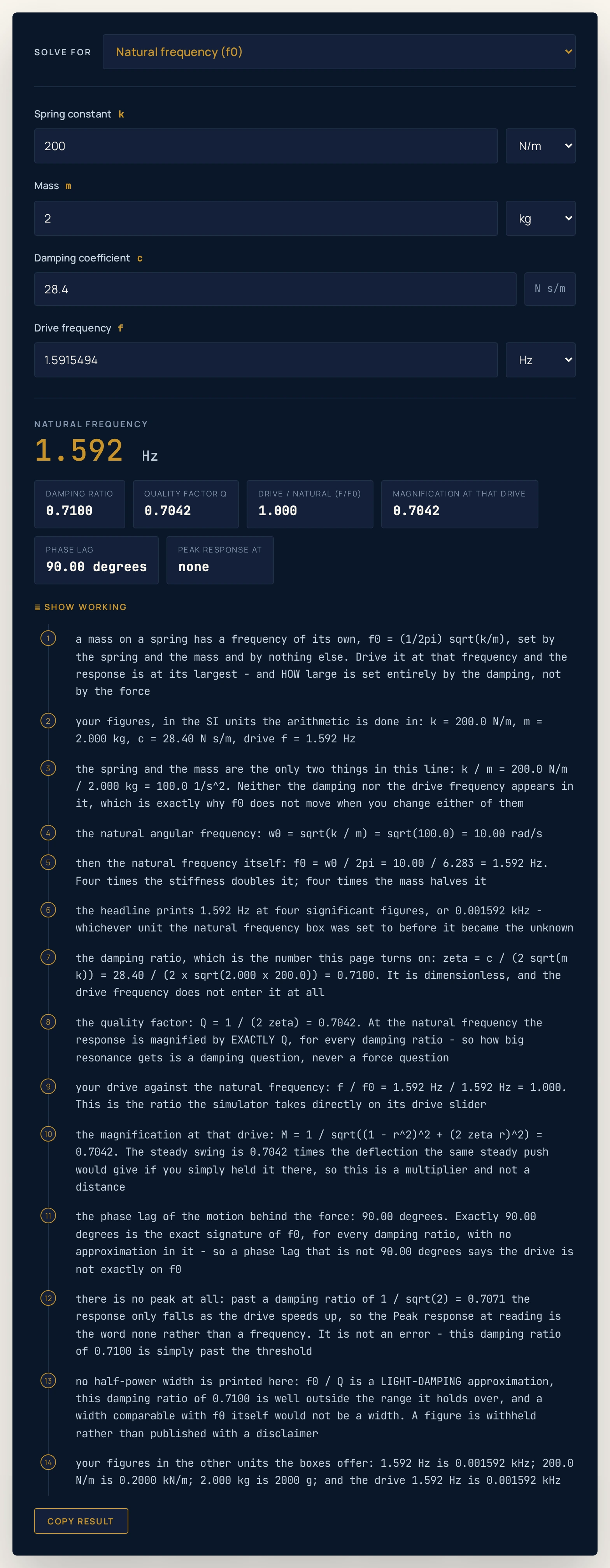
1.592 Hz — it never moved — but the damping ratio of 0.7100 is past 1/sqrt(2), so there is no peak to report and the last reading is the word none. The magnification is 0.7042: driving this oscillator at its natural frequency moves it less than simply pushing and holding would.Where to go next
For what resonance is, how the energy builds up cycle by cycle, the worked problems and the misconceptions, read the resonance in physics guide, which this tool is the arithmetic half of. The simple harmonic motion guide is what the mass is doing once it is moving, the standing waves and harmonics guide is the case where one object has a whole ladder of resonances instead of one, and the amplitude guide is where the height of a vibration belongs as a subject.
Two more posts pick up what this page leaves out. The pendulum period formula guide is the same shape of formula with a length and gravity in place of a spring and a mass, and the frequency formula guide is the period-to-frequency conversion for a reader who arrives with a period.
Four tools sit next to this one. The simple harmonic motion calculator handles the angular frequency, the period and the peak speed; the spring constant calculator supplies the k this page asks for; the Hooke's law calculator is the force-extension relation behind it; and the pendulum period calculator is the same algebra on a different system.
The simple harmonic motion simulator, the spring constant simulator and the standing waves simulator are the neighbouring simulations. The full physics lab library and calculator index are open too.
Frequently asked questions
What does the resonance frequency calculator work out?
It solves f0 = (1/2pi) sqrt(k/m) for any one of three quantities: the natural frequency of a mass on a spring, the spring constant, or the mass. Beside the answer it prints the damping ratio, the quality factor Q, your drive frequency as a ratio of the natural one, the magnification at that drive, the phase lag in degrees, and the frequency at which the response actually peaks.
What is the difference between the natural frequency and the resonance frequency?
The natural frequency is f0 = (1/2pi) sqrt(k/m), fixed by the spring and the mass. Resonance is what happens when you drive the system at or near it. The frequency at which the response is actually largest is f0 times sqrt(1 - 2 zeta squared), which is always a little lower than f0 and moves as the damping changes, so the two are not the same number once there is any damping at all.
Why does the damping coefficient not change the natural frequency?
Because the damping is not in the formula. Only k and m appear in f0 = (1/2pi) sqrt(k/m), so moving the damping box leaves the headline byte for byte where it was while the damping ratio, the quality factor and the magnification all move. Load the light and heavy damping presets one after the other: the answer stays at 1.592 Hz while the magnification goes from 50.00 to 1.000.
How big does resonance actually get?
Exactly Q times the deflection the same steady push would give if you just held it there, where Q is 1 divided by twice the damping ratio. That is a finite number for every real system, so resonance never means infinite amplitude; it only diverges at a damping of exactly zero, which nothing real has. This page therefore declines a zero damping coefficient rather than printing an infinity.
Why does the magnification read 9.997 rather than 10.00 when the page opens?
Because the drive box opens on the rounded 1.592 Hz while 200 N/m on 2 kg has a natural frequency of 1.5915494 Hz, so the drive is 0.02831 per cent above resonance rather than exactly on it. The phase lag reading says so too: it shows 90.32 degrees instead of 90.00. Click the first preset, which carries the drive to eight significant figures, and the magnification reads 10.00 and the phase lag 90.00 degrees.
Why does solving for the spring constant give 200.1 N/m when I typed 200 before?
Because the stiffness goes as the square of the frequency, so an error in the frequency is doubled in the stiffness. The four-figure 1.592 Hz sitting in the box is 0.02831 per cent above the exact natural frequency of a 200 N/m spring on a 2 kg mass, and twice that is the 0.0566 per cent that turns 200 into 200.1. It is a real consequence of typing a rounded frequency, not a fault, and the same effect returns 1.999 kg in the mass direction.
Why is the phase lag exactly 90 degrees at the natural frequency?
Because at a drive ratio of exactly 1 the stiffness term and the inertia term cancel completely, and what is left is the damping force, which is always a quarter of a cycle out of step with the displacement. That cancellation does not depend on how much damping there is, so the 90.00 degrees is exact for every damping ratio. It is the only signature of the natural frequency that does not move when the damping changes.
Why does the peak response reading sometimes say none?
Because past a damping ratio of 1 divided by the square root of 2, which is about 0.7071, the response has no maximum: it simply falls away from its static value as the drive speeds up. Below that threshold the peak sits at f0 times sqrt(1 - 2 zeta squared), always below the natural frequency. The word none is the honest reading there, and by the time the damping ratio reaches 0.70 the peak is already gone in any measurable sense, because its magnification is 1.000 to four figures.
Is the half-power width really f0 divided by Q?
Only approximately, and only for light damping. The exact half-power width is a longer expression, and f0 divided by Q runs low against it by about 0.02 per cent at a damping ratio of 0.01, about 0.08 per cent at 0.02 and about 0.5 per cent at 0.05. For a sharp resonance the approximation is better than anything you could measure; for heavy damping it stops meaning anything, which is why the working labels it rather than printing it as an identity.
Why is there no force box and no amplitude box?
Because the point of resonance is that a small force produces a large response, and a force box lets you get a big amplitude the boring way instead. What the page prints is the magnification, which is dimensionless: multiply it by the deflection your own steady push gives and you have the swing in whatever unit you like. The amplitude as a subject belongs to its own page, and nothing here prints a displacement.
Does this calculator say anything about how long the oscillation takes to build up?
No, and the omission is deliberate. Every figure on this page is the steady state, the swing the system settles into after being driven for a while. How many cycles it takes to get there, and what the motion looks like on the way, is a different calculation that nothing here performs.
Does the same formula work for a pendulum or a tuned circuit?
Not with these boxes. A pendulum has the same shape of formula but its ingredients are the length and gravity rather than a stiffness and a mass, so it needs its own tool. A tuned electrical circuit is described by the same mathematics with an inductance and a capacitance in place of the mass and the spring, but this page has no field for either and quotes no figure for one.
References & formula source
- The relation this page solves is the undamped natural frequency of a one-degree-of-freedom mass-spring system: the restoring force kx and the inertia m x double-dot give an angular frequency of sqrt(k/m), and dividing by 2 pi turns that into a frequency in hertz. It is stated here rather than derived, and it holds for any linear spring and any mass that moves as one body.
- The driven, damped response printed beside the answer is the steady-state solution of m x double-dot plus c x dot plus k x equals a harmonic force. Its magnification is 1 / sqrt((1 - r squared) squared + (2 zeta r) squared) with r the drive frequency divided by the natural frequency and zeta the damping ratio c / (2 sqrt(mk)); its phase lag is the arctangent of 2 zeta r over 1 - r squared, taken in the range 0 to 180 degrees. At r = 1 the magnification is exactly 1 / (2 zeta), which is the quality factor Q, and the phase lag is exactly 90 degrees for every damping ratio.
- The frequency at which the magnification is largest is the natural frequency multiplied by sqrt(1 - 2 zeta squared), which is always below the natural frequency and ceases to exist once the damping ratio reaches 1 / sqrt(2), about 0.7071. Past that threshold the response falls monotonically from its static value and the page prints the word none rather than a frequency. By a damping ratio of 0.70 the peak is already immeasurable: its magnification is 1.000 to four significant figures, the same as the static response.
- The half-power width quoted in the working as about f0 / Q is a light-damping approximation and not an identity. Measured against the exact half-power width by an independent reference written before this page existed, f0 / Q runs low by 0.0200 per cent at a damping ratio of 0.01, 0.0800 per cent at 0.02 and 0.501 per cent at 0.05. It is labelled as an approximation everywhere it appears here.
- The model is linear, single-mode and viscously damped. A real object has many modes rather than one, springs that stiffen or soften with extension, and losses that are not proportional to speed, so the figures here are the behaviour of the idealisation and not a measurement of any particular machine. No figure for any real structure, instrument or installation is published or implied anywhere on this page.
- Nothing on this page describes the transient. Every reading is the steady state the system settles into under a sustained drive, and how long it takes to build up to that, or to die away afterwards, is a separate calculation that is not performed here and for which no figure is given.
- Every figure quoted in the prose and tables above is either a string this calculator printed for the inputs named beside it, or a ratio checked against an independent reference written before this page existed and sharing no code with it, which runs 249 checks with 0 failures. Where a cell and the running widget ever part company, believe the widget.
- Further reading: Resonance — Wikipedia