Amplitude is the maximum displacement of a particle from its rest (equilibrium) position as a wave or oscillation passes through it. Its symbol is A and its SI unit is the metre. Amplitude sets how much energy the wave carries — energy is proportional to amplitude squared — but it never changes the wave’s frequency, wavelength or speed.
Turn the volume knob up and the song does not change key. The notes stay exactly where they were; they just hit you harder. What you have changed is amplitude — how far the speaker cone, and then the air, swings away from rest on every cycle.
That one quantity decides whether an earthquake rattles a window or flattens a street, whether a radio signal is readable or lost in hiss, and whether a guitar string whispers or rings. Learn to read it off a graph and a surprising amount of wave physics stops being guesswork.
What Is Amplitude in Physics?
Amplitude is the maximum distance a point moves away from its rest position while oscillating, measured from the middle of the motion outwards. It is a magnitude, so it is always positive, and it is written as A.
Picture a buoy bobbing on a swell. The water surface has a level it would settle at if the sea were flat — that is the rest position. Amplitude is how far above that level the buoy rises at the top of its climb.
Because amplitude is a displacement, its SI unit is the metre (m). In practice you will meet it in centimetres or millimetres for laboratory work, and in other units whenever something other than position is oscillating: pascals for the pressure swing of a sound wave, volts for an AC signal, amperes for an alternating current.
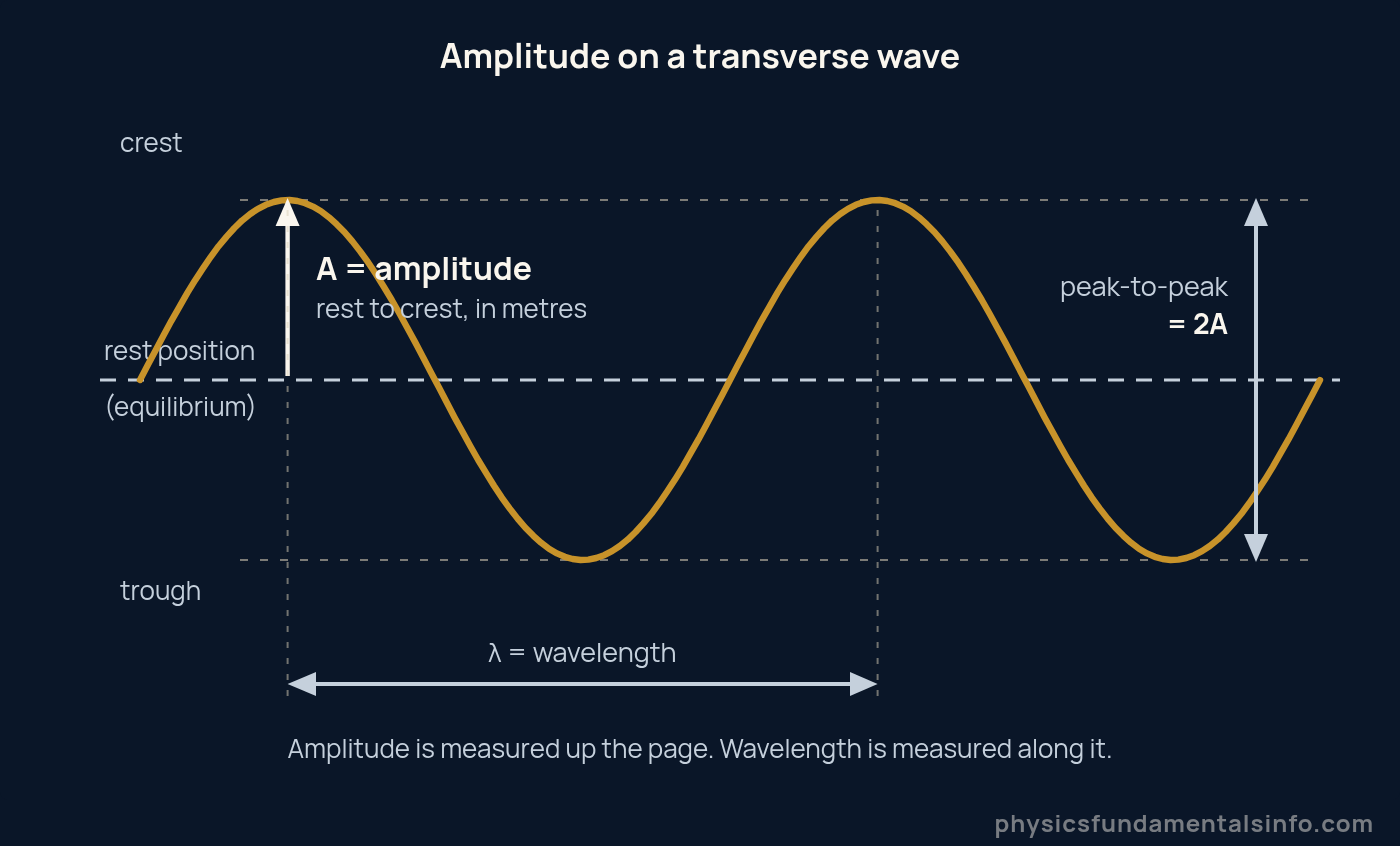
Amplitude is the rest-to-crest distance. The full crest-to-trough span is peak-to-peak, which equals 2A.
Amplitude Is Measured From the Middle, Not End to End
Here is the single most common student slip: measuring from crest all the way down to trough and calling that the amplitude. That span is the peak-to-peak value, and it is twice too big.
Halve it and you have the amplitude. Oscilloscopes and signal generators almost always quote peak-to-peak, so this conversion is one you will do constantly in a practical.
The Amplitude Formula and What Each Symbol Means
There is no standalone “amplitude equation” — amplitude is the constant A that sits in front of the sine in the displacement equation of any simple harmonic oscillation.
- y — displacement of the particle at time t — metre (m)
- A — amplitude, the largest value y ever reaches — metre (m)
- ω — angular frequency, where ω = 2πf — radian per second (rad/s)
- t — time — second (s)
- φ — phase constant, which fixes where in the cycle the motion starts — radian (rad)
Because sin never exceeds 1, y never exceeds A. That is the whole meaning of the symbol: A is the ceiling on the displacement.
When you only have a graph or a trace to work from, use the peak and trough readings instead.
Two further results follow straight from the displacement equation, and both are worth memorising because examiners lean on them heavily.
So a bigger amplitude means a faster maximum speed and a fiercer maximum acceleration — at exactly the same frequency. If you would rather feed in numbers than rearrange by hand, our Simple Harmonic Motion Calculator takes an amplitude and a frequency and returns ω, the period and both maxima with the working shown.
Try it yourself below: drag the amplitude slider and watch two things at once — the total energy readout climbing steeply, and the period sitting completely still.
How Amplitude Carries a Wave’s Energy
Amplitude carries the energy, and it does so as a square: the energy of an oscillation is proportional to A2, so doubling the amplitude multiplies the energy by four.
The cleanest way to see this is a mass on a spring at the instant it reaches its furthest point. Everything is momentarily stationary, so all the energy is stored as elastic potential energy in the spring.
- E — total energy of the oscillation — joule (J)
- k — spring constant — newton per metre (N/m)
- A — amplitude — metre (m)
The same squaring shows up for travelling waves. At a fixed frequency, the intensity a wave delivers is proportional to the square of its amplitude — which is why NASA’s own primer describes amplitude as the strength or intensity of a wave, the direct analogue of a sound’s loudness.
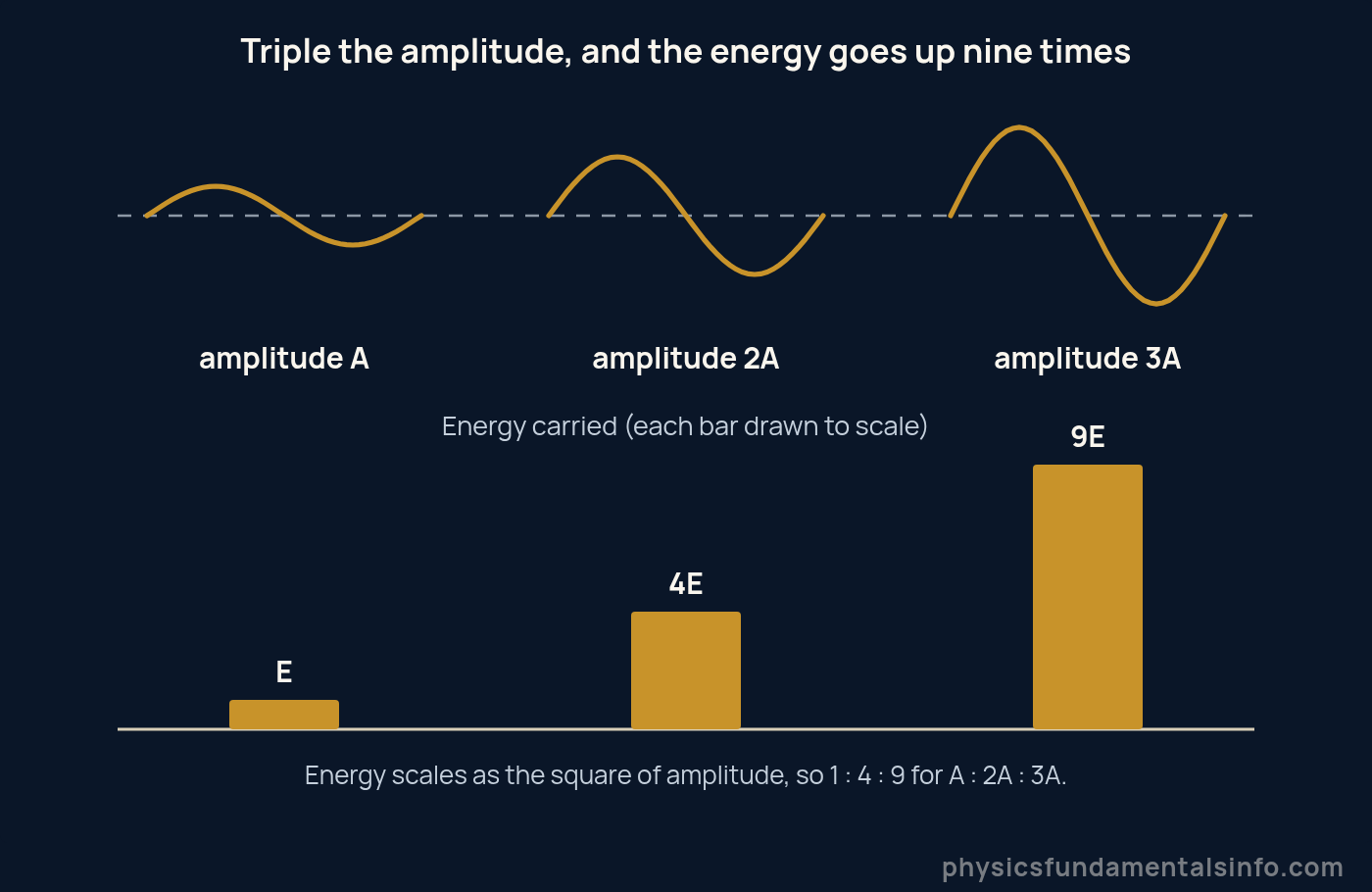
Because energy depends on A2, modest-looking amplitude increases cost a great deal of energy.
This is why loudness is so expensive. To make a speaker sound twice as intense you must push four times the energy through it — and because our ears respond logarithmically, that only buys you about 6 dB on the decibel scale.
Amplitude vs Wavelength, Frequency and Period
Amplitude measures how far the medium moves; wavelength, frequency and period measure how the wave repeats — and changing the amplitude leaves every one of the others untouched.
It helps to think of the two directions on the graph. Amplitude is measured up the page. Wavelength is measured along it.
| Quantity | Symbol | SI unit | What it measures | Does changing amplitude alter it? |
|---|---|---|---|---|
| Amplitude | A | metre (m) | Maximum displacement from rest | — |
| Wavelength | λ | metre (m) | Distance between successive identical points | No |
| Frequency | f | hertz (Hz) | Cycles passing a point each second | No |
| Period | T | second (s) | Time for one complete cycle | No |
| Wave speed | v | metre per second (m/s) | How fast the disturbance travels | No |
That column of “No” is the point of the whole table. Amplitude lives on its own axis, independent of everything in the frequency and period relationship.
How Do You Find Amplitude From a Graph?
To find amplitude from a graph, read off the highest and lowest values, subtract them, and halve the result. Three steps, no algebra.
- Find the rest position — the horizontal line the curve is symmetrical about, which is not always at zero.
- Read the peak value and the trough value, keeping the units the axis is labelled in.
- Apply A = (ymax – ymin) / 2, then convert to metres if the question wants SI units.
Watch the axis. A trace showing 8.0 cm from crest to trough has an amplitude of 4.0 cm, which is 0.040 m — and dropping that factor of two is the mistake that costs the most marks in wave questions.
Peak, Peak-to-Peak and RMS
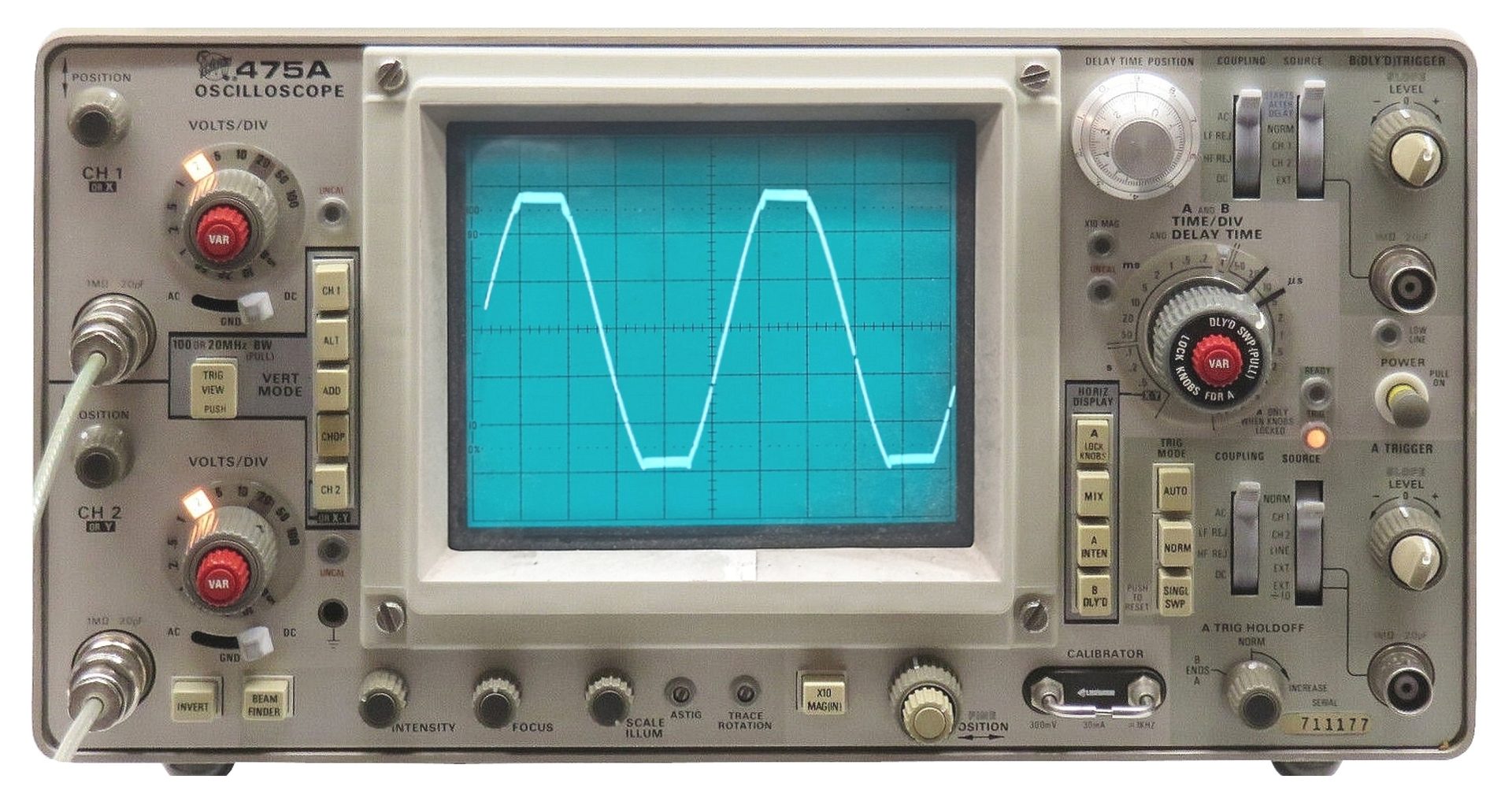
Electronics adds a third measure you will meet in AC work. The root-mean-square value is a kind of effective average, and for a pure sine wave it is fixed at A / sqrt(2), roughly 0.707A.
So a mains supply quoted as 230 V RMS actually swings to a peak amplitude of about 325 V. All three numbers describe the same wave — they are just different ways of summarising its size.
Real-World Examples of Amplitude
Amplitude is not a textbook abstraction. It is the quantity engineers actually design around.
Sound and loudness. The amplitude of the pressure swing in the air is what your eardrum responds to. A whisper and a shout can share the same pitch and travel at the same 343 m/s, yet differ by a factor of thousands in amplitude.
Earthquakes. Seismographs record ground-motion amplitude, and magnitude scales are built on its logarithm. Each whole step up the scale means roughly ten times the ground-motion amplitude and about 32 times the energy released — which is why a magnitude 7 is a different category of event from a magnitude 6, not merely a worse one.
Radio broadcasting. AM stands for amplitude modulation: the audio signal is encoded by varying the amplitude of a carrier wave while its frequency stays locked. FM does the opposite. That single design choice is why AM is more vulnerable to crackle — lightning and motors add amplitude noise.
Gravitational waves. These are the smallest amplitudes ever measured. A passing wave with strain around 10-21 changes the length of LIGO’s 4 km arms by about 4 × 10-18 m. Amplitude also identifies the source: a steadily spinning neutron star should emit a continuous signal of constant frequency and amplitude, unlike the rising chirp of a merger.
Musical instruments. Pluck a guitar string harder and you increase the amplitude of its vibration, not its frequency. The note is identical; only the volume changes — which is exactly why a guitarist can play the same chord loudly or softly.
4 Common Misconceptions About Amplitude
These four errors account for most of the marks lost on amplitude questions. Each one is worth ten seconds of checking.
Myth 1: Bigger amplitude means a higher pitch
It does not. Amplitude and frequency are independent quantities, so a louder note is not a higher note. For a mass on a spring the frequency is fixed by the spring constant and the mass, and no amount of extra amplitude will shift it.
Myth 2: Amplitude is the distance from crest to trough
That distance is peak-to-peak, and it equals 2A. Amplitude is measured from the rest position to one extreme only, so a wave with a 6 cm crest-to-trough span has an amplitude of 3 cm.
Myth 3: A bigger wave travels faster
For ordinary waves, speed is a property of the medium, not of the wave. Sound crosses a room at the same speed whether it is loud or quiet. Only at extreme amplitudes — a blast wave from an explosion — does the disturbance genuinely outrun the normal speed of sound.
Myth 4: Doubling the amplitude doubles the energy
It quadruples it. Energy depends on A2, so a factor of two in amplitude is a factor of four in energy. Perceived loudness rises by only about 6 dB, which is a further reminder that our ears and the physics are measuring different things.
How Amplitude Connects to SHM, Damping and Resonance
Amplitude is the one variable in simple harmonic motion you can set freely without disturbing anything else. Fix the mass and the spring, and the frequency is decided; the amplitude is still yours to choose.
This independence has a name: isochronism. It is the reason pendulum clocks work at all, and why the period of a simple pendulum depends on length and gravity but not on how far you pull it back.
The small-angle caveat matters, though. At a swing of 20° the true period is already about 0.8% longer than the simple formula predicts, and by 45° the error has grown to nearly 4%.
Damping Eats Amplitude, Not Frequency
Real oscillators lose energy to friction and air resistance, so their amplitude decays — typically exponentially — while the frequency barely shifts. A struck tuning fork holds its note and simply fades.
Because energy goes as A2, that fade is steeper than it looks. An amplitude that has fallen to half its starting value has already given up three quarters of its energy.
Resonance Is an Amplitude Phenomenon
Drive an oscillator at its natural frequency and the amplitude builds dramatically, because each push arrives in step with the motion. This is the mechanism behind a wine glass shattering to a sung note and behind the vibration limits engineers design bridges to avoid.
Note what resonance actually does: it does not change the frequency you are driving at. It changes how large a response that frequency produces — and amplitude, in both transverse and longitudinal waves, is the size of that response.
Worked Problems
Show Solution
Solution:
Step 1: The crest-to-trough span is the peak-to-peak value, so A = (ymax – ymin) / 2.
Step 2: Substitute: A = 8.0 cm / 2 = 4.0 cm.
Step 3: Convert to SI units: 4.0 cm = 4.0 × 10⁻² m = 0.040 m.
Answer: A = 0.040 m (2 s.f.)
Show Solution
Solution:
Step 1: Compare with the standard form y = A sin(ωt), so A is the coefficient of the sine and ω is the coefficient of t.
Step 2: Read them off: A = 0.30 m and ω = 50π rad/s = 157.08 rad/s.
Step 3: Convert: f = ω / 2π = 50π / 2π = 25 Hz, and T = 1 / f = 1 / 25 = 0.040 s.
Answer: A = 0.30 m, ω = 157 rad/s, f = 25 Hz, T = 0.040 s
Show Solution
Solution:
Step 1: Starting at the rest position means φ = 0, so y = A sin(ωt) with ω = 2πf.
Step 2: ω = 2π × 2.0 Hz = 12.566 rad/s, so ωt = 12.566 rad/s × 0.10 s = 1.2566 rad.
Step 3: y = 0.15 m × sin(1.2566 rad) = 0.15 m × 0.9511 = 0.1427 m.
Answer: y = 0.14 m (2 s.f.)
Show Solution
Solution:
Step 1: All the energy is elastic potential energy at maximum displacement, so E = (1/2)·k·A2.
Step 2: E = 0.5 × 40 N/m × (0.12 m)2 = 0.5 × 40 × 0.0144 m2 = 0.288 J.
Step 3: With A = 0.24 m: E = 0.5 × 40 N/m × (0.24 m)2 = 0.5 × 40 × 0.0576 m2 = 1.152 J.
Step 4: Check the ratio: 1.152 J / 0.288 J = 4.00, exactly as A2 predicts for a doubling.
Answer: E = 0.288 J, rising to 1.15 J — four times larger
Show Solution
Solution:
Step 1: Use vmax = Aω and amax = Aω2, with ω = 2πf.
Step 2: ω = 2π × 3.0 Hz = 18.850 rad/s.
Step 3: vmax = 0.050 m × 18.850 rad/s = 0.9425 m/s.
Step 4: amax = 0.050 m × (18.850 rad/s)2 = 0.050 × 355.3 = 17.77 m/s2.
Answer: v_max = 0.94 m/s, a_max = 18 m/s2 (2 s.f.)
Show Solution
Solution:
Step 1: At a fixed frequency, intensity is proportional to amplitude squared, so tripling A multiplies the intensity by 32 = 9.
Step 2: The change in sound level is ΔL = 10 · log10(I2 / I1) = 10 · log10(9).
Step 3: log10(9) = 0.9542, so ΔL = 10 × 0.9542 = 9.542 dB.
Answer: The level rises by about 9.5 dB
Show Solution
Solution:
Step 1: Each swing multiplies the amplitude by 0.90, so after n swings A / A0 = (0.90)n.
Step 2: After 5 swings: A / A0 = (0.90)5 = 0.5905, which is 59.0% of the original amplitude.
Step 3: Energy is proportional to A2, so E / E0 = (0.5905)2 = 0.3487.
Step 4: Sanity check: the amplitude has roughly halved, and energy should therefore fall to roughly a quarter — 0.35 is the right order.
Answer: About 59% of the amplitude remains, but only about 35% of the energy