The interference of waves is what happens when two waves overlap: their displacements add at every point, so the result depends entirely on how far out of step the two are. One wavelength of extra path is one whole cycle of phase, which is why only the fraction of a wavelength ever matters.
Drop two stones into a still pond and watch where the two sets of ripples meet. Along some lines the water heaves twice as high as either ring could manage alone; along others it barely moves at all, even though both sets of ripples are passing straight through that spot.
Nothing is being destroyed there, and nothing is being manufactured at the high lines either. Both waves are simply arriving at each point at different moments in their cycles — and that one fact, how far out of step they are, settles everything that follows.
What Is the Interference of Waves?
The interference of waves is what two overlapping waves do to each other: at every point their displacements add, and the sum can be anything from the difference between the two amplitudes up to their total. The waves do not collide and nothing is shared out between them. They pass through one another untouched, and while they overlap the medium does both jobs at once.
That adding-up has a name — superposition. Each wave carries on as though the other were not there, so the displacement you actually measure is the plain arithmetic sum of what each wave would have produced by itself.
Watch a single floating leaf rather than the whole pond and it gets much easier. The leaf has one height at any instant, and that height is wave 1’s contribution plus wave 2’s. Nothing more complicated than that is happening.
Three rules follow, and the rest of this page is those three worked out in numbers:
- The displacements add. At every point and every instant the result is the sum of the two, and no other rule is needed.
- Only the fraction of a wavelength matters. One whole wavelength of extra path is one whole cycle of phase, so whole wavelengths change nothing at all.
- The amplitudes set the range; the geometry sets where in it you land. The resultant can never leave the band running from the difference between the two amplitudes up to their sum.
None of this is exotic. Superposition is the foundation the whole subject rests on, and MIT’s open undergraduate course on vibrations and waves gives interference two separate lectures of its own.
Two neighbouring ideas are worth naming now, so you know where this page stops. Send two waves at each other along one line instead of sending them the same way and the sum stops travelling altogether — that is a standing wave, a separate subject with rules of its own. And the same adding-up, carried out across a whole wavefront rather than between two sources, is what diffraction is; the geometry that goes with it belongs to that page rather than this one.
The Phase Difference Formula: the One Number That Decides
The phase difference is the single quantity that decides what two overlapping waves produce, and it comes straight out of the extra distance one of them has travelled. Divide that path difference by the wavelength and you have the answer in cycles; multiply by 2 pi and you have it in radians.
| Symbol | What it is | SI unit | At the simulator’s opening state |
|---|---|---|---|
| dx | Path difference: the extra distance one wave has travelled before the two meet | metre (m) | 0.500 m |
| lam | Wavelength, taken to be the same for both waves | metre (m) | 2.000 m |
| cycles | dx / lam: the path difference counted in wavelengths rather than in metres | dimensionless | 0.250000 wavelengths |
| dphi | Phase difference, 2 pi times the count of cycles | radian (rad) | 1.57080 rad |
| a1, a2 | The two amplitudes, in whatever the wave displaces — millimetres on a string, pascals in air | arbitrary units | 5.00 units each |
| A | Resultant amplitude, in the same unit as a1 and a2 | arbitrary units | 7.07107 units |
| ratio | A^2 / (a1^2 + a2^2): the intensity against what the two waves would give without interfering | dimensionless | 1.00000 x |
Put the opening numbers through it and nothing clever is required: 0.500 m of extra path on a 2.000 m wavelength is 0.500 / 2.000 = 0.250000 wavelengths, which is 2 pi x 0.250000 = 1.57080 rad of phase. Our wave interference calculator runs that division in whichever direction you need, so it will also tell you what path difference a wanted fraction of a cycle takes, or what wavelength a measured path difference implies.
Two quantities that dominate most wave problems are missing here, and their absence is the point. There is no speed and no frequency anywhere in dphi = 2 pi dx / lam — interference is settled by one distance divided by another. If you arrived holding a frequency instead of a wavelength, the wavelength formula converts it; if you want to know why that wavelength changes when the wave crosses into something else, that is what a medium does to a wave.
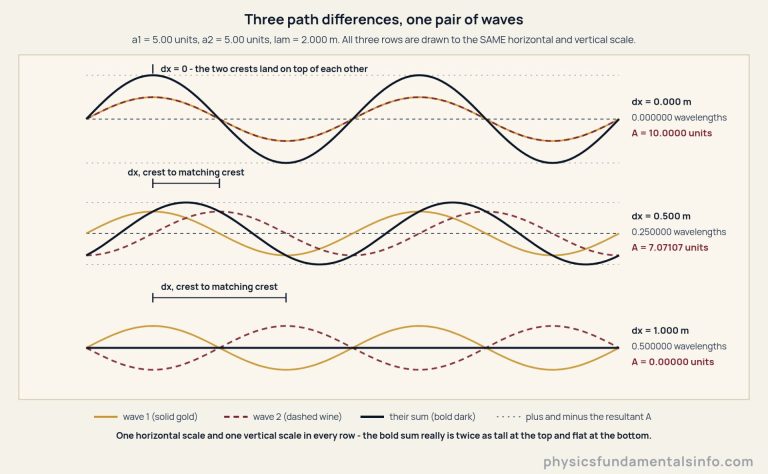
Here is the same picture with the controls handed over. Slide the path difference and watch the sum swell and collapse; drop one amplitude and watch the cancellation stop being complete.
In Step and Out of Step: the Two Conditions
Two conditions matter, and they sit half a wavelength apart. The waves are exactly in step when the path difference is a whole number of wavelengths, dx = n lam, and the resultant is then simply a1 + a2. They are exactly out of step when dx = (n + 1/2) lam, and the resultant falls to the difference between the two amplitudes.
That second condition is the one most explanations leave half-finished. Out of step does not mean nothing is left — it means the smaller wave subtracts from the larger. Total cancellation is the special case where the two amplitudes happen to match exactly.
| The two waves | Path difference (m) | In wavelengths | Phase difference | Resultant amplitude | Intensity vs the two waves alone |
|---|---|---|---|---|---|
| 5.00 and 5.00 units, exactly in step | 0.000 | 0.000000 | 0.00000 rad | 10.0000 units | 2.00000 x |
| 5.00 and 5.00 units, a quarter cycle apart | 0.500 | 0.250000 | 1.57080 rad | 7.07107 units | 1.00000 x |
| 5.00 and 5.00 units, exactly out of step | 1.000 | 0.500000 | 3.14159 rad | 0.00000 units | 0.00000 x |
| 5.00 and 3.00 units, exactly out of step | 1.000 | 0.500000 | 3.14159 rad | 2.00000 units | 0.117647 x |
All four rows use a 2.000 m wavelength, and the first three use the same pair of 5.00 unit waves. Only the fourth changes an amplitude, and look at what it does and does not move: the phase difference and the path difference in wavelengths are untouched, while the resultant climbs off zero to 2.00000 units — exactly 5.00 minus 3.00.
A common student slip is to read that last row as a failed cancellation. It is not. It is the honest general answer, and the row above it is the special case.

Why Only the Fraction of a Wavelength Matters
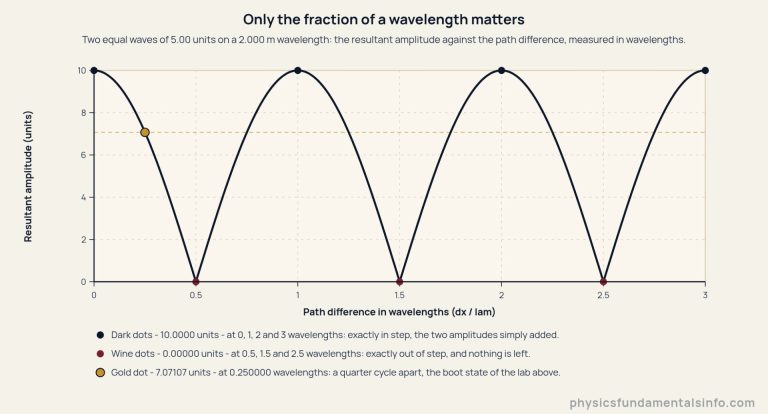
Whole wavelengths of path difference do nothing whatsoever, because one whole wavelength of extra path is one whole cycle of phase and a whole cycle puts a wave back exactly where it started. Only the fraction left over has any effect on the answer.
Take the pair that gave 10.0000 units with no path difference at all and push them three whole wavelengths apart. The phase difference climbs from 0.00000 rad to 18.8496 rad, which sounds like a huge change — and the resultant does not move by a thousandth of a unit.
| Wavelength (m) | Path difference (m) | In wavelengths | Phase difference | Resultant amplitude | Intensity vs the two waves alone |
|---|---|---|---|---|---|
| 2.000 | 0.000 | 0.000000 | 0.00000 rad | 10.0000 units | 2.00000 x |
| 2.000 | 6.000 | 3.000000 | 18.8496 rad | 10.0000 units | 2.00000 x |
| 0.100 | 10.000 | 100.000000 | 628.319 rad | 10.0000 units | 2.00000 x |
Both amplitudes are 5.00 units in all three rows. The resultant and the intensity ratio are identical to the last digit in every one of them, while the phase difference runs from 0.00000 rad to 628.319 rad.
That last row is a test of the arithmetic rather than a description of anything you could build. A hundred wavelengths of extra path is perfectly good algebra, but no real pair of sources holds its timing steady over a distance like that, and the section on limits below explains why.
The Resultant Amplitude and the Range It Must Fall In
The resultant amplitude is A = sqrt(a1^2 + a2^2 + 2 a1 a2 cos dphi), and whatever the geometry does it can never leave the band running from the difference between the two amplitudes up to their sum. The two amplitudes fix that band on their own; the wavelength and the path difference only decide where inside it you land.
Work the opening state through the formula. Two 5.00 unit waves a quarter of a cycle apart have a cosine term of zero, so A = sqrt(25.0000 + 25.0000) = sqrt(50.0000) = 5.00 x sqrt(2) = 7.07107 units — comfortably inside the band from 0.00000 units to 10.0000 units that a pair of equal 5.00 unit waves allows.
Change one amplitude to 3.00 units and the band narrows at both ends, to 2.00000 units and 8.00000 units. Those two numbers are 5.00 minus 3.00 and 5.00 plus 3.00, and no path difference on earth will push the resultant outside them.
Now double both amplitudes to 10.0 units each. The resultant goes from 7.07107 units to 14.1421 units and the band from 0.00000 to 20.0000 units, but the intensity ratio stays at 1.00000 x and the verdict does not change. Only the ratio of the two amplitudes has any say in what interference actually did.
That is why the ratio is the figure worth reading rather than the bare resultant. Intensity goes as the square of the amplitude rather than as the amplitude itself — amplitude is a property of one wave, and this ratio compares the pair with themselves. A reading of 1.00000 x means interference has moved nothing at all.
Interference Does Not Create Energy
Interference moves energy about; it never makes any. The 2.00000 x where two equal waves reinforce is borrowed from the 0.00000 x half a wavelength away, and if you average the ratio across one whole wavelength of path difference it comes back to exactly 1.
This is the part that trips people up, and it is worth being blunt about. A page that printed 2.00000 x and stopped there would be claiming that two waves can deliver twice the energy those same two waves carry, which is nonsense.
The bookkeeping works because the bright places and the quiet places always come as a set. You cannot arrange a path difference that puts every point in step at once; shift the geometry to fill in one quiet line and another opens up somewhere else.
A quarter of a cycle is the clean case to hold on to. At 0.250000 wavelengths the intensity ratio is exactly 1.00000 x: interference has given nothing and taken nothing, and the two waves might as well not have met.
Beats: Interference in Time
Beats are what you get when two waves of slightly different frequency overlap: the loudness rises and falls at the difference between the two frequencies. Everything above this section is interference in space, decided by position; beats are the same adding-up decided by the passage of time.
Two sources at 660 Hz and 664 Hz drift steadily in and out of step with each other. The beat frequency is 664 – 660 = 4.00000 Hz, so the sound swells and fades four times every second, once every 1 / 4.00000 = 0.250000 s.
Open the gap and the beating speeds up. At 288 Hz against 294 Hz the difference is 6.00000 Hz, one loud-quiet cycle every 0.166667 s. Close the gap to nothing and the beating stops altogether, which is precisely what makes it so useful for matching two sources to each other.
Two things to be clear about. This is a different calculation from the rest of the page — there is no path difference in it and the simulator above does not draw it — and it needs two different frequencies, where everything else here needs one shared wavelength. If you arrived from a period rather than a frequency, the frequency formula converts between them.
Where the Interference of Waves Breaks Down
The arithmetic never fails; what fails is an assumption about the two sources or the medium. Seven of them are worth stating out loud, and the first is far more important than the rest.
- It needs coherence, and that is the big one. Every figure on this page assumes the two waves hold a fixed timing relationship for as long as you care about. Two genuinely independent sources drift against one another, the fraction of a cycle wanders, and the pattern washes out into nothing in particular.
- A hundred wavelengths of path needs coherence over that whole distance. The 100.000000 wavelength row above is arithmetically correct and physically unreachable for most sources, which is exactly why it is presented as a test of the sum rather than as an experiment.
- Both waves must share a wavelength. If they do not, there is no steady pattern to report at all — what you get instead is beats, which is the separate calculation set out above.
- Superposition is linear, and that is an assumption about the medium. Displacements add only while the material responds in proportion to what is done to it. Push the amplitude far enough in a real string, membrane or column of air and it stops behaving that way.
- Both waves are assumed to run along the same line, with the same polarisation. Two waves crossing at an angle give a two-dimensional pattern instead, which is the subject of the diffraction guide and of wave-particle duality rather than of this page.
- Interference moves energy and does not make it. Averaged over one whole wavelength of path difference the intensity ratio is exactly 1, so every 2.00000 x somewhere is paid for by a 0.00000 x somewhere else.
- The amplitude unit is arbitrary, and only the ratio matters. Writing “units” is honest: the relation does not know whether you measured millimetres of string or pascals of air, and a resultant of 7.07107 units only means something beside the two amplitudes it came from.
Common Misconceptions About the Interference of Waves
“Destructive interference destroys the energy”
It relocates it. The quiet places and the loud places are produced together and cannot be separated, and the average ratio over one whole wavelength of path difference is exactly 1. Nothing is lost; it is somewhere else.
“Out of step always means total cancellation”
Only when the two amplitudes are equal. Half a wavelength of path difference between a 5.00 unit wave and a 3.00 unit wave leaves 2.00000 units, not zero, and an intensity ratio of 0.117647 x rather than 0.00000 x.
“A bigger path difference means a weaker result”
Size has nothing to do with it; the fraction does. Three whole wavelengths of extra path gives exactly the same 10.0000 units as no path difference at all, and a path difference of half a wavelength — much the smaller of the two — gives nothing.
“Interference needs two separate sources”
It needs two waves, which is not the same requirement. Send one wave at a reflecting boundary and the returning copy overlaps the outgoing one, so there are two displacements to add long before a second source is involved.
“Two waves must have the same amplitude to interfere”
They interfere whatever their amplitudes. Equal amplitudes are only needed for the resultant to reach the two extreme values of the band, 0.00000 units and the full sum; with 5.00 and 3.00 units the pair simply swings between 2.00000 and 8.00000 units instead.
“The two waves damage each other where they overlap”
Neither wave is altered in the slightest. Each carries on with its own amplitude and its own wavelength and emerges on the far side exactly as it arrived — the overlap region is the only place where anything looks different, and what is different there is the sum, not the waves.