Diffraction physics describes how a wave bends and spreads as it passes through a narrow gap or around the edge of an obstacle. The effect is strongest when the gap is close in size to the wavelength. For a diffraction grating, bright fringes appear at angles given by d sin θ = nλ.
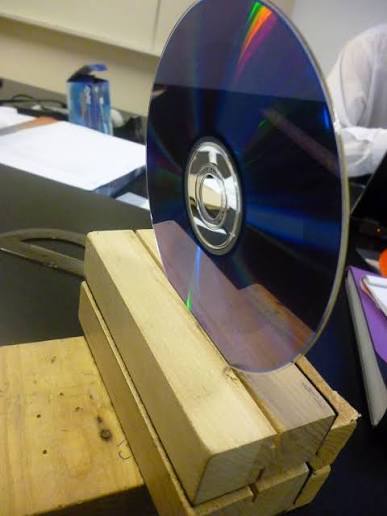
Hold a CD up to a window and tilt it. That sweep of rainbow across its silver face isn’t paint or a coating — it’s the same physics that lets you hear a friend call from around a corner you can’t see past. Both are diffraction.
Waves refuse to travel in perfectly straight lines when they meet an edge. They fan out, overlap, and paint patterns of light and dark, loud and quiet. Once you can read those patterns, you can measure the colour of a distant star or the spacing of atoms in a crystal — from nothing but the angles the waves bend to.
What Is Diffraction in Physics?
Diffraction is the spreading of a wave as it passes through an opening or around an obstacle. It happens for every kind of wave — light, sound, water ripples, even the matter waves of electrons.
Picture straight, parallel wavefronts marching toward a barrier with a gap in it. On the far side, the wave doesn’t continue as a neat straight-edged beam. It bulges outward from the gap, curving into the “shadow” region behind the barrier.
How much it spreads depends on one comparison: the size of the gap versus the wavelength. When the gap is far wider than the wavelength, the wave barely bends and casts an almost-sharp shadow. When the gap shrinks toward the size of the wavelength itself, the spreading becomes dramatic.
This is why diffraction is easy to hear but hard to see. Sound has wavelengths of roughly a metre, similar to a doorway, so it floods around corners. Visible light has wavelengths under a thousandth of a millimetre, so ordinary objects give it no room to bend — which is exactly why it took physicists so long to accept that light is a wave at all.
The Diffraction Grating Formula (d sin θ = nλ)
The diffraction grating equation is d sin θ = nλ, and it locates the bright fringes produced when light passes through many equally spaced slits. A grating is essentially a ruler for wavelength — feed light in, measure the angles, and read off the colour.
Every symbol, with its SI unit:
- d — the grating spacing, the centre-to-centre distance between adjacent slits, in metres (m). If a grating is quoted as N lines per metre, then d = 1/N.
- θ (theta) — the diffraction angle, measured from the straight-through direction to the bright fringe, in degrees or radians.
- n — the order of the maximum: a whole number (0, 1, 2, 3…), dimensionless. n = 0 is the central beam; n = 1 is the first bright fringe on each side.
- λ (lambda) — the wavelength of the light, in metres (m).
The logic is pure geometry. Light leaving two neighbouring slits travels slightly different distances to reach your eye. When that extra distance — the path difference — equals a whole number of wavelengths, the waves arrive in step, reinforce, and you see a bright line. That path difference works out to exactly d sin θ — you can solve for any of the four variables with our Diffraction Grating Calculator.
Notice what the equation predicts. Longer wavelengths (red) bend to bigger angles than short ones (violet), so white light fans into a spectrum. And a finer grating — smaller d — spreads the colours further apart, which is why high-quality spectrometers pack thousands of lines into every millimetre. For a full university-level derivation, the OpenStax University Physics chapter on diffraction gratings is an excellent open reference.
What About a Single Slit? (a sin θ = mλ)
A single slit uses a different equation — and it locates the dark fringes, not the bright ones. This sign-flip trips up more students than almost anything else in wave optics.
- a — the width of the single slit, in metres (m).
- θ — the angle to a dark fringe (a minimum), from the centre.
- m — the order of the minimum, a whole number starting at 1 (there is no m = 0 minimum — the centre is bright).
- λ — the wavelength, in metres (m).
A single slit throws a wide, bright central band with much fainter bands either side. That central maximum is twice as wide as the ones flanking it, and it grows wider as the slit narrows — the clearest everyday signature of diffraction.
How Does Diffraction Actually Work?
Diffraction works because every point on a wavefront acts as a source of its own tiny secondary wavelet. This idea — Huygens’ principle — is the key that unlocks the whole phenomenon.
Imagine a wavefront reaching a gap. Each point across that gap sends out a fresh circular ripple. In open space these ripples add up to reproduce a straight wavefront moving forward. But at an edge, there are no neighbouring ripples to cancel the sideways spreading — so the wave curls into the shadow.
Send the wave through many slits and something powerful happens. The wavelets from every slit overlap and interfere. In most directions they cancel; in a few special directions they line up perfectly and blaze. Those special directions are precisely the ones where the path difference between neighbouring slits is a whole number of wavelengths — the d sin θ = nλ condition.
The diagram below shows that path difference for two adjacent slits. It is the single geometric fact behind the entire grating equation.
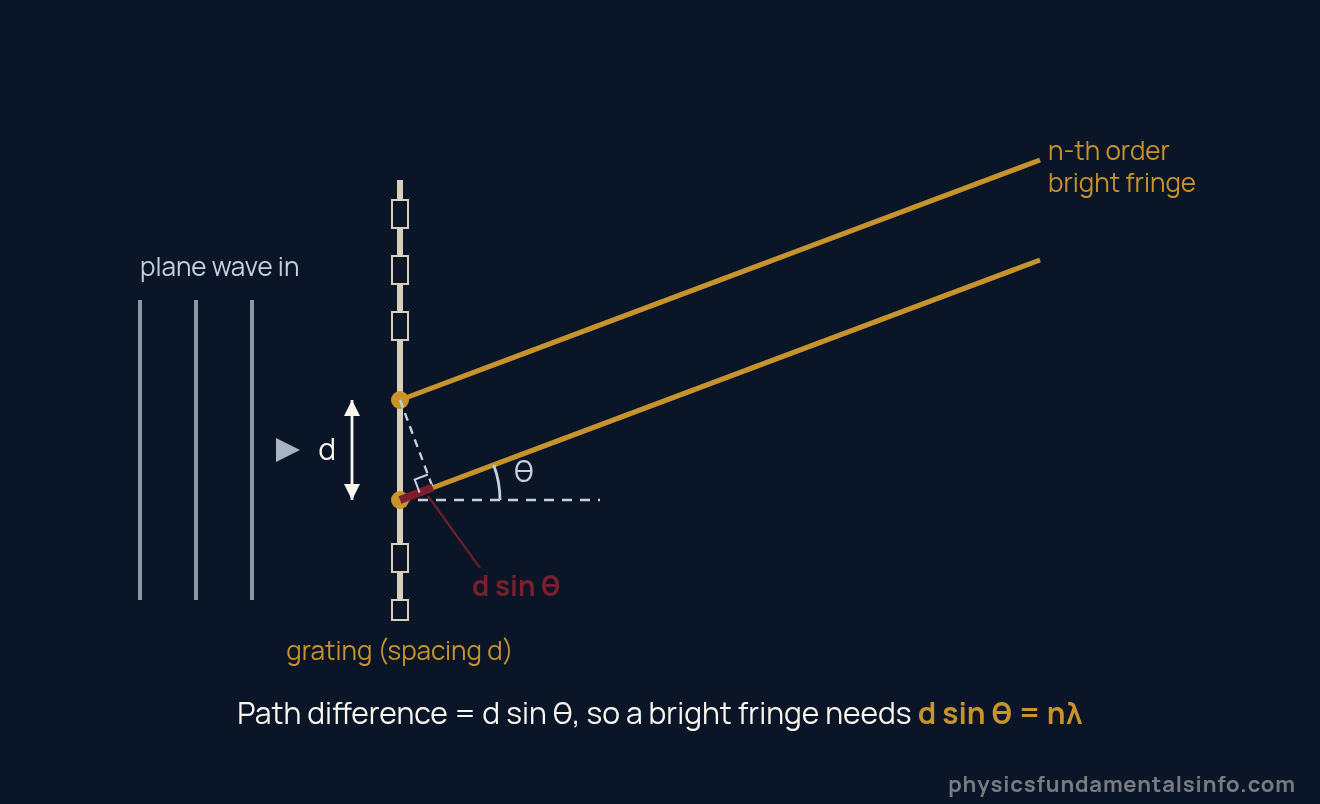
Two neighbouring slits of a grating. Wherever the extra path d sin θ equals a whole number of wavelengths, the waves add up and a bright fringe appears.
Try it yourself below. Change the wavelength and the line density and watch the bright orders swing outward — and see the fringes snap sharper as you add more slits.
6 Real-World Examples of Diffraction
Diffraction shows up far beyond the physics lab — in your music collection, your phone camera, and the instruments that map the universe. Here are six clear examples.
1. The rainbow sheen on a CD or DVD
A disc’s data is stored in microscopic tracks about 1.6 micrometres apart, which act as a reflection grating. White light hits it, each colour diffracts to its own angle by d sin θ = nλ, and the surface blooms into a moving rainbow. A DVD’s tighter 0.74-micrometre tracks spread the colours even wider.
2. Hearing someone around a corner
Sound diffracts around obstacles because its wavelength is roughly a metre — comparable to doorways and walls. Low, bass-heavy tones (longest wavelengths) bend around corners most easily, which is why you catch the muffled boom of distant music before the crisp high notes. Sound and light are both waves, whether transverse or longitudinal, so both diffract.
3. The resolution limit of telescopes and microscopes
Every lens and mirror is a circular aperture, and diffraction sets a hard ceiling on the detail it can resolve. Two stars closer than this limit blur into one, no matter how good the optics. It’s the reason astronomers build ever-larger telescopes — a bigger aperture means finer resolution.
4. Splitting starlight in a spectrometer
Diffraction gratings are the heart of the spectrometer, the instrument that decodes what things are made of. By spreading light into a precise spectrum, they reveal the fingerprint of dark and bright lines that identifies each element. It’s how we know the chemical make-up of stars we will never visit — a technique detailed on Georgia State University’s HyperPhysics.
5. X-ray diffraction and the shape of molecules
Fire X-rays at a crystal and the regularly spaced atoms diffract them into a pattern of spots — a technique known as X-ray diffraction. Because X-ray wavelengths match atomic spacings, that pattern encodes the crystal’s structure. This is how the double-helix shape of DNA and the architecture of countless proteins were first revealed.
6. Speckle from a laser pointer
Shine a laser through a narrow slit or a pinhole and it fans into a broad central blob flanked by fainter bands — textbook single-slit diffraction. The same effect blurs the edges of the beam and produces the grainy “speckle” you see when laser light scatters off a rough wall.
Common Misconceptions About Diffraction
Diffraction is intuitive once it clicks, but a handful of stubborn myths get in the way. Here are four worth clearing up.
Myth 1: “d sin θ = nλ gives the dark fringes.”
It gives the bright fringes. For a diffraction grating (and for double slits), d sin θ = nλ locates the maxima. The single-slit equation a sin θ = mλ locates the minima — the dark bands. Swapping the two is the most common exam-day slip, so anchor it: grating equation → bright, single-slit equation → dark.
Myth 2: “A wider slit diffracts light more.”
The opposite is true. Spreading increases as the slit gets narrower, toward the size of the wavelength. A wide slit lets the wave pass almost straight through, casting a nearly sharp shadow. Squeeze it down and the wave fans out dramatically — as the two panels below make plain.
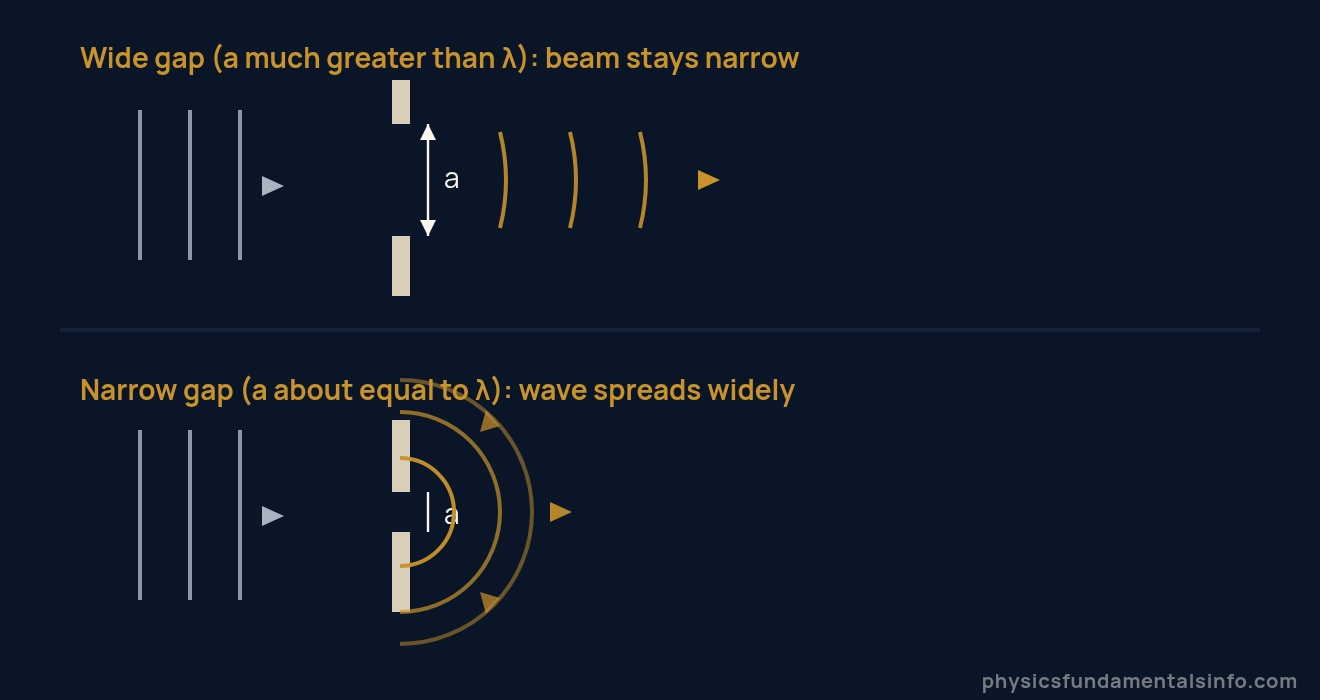
The narrower the gap relative to the wavelength, the more the wave spreads. Diffraction grows as openings shrink.
Myth 3: “Only light diffracts.”
All waves diffract. Water waves bend around a harbour wall, sound floods through a doorway, and electrons fired at a crystal produce a diffraction pattern — the experiment that confirmed matter behaves as a wave. Diffraction is a property of waves in general, not of light in particular.
Myth 4: “Diffraction is just another word for refraction.”
They are different effects. Refraction is bending caused by a change in a wave’s speed as it crosses between two media — the reason a straw looks broken in a glass of water. Diffraction is spreading around edges and through gaps, and it needs no change of medium at all. Diffraction is also closely tied to interference — in fact, diffraction patterns are the interference of a wave with itself.
How Diffraction Physics Connects to Interference, Refraction and Resolution
Diffraction sits at the centre of a web of wave behaviour, and seeing the links makes each idea stronger.
Interference — two sides of one coin
Interference and diffraction are the same underlying physics: waves adding up where they meet. The word “interference” tends to be used for a few distinct sources (like two slits), and “diffraction” for the continuous spreading from an edge or many slits. The grating equation is really an interference condition dressed in diffraction’s clothes.
Refraction and the wave nature of light
Diffraction was one of the decisive clues that light is a wave rather than a stream of particles. It works hand in hand with refraction, reflection and the speed of a wave, all governed by the same relationship v = fλ. If you want the wider context, our guides on the speed of light and the Doppler effect show other faces of the same wave behaviour.
Resolution — the diffraction limit
For a circular aperture of diameter D, diffraction blurs every point of light into a small disc, and two points can only be told apart if they are separated by roughly the angle below.
- θ — the smallest angular separation that can be resolved, in radians.
- λ — the wavelength of the light, in metres (m).
- D — the diameter of the aperture (lens, mirror or pupil), in metres (m).
This single line explains why bigger telescopes see finer detail. A space telescope working at the diffraction limit of a circular aperture is held back only by its wavelength and mirror size — nothing else.
It’s the same reason electron microscopes, using far shorter matter-wavelengths, outperform light microscopes, and why your phone camera can only pack in so much sharpness before physics — not engineering — calls a halt.
Worked Problems
Show Solution
Solution:
Step 1: Convert lines per mm to lines per metre: 300 lines/mm = 300 × 1000 = 3 × 10⁵ lines/m.
Step 2: The spacing is the reciprocal: d = 1 / N = 1 / (3 × 10⁵ m-1).
Step 3: d = 3.33 × 10⁻⁶ m.
Answer: d ≈ 3.33 × 10⁻⁶ m (3.33 μm)
Show Solution
Solution:
Step 1: Grating spacing: d = 1 / (500 × 103 m-1) = 2.00 × 10⁻⁶ m.
Step 2: Rearrange d sin θ = nλ for θ: sin θ = nλ / d = (1 × 550 × 10-9) / (2.00 × 10⁻⁶) = 0.275.
Step 3: θ = sin-1(0.275) = 15.97°.
Answer: θ ≈ 16.0°
Show Solution
Solution:
Step 1: Grating spacing: d = 1 / (600 × 103 m-1) = 1.667 × 10⁻⁶ m.
Step 2: Rearrange for λ: λ = d sin θ / n = (1.667 × 10⁻⁶ × sin 21.0°) / 1.
Step 3: sin 21.0° = 0.3584, so λ = 1.667 × 10-6 × 0.3584 = 5.97 × 10⁻⁷ m.
Answer: λ ≈ 597 nm (orange-yellow light)
Show Solution
Solution:
Step 1: d = 2.00 × 10⁻⁶ m. The maximum order occurs when sin θ = 1, so nmax = d / λ = (2.00 × 10⁻⁶) / (600 × 10-9) = 3.33.
Step 2: n must be a whole number for which sin θ is no greater than 1, so the highest visible order is n = 3. Check: sin θ = (3 × 600 × 10-9) / (2.00 × 10⁻⁶) = 0.900 (valid); n = 4 would need sin θ = 1.20 (impossible).
Step 3: Fringes appear at orders −3 to +3, including the central n = 0: total = 2 × 3 + 1.
Answer: Highest order n = 3; 7 bright fringes in total
Show Solution
Solution:
Step 1: First minimum uses a sin θ = mλ with m = 1: sin θ = λ / a = (600 × 10-9) / (0.10 × 10⁻³) = 6.0 × 10⁻³.
Step 2: θ ≈ 6.0 × 10⁻³ rad ≈ 0.34° (small-angle, so sin θ ≈ θ).
Step 3: The central maximum runs between the first minima on each side. Its width is w = 2λL / a = (2 × 600 × 10-9 × 2.0) / (0.10 × 10⁻³) = 0.024 m.
Answer: (a) θ1 ≈ 0.34° (b) central maximum ≈ 2.4 cm wide
Show Solution
Solution:
Step 1: Treat the track spacing as d = 1.60 × 10⁻⁶ m and use d sin θ = nλ.
Step 2: sin θ = nλ / d = (1 × 650 × 10-9) / (1.60 × 10⁻⁶) = 0.406.
Step 3: θ = sin-1(0.406) = 23.97°.
Answer: θ ≈ 24°
Show Solution
Solution:
Step 1: Use the Rayleigh criterion for a circular aperture: θ ≈ 1.22 λ / D.
Step 2: θ = 1.22 × (550 × 10-9) / 2.4 = 2.80 × 10⁻⁷ rad.
Step 3: Convert to arcseconds (1 rad = 206 265 arcsec): θ = 2.80 × 10-7 × 206 265 = 0.058 arcsec.
Answer: θ ≈ 2.8 × 10⁻⁷ rad ≈ 0.058 arcsec (a good sanity match to Hubble’s real ~0.05 arcsec resolution)
Show Solution
Solution:
Step 1: Slits illuminated: N = 400 lines/mm × 20 mm = 8000 slits.
Step 2: Resolving power available in first order: R = nN = 1 × 8000 = 8000.
Step 3: Resolving power required: R = λ / Δλ = 589.0 / (589.6 − 589.0) = 589.0 / 0.6 = 982.
Since 8000 is far larger than 982, the lines are separated with room to spare.
Answer: Yes — R ≈ 8000 available versus ≈ 982 required, so the sodium doublet is clearly resolved
Single Slit vs Double Slit vs Diffraction Grating
| Feature | Single slit | Double slit | Diffraction grating |
|---|---|---|---|
| Setup | One narrow opening | Two narrow openings | Hundreds to thousands of evenly spaced slits |
| Key equation | a sin θ = mλ | d sin θ = nλ | d sin θ = nλ |
| That equation locates | Dark fringes (minima) | Bright fringes (maxima) | Bright fringes (maxima) |
| Pattern | Broad central band, faint side bands | Evenly spaced fringes of similar brightness | Very sharp, widely separated bright lines |
| Main use | Measuring slit width; demonstrating diffraction | Young’s experiment; measuring wavelength | Spectroscopy; splitting light into precise spectra |