When two waves overlap, their displacements simply add at every point and every instant — and the single number that decides the result is how far out of step they are. One whole wavelength of extra path is one whole cycle of phase, so the quantity that matters is the path difference measured in wavelengths: cycles = dx / lam. This free interference of waves calculator solves that for the count of wavelengths, the path difference or the wavelength, printing the phase difference, the resultant amplitude, the intensity against the two waves alone and a verdict on what the pair is doing — and it takes the wavelength as given, computing no wave speed, no frequency and no loudness.
Load a real pair of overlapping waves
Every button writes all five boxes in their default units, so whichever quantity the Solve for menu is pointing at, the remaining four already agree with it. The line underneath quotes back whatever the widget works out from that, so nothing in it is stored text.
Pick a pair of waves above, or type your own numbers.
What Is the Interference of Waves Calculator?
The interference of waves calculator is a free online tool for the one quantity that settles what two overlapping waves do to each other. Their displacements add at every point, so the result turns entirely on how far through its cycle one wave is relative to the other, and that is fixed by the extra distance one of them has travelled divided by the wavelength they share. Give the tool any two of the path difference in wavelengths, the path difference in metres and the wavelength, and it returns the third in whichever of the unit menus that box was set to.
The first box counts wavelengths rather than radians, and that choice is deliberate rather than cosmetic. A radians box would need a default of 1.5708 rad, which back-solves to a path difference of 0.50000117 m instead of 0.500 m, so the tool would quietly disagree with itself the moment you changed the unknown. Counting wavelengths keeps every one of the three directions exact to the last bit a double holds, and the phase in radians is printed beside the answer instead.
Four readings sit next to the result. The first is the total phase difference, 2 pi times that count of wavelengths, and it is the only reading that can tell three whole wavelengths of extra path from none at all. The second is the resultant amplitude, which can never leave the band the two amplitudes fix between them: from the difference between them up to their sum. The third compares the resultant intensity with what the same two waves would give without interfering, which is the figure that stays meaningful whatever unit the amplitudes are in. The fourth names the state in one of seven fixed phrases, from exactly in step through to exactly out of step.
All four are worked out from the complete state with the solved value substituted back, which is what makes them the same four readings whichever quantity you asked for. That matters most in the wavelength direction: with the unknown pointed at the wavelength there is no wavelength among the inputs, so every reading can only come from the answer.
One asymmetry is worth knowing before you meet it. A path difference of zero is a perfectly good entry when you are asking for the count of wavelengths, because it says the two waves are exactly in step and the tool answers with a count of zero. The same entry is refused when you are asking for the wavelength, because a zero path difference has no wavelength behind it. Nothing else about the two directions differs, and the tool declines rather than publishing a zero or an infinity.
Eight entries are declined in words instead of being answered. A zero wavelength, a negative wavelength, a negative path difference, a negative count of wavelengths and a negative amplitude all describe something that is not a pair of waves; the wavelength direction adds a zero path difference and a zero count of wavelengths; and an entry large enough to parse as infinity is refused as well, which has to be tested for explicitly because an infinity passes a sign test. A zero amplitude, by contrast, is answered: it is the case where one wave has nothing left to interfere with, and the tool says so.
What the tool does not do, it says. There is no angle, no slit spacing, no grating and no fringe spacing anywhere on the page: the angular pattern two openings throw onto a screen is a different relation belonging to a different tool. Nothing here derives a wave speed or a frequency either, because interference needs neither, and nothing prints an energy or a loudness. The intensity figure is a dimensionless ratio, and averaged over one whole wavelength of path difference it is exactly 1 — interference moves intensity about, it does not create any.
| Symbol | Quantity | Default unit | Also accepts | Example value |
|---|---|---|---|---|
| cycles | Path difference in wavelengths | — | — | 0.25 |
| dx | Path difference | m | cm, mm, in | 0.500 |
| lam | Wavelength of both waves | m | cm, mm, nm | 2.000 |
| a1 | Amplitude of wave 1 | units | — | 5 |
| a2 | Amplitude of wave 2 | units | — | 5 |
How to use the interference of waves calculator
- Choose the unknown. The Solve for menu opens on Path difference in wavelengths, and the other two choices are Path difference and Wavelength of both waves. Any two of the three fix the third.
- Type the count of wavelengths. It is dimensionless and has no unit menu, and it opens on 0.25. Whole wavelengths in it change nothing, so 0.25, 1.25 and 7.25 all describe the same pair.
- Type the path difference. It takes m, cm, mm or in and opens on 0.500 m. It is the extra distance one wave travels, not the gap between the two sources.
- Type the wavelength. It takes m, cm, mm or nm and opens on 2.000 m. One box serves both waves, and that is an assumption rather than a law.
- Type the two amplitudes. Both are inputs in every mode, so neither ever leaves the form. The unit is the bare word units, because a wave amplitude is measured in whatever the wave displaces.
- Read the answer. The headline always carries four significant figures, with trailing zeros dropped, in the unit that box was showing — switching to scientific notation outside the range 0.0001 to 10,000,000. Set the unit while the quantity is still an input and then point Solve for back at it.
- Read the phase chip first. It is
2 pi x cycles, and at the defaults it reads1.57080 rad. Three whole wavelengths further on it reads18.8496 radwhile nothing else on the page moves at all. - Read the resultant chip. At the defaults it reads
7.07107 units. It can never leave the band the two amplitudes fix on their own, from the difference between them up to their sum. - Read the intensity chip. At the defaults it reads
1.00000 x— interference has moved nothing. In step it reads2.00000 x, out of step0.00000 x, and with both amplitudes at zero it reads a hyphen. - Read the verdict chip. One of exactly seven fixed phrases, with the two amplitude cases tested before the geometry so that one wave switched off is never reported as a quarter cycle apart.
- Open Show working. The steps split the count of wavelengths into whole ones plus the fraction, build the resultant term by term with the cosine printed to six decimals, form the intensity ratio and give the band the two amplitudes allow.
This page exists for the one step that turns a distance into a verdict: dividing the path difference by the wavelength. The interference of waves guide is the prose half of it, with the two conditions, the worked problems and the misconceptions set out in full. Where the wavelength in the box comes from is a different question and a different page: the guide to wave speed in different media is what sets it in a given medium, and nothing on this calculator derives it.
Three mistakes account for most wrong answers here. The first is typing the distance between the two sources into the path difference box, which is a different quantity and usually a much larger one; the second is expecting a complete cancellation from unequal amplitudes, when out of step they leave the difference behind. The third is reading the resultant chip as a measure of how much energy is present, when the intensity chip is the figure that actually compares like with like.
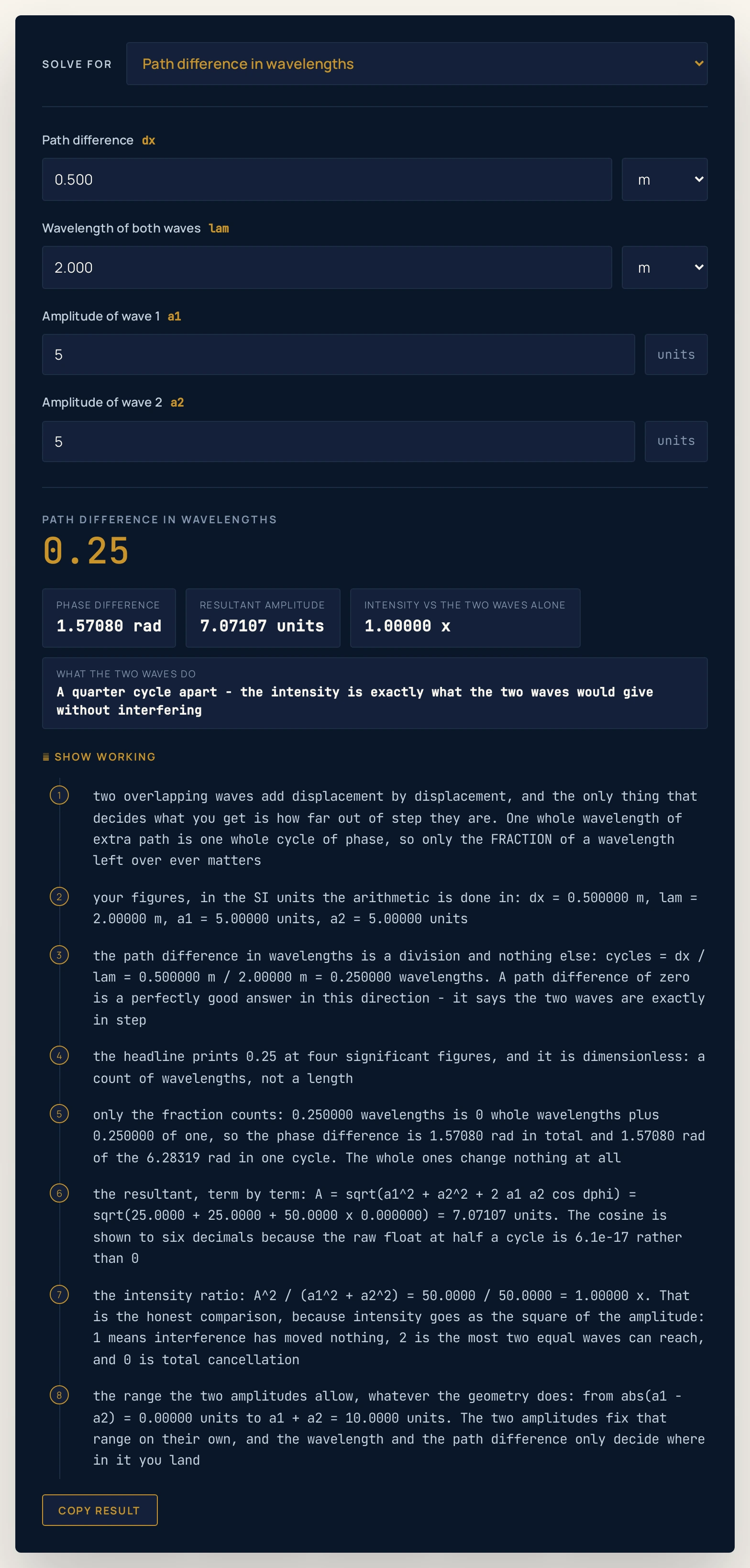
0.25 of a cycle. The chip to watch is the intensity: 1.00000 x says interference has given nothing and taken nothing, which is the one state on the page where that is exactly true.Worked example: change one thing at a time
The table starts at the defaults, moves the unknown through all three quantities, then changes only the path difference, only the wavelength and only an amplitude, walks both unit menus, runs the two back-solves worth doing, and finally reaches the entries the calculator declines. Rows 1 to 3 are one state solved three ways. Every answer and chip cell was read out of the running widget rather than worked out by hand, so where a cell and the tool ever part company, believe the tool.
| Step | Solving for | What you type | Headline answer | Phase difference | Resultant amplitude | Intensity vs the two waves alone |
|---|---|---|---|---|---|---|
| The page as it opens | Path difference in wavelengths | dx 0.500 m, lam 2.000 m, both amplitudes 5 | 0.25 | 1.57080 rad | 7.07107 units | 1.00000 x |
| The same state solved for the path difference | Path difference | 0.25 wavelengths of a 2.000 m wave | 0.5 m | 1.57080 rad | 7.07107 units | 1.00000 x |
| The same state solved for the wavelength | Wavelength of both waves | 0.25 wavelengths from a 0.500 m path | 2 m | 1.57080 rad | 7.07107 units | 1.00000 x |
| No path difference at all: exactly in step | Path difference in wavelengths | dx 0 instead of 0.500 m | 0 | 0.00000 rad | 10.0000 units | 2.00000 x |
| Half a wavelength: exactly out of step | Path difference in wavelengths | dx 1.000 m instead of 0.500 m | 0.5 | 3.14159 rad | 0.00000 units | 0.00000 x |
| The same half wavelength with one wave weaker | Path difference in wavelengths | a2 3 instead of 5 | 0.5 | 3.14159 rad | 2.00000 units | 0.117647 x |
| Three whole wavelengths further on | Path difference in wavelengths | dx 6.000 m instead of 0 | 3 | 18.8496 rad | 10.0000 units | 2.00000 x |
| A hundred wavelengths apart | Path difference in wavelengths | lam 0.100 m with dx 10.000 m | 100 | 628.319 rad | 10.0000 units | 2.00000 x |
| Three quarters of a cycle | Path difference in wavelengths | dx 1.500 m instead of 0.500 m | 0.75 | 4.71239 rad | 7.07107 units | 1.00000 x |
| Only the wavelength changed | Path difference in wavelengths | lam 4.000 m instead of 2.000 m | 0.125 | 0.785398 rad | 9.23880 units | 1.70711 x |
| A third of a cycle | Path difference in wavelengths | lam 3.000 m with dx 1.000 m | 0.3333 | 2.09440 rad | 5.00000 units | 0.500000 x |
| Unequal amplitudes, exactly in step | Path difference in wavelengths | a2 2 instead of 5, dx 0 | 0 | 0.00000 rad | 7.00000 units | 1.68966 x |
| One wave switched off | Path difference in wavelengths | a2 0 instead of 5 | 0.25 | 1.57080 rad | 5.00000 units | 1.00000 x |
| Both waves switched off | Path difference in wavelengths | a1 0 and a2 0 | 0.25 | 1.57080 rad | 0.00000 units | - |
| Both amplitudes doubled | Path difference in wavelengths | 10 and 10 instead of 5 and 5 | 0.25 | 1.57080 rad | 14.1421 units | 1.00000 x |
| What cancels two equal waves of 1.400 m | Path difference | 0.5 wavelengths at lam 1.400 m | 0.7 m | 3.14159 rad | 0.00000 units | 0.00000 x |
| The next cancellation of the same pair | Path difference | 1.5 wavelengths at lam 1.400 m | 2.1 m | 9.42478 rad | 0.00000 units | 0.00000 x |
| A first cancellation at 0.900 m: find the wavelength | Wavelength of both waves | 0.5 wavelengths from a 0.900 m path | 1.8 m | 3.14159 rad | 0.00000 units | 0.00000 x |
| The path difference typed in centimetres | Path difference in wavelengths | 50 cm instead of 0.500 m | 0.25 | 1.57080 rad | 7.07107 units | 1.00000 x |
| The path difference typed in millimetres | Path difference in wavelengths | 500 mm instead of 0.500 m | 0.25 | 1.57080 rad | 7.07107 units | 1.00000 x |
| The path difference typed in inches | Path difference in wavelengths | 19.6850393701 in instead of 0.500 m | 0.25 | 1.57080 rad | 7.07107 units | 1.00000 x |
| The wavelength typed in centimetres | Path difference in wavelengths | 200 cm instead of 2.000 m | 0.25 | 1.57080 rad | 7.07107 units | 1.00000 x |
| The same quarter cycle 2.5 million times smaller | Path difference in wavelengths | lam 800 nm with dx 0.0000002 m | 0.25 | 1.57080 rad | 7.07107 units | 1.00000 x |
| A zero wavelength is declined | Path difference in wavelengths | lam 0 | no answer | - | - | - |
| A negative wavelength is declined | Path difference in wavelengths | lam -2.000 m | no answer | - | - | - |
| A negative path difference is declined | Path difference in wavelengths | dx -0.500 m | no answer | - | - | - |
| An entry that parses to infinity is declined | Path difference in wavelengths | lam 1e400 | no answer | - | - | - |
| A negative amplitude is declined in every mode | Path difference in wavelengths | a2 -5 | no answer | - | - | - |
| A zero path difference is declined in the wavelength mode | Wavelength of both waves | dx 0 with 0.25 wavelengths | no answer | - | - | - |
| A zero count of wavelengths is declined in the wavelength mode | Wavelength of both waves | 0 wavelengths with dx 0.500 m | no answer | - | - | - |
| A negative count of wavelengths is declined | Path difference | -0.25 wavelengths | no answer | - | - | - |
Rows 1 to 3 are one pair of waves with the Solve for menu in each of its three positions, and all four chips are identical down all three because the chips describe the state rather than the mode. That is not free: they are worked out from the answer substituted back into the state, so the mode in which the wavelength is the unknown still has a wavelength to divide by. The residual is exactly zero in all three directions, because no rounding enters this relation anywhere — which is the whole reason the first box counts wavelengths rather than radians.
Rows 4 to 6 are the two conditions and the honest version of the second. No extra path gives 10.0000 units and 2.00000 x; half a wavelength gives 0.00000 units and 0.00000 x; and the same half wavelength with the second wave at 3 instead of 5 leaves 2.00000 units behind, which is the difference between the two amplitudes rather than nothing. Out of step and nothing left are not the same claim, and only equal amplitudes make them agree.
Rows 7 and 8 are the point of the whole page. Three whole wavelengths and a hundred whole wavelengths give the same 10.0000 units and the same 2.00000 x as no path difference at all, byte for byte, while the phase chip climbs from 0.00000 rad to 18.8496 rad to 628.319 rad. The phase chip is the only one of the four that can tell those three states apart.
Rows 9 to 11 walk round the cycle. Three quarters of a cycle returns the identical 7.07107 units and 1.00000 x as a quarter of one, because the cosine does not care which side of the half you are on. An eighth of a cycle sits above that at 9.23880 units and 1.70711 x, and a third of one below it at 5.00000 units and 0.500000 x.
Rows 12 to 15 move the amplitudes alone. Unequal and in step gives exactly 7.00000 units, the two simply added, while one wave switched off leaves 5.00000 units and a verdict of its own — and through both the phase chip holds at 1.57080 rad, because the amplitudes never touch the geometry. Both switched off is the one row where a chip prints a hyphen: a1^2 + a2^2 is zero, so the ratio is undefined rather than a NaN.
Row 15 is the scale test. Doubling both amplitudes doubles the resultant to 14.1421 units and leaves 1.00000 x exactly where it was, which is what makes the bare word units an honest label on the two amplitude boxes.
Rows 16 to 18 are the two back-solves. Two equal waves of 1.400 m cancel at a path difference of 0.7 m, and again every 1.400 m after that — row 17 takes the next one at 2.1 m, where the phase has reached 9.42478 rad and the resultant is still 0.00000 units. Row 18 turns a measurement round: if 0.900 m of extra path is the first cancellation, the wavelength behind it is 1.8 m.
Rows 19 to 23 change nothing but the units, and every one returns the same strings: one path difference reads 0.500 m, 50 cm, 500 mm or 19.6850393701 in, and one wavelength reads 2.000 m or 200 cm. Row 23 is the best of them: an 800 nm wavelength with a path difference of 0.0000002 m — 200 nm, typed in metres because the nanometre is on the wavelength menu only — is a quarter cycle apart just as surely as the metre-scale default. Every chip there is byte for byte identical to the default row, because the geometry only ever cared about the ratio.
Rows 24 to 31 sit outside the domain and are declined there rather than answered. A zero or negative wavelength has no cycle behind it; a negative path difference and a negative count of wavelengths would hand back negative lengths; a negative amplitude is not a wave; and an entry that parses to infinity is refused rather than published, because Infinity > 0 is true and a sign test alone would let it through.
Row 29 is the one worth reading twice. A zero path difference is perfectly legal when you are solving for the count of wavelengths — row 4 answers it with 0 and the in-step verdict — and illegal when you are solving for the wavelength, where it would divide out to a zero wavelength. The same entry is answered in one direction and declined in the other.
The no answer rows are what the widget actually does with those entries: the result area prints That combination has no valid solution. Check your inputs.
No chips are drawn beside that message, which is why the last four columns of those rows are hyphens rather than figures. It is a refusal rather than a crash, and nothing on this page ever returns a NaN or an infinity.
| What the verdict chip prints | When it appears | Resultant amplitude there |
|---|---|---|
| Both amplitudes are zero - there is no wave here at all | Both amplitude boxes set to 0, at any geometry | 0.00000 units, and the intensity chip prints a hyphen |
| Only one wave is present - there is nothing for it to interfere with | One amplitude box set to 0: a2 0 with a1 5 | 5.00000 units, the surviving wave untouched |
| Exactly in step - fully constructive, so the two amplitudes simply add | A whole number of wavelengths: 0, 3 or 100 of them | 10.0000 units for two waves of 5 |
| Exactly out of step - fully destructive, so the resultant is the difference of the amplitudes | Half a wavelength past a whole one: 0.5 or 1.5 | 0.00000 units for equal waves, 2.00000 units at a2 3 |
| A quarter cycle apart - the intensity is exactly what the two waves would give without interfering | A quarter or three quarters of a cycle: 0.25 or 0.75 | 7.07107 units, and the intensity chip reads 1.00000 x |
| Partly in step - the waves reinforce, but not completely | Nearer a whole wavelength than a half: 0.125 of a cycle | 9.23880 units, above the 7.07107 of a quarter cycle |
| Partly out of step - the waves cancel, but not completely | Nearer a half wavelength than a whole one: 0.333333 | 5.00000 units, below the 7.07107 of a quarter cycle |
Those seven phrases are the whole vocabulary of the fourth chip, and the order of the tests matters. The two amplitude cases are checked before the geometry, so the one wave switched off state is never reported as a quarter cycle apart even though its path difference is exactly that. Note also that there is no "they cancel completely" phrase: the destructive string says the resultant is the difference of the amplitudes, which is true whether that difference is zero or not.
Formula and symbol reference
One division does all the work here. The path difference in wavelengths is cycles = dx / lam, and because one whole wavelength of extra path is one whole cycle of phase, the total phase difference is dphi = 2 pi x cycles. Rearranged the other two ways that is dx = cycles x lam and lam = dx / cycles, and those are the three positions of the Solve for menu.
The resultant follows from the phase and the two amplitudes: A = sqrt(a1^2 + a2^2 + 2 a1 a2 cos dphi), worked out from the phase reduced into a single cycle. In step that collapses to a1 + a2; out of step it collapses to the difference between a1 and a2, which is zero only when the two are equal. Those are the two conditions, dx = n lam and dx = (n + 1/2) lam, and the page prints both halves rather than only the reinforcing one.
The wavelength is a property of the wave in its medium and this page never derives it — the wave speed calculator is the tool that relates a wavelength to a speed and a frequency, and the guide to wave speed in different media is what sets that speed in the first place. For a reader who arrives holding a frequency rather than a wavelength, the wavelength formula and units guide is the conversion. Interference needs no speed and no frequency at all, which is why neither has a box here.
The intensity figure is a ratio, and that is deliberate. It is A^2 / (a1^2 + a2^2): the resultant intensity against what the same two waves would give with no interference at all. Intensity goes as the square of the amplitude, which is the one reason the ratio is the honest comparison and is the whole of what this page says about it — the amplitude guide is where a wave amplitude and the intensity that follows from it belong, and averaged over one whole wavelength of path difference this ratio is exactly 1: interference moves energy about, it does not make any.
| Symbol | Meaning | SI unit | Values used on this page |
|---|---|---|---|
| cycles | The path difference measured in wavelengths, which is the one number that decides everything. Dimensionless, and the quantity the page opens solving for | dimensionless | No unit menu: 0.25 is the default. 0 is in step, 0.5 is out of step, and 3 behaves exactly like 0. |
| dx | The extra distance one wave travels before the two overlap — not the distance between the two sources, and not a distance along a screen | metre | Boxes take m, cm, mm or in: 0.500 m is the default, which is 50 cm, 500 mm and 19.6850 in. |
| lam | The wavelength, which is the SAME for both waves. That is an assumption about the situation rather than a law: two different wavelengths give no steady pattern at all | metre | Boxes take m, cm, mm or nm: 2.000 m is the default, which is 200 cm, 2000 mm and 2.000e+9 nm. |
| a1 | The amplitude of the first wave, in whatever unit the wave displaces. An input in every mode and never one of the three solve targets | arbitrary — the unit of the displacement | No unit menu beyond the word units: 5 is the default, and the table runs it from 0 to 10. |
| a2 | The amplitude of the second wave, in the same unit as the first. Only the RATIO of the two changes anything: double both and the intensity chip does not move | arbitrary — the unit of the displacement | No unit menu beyond the word units: 5 is the default, with 3, 2 and 0 in the table rows. |
| dphi | The total phase difference in radians, 2 pi times the count of wavelengths. A chip rather than a box, because the page solves in wavelengths and pi is irrational | radian | A chip: 1.57080 rad at the defaults, 3.14159 rad out of step, 18.8496 rad three wavelengths on. |
| A | The resultant amplitude, in the same unit as the two it is built from. It can never leave the band from the difference between a1 and a2 up to their sum | arbitrary — the unit of the displacement | A chip: 7.07107 units at the defaults, 10.0000 units in step, 0.00000 units out of step. |
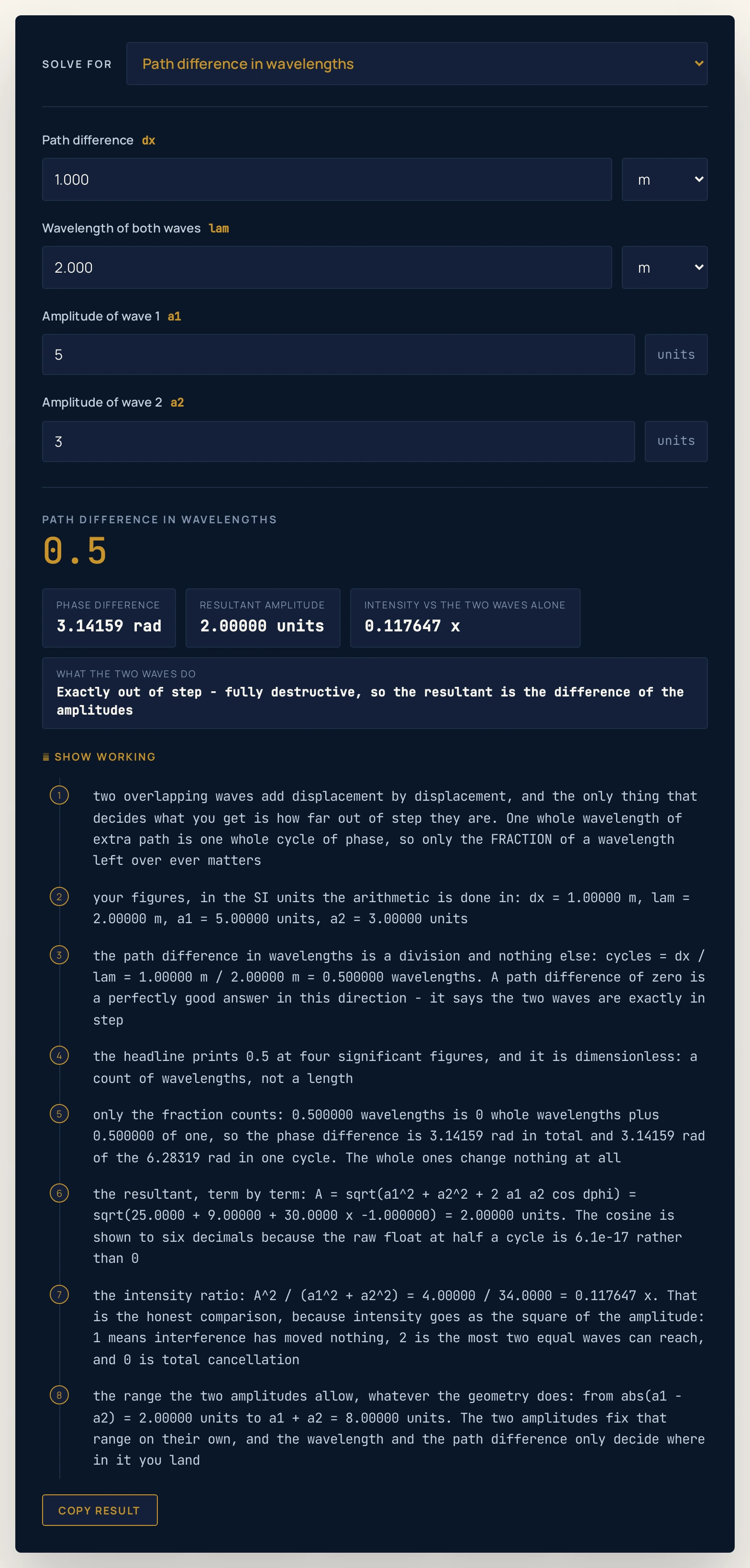
2.00000 units — the difference between the two, not nothing — and an intensity of 0.117647 x. Only equal amplitudes cancel completely.The physics: what the five boxes actually decide
Two waves on the same line add displacement by displacement, so at any instant the combined displacement is just the sum of the two. Shift one of them along by a distance dx and every point of it arrives a fraction of a cycle later; that fraction, and nothing else, decides whether the two reinforce or fight each other. The page is built around the observation that the fraction is all that survives.
The five boxes split cleanly into two jobs, and the chips are arranged so you can watch the split. The two amplitude boxes set how big the answer is allowed to be — from the difference between them up to their sum — and never touch the phase or the count of wavelengths at all. The wavelength and the path difference decide where inside that band you land, and never move the band.
Load out of step, but one wave is weaker straight after exactly out of step to see that split happen. The phase chip holds at 3.14159 rad while the resultant goes from 0.00000 to 2.00000 units, which is one control moving one half of the answer and nothing else.
Whole wavelengths are the other half of the lesson, and the phase chip is the only place they show. Press exactly in step and then three whole wavelengths further on: the resultant, the intensity and the verdict are byte for byte the same, while the phase climbs from 0.00000 rad to 18.8496 rad. That is why the chip prints the total phase rather than the phase within one cycle — drop the whole cycles and no chip on the page could separate those two states at all.
One clause for each of the two neighbours this page deliberately stops short of. Two waves running in opposite directions along the same line give a standing wave, which is a pattern that does not travel and is a subject of its own. And the same adding-up, seen at an angle through a pair of slits, is what the diffraction guide calls diffraction — the diffraction grating calculator solves that angular condition, and no angle, slit or fringe spacing is derived anywhere here.
Where the interference of waves calculator breaks down
The arithmetic here is exact to the last digit a double can hold. What still goes wrong is physical: a phase relationship the boxes assume and two real sources will not hold, a wavelength box that has to be true of both waves, and a question about energy put to a relation that only sorts geometry.
- Nothing you can type tells the page whether the two sources are coherent
- Every answer here assumes the two waves hold a fixed phase relationship for as long as you care about, and that is the assumption most likely to be false. Two independent sources drift against each other, the fraction of a cycle wanders, and the pattern washes out into nothing in particular — the chips keep printing a steady verdict regardless, because they only ever see the numbers in the boxes. This is the single biggest caveat on the page and there is no box for it.
- A hundred wavelengths of path is arithmetic the boxes will do and a real source will not sustain
- Row 8 of the table is reachable and arithmetically correct: a hundred whole wavelengths of extra path returns the same
10.0000 unitsas none at all. For that to be true of anything real, the source has to hold its phase over the whole of that distance, and a real one loses it long before. Treat that row as a test of the arithmetic rather than as a description of an experiment. - One wavelength box serves both waves, and two different wavelengths are a different calculation
- If the two waves do not share a wavelength there is no steady pattern to report at all: what you get instead is a slow swelling and fading in time rather than a fixed verdict in space, and it is governed by the difference between the two frequencies rather than by anything in these boxes. This page has no second wavelength box and will not acquire one, because that is a different relation.
- The two displacements only add while the medium stays linear
- Adding the displacements is itself a model assumption. A real medium responds linearly over some range and not beyond it, so a very large amplitude in a real string, membrane or column does not simply superpose. The page will happily add 10 units to 10 units; whether the thing being displaced would is a question about the material, not about this relation.
- Both waves are assumed to run along the same line, with the same polarisation
- There is no angle box here and there will not be one. Two waves crossing at an angle give a two-dimensional pattern, which is the subject of the wave-particle duality guide and of the diffraction guide rather than of this page, and the diffraction grating lab is where that geometry is drawn. Everything here is one line, two waves and one shift along it.
- The 2.00000 x is borrowed, not created
- Reading
2.00000 xand stopping there would be dishonest. The extra intensity where two waves reinforce is paid for by the0.00000 xhalf a wavelength away, and over one whole wavelength of path difference the average ratio is exactly 1. Interference redistributes intensity; it never adds any. The quarter-cycle default is the cleanest view of that:1.00000 x, nothing gained and nothing lost. - The amplitude unit is whatever you put in, and only the ratio matters
- The boxes say units rather than millimetres or pascals on purpose, because the relation does not know what is being displaced. Multiply both amplitudes by any factor and the resultant and the band scale by exactly that factor while the intensity chip and the verdict do not move at all. That is also why a resultant of
7.07107 unitsis only meaningful next to the two amplitudes it came from. - The cosine is printed to six decimals rather than to six significant figures
- At half a cycle the cosine of the half-angle is 6.1e-17 in floating point rather than 0, and printing it raw would put a 23-character number on the page. Every displayed cosine here is rounded to six decimals first, and every threshold in the verdict is tested on that printed figure rather than on the raw float. A negative zero is stripped too, because
cos(3 pi / 2)is a small negative number and a readout of-0.000000would be nonsense. - A hyphen in the intensity chip is an answer, not a fault
- With both amplitudes set to zero there is no intensity to compare anything with:
a1^2 + a2^2is zero, so the ratio is genuinely undefined and the chip prints a hyphen rather than a NaN. The geometry chips still read normally in that state, because the path difference and the wavelength do not depend on the amplitudes at all. - Eight entries are declined in words rather than answered
- A zero wavelength, a negative wavelength, a negative path difference, a negative count of wavelengths, a negative amplitude, and — in the wavelength mode only — a zero path difference or a zero count of wavelengths. Each would produce an infinity, a negative length or a zero wavelength, so the page says so instead. The eighth is anything that parses to infinity, which needs testing explicitly:
Infinity > 0is true, so a sign test on its own would publish it. - The calculator measures nothing — you supply the numbers
- Two quantities go in, one division is rearranged, and the answer describes the pair of waves you described. The preset names are shorthand for the five figures behind them and are not claims about any particular experiment, instrument or installation.
Where the interference of waves calculator is actually used
- Working out the extra path that will cancel two sources
- Point Solve for at the path difference and the question inverts: a fraction of a cycle you want and the wavelength you have return the distance that produces it. Two equal waves of 1.400 m cancel at
0.7 mof extra path, and again at2.1 m, and at every 1.400 m after that. The repeat is the useful part — there is never only one answer. - Getting a wavelength out of a cancellation you can measure
- Point Solve for at the wavelength and a measured path difference becomes a wavelength. If 0.900 m of extra path is the first place a pair cancels, the wavelength is
1.8 m. Get the order wrong in that measurement — use the second cancellation as though it were the first — and the answer is wrong by exactly the factor you misread, which is the one real trap in this direction. - Noise cancelling, which inverts the phase instead of adding path
- Adding half a wavelength of path is one way to put two waves out of step; electronically inverting one of them is another, and it reaches the same place without any geometry. Load exactly out of step for the ideal case and then drop one amplitude to see what imperfect matching costs: at 5 against 3 the residue is
2.00000 units, which is why the useful figure is the amplitude ratio rather than either amplitude alone. - Quarter-wave layers, where a round trip doubles the path
- A layer a quarter of a wavelength thick gives a wave that crosses it and comes back half a wavelength of extra path, because the round trip counts twice. That is row 5 of the table:
0.5of a cycle,0.00000 unitsfor equal amplitudes. The reason real coatings do not cancel perfectly is the reason row 6 exists — the two reflected amplitudes are not equal, and the resultant is their difference. - Checking two sources are driven in step rather than inverted
- Swapping the connections on one of a pair of loudspeakers inverts its displacement, which is exactly half a cycle, and the pair that should have been adding is now subtracting. With matched sources the verdict chip goes from exactly in step at
10.0000 unitsto exactly out of step at0.00000 units: everything gone rather than merely quieter, since what the pair forfeits is the doubling of one source's own5.00000 units. That is a wiring fault worth catching before anyone else hears it. - Deciding whether the resultant chip or the intensity chip answers your question
- The resultant is in whatever unit you typed, so it is the right figure when you are comparing against a displacement you can measure. The intensity ratio is dimensionless and scale-free, so it is the right figure when you want to know what interference actually did:
1.00000 xmeans nothing moved,2.00000 xis the ceiling for two equal waves, and0.117647 xsays most of it has gone somewhere else. - Sizing the next quantity on a neighbouring tool
- This page takes the wavelength as given, so the usual next step is somewhere else. The wave speed calculator turns a frequency into that wavelength or back again, and the de Broglie wavelength calculator is the one for a particle rather than a sound or a ripple. Neither adds two waves together, which is the one thing this page does.
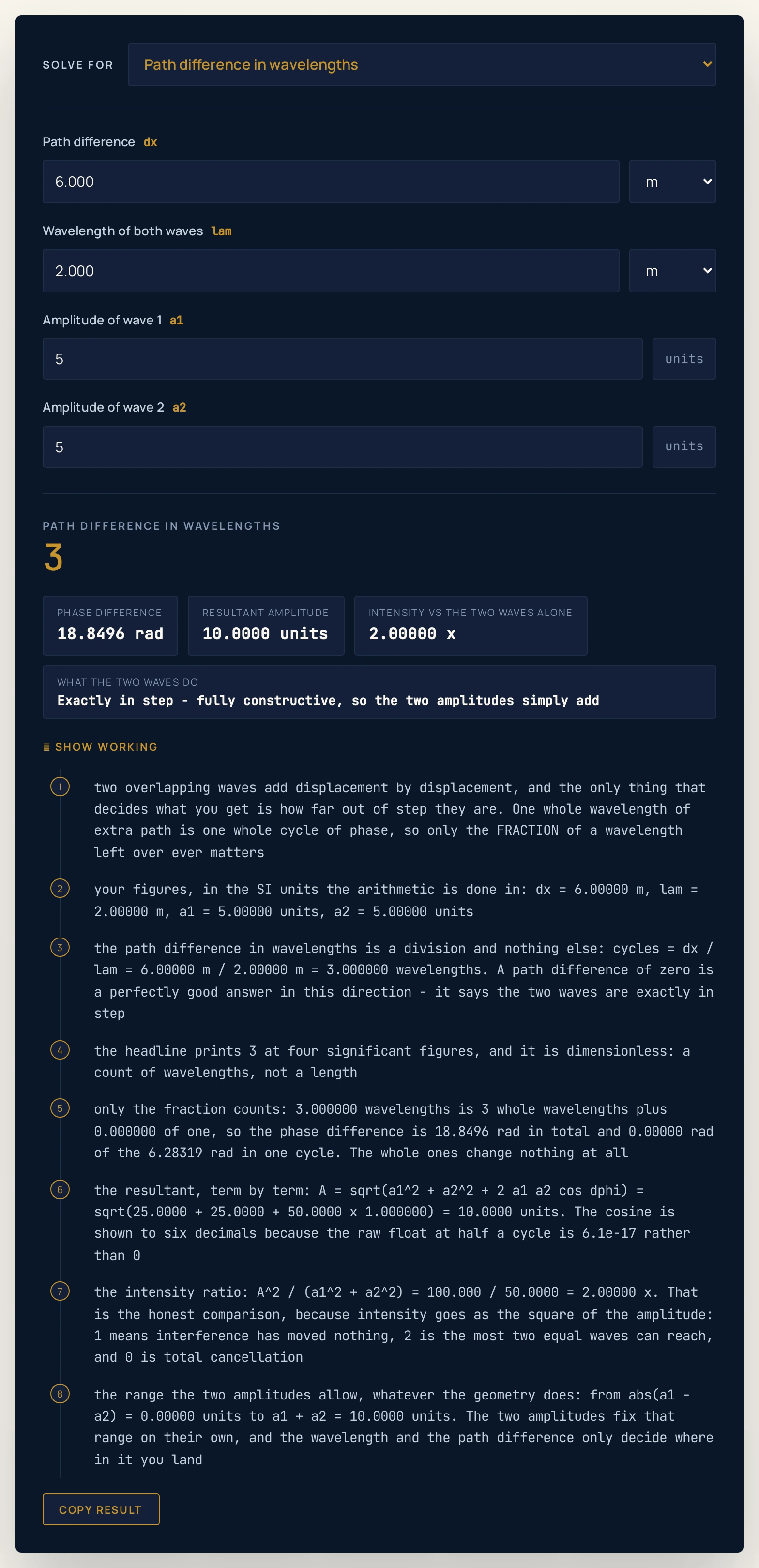
10.0000 units and 2.00000 x as none at all. Only the phase chip notices, at 18.8496 rad instead of 0.00000 rad — which is exactly why the chip prints the total phase rather than the fraction.Where to go next
For what the interference of waves is, the two conditions in full, the worked problems, beats and the misconceptions, read the interference of waves guide, which this tool is the arithmetic half of. The diffraction guide is the same adding-up seen at an angle through slits, the guide to wave speed in different media is what sets the wavelength this page takes as given, and the amplitude guide is where the height of a single wave belongs.
Four more posts pick up what this page deliberately leaves out. The wavelength formula and units guide is the wavelength on its own, the frequency formula guide is the period-to-frequency conversion a reader arriving at beats will want, the transverse and longitudinal waves guide is what is actually doing the displacing, and the guide to how sound waves travel is the everyday case of two overlapping waves. The wave-particle duality guide is the double slit, and what it does to single electrons.
Four tools sit next to this one. The diffraction grating calculator solves the angular condition for slits; the wave speed calculator relates a speed, a frequency and a wavelength; the de Broglie wavelength calculator is the matter-wave case; and the decibel calculator answers how loud rather than how far out of step.
The travelling wave lab is one wave on its own, with nothing to add to. The transverse and longitudinal lab shows the two particle motions, and the lab for a wave crossing into a new medium is where a wavelength changes. The diffraction grating lab and the double-slit lab are the same adding-up drawn as an angular pattern through slits, which is honestly a different geometry from this one.
The full physics lab library and calculator index are open too.
Frequently asked questions
What does the interference of waves calculator work out?
It solves one relation, cycles = dx / lam, for any one of three quantities: the path difference in wavelengths, the path difference in metres, or the wavelength shared by both waves. Beside the answer it prints the total phase difference in radians, the resultant amplitude, the intensity against what the two waves would give without interfering, and a plain-English verdict on what the pair is doing.
Why does it solve in wavelengths rather than in radians?
Because pi is irrational and a radians box would force a rounded default. A default of 1.5708 rad back-solves the path difference to 0.50000117 m rather than 0.500 m, so the page would contradict itself the moment you changed the Solve for menu. In wavelengths all three back-solves are exact to the last bit a double can hold, and the phase in radians is printed as a chip instead.
What is a phase difference?
It is how far through its cycle one wave is compared with the other, measured in radians, with a full cycle being 2 pi. One whole wavelength of extra path is one whole cycle, which is why the phase chip is simply 2 pi times the count of wavelengths. The useful consequence is that only the fraction of a wavelength left over ever changes the answer.
Why does a path difference of a whole wavelength do nothing?
Because a whole wavelength of extra path puts a wave back exactly where it started in its cycle. At 0, 3 and 100 whole wavelengths the resultant amplitude reads 10.0000 units and the intensity 2.00000 x, byte for byte identical, while the phase chip reads 0.00000 rad, 18.8496 rad and 628.319 rad. The phase chip is the only one that can tell the three apart.
Why is the resultant 2.00000 units and not zero when the waves are exactly out of step?
Because the two amplitudes were not equal. Out of step, the resultant is the difference between the two amplitudes, so 5 units against 3 units leaves 2.00000 units behind. Only equal amplitudes cancel completely, and the verdict chip says "the resultant is the difference of the amplitudes" rather than claiming total cancellation.
Does destructive interference destroy energy?
No, it moves it. The 2.00000 x the intensity chip shows where the waves reinforce is borrowed from the 0.00000 x half a wavelength away, and averaged over one full cycle of path difference the ratio is exactly 1. That is also why the quarter-cycle default reads 1.00000 x: at a quarter of a cycle interference has given nothing and taken nothing.
Why will it not give me a wavelength when the path difference is zero?
Because a zero path difference divided by a count of wavelengths is a zero wavelength, which is not a wave. The page declines it rather than printing a zero or an infinity, and it declines a zero count of wavelengths in the same direction for the same reason. A zero path difference is perfectly legal in the other direction, where it simply means the two waves are exactly in step.
What unit are the amplitudes in?
Whatever you put in. A wave amplitude is measured in whatever the wave displaces, so millimetres for a string and pascals for sound, and the resultant comes out in the same unit as the two you typed. Only the ratio of the two amplitudes changes anything: double both and the resultant doubles while the intensity chip and the verdict do not move at all.
Does this calculator work out the frequency, the wave speed or the loudness?
No, and all three omissions are deliberate. Interference is settled by the path difference and the wavelength alone, so the wave speed never enters and there is no box for it; the frequency and the period belong to other pages; and nothing here prints an energy or a decibel figure. What it prints instead is the intensity ratio, which is the comparison that stays honest whatever unit the amplitudes are in.
Why does the verdict chip test the printed figure rather than the number?
Because a whole number of wavelengths is often inexact in floating point. A 0.100 m wavelength with a 0.300 m path difference gives a ratio of 2.9999999999999996, and a verdict that tested the raw float would call that pair partly in step, reinforcing but not completely, when they are exactly in step. Rounding to six decimals first fixes 2,073 such states, which were counted rather than estimated.
References & formula source
- The relation this page solves is the definition of a path difference measured in wavelengths: cycles = dx / lam, and one whole wavelength of extra path is one whole cycle of phase, so the total phase difference is 2 pi times that count. It is stated here rather than derived, and it assumes both waves share the one wavelength the box takes.
- The resultant amplitude printed beside the answer is the general two-wave superposition, A = sqrt(a1^2 + a2^2 + 2 a1 a2 cos dphi), evaluated through the phase REDUCED into one cycle. For equal amplitudes that is the same number as abs(2a cos(dphi/2)), and the two forms were checked against each other over 246 states with a worst disagreement of 4e-15. The reduced-phase route is the only one used, so there is no second code path to disagree with it.
- The in-step and out-of-step conditions are dx = n lam and dx = (n + 1/2) lam. Out of step the resultant falls to the difference between the two amplitudes rather than to zero, and it reaches zero only when the two amplitudes are equal; that distinction is stated on this page rather than assumed, because it is the half of the pair that is most often left out.
- The intensity figure is a RATIO and never an energy or a loudness: it is A^2 divided by a1^2 + a2^2, which is the resultant intensity against what the two waves would give with no interference at all. Intensity goes as the square of the amplitude, which is named once here as the reason the ratio is the honest comparison and is not built on anywhere. Averaged over one whole wavelength of path difference the ratio is exactly 1, which was checked over 720 path differences for every amplitude pair tested.
- No wave speed, frequency, period, energy, loudness, angle, slit spacing or fringe spacing is computed anywhere on this page, and none of those is an oversight. Interference is settled by the path difference and the wavelength alone. The angular geometry of two slits is a different relation on a different page, and so is the resultant of a travelling wave crossing into a new medium.
- The model assumes two coherent sources holding a fixed phase relationship, both waves running along the same line with the same polarisation, the same wavelength for both, and a medium that responds linearly. Those four are assumptions about the situation rather than measurements of one, and this page states them instead of quoting figures for them. Verify anything you mean to rely on.
- Every figure quoted in the prose and the tables above is either a string this calculator printed for the inputs named beside it, or a ratio checked against an independent reference written before this page existed and sharing no code with it, which runs 3,666 checks with 0 failures. Where a cell and the running widget ever part company, believe the widget.
- Further reading: Wave interference — Wikipedia