Wave speed is how fast a wave carries its energy through a medium, and it is set almost entirely by that medium rather than by whatever produced the wave. Sound travels at 343 m/s in air but about 5,960 m/s in steel, while light falls from 299,792,458 m/s in a vacuum to roughly 124 million m/s inside diamond.
Watch a firework burst and you see it instantly, then wait — one, two, three — before the bang arrives. Both signals left the same point at the same moment. Only one of them was in a hurry.
That gap is wave speed. Over a kilometre the light took about three microseconds; the sound needed nearly three seconds, because it had to shove air molecules along the way. Swap the material and both numbers change — and, strangely, they move in opposite directions.
What Is Wave Speed?
Wave speed is the distance a wave crest travels each second through a medium, measured in metres per second (m/s). It describes how fast the disturbance moves, not how fast the material itself moves.
That distinction trips up more students than any other part of the topic. When sound crosses a room at 343 m/s, no air molecule makes that journey — each one jiggles back and forth by a fraction of a millimetre and passes the disturbance to its neighbour.
Think of a stadium Mexican wave. The wave sweeps around the ground in seconds; every spectator simply stands up and sits down on the spot.
So wave speed is a property of the medium, in the same way that density or stiffness is. Change the medium and you change the speed. Keep the medium fixed and the speed is essentially locked, no matter how the wave was made.
Wave Speed in Different Media: The Reference Table
Wave speed ranges from around 100 m/s on a slack guitar string to 299,792,458 m/s for light in a vacuum — a span of more than six orders of magnitude. The table below collects the values you are most likely to need, with the conditions that define them.
| Medium | Wave | Wave speed (m/s) | Conditions & notes |
|---|---|---|---|
| Guitar low-E string | Transverse | about 107 | Tension 68 N, mass per metre 6.0 g/m |
| Carbon dioxide | Sound | 268 | 20 °C; heavy molecules, so slower than air |
| Air | Sound | 331 | 0 °C, dry — the freezing-point value |
| Air | Sound | 343 | 20 °C, dry — the standard exam value |
| Helium | Sound | 1,007 | 20 °C; about 2.9 times faster than air |
| Fresh water | Sound | 1,482 | 20 °C; roughly 4.3 times the speed in air |
| Seawater | Sound | about 1,500 | Varies with depth, salinity and temperature |
| Soft body tissue | Ultrasound | about 1,540 | The value clinical scanners assume |
| Pyrex glass | Sound | about 5,640 | Bulk longitudinal wave |
| Steel | Sound | about 5,960 | Bulk longitudinal; about 5,050 in a thin rod |
| Aluminium | Sound | about 6,420 | Bulk longitudinal wave |
| Diamond | Light | 1.24 × 10⁸ | Refractive index n = 2.42 |
| Crown glass | Light | 1.97 × 10⁸ | n = 1.52 (varies with colour) |
| Water | Light | 2.25 × 10⁸ | n = 1.333 |
| Air | Light | 2.997 × 10⁸ | n = 1.0003; only 90 km/s below vacuum speed |
| Vacuum | Light | 299,792,458 | Exact by definition of the metre |
Two patterns jump out of that table. Sound gets dramatically faster as you move from gas to liquid to solid, while light gets steadily slower as the material gets denser.
The same word — denser — pushes the two families in opposite directions. Working out why is the whole point of the next two sections.

Wave speed across common media. Note the two rows use different scales — on a single axis, the light bars would be around 50,000 times longer than the steel bar.
The Wave Speed Formulas
Three equations cover almost every wave-speed problem you will meet. The first is universal; the other two tell you what the medium actually contributes.
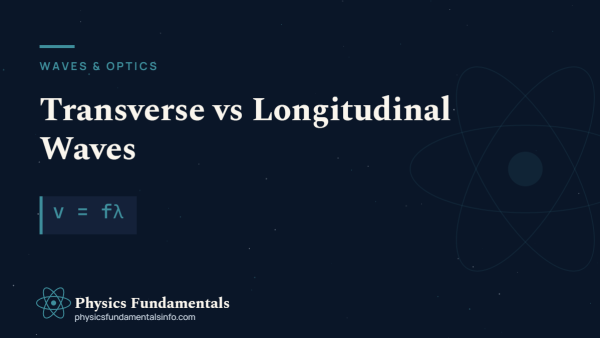
Start with the relationship every wave obeys, whatever it is made of:
- v — wave speed, in metres per second (m/s)
- f — frequency, in hertz (Hz)
- λ — wavelength, in metres (m)
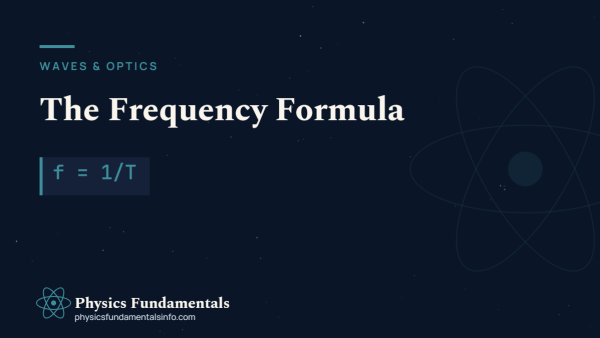
Read this the right way round and it stops being misleading. The medium fixes v, the source fixes f, and λ is whatever those two force it to be. If you need a refresher on the frequency side of that equation, our guide to the frequency formula works through f = 1/T and its variations.
For light, the medium’s effect is bundled into a single number, the refractive index:
- v — speed of light in the medium (m/s)
- c — speed of light in a vacuum, exactly 299,792,458 m/s (defined by NIST as one of the seven constants that fix the SI)
- n — refractive index of the medium, a pure number with no units, never less than 1
And for a wave running along a stretched string or wire:
- v — wave speed along the string (m/s)
- T — tension in the string, in newtons (N)
- μ — mass per unit length, in kilograms per metre (kg/m)
Notice that neither v = c/n nor v = sqrt(T/μ) contains a frequency term. That is not an accident — it is the clearest possible statement that the medium, not the source, is in charge. You can check any of these numbers against our Wave Speed Calculator, which rearranges v = f λ for whichever quantity you are missing.
What Determines Wave Speed? Stiffness Versus Inertia
Wave speed in a mechanical medium is set by two competing properties: how hard the material springs back when you disturb it (stiffness) and how much mass has to be dragged along (inertia). Every mechanical wave speed is the square root of the first divided by the second.
| Wave | Formula | The “springiness” | The “sluggishness” |
|---|---|---|---|
| Sound in a gas | v = sqrt(γRT / M) | Temperature T and the ratio γ | Molar mass M (kg/mol) |
| Sound in a liquid | v = sqrt(K / ρ) | Bulk modulus K (Pa) | Density ρ (kg/m3) |
| Sound in a thin solid rod | v = sqrt(E / ρ) | Young’s modulus E (Pa) | Density ρ (kg/m3) |
| Wave on a string | v = sqrt(T / μ) | Tension T (N) | Mass per length μ (kg/m) |
Now the water-versus-air puzzle solves itself. Water is about 830 times denser than air, which should make it far slower — but water is roughly 15,000 times stiffer, and stiffness wins because both sit under the same square root.
Run the numbers as a sanity check. Water’s bulk modulus is about 2.2 GPa and its density about 998 kg/m3, so v = sqrt(2.2 × 10⁹ ÷ 998) = 1,485 m/s — within 0.2% of the measured 1,482 m/s.
The same logic explains helium. A helium atom is seven times lighter than an average air molecule, so there is far less inertia to move, and sound races through at roughly 1,007 m/s. NASA’s Glenn Research Center sets out the full gas derivation if you want the algebra.
Solids complicate things pleasantly: they resist both squeezing and shearing, so they carry two sound speeds at once. That is why a single “speed of sound in steel” figure always needs a footnote — and why transverse and longitudinal waves travel at different speeds through the same block of metal.
Light refuses to play this game. It needs no medium at all, and inside matter it slows because the oscillating field keeps being absorbed and re-radiated by bound electrons — a delay, not a drag. So for light the rule inverts: more electrons packed more tightly means a higher refractive index and a lower speed.
Wave Speed on a String: v = sqrt(T / mu)
The speed of a wave on a string depends only on how tightly it is stretched and how heavy it is per metre — never on how hard you pluck it or how fast you shake it. Tighten the string and the wave speeds up; use a thicker string and it slows down.
Both effects live under a square root, and that square root is where marks get lost. Doubling the tension in the string does not double the speed — it multiplies it by sqrt(2), about 1.41.
To genuinely double the wave speed you must quadruple the tension.
You can hear this on any guitar. The six strings share almost the same length and similar tensions, so the low, thick strings sound low mainly because their larger μ drags the wave speed down.
In practice, a wound low-E string with μ of about 6.0 g/m under about 68 N of tension carries waves at roughly 107 m/s. Fret it halfway and you halve the wavelength; the speed is unchanged, so the frequency doubles and you hear the octave.
What Changes When a Wave Crosses into a New Medium?
When a wave passes into a new medium its frequency stays exactly the same, its speed changes to whatever the new medium dictates, and its wavelength changes by the same factor as the speed. Frequency is set at the source and cannot be altered by the material.
The reasoning is almost embarrassingly simple. Crests arrive at the boundary 256 times a second, so crests must leave it 256 times a second — otherwise they would pile up at the interface.
Since v = f λ and f is pinned, any change in v forces an identical change in λ.
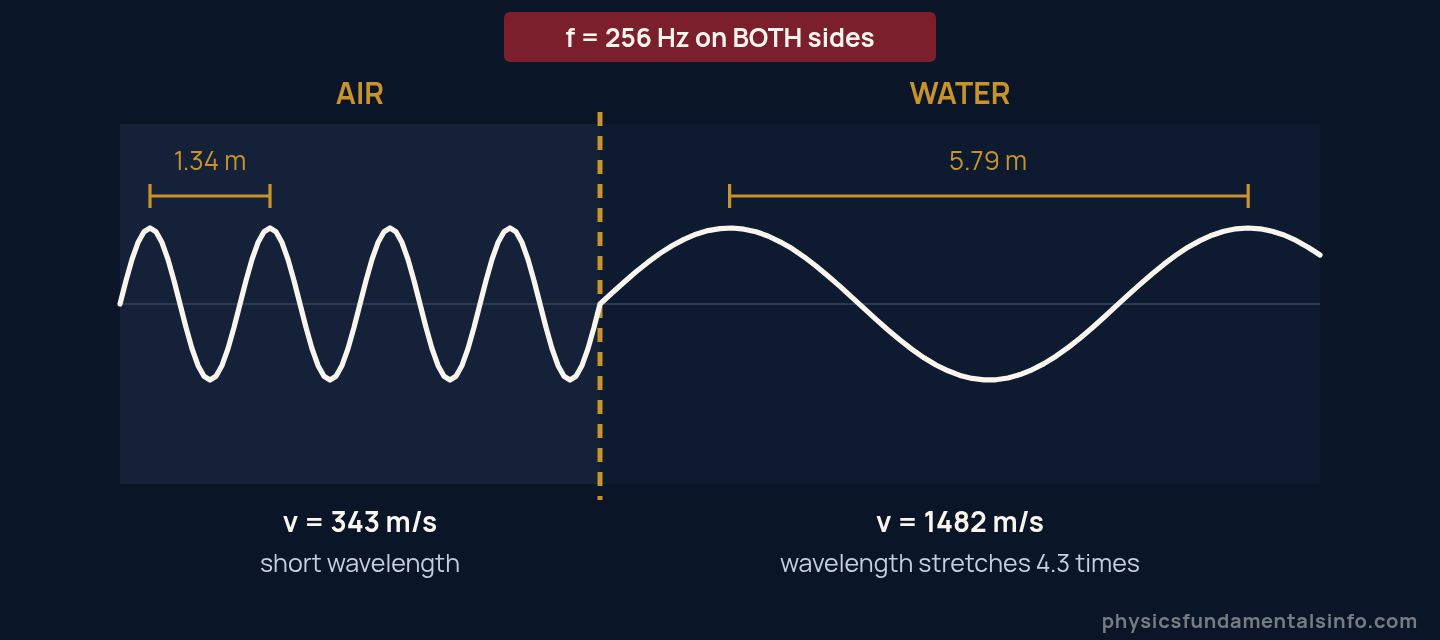
A 256 Hz wave crossing from air into water: the frequency is identical on both sides, while the speed and the wavelength both rise by a factor of 4.3.
This is the mechanism behind refraction. A wavefront striking a boundary at an angle has one edge slowing down before the other, so the whole front pivots — which is exactly why a straw looks broken at the surface of a glass of water.
Real-World Examples of Wave Speed
1. Timing a thunderstorm
Light reaches you almost instantly, so the delay before the thunder is essentially the sound’s whole journey. At 343 m/s, three seconds means roughly one kilometre — the old “count the seconds and divide by three” rule, and it is genuinely accurate.
2. Sonar and echo sounding
Ships map the seabed by timing a pulse’s round trip at about 1,500 m/s. Because speed varies with temperature, salinity and depth, sound rays bend as they travel — creating the deep sound channel NOAA describes, in which whale calls carry for thousands of kilometres.
3. Medical ultrasound
A scanner converts echo delays into depths by assuming soft tissue carries sound at 1,540 m/s. Every pixel position in the image depends on that single number being right.
4. Fibre-optic internet
Light in a glass fibre travels at roughly two-thirds of its vacuum speed, near 2.0 × 10⁸ m/s. That deficit is why a London-New York round trip cannot beat about 56 milliseconds, no matter how good the hardware is.
5. Earthquake early warning
Longitudinal P-waves outrun transverse S-waves through rock, typically about 6 km/s against 3.5 km/s. Warning systems detect the harmless P-wave first and issue an alert seconds before the destructive S-wave arrives.
Common Misconceptions About Wave Speed
“Denser media always slow a wave down”
This is the single most common error, and the table above demolishes it — sound is more than seventeen times faster in steel than in air. Density does slow mechanical waves, but only when stiffness is held constant, and moving from gas to solid raises stiffness far more than density.
Compare two metals instead and the rule reappears: lead is denser than aluminium and carries sound more slowly.
“Raising the frequency makes the wave travel faster”
Frequency and speed are independent for ordinary waves in ordinary media. Raise the frequency and the wavelength shrinks to compensate, leaving v = f λ satisfied and v untouched.
There is a neat proof in everyday life: an orchestra 50 metres away arrives in time. If high notes outran low ones, distant music would reach you scrambled.
“Wave speed is how fast the particles move”
Particle speed and wave speed are entirely different quantities. In normal conversation, air molecules oscillate at a fraction of a millimetre per second while the sound wave itself sprints along at 343 m/s.
“Doubling the tension doubles the speed on a string”
It multiplies the speed by about 1.41, because tension sits inside a square root. This is also why tuning a guitar up by an octave requires four times the tension — a jump most strings will not survive.
How Wave Speed Relates to Frequency, Refraction and the Doppler Effect
Wave speed is the hinge that connects several topics that look separate on a syllabus. Once you know v is fixed by the medium, the rest tends to fall into place.
Frequency and wavelength are the two quantities that must adjust around it, which is why v = f λ appears in nearly every wave question. Refraction is simply what happens when v changes at a boundary and the wavefront pivots.
The Doppler effect depends on wave speed too, but in a subtler way — the source’s motion shifts the observed frequency relative to a wave speed that stays constant in the medium. That is precisely why a passing siren changes pitch without the sound ever changing speed.
Worked Problems
Show Solution
Solution:
Step 1: Light arrives almost instantly, so the 3.0 s is the sound’s travel time. Use distance = v × t.
Step 2: Substitute with units: distance = 343 m/s × 3.0 s.
Step 3: Solve: distance = 1,029 m.
Answer: about 1.0 km (1,029 m)
Show Solution
Solution:
Step 1: Rearrange v = f λ to give λ = v / f. The frequency is set by the fork, so it is 256 Hz in both media.
Step 2: In air, λ = 343 m/s ÷ 256 Hz = 1.34 m.
Step 3: In water, λ = 1482 m/s ÷ 256 Hz = 5.79 m.
Answer: 1.34 m in air and 5.79 m in water — a factor of 4.32, exactly the ratio of the two speeds
Show Solution
Solution:
Step 1: The pulse travels down and back, so it covers twice the depth. Depth = v × t ÷ 2.
Step 2: Substitute with units: depth = 1500 m/s × 0.40 s ÷ 2.
Step 3: Solve: depth = 600 m ÷ 2 = 300 m.
Answer: 300 m
Show Solution
Solution:
Step 1: Use v = c / n with c = 299,792,458 m/s.
Step 2: v = 299,792,458 m/s ÷ 1.52 = 1.97 × 10⁸ m/s.
Step 3: Time = distance ÷ speed = 0.0020 m ÷ (1.97 × 10⁸ m/s) = 1.01 × 10⁻¹¹ s.
Answer: v = 1.97 × 10⁸ m/s, and the crossing takes about 10 picoseconds
Show Solution
Solution:
Step 1: The fundamental fits half a wavelength between the fixed ends, so λ = 2L = 2 × 0.648 m = 1.296 m.
Step 2: v = f λ = 82.4 Hz × 1.296 m = 106.8 m/s.
Step 3: Rearrange v = sqrt(T / μ) to T = μ v2, with μ = 0.0060 kg/m.
Step 4: T = 0.0060 kg/m × (106.8 m/s)2 = 68 N.
Answer: v = 107 m/s and T of about 68 N (about 7 kgf)
Show Solution
Solution:
Step 1: Start from v = sqrt(T / μ), with μ unchanged.
Step 2: Write the ratio: v2 / v1 = sqrt(T2 / T1). We need v2 / v1 = 2.
Step 3: Square both sides: T2 / T1 = 22 = 4.
Answer: the tension must be quadrupled
Show Solution
Solution:
Step 1: Use t = d / v for each path.
Step 2: Through steel: t = 1000 m ÷ 5960 m/s = 0.168 s.
Step 3: Through air: t = 1000 m ÷ 343 m/s = 2.92 s.
Step 4: Difference = 2.92 s – 0.168 s = 2.75 s.
Answer: about 2.7 s — you hear the rail-borne sound first, then the airborne one
Show Solution
Solution:
Step 1: Substitute the temperature: v = 331 + 0.6 × 35.
Step 2: v = 331 + 21 = 352 m/s.
Step 3: λ = v / f = 352 m/s ÷ 440 Hz = 0.80 m.
Answer: v = 352 m/s and λ = 0.80 m (about 9 m/s faster than at 20 °C)