The speed of sound is the rate at which a pressure disturbance travels through a material, equal to about 343 m/s in dry air at 20 °C. In a gas it is fixed by the temperature and by the gas itself, following v = sqrt(γRT/M). Air pressure on its own does not change it.
Count the seconds between a lightning flash and the thunder. Three seconds means the strike was roughly a kilometre away — a trick that works only because sound ambles along slowly enough to time with a wristwatch, while the light arrives essentially instantly.
But that amble is not a fixed number. A trumpet plays sharp on a hot afternoon, an airliner cruising at 11 km hits Mach 1 far slower than it would at sea level, and a diver hears an outboard motor long before anyone at the surface does. Same physics — three different speeds.
What Is the Speed of Sound?
The speed of sound is how fast a pressure wave travels through a material: about 343 m/s in air at 20 °C, roughly 1,480 m/s in fresh water, and around 5,000 m/s along a steel rail.
Here is the thing most people picture wrongly. Sound is not a packet of air flying from the speaker to your ear. Each molecule shuffles back and forth by a fraction of a millimetre and shoves its neighbour, which shoves its neighbour — and the pattern of squeeze and stretch races away while the air itself stays put.
Because that shuffling happens along the same line the wave travels, sound is a longitudinal wave rather than the up-and-down ripple most diagrams of “a wave” show.
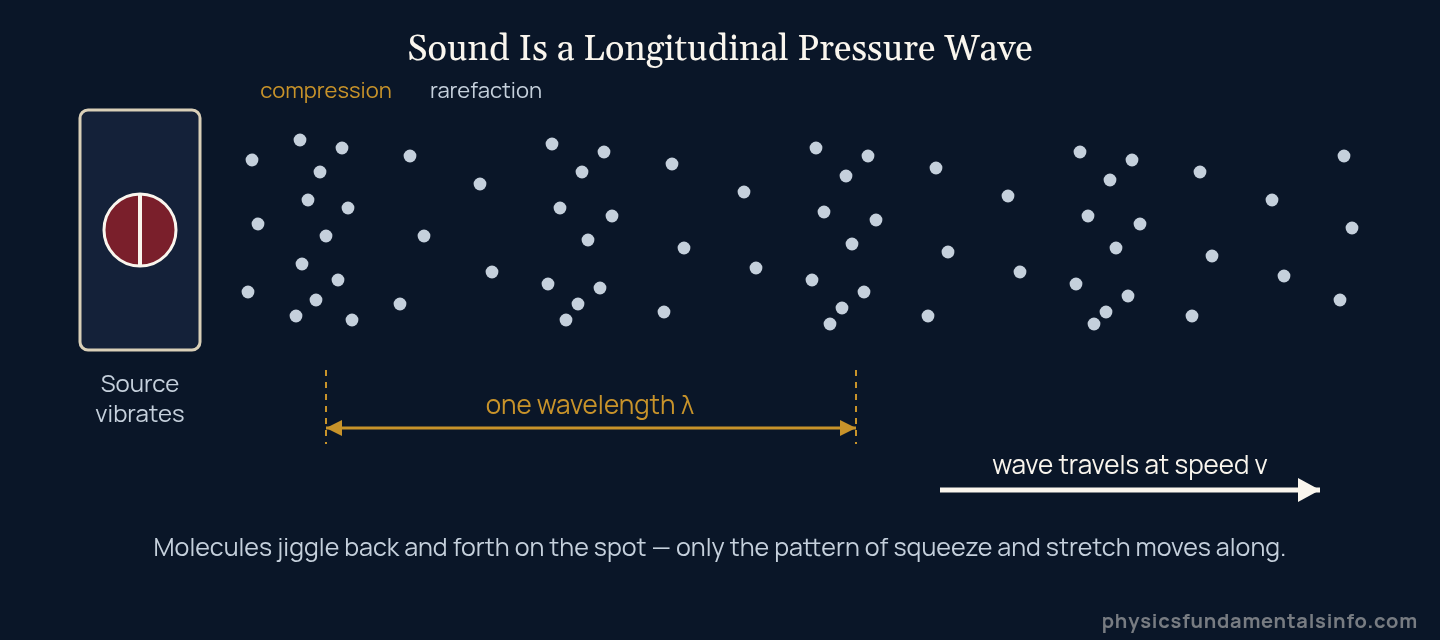
Sound moves as compressions and rarefactions. The air stays put; the pattern travels.
So what sets the pace? Two properties fight it out in every material:
- Stiffness — how hard the material pushes back when you squeeze it. Stiffer means each molecule passes the shove on sooner, so sound goes faster.
- Inertia (density) — how heavy the molecules are. Heavier means they are more sluggish to accelerate, so sound goes slower.
Every speed-of-sound formula you will ever meet is that same tug-of-war: the square root of stiffness divided by density.
The Speed of Sound Formula
For an ideal gas, the speed of sound is the square root of the adiabatic index times the gas constant times the absolute temperature, divided by the molar mass.
Every symbol, with its SI unit:
| Symbol | Quantity | SI unit | Value for dry air |
|---|---|---|---|
| v | Speed of sound | m/s | the answer |
| γ | Adiabatic index (ratio of specific heats, cp/cv) | dimensionless | 1.40 |
| R | Molar gas constant | J/(mol·K) | 8.314 |
| T | Absolute temperature | K (kelvin, never °C) | 293.15 K at 20 °C |
| M | Molar mass of the gas | kg/mol | 0.0290 |
Note what is missing from that formula: pressure. Nowhere in v = sqrt(γRT/M) does the air pressure appear — a point we will come back to, because it trips up almost everybody. The value of R used here is the standard molar gas constant published by NIST, the same constant that drives the ideal gas law.
For everyday work in air, there is a shortcut worth memorising:
It sits within about 1 m/s of the exact formula between -20 °C and +40 °C, which is far tighter than most measurements you will ever make.
And if you already know a sound’s frequency and wavelength, you do not need temperature at all — the same speed drops out of v = fλ, the universal wave relationship. Our Wave Speed Calculator handles that rearrangement in either direction, and the frequency formula covers where f comes from in the first place.
How Temperature Changes the Speed of Sound
Warming the air speeds sound up by roughly 0.6 m/s for every degree Celsius — so sound travels about 24 m/s faster on a 40 °C day than on a freezing one.
Why? Temperature is molecular motion. Warm the gas and its molecules are already flying about faster, so each one reaches its neighbour sooner and passes the shove along more quickly.
The dependence is on the square root of absolute temperature, not on temperature itself. Double the kelvin temperature and the speed rises by a factor of only sqrt(2), about 1.41.
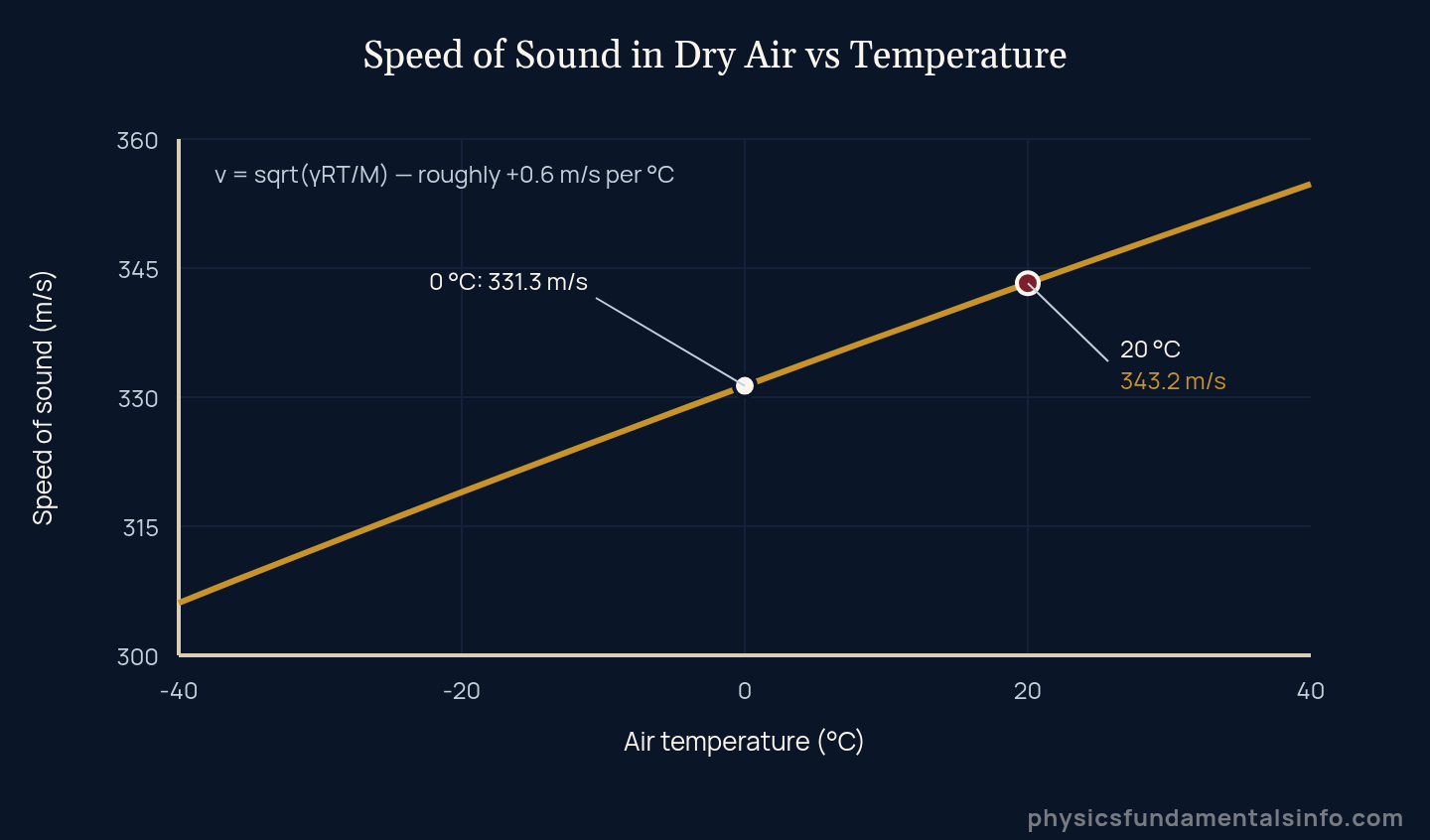
Speed of sound in dry air across everyday temperatures. Over this narrow range the square-root curve looks almost perfectly straight.
The Kelvin trap
This is the single most common way students lose marks on this topic. The T in v = sqrt(γRT/M) is absolute temperature in kelvin — add 273.15 to your Celsius value before it goes anywhere near the formula.
Drop 20 straight in instead of 293.15 and you will get about 90 m/s. In practice, a good sanity check is that any answer for air near room temperature should land close to 340 m/s. If it does not, check your kelvins first.
The Speed of Sound in Different Materials
Sound travels fastest in stiff solids, slower in liquids and slowest in gases — roughly 15 times faster in steel than in air.
| Medium | Speed (m/s) | Conditions | Why it lands there |
|---|---|---|---|
| Carbon dioxide | 259 | 0 °C | Heavy molecules (44 g/mol) and a low γ |
| Air (dry) | 331 | 0 °C | The textbook reference value |
| Air (dry) | 343 | 20 °C | Room temperature — the number to remember |
| Helium | 1,007 | 20 °C | Very light molecules (4 g/mol) accelerate easily |
| Fresh water | 1,482 | 20 °C | Far stiffer than air, only ~800× denser |
| Seawater | ~1,520 | 20 °C, 35 g/kg salinity | Salt raises stiffness more than density |
| Aluminium (thin rod) | ~5,000 | Room temperature | Stiff and unusually light for a metal |
| Steel (thin rod) | ~5,050 | Room temperature, varies with alloy | Huge stiffness beats its high density |
| Steel (bulk) | ~5,960 | Room temperature | Bulk waves are stiffer still than rod waves |
Outside gases the formula changes shape, but never its logic. In a liquid the speed is sqrt(K/ρ), where K is the bulk modulus; along a thin solid rod it is sqrt(E/ρ), with E the Young’s modulus.
Stiffness over density, every time. Water is about 800 times denser than air, which alone would make sound slower — but water is roughly 15,000 times harder to compress, and stiffness wins decisively. For a wider comparison that brings light and vibrating strings into the picture, see our guide to wave speed in different media.
Do Pressure and Humidity Change the Speed of Sound?
Air pressure alone does not change the speed of sound, but humidity does — by a few tenths of a percent.
Why pressure cancels out
Squeeze air into half the volume at the same temperature and you double its pressure — but you also double its density. Stiffness and inertia rise together, in lockstep, and the ratio that sets the speed does not budge.
That is why pressure never appears in v = sqrt(γRT/M). For an ideal gas the two effects cancel exactly.
So why is sound slower high up?
Because it is cold up there, not because the air is thin. At the top of the troposphere, around 11 km, the standard atmosphere sits at about -56.5 °C, and the speed of sound falls to roughly 295 m/s.
An airliner therefore reaches Mach 1 at a much lower true airspeed at cruise than it would at sea level. NASA’s own guide to the speed of sound makes the same point for aircraft design: track the temperature, not the pressure.
The humidity nudge
Water vapour is lighter than the nitrogen and oxygen it displaces — 18 g/mol against about 29. Humid air is therefore slightly less dense than dry air at the same pressure, so sound moves marginally faster through it.
The effect is real but small: going from bone-dry to fully saturated at 20 °C lifts the speed by roughly 1.3 m/s, about 0.4%. Enough to matter for precision acoustics; not enough to change your thunder count.
Real-World Examples of the Speed of Sound
Counting thunder
Light covers a kilometre in about three-millionths of a second; sound needs almost three full seconds. Count the gap and divide by three for the distance in kilometres — or by five for miles.
Sonar and echo sounding
Ships map the seabed by timing a pulse’s round trip, using roughly 1,500 m/s for seawater. Halve the total time, because the sound has gone down and back.
Mach numbers and sonic booms
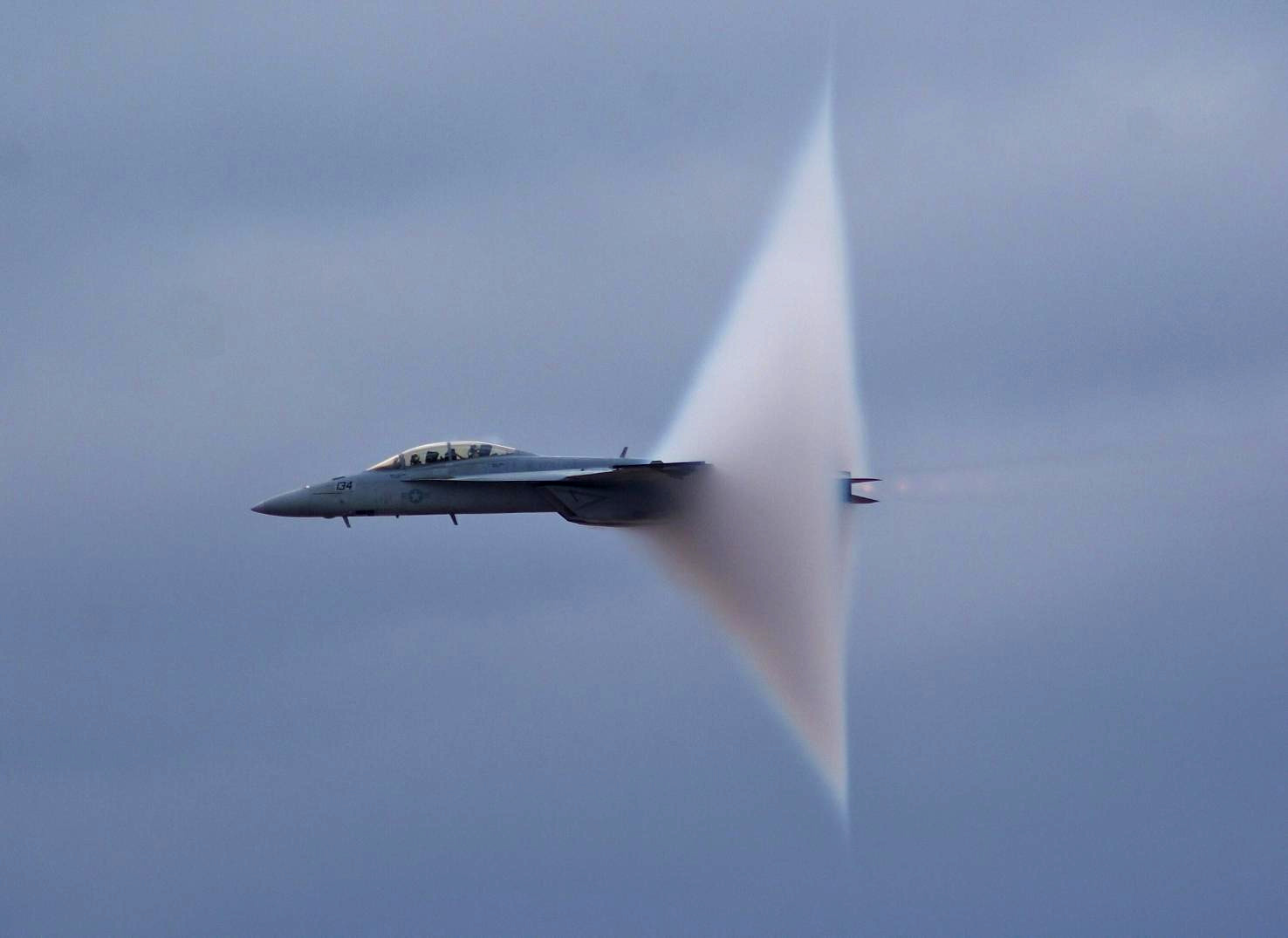
Mach number is simply an object’s speed divided by the local speed of sound. Because the divisor shrinks in cold air, the same aircraft at the same true airspeed sits at a higher Mach number when it climbs.
Instruments that drift sharp
A flute or trumpet sets its pitch by resonating a column of air, and that resonance depends on the speed of sound inside the tube. As the instrument warms, the speed rises and the pitch creeps upwards — which is exactly why orchestras retune after warming up.
Medical ultrasound
Scanners convert echo times into depth by assuming sound moves at about 1,540 m/s through soft tissue. Get that assumed speed wrong and every measurement on the image shifts with it.
Common Misconceptions About the Speed of Sound
“Sound travels faster in denser materials”
Density on its own slows sound down — look at where ρ sits in sqrt(K/ρ). Steel beats air because its stiffness is millions of times greater, easily outrunning its higher density. Among gases, where stiffness is similar, the heavier gas really is the slower one: carbon dioxide trails air, helium leaves it standing.
“Sound is slower at altitude because the air is thin”
Thin air is not the reason — cold air is. Pressure and density fall together and cancel; the temperature drop is what pulls the speed down from 340 m/s to about 295 m/s at cruise altitude.
“Helium makes your voice higher by speeding up your vocal cords”
Your vocal folds vibrate at very nearly their normal rate, so the pitch you are producing barely changes. What shifts is the resonance of your vocal tract: sound moves about 2.9 times faster in helium, so the frequencies your throat amplifies jump upwards and the timbre turns squeaky.
“A sonic boom happens once, at the moment the barrier is broken”
The boom is not a one-off event. A supersonic aircraft drags a cone of shock waves behind it continuously, and anyone the cone sweeps over hears a boom — so the noise arrives at different places at different times for as long as the aircraft stays supersonic.
How the Speed of Sound Relates to Mach Number, Wavelength and the Doppler Effect
The speed of sound is the reference speed sitting inside several other acoustics formulas, which is why getting it right matters well beyond this one number.
- Mach number: the ratio of an object’s speed to the local speed of sound. Mach 1 is not a fixed velocity — it depends entirely on the air temperature.
- Wavelength: λ = v/f. Because v shifts with temperature, a 440 Hz note has a measurably different wavelength on a cold morning than on a hot afternoon.
- The Doppler effect: every version of the Doppler formula contains v, so an error in the speed of sound propagates straight into your predicted frequency shift.
One contrast is worth holding onto. Sound needs a medium and creeps along at a few hundred metres per second, while light needs none and travels at 299,792,458 m/s — nearly 900,000 times faster. In a vacuum, the speed of sound is not slow. It simply does not exist.
Worked Problems
Show Solution
Solution:
Step 1: Use the everyday shortcut, v = 331.3 + 0.606 × T, with T in °C.
Step 2: Substitute T = 25 °C, giving v = 331.3 + 0.606 × 25.
Step 3: 0.606 × 25 = 15.15, so v = 331.3 + 15.15 = 346.45 m/s.
Answer: v = 346.5 m/s (4 s.f.)
Show Solution
Solution:
Step 1: The light arrives effectively instantly, so the 6.0 s is the sound’s travel time. Use d = v × t.
Step 2: At 20 °C, v = 343 m/s, so d = 343 m/s × 6.0 s.
Step 3: d = 2058 m.
Answer: d = 2.1 km (2 s.f.)
Show Solution
Solution:
Step 1: Convert to absolute temperature: T = 30 + 273.15 = 303.15 K.
Step 2: Numerator: γRT = 1.40 × 8.314 J/(mol·K) × 303.15 K = 3528.5 J/mol.
Step 3: Divide by molar mass: 3528.5 J/mol ÷ 0.0290 kg/mol = 121,674 m2/s2.
Step 4: Take the square root: v = sqrt(121,674) = 348.8 m/s.
Answer: v = 349 m/s (3 s.f.) — within 0.7 m/s of the shortcut formula’s 349.5 m/s
Show Solution
Solution:
Step 1: Use the wave relationship v = fλ, rearranged to λ = v/f.
Step 2: At 20 °C, v = 343 m/s, so λ = 343 m/s ÷ 440 Hz.
Step 3: λ = 0.7795 m.
Answer: λ = 0.780 m (3 s.f.)
Show Solution
Solution:
Step 1: T = 20 + 273.15 = 293.15 K.
Step 2: γRT = 1.67 × 8.314 J/(mol·K) × 293.15 K = 4070.2 J/mol.
Step 3: Divide by M: 4070.2 ÷ 0.00400 = 1,017,551 m2/s2; v = sqrt(1,017,551) = 1008.7 m/s.
Step 4: Compare with air: 1008.7 ÷ 343 = 2.94.
Answer: v = 1009 m/s, about 2.9 times the speed in air — the molar mass is roughly 7 times smaller
Show Solution
Solution:
Step 1: T = -56.5 + 273.15 = 216.65 K.
Step 2: γRT = 1.40 × 8.314 × 216.65 = 2521.7 J/mol; divide by M: 2521.7 ÷ 0.0290 = 86,956 m2/s2.
Step 3: Local speed of sound: v = sqrt(86,956) = 294.9 m/s.
Step 4: Mach number = aircraft speed ÷ local speed of sound = 250 ÷ 294.9.
Answer: Mach 0.848 — the same 250 m/s would be only Mach 0.73 at 20 °C
Show Solution
Solution:
Step 1: For a thin solid rod, v = sqrt(E/ρ).
Step 2: v = sqrt(200 × 109 Pa ÷ 7850 kg/m3) = sqrt(2.548 × 10⁷ m2/s2) = 5048 m/s.
Step 3: Time through the rail: t = 1000 m ÷ 5048 m/s = 0.198 s.
Step 4: Time through the air: t = 1000 m ÷ 343 m/s = 2.915 s.
Step 5: Difference = 2.915 – 0.198 = 2.717 s.
Answer: v = 5050 m/s in the rail; the sound arrives about 2.7 s earlier through the steel