Reflection and refraction are the two ways light changes direction at a boundary between materials: reflection is when light bounces back off a surface, while refraction is when light bends as it passes through into a new medium because its speed changes. The bending follows Snell’s law, n1 sin θ1 = n2 sin θ2.
Drop a straw into a glass of water and it looks snapped in half. Glance in a shop window at night and your own face stares back. Two everyday illusions, two different physics — and between them they explain mirrors, lenses, rainbows, cameras, your spectacles and the fibre-optic cable carrying this page to your screen.
Both effects happen at the same place: the boundary where one material meets another. What the light does there — bounce or bend — comes down to one question. Does it stay where it is, or does it cross over?
What Are Reflection and Refraction?
Start with the boundary. Light is travelling along happily, and it meets a surface — the face of a mirror, the top of a pond, the curve of a lens. Two things can happen, and usually both do at once.
Reflection is the part of the light that bounces back. It never leaves the first medium; the surface simply turns it around. A mirror reflects almost all of it, which is why you see a sharp image. Refraction is the part that crosses into the new medium — and as it crosses, it bends, because its speed changes.
So reflection is a bounce and refraction is a bend. The crucial distinction is whether the light stays put or passes through.
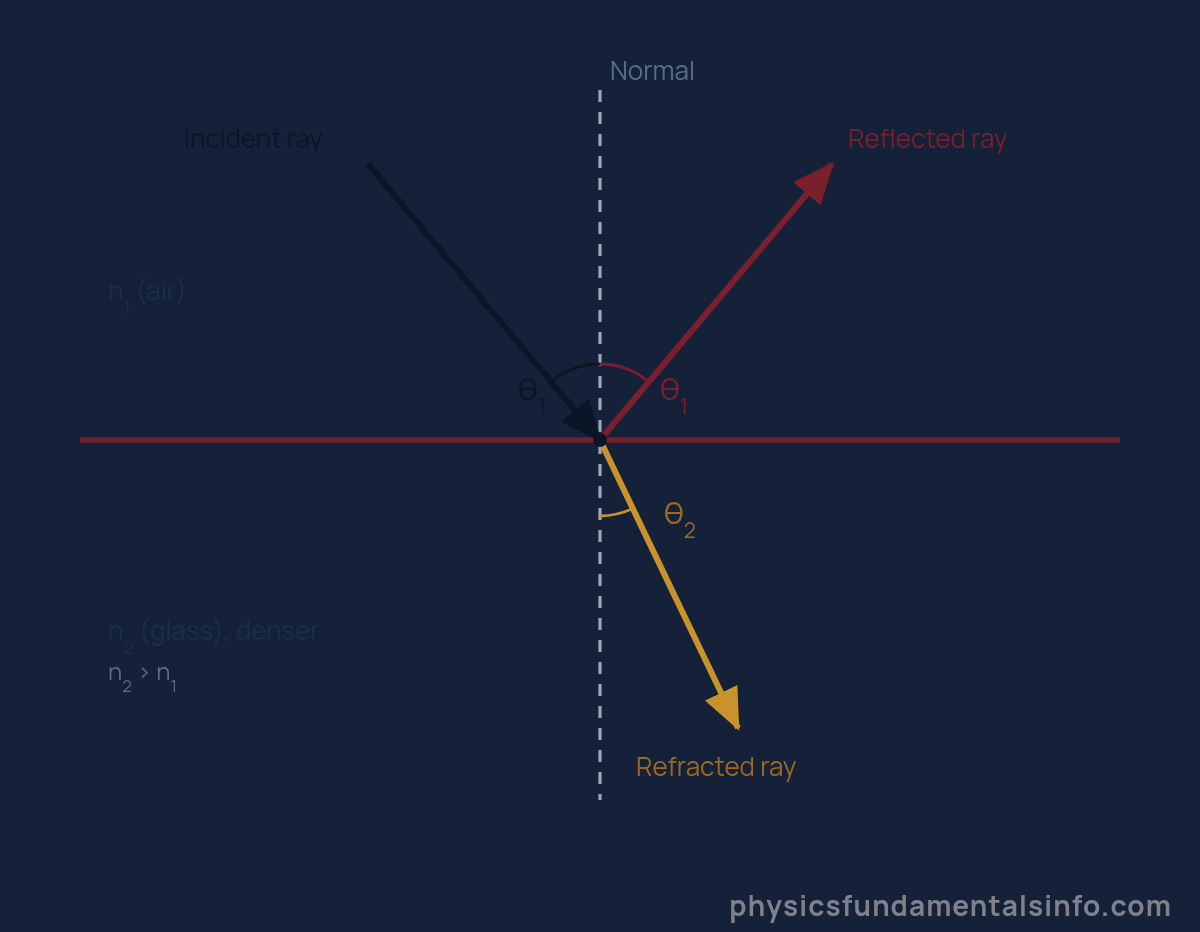
A single ray hitting a boundary splits into a reflected ray (θ1 = angle of reflection) and a refracted ray (θ2), which bends toward the normal when it enters the denser medium.
Reflection vs Refraction at a Glance
Because these two are so often confused, here is the side-by-side. Notice that the deciding factor running down the table is always the same: does the light stay in one medium, or cross into another?
| Property | Reflection | Refraction |
|---|---|---|
| What happens | Light bounces back off the surface | Light passes into a new medium and changes direction |
| Medium | Stays in the same medium | Crosses into a different medium |
| Cause | The surface turns the wave around | The light’s speed changes between the two media |
| Key law | Angle of incidence = angle of reflection (θi = θr) | Snell’s law: n1 sin θ1 = n2 sin θ2 |
| Speed of light | No change | Changes (slower in the denser medium) |
| Wavelength | Unchanged | Changes (the frequency stays the same) |
| Everyday example | Your image in a mirror | A straw looking bent in water |
The Laws of Reflection and Refraction
Two short rules govern everything above. Both are written in terms of angles measured from the normal — the imaginary line drawn at right angles to the surface where the ray strikes it.
The Law of Reflection
The reflected ray leaves at the same angle it arrived. Simple, and exactly true for any smooth surface.
- θi — angle of incidence, between the incoming ray and the normal (degrees, or radians).
- θr — angle of reflection, between the reflected ray and the normal (degrees, or radians).
The Law of Refraction (Snell’s Law)
When light crosses into a new medium, the angle changes by an amount set by the two refractive indices. This is Snell’s law, the single most useful equation in optics.
- n1 — refractive index of the first medium (dimensionless).
- n2 — refractive index of the second medium (dimensionless).
- θ1 — angle of incidence in medium 1, from the normal (degrees).
- θ2 — angle of refraction in medium 2, from the normal (degrees).
A common student slip is to measure the angle from the surface. Always draw the normal first, then measure from it — every formula on this page assumes that.
The law of refraction is named after the Dutch astronomer Willebrord Snellius, who set it down in 1621; it is sometimes called the Snell–Descartes law, and the same relationship was described even earlier, around 984, by the Persian scholar Ibn Sahl.
How Reflection and Refraction Work
Reflection is the easy one. Light is an electromagnetic wave, and when it meets a surface it cannot cross, the surface sends it back — like a ball off a wall, leaving at the mirror image of the angle it came in.
Refraction is subtler, and it hinges on a single fact: light travels at different speeds in different materials. It is fastest in a vacuum, a touch slower in air, slower again in water, and slower still in glass or diamond.
Why does a change in speed make the ray bend? Picture a marching band crossing from a paved road onto a muddy field at an angle. The musicians who reach the mud first slow down while the others are still on firm ground — so the whole row pivots and changes heading. Light does exactly this.
The edge of the wavefront that enters the slower medium first gets held up, the rest catches up, and the wave swings toward the normal. Enter a slower (denser) medium and light bends toward the normal; enter a faster (less dense) medium and it bends away. NASA describes the same behaviour for light right across the electromagnetic spectrum, where the speed change at a boundary is what bends light as it passes from one medium to another.
One detail that trips people up: if light hits the surface dead-on (0° to the normal), it still slows down — but it does not bend, because no part of the wavefront is held up before any other. Bending needs an angle.
Use the lab below to fire a ray at a boundary, change the angle and the materials, and watch the reflected and refracted rays respond in real time.
Refractive Index — the Key to Bending Light
The refractive index, written n, is simply a measure of how much a material slows light down. It is the ratio of the speed of light in a vacuum to its speed in the material.
- n — refractive index of the material (dimensionless).
- c — speed of light in a vacuum, 299,792,458 m/s (about 3.00 × 10⁸ m/s).
- v — speed of light in the material (m/s).
A vacuum has n = 1 exactly. Everything ordinary has n greater than 1, because light always slows in matter. The bigger the index, the slower the light and the harder it bends. Diamond’s enormous index of 2.42 is the whole reason it dazzles.
Sanity check: light slows in any normal material, so n for glass, water or diamond is always above 1. If your arithmetic ever hands you n < 1 for these, you’ve flipped the c/v ratio.
| Material | Refractive index (n) | Speed of light inside (approx.) |
|---|---|---|
| Vacuum | 1.0000 | 3.00 × 10⁸ m/s |
| Air | 1.0003 | ≈ 3.00 × 10⁸ m/s |
| Water | 1.33 | 2.26 × 10⁸ m/s |
| Ice | 1.31 | 2.29 × 10⁸ m/s |
| Glass (typical) | 1.50 | 2.00 × 10⁸ m/s |
| Diamond | 2.42 | 1.24 × 10⁸ m/s |
These figures are approximate, and n shifts very slightly with the colour of the light — a detail that turns out to matter enormously, as we’ll see with rainbows. The measured indices for these common materials are catalogued in this LibreTexts reference on Snell's law.
Because n is tied to speed, the slowing of light depends ultimately on the fixed speed of light in a vacuum — the c at the top of that fraction.
Total Internal Reflection and the Critical Angle
Here is where reflection and refraction stop being separate stories and merge into one. Send light the “wrong way” — from a dense medium toward a less dense one, say from water up into air — and the refracted ray bends away from the normal. Tilt the ray more, and the refracted ray bends flatter and flatter.
At one special angle, the critical angle, the refracted ray skims right along the surface at 90°. Push past it, and refraction vanishes entirely: all the light reflects back inside. This is total internal reflection.
- θc — critical angle, measured from the normal (degrees). Only exists when n1 > n2.
- n1 — refractive index of the denser medium the light starts in (dimensionless).
- n2 — refractive index of the less dense medium (dimensionless).
For a water–air boundary the critical angle is about 48.8°; for ordinary glass to air, about 41°; for diamond, a tiny 24.4°. The smaller that angle, the more easily light gets trapped — which is precisely why a cut diamond holds onto light and throws it back at you in flashes.
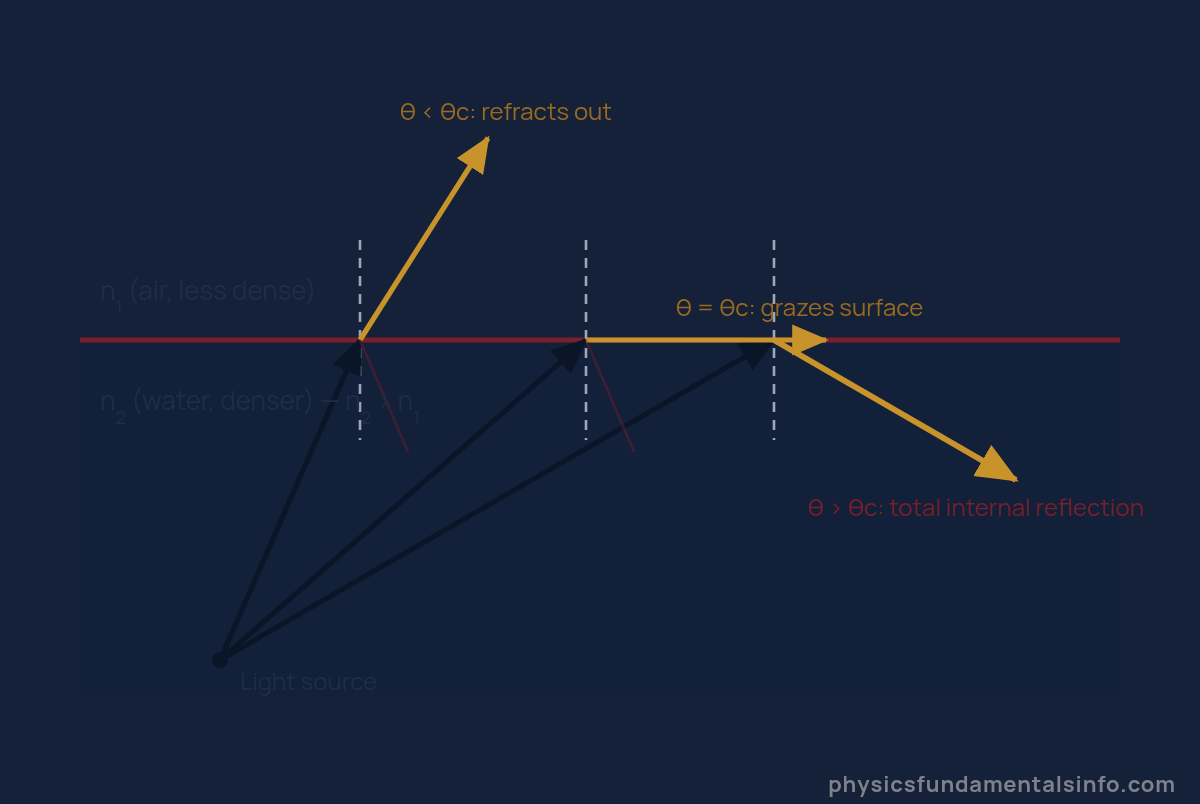
As the angle of incidence in the denser medium grows, the escaping ray bends flatter, grazes the surface at the critical angle θc, and beyond it is reflected entirely — total internal reflection. (Faint rays show the partial reflection that always accompanies refraction.)
Real-World Examples of Reflection and Refraction
Once you know what to look for, these two effects are everywhere.
Mirrors and your reflection
A mirror is a sheet of glass backed with metal so smooth that it reflects almost every ray. Because the reflection is even, the rays keep their arrangement and you see a crisp image of yourself.
The bent straw
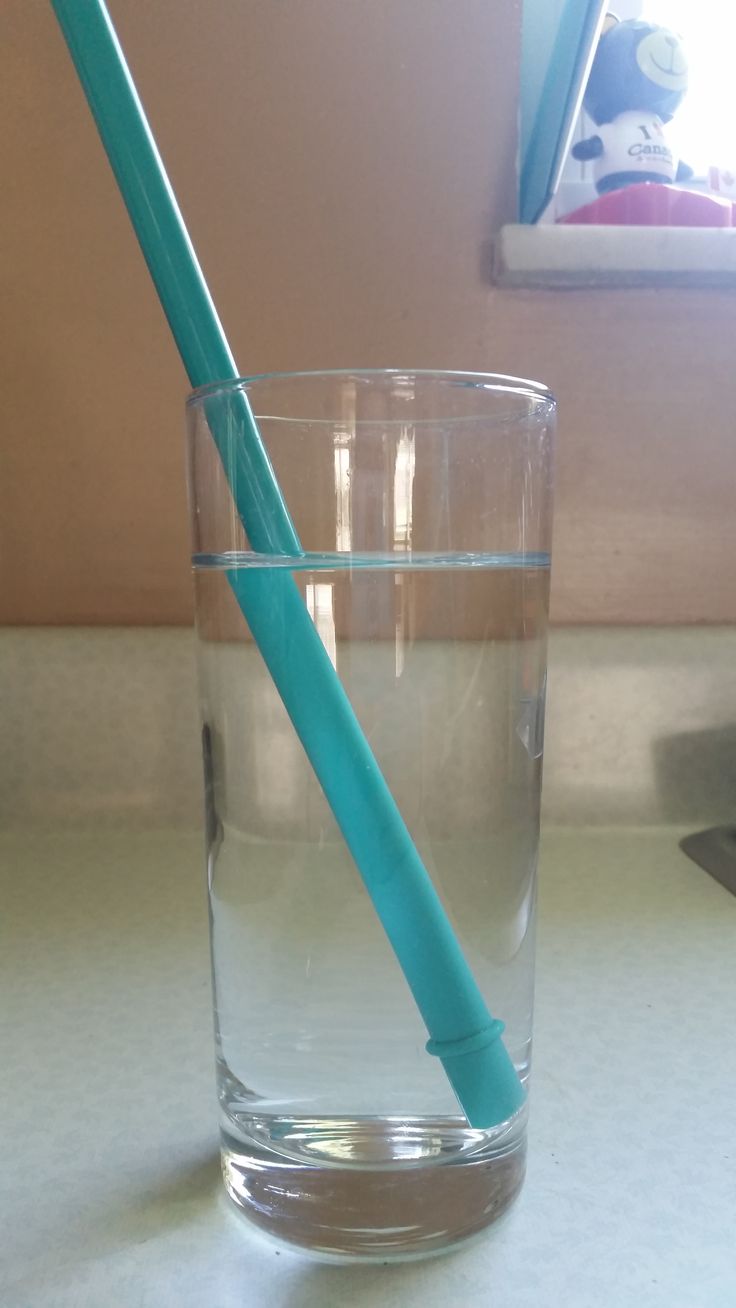
The straw that looks broken at the waterline isn’t bent at all. Light from the submerged part refracts as it leaves the water, so your eyes trace it back along the wrong line — and the straw appears to jump sideways.
Rainbows
A raindrop is a tiny lens. Sunlight refracts going in, reflects off the back, and refracts again coming out. Because each colour bends by a slightly different amount, the white light fans out into the familiar arc of red through violet.
Optical fibres
The internet runs on total internal reflection. Light pulses fired down a hair-thin glass fibre strike the walls beyond the critical angle every time, so they bounce along the inside for kilometres without leaking out — carrying data at the speed of light.
Lenses
Spectacles, cameras, microscopes and telescopes all bend light on purpose. A curved lens refracts every ray that passes through by just the right angle to bring them to a focus, sharpening a blurred world or magnifying a distant one.
Common Misconceptions About Reflection and Refraction
A few stubborn misunderstandings are worth clearing up.
“Reflection only happens with mirrors.”
Every surface reflects some light — that’s how you see this page, a wall, or a wooden table, none of which glow on their own. Rough surfaces simply scatter the reflection in all directions (diffuse reflection) instead of returning a clean image.
“All refraction bends the light.”
Only refraction at an angle bends it. Light striking a surface straight on still slows down as it enters the new medium, but it carries straight through without changing direction.
“The angle is measured from the surface.”
It is always measured from the normal — the perpendicular to the surface. Mixing this up flips your numbers; an angle of 30° from the surface is 60° from the normal, and Snell’s law wants the latter.
“Light always bends toward the normal.”
It only bends toward the normal when entering a denser medium. Going the other way — from glass or water out into air — it bends away from the normal, and at a steep enough angle it doesn’t escape at all.
How Reflection and Refraction Relate to Other Wave Concepts
Light is a wave, so everything here is a special case of wider wave behaviour. Reflection and refraction happen for sound and water waves too — but light makes them easy to see.
The fact that light is a transverse wave underlies its whole personality, including how it reflects and polarises. And the rule that the frequency of a wave stays fixed while its speed changes is exactly why the wavelength shrinks in glass while the colour stays the same.
That same wave-speed thinking drives a different effect entirely. When a source moves, the apparent frequency shifts — the Doppler effect — a useful contrast, because there the wave bends in frequency rather than in direction.
Worked Problems
Show Solution
Solution:
Step 1: Apply the law of reflection, θi = θr.
Step 2: The angle of incidence is 32°, so the angle of reflection equals it directly.
Answer: 32° from the normal.
Show Solution
Solution:
Step 1: The normal is perpendicular to the surface, so convert: angle of incidence = 90° − 25° = 65°.
Step 2: By the law of reflection, θr = θi = 65°.
Answer: 65° from the normal. (Always measure from the normal, never the surface.)
Show Solution
Solution:
Step 1: Use Snell’s law: n1 sin θ1 = n2 sin θ2.
Step 2: Substitute: (1.00)(sin 30°) = (1.50)(sin θ2), so (1.00)(0.5000) = 1.50 sin θ2.
Step 3: sin θ2 = 0.5000 / 1.50 = 0.3333, so θ2 = sin−1(0.3333) = 19.5°.
Answer: 19.5° from the normal — bent toward the normal, as expected entering a denser medium.
Show Solution
Solution:
Step 1: Use n = c / v.
Step 2: Substitute: n = (3.00 × 10⁸ m/s) / (2.00 × 10⁸ m/s).
Step 3: n = 1.50.
Answer: n = 1.50 (dimensionless — the units of speed cancel).
Show Solution
Solution:
Step 1: Rearrange n = c / v to give v = c / n.
Step 2: Substitute: v = (3.00 × 10⁸ m/s) / 1.33.
Step 3: v = 2.26 × 10⁸ m/s.
Answer: 2.26 × 10⁸ m/s — about three-quarters of its vacuum speed.
Show Solution
Solution:
Step 1: Apply Snell’s law: n1 sin θ1 = n2 sin θ2.
Step 2: Substitute: (1.33)(sin 30°) = (1.00)(sin θ2), so (1.33)(0.5000) = sin θ2.
Step 3: sin θ2 = 0.6650, so θ2 = sin−1(0.6650) = 41.7°.
Answer: 41.7° from the normal — bent away from the normal, because the light is entering a less dense medium.
Show Solution
Solution:
Step 1: Use the critical-angle formula: sin θc = n2 / n1, with n1 = 2.42 (diamond) and n2 = 1.00 (air).
Step 2: sin θc = 1.00 / 2.42 = 0.4132, so θc = sin−1(0.4132) = 24.4°.
Step 3 (part b): Because the critical angle is only about 24°, light entering the diamond meets most internal faces at more than 24.4° and is totally internally reflected. It bounces around inside many times before escaping, emerging in bright flashes.
Answer: critical angle ≈ 24.4°; the small angle traps light by total internal reflection, producing the diamond’s brilliance.