The decibel formula, L = 10 log10(I / I0), gives sound level in decibels by comparing a measured intensity I, in watts per square metre, with the reference intensity I0 = 1 × 10-12 W/m2 at the threshold of hearing. Every tenfold rise in intensity adds exactly 10 dB.
Lie awake in a quiet bedroom and you can hear yourself breathing. Stand near a runway and the noise is close to painful. Between those two moments your ear copes with a range of sound energy of roughly a trillion to one, without ever needing a moment to adjust.
No ordinary number line survives that. Writing one sound as 0.000000000001 watts per square metre and another as 1 watt per square metre is unusable on a meter, a mixing desk or a safety sign. So acoustics squeezes the whole range into a scale that runs from about 0 to 140 — and a single logarithm does the squeezing.
What Is the Decibel Formula?
The decibel formula converts sound intensity into sound level by taking ten times the base-ten logarithm of the ratio between a measured intensity and a fixed reference intensity. Written out, that is L = 10 log10(I / I0).
Think of it as a currency conversion. Intensity is the raw physical quantity — the acoustic power flowing through each square metre of air. The decibel is the human-friendly currency the physics gets converted into.
Sound itself is a longitudinal wave: air molecules squash together and spread apart along the direction of travel, and each compression carries a little energy past your eardrum. Intensity measures how much energy arrives per second on each square metre.
What makes the decibel unusual is that it is a ratio, not an amount. A level of 60 dB does not describe a fixed quantity of energy on its own — it says this sound is one million times as intense as the quietest sound a healthy young ear can detect.
The Decibel Formula Explained Symbol by Symbol
Every term in the equation has a job, and the reference term is the one students most often ignore.
| Symbol | Meaning | SI unit | Typical value |
|---|---|---|---|
| L | Sound intensity level | decibel (dB) | 0 dB at the hearing threshold; about 120 dB at the pain threshold |
| I | Sound intensity — acoustic power per unit area | watt per square metre (W/m2) | about 10-6 W/m2 for ordinary speech at 1 m |
| I0 | Reference intensity, fixed by convention | watt per square metre (W/m2) | exactly 1 × 10-12 W/m2 |
| log10 | Base-ten logarithm of the ratio I / I0 | dimensionless | log10(1000) = 3 |
| 10 | Factor converting bels into decibels | dimensionless | 1 bel = 10 dB |
Because I and I0 share the same unit, the ratio inside the logarithm is a pure number. That is why the decibel is not a unit in the way the metre is — it is a labelled ratio, and it means nothing until you state the reference.
The formula also runs backwards. Rearranging for intensity gives I = I0 × 10(L/10), which turns a meter reading straight back into watts per square metre. If you would rather check your algebra than grind through logs by hand, our Decibel Calculator converts in both directions and prints every substitution step.
Why Some Decibel Formulas Use 20 log Instead of 10 log
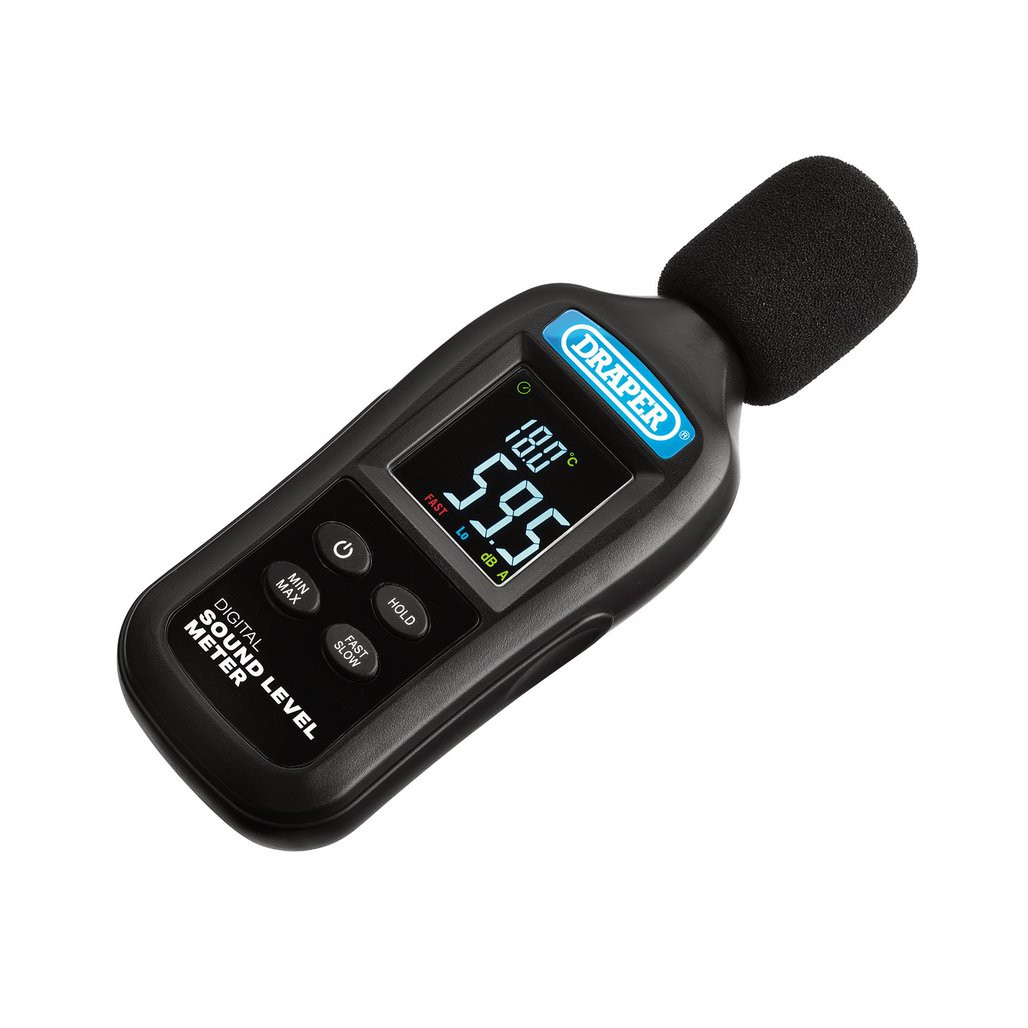
A sound level meter does not actually measure intensity. It measures pressure fluctuations, so it uses the sound pressure level equation instead:
The 20 is not a different convention pulled out of thin air. Intensity is proportional to pressure squared, and squaring inside a logarithm doubles it — so 10 log(p2) becomes 20 log(p).
The two references are deliberately matched. In air with a characteristic impedance of 400 Pa·s/m, a pressure of 20 μPa produces an intensity of exactly 10-12 W/m2, so both formulas put the hearing threshold at 0 dB and agree with each other in practice.
Why Sound Intensity Needs a Logarithmic Scale
Sound intensity gets a logarithmic scale because human hearing spans about twelve orders of magnitude, and because the ear responds to ratios rather than differences. The logarithm turns multiplying into adding.
Look at what that buys you. Ten times the intensity is always +10 dB — whether you are stepping from a whisper to a quiet room or from a chainsaw to a jet engine.
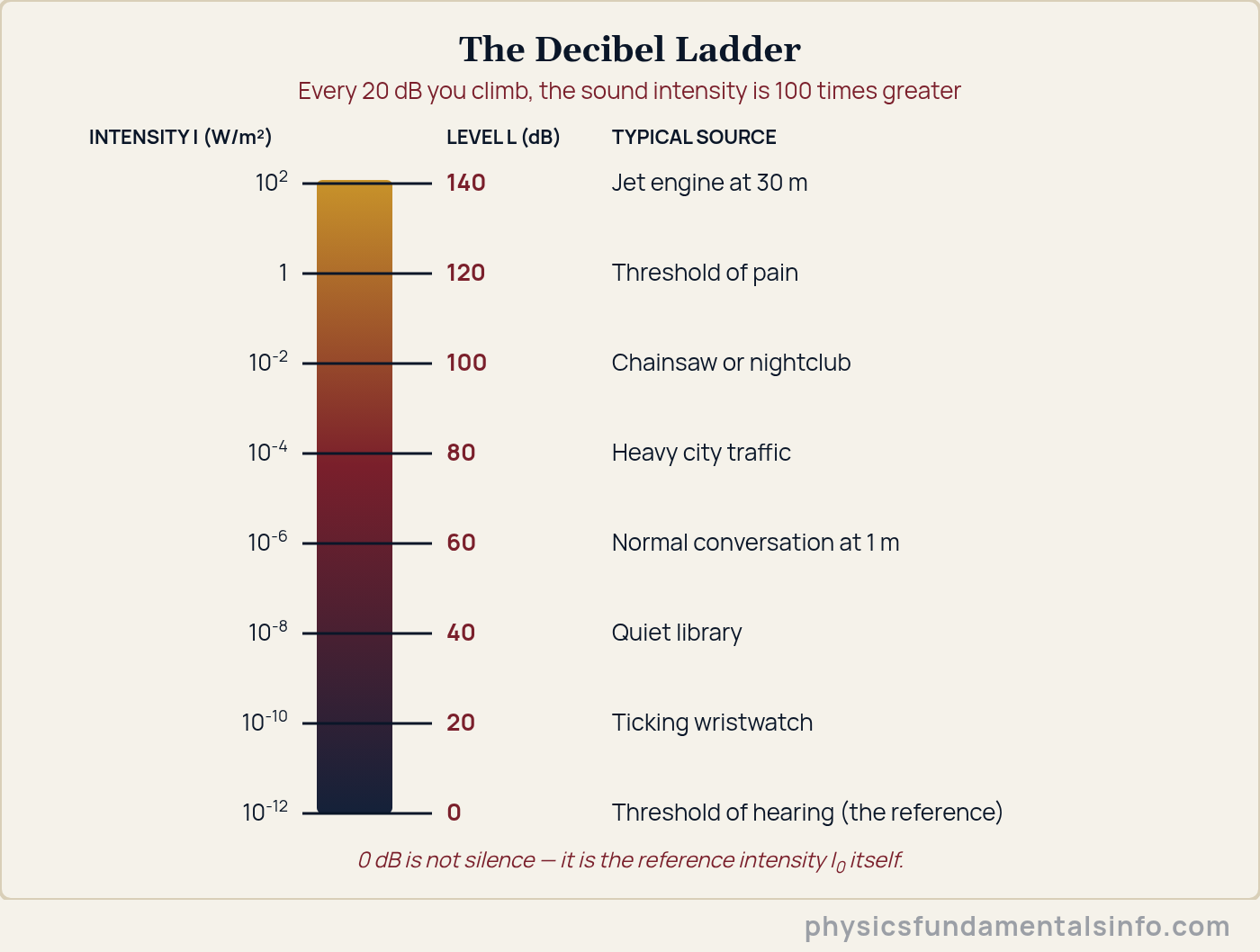
The decibel ladder: a factor of 100 in intensity is always a step of 20 dB, anywhere on the scale.
There is a second reason, and it is biological. Your perception of loudness tracks the logarithm of intensity far better than intensity itself, so a scale built on logarithms happens to line up with what your ear reports.
Slide the intensity control below and watch the level respond. The readout climbs in a straight line while the intensity underneath it explodes through the powers of ten.
The +3 dB and +10 dB Rules
Two shortcuts do most of the work in real acoustics, and both fall straight out of the formula. Doubling the intensity adds 3.01 dB, because 10 log10(2) = 3.01. Multiplying the intensity by ten adds exactly 10 dB.

Decibel steps and what they mean for intensity and for perceived loudness.
Here is the part that surprises people. Put a second identical machine beside the first — genuinely twice the acoustic energy — and the level rises from 82 dB to just 85 dB. Doubling the physics barely shifts the number.
To combine sources you must convert each level back to intensity, add the intensities, then convert once at the end. Levels themselves never add: 60 dB plus 60 dB is 63 dB, not 120 dB.
In practice this is why halving the traffic on a road is disappointing. Cut the flow by half and you win about 3 dB — real, measurable, and almost inaudible to a resident standing at the kerb.
Sound Levels of Common Sounds: The Reference Table
The table below is the fastest way to build intuition for what a decibel figure means. Every 10 dB step multiplies the intensity by ten, so the right-hand column climbs by a power of ten each row.
| Sound source (typical) | Level L (dB) | Intensity I (W/m2) | I / I0 |
|---|---|---|---|
| Threshold of hearing at 1 kHz | 0 | 1 × 10-12 | 1 |
| Rustling leaves, calm breathing | 10 | 1 × 10-11 | 10 |
| Whisper at 1 m | 30 | 1 × 10⁻⁹ | 103 |
| Quiet library, bedroom at night | 40 | 1 × 10⁻⁸ | 104 |
| Refrigerator hum | 50 | 1 × 10⁻⁷ | 105 |
| Normal conversation at 1 m | 60 | 1 × 10⁻⁶ | 106 |
| Vacuum cleaner, busy street | 70 | 1 × 10⁻⁵ | 107 |
| Heavy city traffic, alarm clock | 80 | 1 × 10⁻⁴ | 108 |
| Petrol lawnmower, motorcycle | 90 | 1 × 10⁻³ | 109 |
| Chainsaw, nightclub | 100 | 1 × 10⁻² | 1010 |
| Front row at a rock concert, siren | 110 | 1 × 10⁻¹ | 1011 |
| Threshold of pain | 120 | 1 | 1012 |
| Jet engine at 30 m | 140 | 1 × 10² | 1014 |
Treat these as representative figures, not fixed constants. A real measurement depends on distance, on the room, and on which frequency weighting the meter applies.
One number in that table is worth pausing on. From the threshold of hearing to the threshold of pain, the intensity grows by a factor of a million million — and the decibel scale files the whole span between 0 and 120.
How Sound Level Falls With Distance
Sound level falls by about 6 dB every time your distance from a small source doubles, provided the sound spreads freely with no reflections. The rule comes from the inverse-square law.
A point source radiating power P spreads that energy over a sphere, so the intensity at distance r is I = P / (4πr2). Double r and the same energy covers four times the area.
Feed that into the decibel formula and the distance rule appears:
Double the distance and you lose 20 log10(2) = 6.02 dB. Move ten times further away and you lose 20 dB.
This is why stepping back from a speaker helps far more than you expect, and why quoted levels are almost meaningless without a distance. A jet engine is 140 dB at 30 m and nothing like that from the terminal window.
How Loud Is Too Loud? Decibels and Hearing Damage
Sustained exposure at or above 85 A-weighted decibels can permanently damage hearing, and the safe daily exposure time halves for every extra 3 dB. That 3 dB step is exactly the doubling of intensity from earlier in this article, which is why the safety table and the physics table are the same table.
NIOSH sets its recommended exposure limit at 85 dBA averaged over an eight-hour working day, and treats anything at or above that as hazardous noise. The US National Institute on Deafness and Other Communication Disorders notes that sounds at or below 70 dBA are unlikely to cause hearing loss even after long exposure.
| Level (dBA) | Intensity relative to 85 dBA | NIOSH recommended daily limit |
|---|---|---|
| 85 | 1× | 8 hours |
| 88 | 2× | 4 hours |
| 91 | 4× | 2 hours |
| 94 | 8× | 1 hour |
| 97 | 16× | 30 minutes |
| 100 | 32× | 15 minutes |
| 106 | 128× | under 4 minutes |
| 112 | 512× | under 1 minute |
Notice how brutal the arithmetic becomes. Six decibels — the difference between 100 dBA and 106 dBA, which most people would describe as merely a bit louder — cuts the safe exposure from fifteen minutes to under four.
The A-weighting matters too. A dBA figure has been filtered to match the ear’s reduced sensitivity to very low and very high frequencies, so it predicts hearing risk better than an unweighted dB reading of the same sound.
Common Misconceptions About Decibels
“0 dB means total silence”
It does not. Zero decibels is simply the point where I equals I0, because log10(1) = 0. Sounds quieter than the reference are perfectly possible and give negative levels — an anechoic chamber can sit below -9 dB.
“Twice the intensity sounds twice as loud”
Twice the intensity is +3 dB, which most listeners can barely detect. Doubling perceived loudness takes roughly +10 dB, which is ten times the intensity. Physics and perception are pulling on different ropes here, and conflating them is the single most common decibel error.
“You can add decibel readings together”
Levels are logarithms, and logarithms do not add like ordinary numbers. Two 60 dB sources give 63 dB. Ten of them give 70 dB. Always convert back to intensity, sum, then convert forward again.
“Loudness and pitch are the same thing”
They are independent. Loudness follows intensity, which depends on the wave’s amplitude, while pitch follows frequency. A double bass and a piccolo can register the identical decibel level while sounding nothing alike.
How the Decibel Formula Connects to Waves, Power and Pressure
The decibel sits at a junction between several ideas you have probably already met. Intensity is power per unit area, so the same energy accounting that governs a light bulb governs a loudspeaker — the acoustic version just measures watts spread across square metres, in the standard SI units.
Intensity depends on the square of the wave’s amplitude, which is why a modest increase in the vibration of a speaker cone produces a much larger jump in energy delivered.
Frequency and level are separate properties of the same wave, and both can change independently. A siren passing at speed keeps roughly its acoustic power while its pitch shifts through the Doppler effect, and its level climbs then falls purely because the distance changes.
The decibel idea also travels well beyond sound. Engineers use dB for optical loss, radio gain and signal-to-noise ratio — any place a quantity spans many orders of magnitude and only ratios matter.
Worked Problems
Show Solution
Solution:
Step 1: Use the decibel formula L = 10 log10(I / I0), with I0 = 1 × 10-12 W/m2.
Step 2: Form the ratio: I / I0 = (3.2 × 10⁻⁵ W/m2) / (1 × 10-12 W/m2) = 3.2 × 10⁷.
Step 3: Take the logarithm: log10(3.2 × 10⁷) = 7.505, so L = 10 × 7.505 = 75.05 dB.
Answer: L = 75.1 dB (3 s.f.)
Show Solution
Solution:
Step 1: Rearrange the formula for intensity: I = I0 × 10(L/10).
Step 2: Substitute: I = (1 × 10-12 W/m2) × 10(85/10) = (1 × 10-12) × 108.5.
Step 3: Evaluate: 108.5 = 3.162 × 10⁸, so I = 3.162 × 10⁻⁴ W/m2.
Answer: I = 3.2 × 10⁻⁴ W/m2 (2 s.f.)
Show Solution
Solution:
Step 1: Levels cannot be added, so convert to intensity first: I1 = 10-12 × 108.2 = 1.585 × 10⁻⁴ W/m2.
Step 2: Two identical machines give twice the intensity: Itotal = 2 × 1.585 × 10-4 = 3.170 × 10⁻⁴ W/m2.
Step 3: Convert back: L = 10 log10(3.170 × 10⁻⁴ / 10-12) = 10 × 8.501 = 85.01 dB.
Answer: L = 85.0 dB — an increase of just 3.01 dB
Show Solution
Solution:
Step 1: Take the difference of levels: ΔL = 90 dB – 60 dB = 30 dB.
Step 2: Since ΔL = 10 log10(I2 / I1), rearrange to I2 / I1 = 10(ΔL/10).
Step 3: Evaluate: I2 / I1 = 10(30/10) = 103 = 1000.
Answer: The intensity must be 1000 times greater
Show Solution
Solution:
Step 1: For a point source, intensity obeys the inverse-square law, giving ΔL = 20 log10(r1 / r2).
Step 2: Substitute the distances: ΔL = 20 log10(2.0 m / 16 m) = 20 log10(0.125) = 20 × (-0.9031) = -18.06 dB.
Step 3: Add to the original level: L2 = 100 dB – 18.06 dB = 81.94 dB.
Answer: L = 81.9 dB (3 s.f.)
Show Solution
Solution:
Step 1: Intensity from a point source is I = P / (4πr2).
Step 2: Substitute with units: I = 0.50 W / (4π × (4.0 m)2) = 0.50 / 201.06 = 2.487 × 10⁻³ W/m2.
Step 3: Apply the decibel formula: L = 10 log10(2.487 × 10⁻³ / 10-12) = 10 × 9.396 = 93.96 dB.
Step 4: Compare with the NIOSH limits: at about 94 dBA the recommended daily exposure is one hour, so a full shift at this distance is not safe.
Answer: L = 94.0 dB (3 s.f.); safe for roughly 1 hour, not a full day
Show Solution
Solution:
Step 1: Use the pressure form of the formula: Lp = 20 log10(p / p0), with p0 = 2.0 × 10⁻⁵ Pa.
Step 2: Substitute: Lp = 20 log10(2.0 Pa / 2.0 × 10⁻⁵ Pa) = 20 log10(1.0 × 10⁵) = 20 × 5 = 100 dB.
Step 3: Subtract the attenuation: 100 dB – 25 dB = 75 dB at the eardrum.
Step 4: Check what 25 dB means physically: the intensity ratio is 10(25/10) = 316, so the plug lets through only about 0.32 per cent of the incoming intensity.
Answer: Lp = 100 dB unprotected, 75 dB behind the plug