Pressure in physics is the force pushing at right angles on a surface divided by the area that force is spread over, written P = F/A. Its SI unit is the pascal (Pa), where one pascal equals one newton per square metre. The smaller the area, the greater the pressure.
Press your thumb gently against the flat side of a butter knife and nothing happens. Flip the blade around, push with the very same force, and you can slice straight through. Your thumb didn’t suddenly get stronger — the force just got squeezed onto a far thinner edge.
That squeeze is pressure at work. The same push, spread over a tiny area, turns fierce; spread over a wide one, it stays gentle. From a drawing pin to a diver’s aching ears to the brakes that stop your car, pressure quietly runs the physical world — and it all begins with one short formula.
What Is Pressure in Physics?
Imagine standing on fresh snow in ordinary boots. You sink. Strap on a pair of snowshoes and you walk on top of it. Your weight hasn’t changed at all — only the area carrying it has.
That is the whole idea. Pressure measures how concentrated a force is on the surface it pushes against. Take a force and pack it onto a small area and the pressure is high. Spread that identical force over a large area and the pressure drops.
More precisely: pressure is the force acting perpendicular to a surface, per unit area of that surface. “Perpendicular” matters — only the part of a force pressing straight into the surface counts, not the part sliding along it.
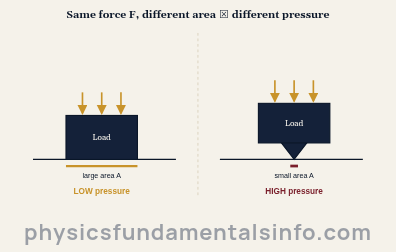
The same load gives very different pressures depending on contact area — spread it out for low pressure, concentrate it for high pressure (P = F ÷ A).
The Pressure Formula: P = F/A
Everything about pressure lives in one compact equation.
Each symbol has a precise meaning and its own SI unit:
- P — pressure, measured in pascals (Pa). One pascal is one newton per square metre.
- F — the force pushing perpendicular to the surface, measured in newtons (N). If that force is an object’s weight, find it with Newton’s second law, F = ma.
- A — the area the force is spread over, measured in square metres (m2).
The pascal is a small unit. One pascal is roughly the pressure a sheet of paper exerts lying flat on a table, so real-world pressures are usually quoted in kilopascals (kPa) or atmospheres. You can compute any of the three quantities instantly with our Pressure Calculator.
There is a second formula you need for liquids and gases — the pressure caused by a fluid’s own weight at a given depth:
- ρ (rho) — the fluid’s density in kg/m3 (water is about 1000 kg/m3).
- g — gravitational field strength, ≈ 9.81 m/s2 on Earth.
- h — depth below the fluid’s surface, in metres (m).
Notice what’s missing: area. The pressure deep in a fluid doesn’t depend on the shape or width of the container — only on how far down you go.
How Pressure Works
Why does shrinking the area raise the pressure so dramatically? Because the same total force now has fewer square metres to share itself between. Halve the area and you double the pressure. Cut it to a hundredth and the pressure multiplies a hundredfold.
This is exactly why sharp things work. A knife edge, a needle, a drawing pin or a stiletto heel all funnel a modest force onto a sliver of area, and the pressure soars high enough to pierce, cut or sink in. Blunt the edge and you spread the force back out, and the cutting stops.
Pressure in fluids acts in every direction
In a solid, a push goes straight down to the floor. In a liquid or gas it behaves differently. The molecules are free to move, so a squeeze in one direction sets off pushes in all directions. At any single point in a still fluid, the pressure is the same whichever way you face — which is why pressure is a scalar, with size but no direction of its own. NASA’s Beginner’s Guide to Aeronautics describes this nicely using the constant drumming of gas molecules on a container wall.
Deeper means greater pressure
Dive into a pool and your ears feel it within a metre or two. That ache is the weight of the water stacked above you pressing in. The deeper you go, the taller that column of fluid, and the harder it pushes — captured exactly by P = ρgh.
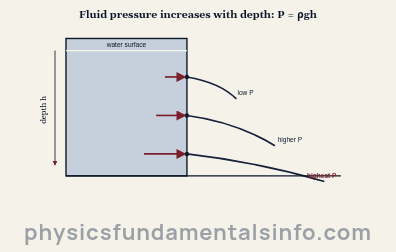
Pressure in a fluid grows with depth because more fluid weighs down from above, so the deepest opening is under the greatest pressure and pushes water out fastest (P = ρgh).
Pascal’s principle and the hidden superpower of fluids
Squeeze an enclosed fluid and that extra pressure spreads to every part of it, undiminished. This is Pascal’s principle, and it is the trick behind every hydraulic system.
Push a small piston with a small force and you create a certain pressure. That same pressure pushes back on a much larger piston — and because force equals pressure times area, the big piston feels a much bigger force. A gentle push on a brake pedal becomes enough to stop a tonne of car.

Types of Pressure
“Pressure” on a weather app, a tyre gauge and a deep-sea sensor don’t all mean quite the same thing. Four versions come up again and again.
Atmospheric pressure is the weight of the whole column of air above you. At sea level it’s about 101 kPa — the air is genuinely heavy, you simply grew up under it. Gauge pressure is how much a pressure sits above that local atmosphere; it’s what most tyre and tank gauges read, since they zero themselves against the surrounding air.
Absolute pressure is the true total, measured from a perfect vacuum: absolute = gauge + atmospheric. Hydrostatic (fluid) pressure is the part contributed by a column of fluid at depth, given by P = ρgh.
| Type | What it is | Measured from | Relation | Example |
|---|---|---|---|---|
| Atmospheric | Weight of the air column above you | — | ≈ 101 kPa at sea level | A barometer reading |
| Gauge | Pressure above the local atmosphere | Local air pressure | Pgauge = Pabs − Patm | A tyre gauge showing 220 kPa |
| Absolute | The true total pressure | A perfect vacuum | Pabs = Pgauge + Patm | Pressure inside a sealed cylinder |
| Hydrostatic (fluid) | Pressure from a fluid’s own weight at depth | The fluid surface | P = ρgh | Water pushing on a diver |
The units you’ll meet
Because the pascal is so small, pressure shows up in a zoo of other units. They all convert back to pascals, the SI base unit confirmed in NIST’s SI reference.
| Unit | Symbol | Value in pascals | Where you meet it |
|---|---|---|---|
| Pascal | Pa | 1 Pa = 1 N/m2 | The SI unit; small pressures |
| Hectopascal | hPa | 100 Pa | Weather maps (1 hPa = 1 millibar) |
| Kilopascal | kPa | 1,000 Pa | Tyres, engineering, gases |
| Bar | bar | 100,000 Pa | Industry, scuba (≈ 1 atm) |
| Atmosphere | atm | 101,325 Pa | Standard sea-level air pressure |
| Pound per square inch | psi | ≈ 6,895 Pa | Tyres, plumbing (US units) |
| Millimetre of mercury | mmHg (torr) | ≈ 133.3 Pa | Blood pressure, vacuum systems |
Real-World Examples of Pressure
Once you start looking, pressure is everywhere.
Sharp tools concentrate force
Knives, axes, needles, nails and drawing pins all do the same job: they take an everyday force and squeeze it onto a tiny area. The pressure rockets up and the tool bites. A pin pushed by your thumb can reach pressures higher than under an elephant’s foot, simply because the point is so small.
Wide surfaces spread it out
Snowshoes, skis, tractor tyres, camel feet and tank tracks chase the opposite goal. By enlarging the contact area, they keep the pressure low enough to stay on top of soft snow, sand or mud instead of sinking in.
Hydraulics multiply force
Car brakes, log splitters, diggers and garage jacks all run on Pascal’s principle. A small force on a narrow piston creates a pressure that pushes hard on a wide piston, turning a light input into a heavy lift.
Pressure in your body and the sky
Blood pressure is quoted as something like 120/80 mmHg — a fluid pressure your heart maintains. Weather forecasters track air pressure in hectopascals, because falling pressure often signals a storm. And drinking through a straw works by lowering the pressure in your mouth so the higher outside air pressure pushes the drink up.
Common Misconceptions About Pressure
“Pressure and force are the same thing”
They aren’t. Force is the total push in newtons; pressure is that push divided by area. Apply the very same force through a blunt edge and a sharp one and you get wildly different pressures — only the second one cuts.
“Heavier objects always exert more pressure”
Not necessarily. A featherlight drawing pin on a pinpoint can exert far more pressure than a heavy person standing flat-footed, because area, not just weight, sets the pressure.
“Pressure in a liquid only pushes downwards”
Fluid pressure pushes equally in every direction at a given depth — sideways and upward too, not just down. That’s why a submarine hull is squeezed from all sides and why water spurts sideways out of a hole in a bottle.
“Air pressure should crush us”
Atmospheric pressure presses on roughly every square centimetre of you, yet you feel nothing. The fluids inside your body push back outward with matching pressure, so the forces balance — your body is built in equilibrium with the air.
How Pressure Relates to Force, Area and Other Physics
Pressure is really a way of repackaging ideas you already know. The F in P = F/A is a genuine force, so it obeys the same rules as any other push or pull — including tension force in a rope or the friction under your shoes. What makes pressure distinct is the second ingredient: area.
In fluids, pressure links straight to density through P = ρgh — denser fluids build pressure faster with depth, which is why you’d feel mercury far sooner than water. Pressure differences in moving air are also what create drag; an object falling through the atmosphere settles at its terminal velocity when that resistance balances its weight.
Pressure even connects to energy. When a gas expands against a piston, the pressure does work done on its surroundings — the principle behind every engine cylinder. Master P = F/A and a surprising amount of physics, from diving to weather to machinery, slots into place.
Worked Problems
Show Solution
Solution:
Step 1: Use the definition of pressure, P = F / A.
Step 2: Substitute with units. P = 200 N ÷ 0.50 m2.
Step 3: Solve. P = 400 Pa.
Answer: 400 Pa (or 0.40 kPa)
Show Solution
Solution:
Step 1: Rearrange P = F / A to make F the subject, F = P × A.
Step 2: Convert and substitute. 250 kPa = 250,000 Pa, so F = 250,000 Pa × 0.020 m2.
Step 3: Solve. F = 5,000 N.
Answer: 5,000 N (5 kN)
Show Solution
Solution:
Step 1: Rearrange P = F / A to make A the subject, A = F / P.
Step 2: Substitute with units. A = 700 N ÷ 3,500 Pa.
Step 3: Solve. A = 0.20 m2.
Answer: 0.20 m2 of contact area
Show Solution
Solution:
Step 1: Find the weight (the force). F = mg = 50 kg × 9.81 m/s2 = 490.5 N.
Step 2: Convert areas to m2. Heel: 1.0 cm2 = 1.0 × 10⁻⁴ m2. Sole: 150 cm2 = 1.5 × 10⁻² m2.
Step 3: Apply P = F / A to each. Heel: P = 490.5 ÷ 1.0 × 10−4 = 4.9 × 10⁶ Pa. Sole: P = 490.5 ÷ 1.5 × 10⁻² ≈ 3.3 × 10⁴ Pa.
Answer: about 4.9 MPa on the heel versus 33 kPa on the sole — roughly 150 times more pressure on the heel.
Show Solution
Solution:
Step 1: Use the fluid-pressure formula, P = ρgh.
Step 2: Substitute with units. P = 1000 kg/m3 × 9.81 m/s2 × 10 m.
Step 3: Solve. P = 98,100 Pa.
Answer: about 98 kPa — close to one extra atmosphere for every 10 m of water.
Show Solution
Solution:
Step 1: Find the gauge (fluid) pressure first. Pgauge = ρgh = 1000 × 9.81 × 20 = 196,200 Pa.
Step 2: Add atmospheric pressure. Pabs = Pgauge + Patm = 196,200 + 101,325.
Step 3: Solve. Pabs = 297,525 Pa.
Answer: about 298 kPa, or roughly 2.9 atmospheres.
Show Solution
Solution:
Step 1: Find the pressure created at the small piston. P = F1 / A1 = 100 N ÷ 0.010 m2 = 10,000 Pa.
Step 2: By Pascal’s principle that pressure acts on the large piston too, so F2 = P × A2.
Step 3: Substitute and solve. F2 = 10,000 Pa × 0.50 m2 = 5,000 N.
Answer: 5,000 N — the jack multiplies the force 50 times (the ratio of the areas).