The Doppler effect is the change in the observed frequency of a wave when the source and the observer move relative to each other. Waves bunch together ahead of an approaching source, raising the observed frequency, and stretch out behind a receding source, lowering it. For sound, the observed frequency equals the emitted frequency multiplied by (wave speed ± observer speed) divided by (wave speed ∓ source speed).
You already know this effect by ear. An ambulance races towards you with its siren high and urgent — then, the instant it passes, the pitch sags downwards, as if the siren itself were deflating.
The siren never changed. What changed was the spacing of the sound waves arriving at you. That everyday observation, properly understood, is the same physics that lets astronomers measure galaxies receding at millions of metres per second.
What Is the Doppler Effect?
The Doppler effect (or Doppler shift) is the apparent change in a wave’s frequency caused by relative motion between the wave’s source and an observer. Approach raises the observed frequency; recession lowers it.
Picture a duck paddling across a pond. The ripples ahead of it crowd together because the duck keeps chasing its own waves, while the ripples behind spread further apart. Sound from a moving siren behaves exactly the same way — and a wave’s frequency is just how many crests reach you per second.
Crucially, nothing about the wave’s true frequency changes at the source. The shift exists only in what each observer measures, and observers in different positions can measure different frequencies from the same siren at the same moment.
Who discovered it?
The Austrian physicist Christian Doppler proposed the effect in 1842, originally to explain the colours of double stars. Three years later it was famously tested with trained musicians playing aboard a moving train while other musicians on the platform judged the pitch — and the prediction held.

The Doppler Effect Formula
For sound — or any wave travelling through a medium — one equation covers every combination of moving source and moving observer:
| Symbol | Meaning | SI unit |
|---|---|---|
| f’ | Observed (Doppler-shifted) frequency | hertz (Hz) |
| f | Frequency emitted by the source | hertz (Hz) |
| v | Speed of the wave in the medium (≈ 343 m/s for sound in air at 20 °C) | metres per second (m/s) |
| vo | Speed of the observer relative to the medium | metres per second (m/s) |
| vs | Speed of the source relative to the medium | metres per second (m/s) |
The sign convention trips up more students than the algebra does. Use the top signs for motion towards the other party and the bottom signs for motion away:
- Observer moves towards the source: use +vo (you intercept crests more often).
- Observer moves away: use −vo.
- Source moves towards the observer: use −vs (a smaller denominator makes f’ larger).
- Source moves away: use +vs.
A quick sanity check beats memorising signs: approach must always give a higher frequency. If your chosen signs produce the opposite, flip them.
The Doppler frequency for wavelength
A moving source also reshapes the wavelength of the sound around it. Ahead of and behind the source:
The wave speed v itself never changes — it is fixed by the medium. Only the spacing of the crests, and therefore the Doppler frequency you measure, is altered.
How the Doppler Effect Works
Think of a siren as a machine that drops one wave crest into the air every T seconds, where T = 1/f. Each crest then expands outwards at 343 m/s, completely indifferent to what the siren does next.
Now set the siren moving. Each new crest is emitted from a point slightly closer to you than the last one, so consecutive crests leave from a shrinking head start. They arrive at your ear with less time between them — a shorter period, which is a higher frequency.
Behind the source the logic runs in reverse: each crest is born further away than the one before it, the gaps stretch, and the frequency drops. One siren, one true frequency, two different sounds.
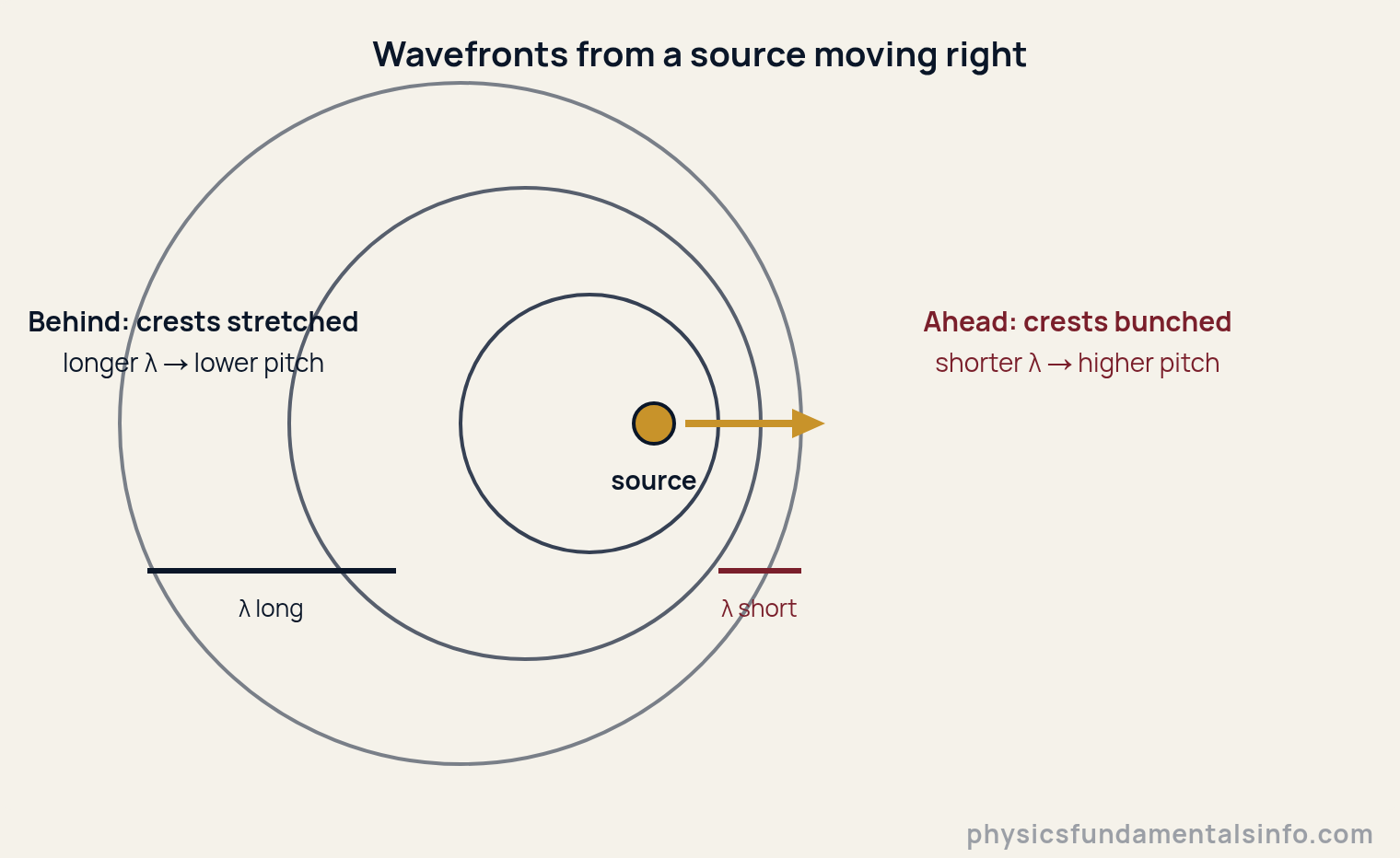
Each wavefront expands from where the source was when it was emitted — so crests pile up ahead of the motion and spread out behind it.
Want to feel it rather than read it? Drag the sliders below — push the source speed up and watch the wavefronts crowd, and the Doppler frequency readouts split apart.
Doppler Effect for Sound vs Light
Does the same trick work for light? Yes — with one deep difference. Sound needs a medium, so it matters separately whether the source or the observer moves through the air. Light needs no medium, so only the relative velocity between source and observer counts.
For light, motion away from us stretches wavelengths towards the red end of the spectrum (redshift), and motion towards us compresses them towards the blue (blueshift). At everyday speeds the shift in light is far too small to see — which is why you hear the ambulance change but never see its lights change colour.
Here z is the redshift, Δλ the change in wavelength, λ the emitted wavelength, v the recession speed, and c = 299,792,458 m/s the speed of light. At speeds approaching c the full relativistic formula is needed; the HyperPhysics treatment of the Doppler effect walks through both versions cleanly.
| Situation | Observed frequency | Observed wavelength | Sound | Light |
|---|---|---|---|---|
| Source approaching | Higher (f’ > f) | Shorter | Pitch rises | Blueshift |
| Source receding | Lower (f’ < f) | Longer | Pitch falls | Redshift |
| No relative motion | Unchanged (f’ = f) | Unchanged | True pitch | True colour |
Real-World Examples of the Doppler Effect
1. The passing siren
An ambulance at 25 m/s (90 km/h) shifts a 700 Hz siren up to about 755 Hz on approach and down to about 652 Hz once past. That total drop of roughly 16% is around two-and-a-half semitones — easily audible, which is exactly why you notice it.
2. Police speed radar
A radar gun fires microwaves at your car and measures the frequency of the reflection. Because the moving car shifts the reflected wave, the difference between transmitted and received frequencies reveals your speed directly. The shift is tiny, but electronics can resolve it effortlessly.
3. Medical Doppler ultrasound
Ultrasound reflected from moving red blood cells comes back Doppler-shifted in proportion to the blood’s speed. Clinicians use this to map blood flow, find blockages, and listen to a foetal heartbeat — all without a single incision.
4. Redshift in astronomy
Spectral lines from distant galaxies arrive stretched to longer wavelengths than the same lines produced in a laboratory. Measuring that shift gives the galaxy’s recession speed — the observational backbone of the expanding-universe picture. The same technique, run with exquisite precision, detects exoplanets by the tiny wobble they induce in their star.
5. Doppler weather radar
Weather radar doesn’t just see where rain is — it sees how fast the rain is moving towards or away from the dish, via the frequency shift of the echo. That velocity map is how rotation inside a storm is spotted before a tornado fully forms.
Common Misconceptions About the Doppler Effect
“The siren itself changes pitch”
It doesn’t. The source emits one fixed frequency throughout; only the observed frequency differs, and it differs between observers. A passenger riding inside the ambulance hears the same steady pitch the whole time.
“The pitch keeps rising as it gets closer”
Not for a head-on approach. While the source approaches at constant speed you hear one constant, raised pitch; the drop happens around the moment it passes. The growing loudness as it nears is a separate effect — amplitude, not frequency.
“The Doppler effect changes the wave’s speed”
The medium alone sets the wave speed. Sound leaves a 300 km/h train at the same 343 m/s as sound from a parked one. What motion changes is the spacing of crests — wavelength and frequency — never v.
“Source motion and observer motion are interchangeable”
For sound they are not, because the air provides a reference. A source moving at v towards you sends the frequency to infinity (the sonic-boom limit), while an observer moving at v towards a still source only doubles it. Only for light, with no medium, is pure relative motion all that matters.
How the Doppler Effect Relates to Frequency, Waves and Relativity
Everything here rests on the basic wave relationship v = fλ — if the speed is fixed and the wavelength is squeezed, the frequency must rise. If that relationship feels shaky, our guide to the frequency formula is the right foundation to revisit first.
The effect is also a lesson in relative motion: what you measure depends on how you move, which connects directly to the distinction between velocity and speed. And pushed to light speeds, the Doppler shift picks up time-dilation corrections from special relativity — including a purely relativistic transverse shift with no classical counterpart at all.
Worked Problems
Show Solution
Solution:
Step 1: Source approaching a stationary observer: f’ = f v / (v − vs).
Step 2: f’ = 700 Hz × (343 m/s) / (343 m/s − 25.0 m/s) = 700 × 343/318 Hz.
Step 3: f’ = 240,100/318 Hz = 755.0 Hz.
Answer: ≈ 755 Hz (3 s.f.) — higher than 700 Hz, as approach demands.
Show Solution
Solution:
Step 1: Source receding from a stationary observer: f’ = f v / (v + vs).
Step 2: f’ = 700 Hz × (343 m/s) / (343 m/s + 25.0 m/s) = 700 × 343/368 Hz.
Step 3: f’ = 240,100/368 Hz = 652.4 Hz.
Answer: ≈ 652 Hz (3 s.f.) — the pedestrian hears the pitch fall from 755 Hz to 652 Hz as it passes.
Show Solution
Solution:
Step 1: Observer approaching a stationary source: f’ = f (v + vo) / v.
Step 2: f’ = 500 Hz × (343 m/s + 20.0 m/s) / (343 m/s) = 500 × 363/343 Hz.
Step 3: f’ = 181,500/343 Hz = 529.2 Hz.
Answer: ≈ 529 Hz (3 s.f.).
Show Solution
Solution:
Step 1: Both moving towards each other: f’ = f (v + vo) / (v − vs).
Step 2: f’ = 400 Hz × (343 + 15.0) m/s / (343 − 30.0) m/s = 400 × 358/313 Hz.
Step 3: f’ = 143,200/313 Hz = 457.5 Hz.
Answer: ≈ 458 Hz (3 s.f.) — both motions raise the frequency, so f’ > 400 Hz checks out.
Show Solution
Solution:
Step 1: Approaching source: f’ = f v / (v − vs). Rearrange for the denominator: v − vs = f v / f’.
Step 2: v − vs = (600 Hz × 343 m/s) / 640 Hz = 205,800/640 m/s = 321.6 m/s.
Step 3: vs = 343 m/s − 321.6 m/s = 21.4 m/s.
Answer: ≈ 21.4 m/s (about 77 km/h).
Show Solution
Solution:
Step 1: Redshift: z = Δλ / λ, and for v ≪ c, v ≈ z c.
Step 2: z = (660.0 nm − 656.3 nm) / 656.3 nm = 3.7/656.3 = 5.64 × 10⁻³.
Step 3: v ≈ 5.64 × 10−3 × 2.998 × 108 m/s = 1.69 × 10⁶ m/s.
Answer: ≈ 1.69 × 10⁶ m/s (about 1,690 km/s), receding — the line shifted towards the red. The approximation is valid since z ≪ 1.