Total internal reflection is the complete reflection of a light ray back into its original medium, occurring when the ray meets a boundary with a lower-refractive-index medium at an angle beyond the critical angle. It works only when light travels from a higher to a lower refractive index, where sin θc = n2/n1.
Every second, the message you’re reading is fired as pulses of light down hair-thin glass threads under the ocean. The light should leak out of the sides — but it doesn’t. It stays trapped, bouncing thousands of times, racing across continents with almost none escaping.
That trick is total internal reflection. The same effect is why a cut diamond blazes, why a submarine’s periscope needs no mirror, and why, from underwater, the surface of a pool can look like a sheet of silver. One rule of light explains all of it.
What Is Total Internal Reflection?
Picture a torch beam inside a block of glass, aimed up at the top surface. Tilt the beam gently and it passes out into the air, bending as it goes. Keep tilting, though, and you reach an angle where the beam suddenly refuses to leave — it reflects straight back down into the glass as if the surface had turned into a mirror.
Total internal reflection (TIR) is that moment and everything beyond it: the point at which all the light is reflected back inside, and none is transmitted through the boundary.
It happens for one reason. When light tries to pass into a medium where it travels faster — a lower refractive index — it bends away from the normal. Push the incidence angle high enough and the “bent” ray would need to leave at more than 90°, which is impossible. So instead of refracting, the light has nowhere to go but back.
The tipping point has a name: the critical angle, written θc. Below it, light splits between reflection and refraction. At it, the refracted ray skims along the surface. Above it, reflection is total.
The Total Internal Reflection Formula: The Critical Angle
The critical angle comes straight out of the law of refraction. Snell’s law relates the two media and the two angles:
Total internal reflection sits at the special case where the refracted ray grazes the boundary — that is, θ2 = 90°. Since sin 90° = 1, Snell’s law collapses to a compact expression for the critical angle:
Rearranged for the angle itself:
Here is what each symbol means:
- θc — the critical angle, measured from the normal (the perpendicular to the surface). Unit: degrees (°) or radians (dimensionless).
- n1 — the refractive index of the denser medium, the one the light starts in. Dimensionless.
- n2 — the refractive index of the less dense medium the light is trying to enter. Dimensionless.
Refractive index itself is just a ratio, n = c / v: how many times slower light travels in the material than in a vacuum. Because it’s a ratio of two speeds, it has no units.
Notice what the formula predicts. The bigger the gap between n1 and n2, the smaller n2/n1 becomes, and the smaller the critical angle. A material with a very high index — like diamond — traps light at surprisingly shallow angles. You can work out the critical angle for any pair of media instantly with our Snell’s Law calculator, which also handles the full refraction case.
This critical-angle relationship is derived by setting the angle of refraction to 90° in Snell’s law, a result you can see spelled out in the HyperPhysics reference on total internal reflection from Georgia State University.
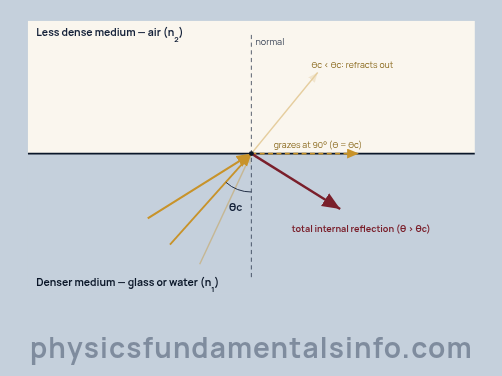
How the critical angle governs total internal reflection: below θc the ray escapes into the air, at θc it grazes along the boundary, and beyond θc every ray is reflected back into the denser medium.
How Total Internal Reflection Works
Follow a single ray as you steadily increase its angle of incidence, and the whole phenomenon unfolds in three stages.
Stage one — partial escape. At small angles, most of the light refracts through into the thinner medium, bending away from the normal. A little is always reflected too, but the escaping ray dominates.
Stage two — the grazing ray. As the angle grows, the refracted ray bends further and further from the normal until it lies almost flat against the boundary. The instant it hits 90° — running along the surface itself — you’ve reached the critical angle.
Stage three — total reflection. Nudge the angle past θc and refraction becomes geometrically impossible. There is no valid exit angle, so 100% of the light energy is thrown back into the original medium. The boundary now behaves like a flawless mirror — no silver, no coating, just physics. The Physics Classroom’s total internal reflection lesson walks through this three-stage progression with animated diagrams.
The Two Conditions for Total Internal Reflection
TIR is picky. Both of these must be true at once, or it simply won’t happen:
- Higher index to lower index. Light must travel from a medium of larger refractive index into one of smaller refractive index (for example, glass → air). Reverse the direction and there’s no critical angle at all.
- Angle above the critical angle. The angle of incidence must exceed θc. Right at θc you get the grazing ray; below it, light leaks out.
Fail either test and the reflection is only partial — some light always sneaks through.
Try it yourself below. Drag the angle of incidence past the critical angle and watch the refracted ray vanish the moment total internal reflection kicks in. Set the upper medium’s index below the lower one to see why direction matters.
Real-World Examples of Total Internal Reflection
This isn’t a lab curiosity. Total internal reflection quietly runs a surprising amount of the modern world.
1. Optical fibres — the internet’s backbone
An optical fibre is a thread of very pure glass with a high-index core wrapped in a lower-index cladding. Light launched into the core strikes the core–cladding boundary at a steep, glancing angle — well beyond the critical angle — so it’s totally reflected at every bounce.
The signal ricochets down the fibre, following it around gentle bends, losing almost nothing over many kilometres. That “low loss” is exactly why glass beat copper for long-distance data.
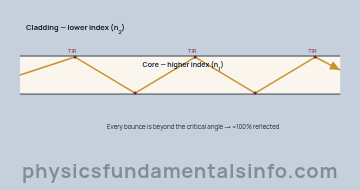
Inside an optical fibre, light meets the core–cladding boundary beyond the critical angle, so it is totally reflected at every bounce and races down the fibre — even around bends — with almost no loss.
2. The sparkle of diamonds
Diamond has an enormous refractive index — about 2.42 — which gives it a tiny critical angle of just 24.4°. Light that enters a well-cut stone hits the internal facets beyond that angle and bounces around many times before it can escape.
Cutters shape the facets so light can only leave through the top, concentrating all those internal reflections into the fire and brilliance you see. As the OpenStax College Physics chapter on total internal reflection explains, that small critical angle is the whole secret behind a diamond’s sparkle.
3. Prisms in binoculars and periscopes
Look inside a good pair of binoculars and you’ll find right-angle glass prisms, not mirrors. Light strikes the long face of a 45–45–90 prism at 45°, which comfortably exceeds glass’s ~41.8° critical angle, so it’s totally reflected.
Prisms make better reflectors than metal mirrors: they don’t tarnish, and they reflect essentially all the light. The same trick folds the light path in periscopes and SLR camera viewfinders.
4. Endoscopes and medical imaging
A medical endoscope is a flexible bundle of thousands of optical fibres. TIR carries light down to illuminate inside the body and pipes the image back out — letting surgeons see and operate through a tiny incision.
5. Refractometers and rain sensors
Because the critical angle depends only on the two indices, measuring it reveals an unknown refractive index. Refractometers use this to check the sugar content of juice or the concentration of a solution. Cars use a cousin of the idea: a rain sensor on the windscreen watches how droplets disrupt an internally reflected beam.
The table below shows how the critical angle shrinks as the material’s index climbs.
| Material (into air) | Refractive index, n | Critical angle, θc | Why it matters |
|---|---|---|---|
| Ice | 1.31 | 49.8° | Optical effects in glaciers and frost |
| Water | 1.33 | 48.6° | Snell’s window; a pond surface can look mirrored from below |
| Acrylic (PMMA) | 1.49 | 42.2° | Light pipes, edge-lit signs, plastic fibre |
| Crown glass | 1.52 | 41.1° | Prisms in binoculars and periscopes |
| Flint glass | 1.62 | 38.1° | Higher-index lenses; stronger internal reflection |
| Cubic zirconia | ~2.16 | ~27.6° | Diamond simulant — sparkles, but less than diamond |
| Diamond | 2.42 | 24.4° | Tiny critical angle traps light → maximum sparkle |
Common Misconceptions About Total Internal Reflection
“It’s the same as the reflection in any window.” Not even close. Ordinary reflection at a glass surface bounces back only about 4% of the light; the rest passes through. Total internal reflection returns essentially all of it — which is exactly why a fibre can carry a beam for kilometres and a window can’t.
“TIR happens whenever light hits a boundary.” It needs both conditions together: light going from higher index to lower index, and an angle above the critical angle. Miss either and light escapes.
“The critical angle is a fixed property of a material.” There’s no single “critical angle of glass.” It depends on both media through the ratio n2/n1. Glass-to-air (~41°) and glass-to-water (~61°) give very different answers for the same glass.
“Denser means heavier.” The “density” that matters here is optical density — refractive index — not mass density. They usually rise together, but it’s the index that sets the critical angle, so always compare n values, not weights.
How Total Internal Reflection Relates to Refraction and the Speed of Light
TIR isn’t a separate law of nature — it’s refraction pushed to its limit. Everything traces back to one fact: light changes speed when it crosses into a new medium.
A material’s refractive index is defined as n = c/v, where v is the speed of light inside it. A higher index simply means light crawls more slowly through that material, which is what forces the ray to bend at the boundary in the first place.
When light crosses from glass into air, its speed and wavelength both change, but its frequency stays fixed — the colour doesn’t change. That constant frequency is why we can track a single ray cleanly through the boundary and talk about one critical angle.
It also helps to remember what light is. Light is a transverse wave, and Snell’s law governs how any such wave refracts. That’s why the same critical-angle logic reappears for sound and seismic waves whenever they meet a boundary into a faster medium.
Worked Problems
Show Solution
Solution:
Step 1: Use the critical-angle formula — sin θc = n2 / n1.
Step 2: Substitute the indices — sin θc = 1.00 / 1.52 = 0.658.
Step 3: Take the inverse sine — θc = sin−1(0.658) = 41.1°.
Answer: θc ≈ 41.1° (any ray inside the glass hitting the surface beyond 41.1° is totally reflected).
Show Solution
Solution:
Step 1: sin θc = n2 / n1, with n2 = 1.00 (air) and n1 = 1.333 (water).
Step 2: sin θc = 1.00 / 1.333 = 0.750.
Step 3: θc = sin−1(0.750) = 48.6°.
Answer: θc ≈ 48.6°. (Rounding water to n = 1.33 instead gives ≈ 48.8°; textbooks quote 48.6° from the more precise 1.333.)
Show Solution
Solution:
Step 1: sin θc = n2 / n1 = 1.00 / 2.42.
Step 2: sin θc = 0.413.
Step 3: θc = sin−1(0.413) = 24.4°.
Answer: θc ≈ 24.4°. Such a small angle means light striking almost any internal facet is trapped and reflected many times — the physics behind a diamond’s brilliance.
Show Solution
Solution:
Step 1: Find the critical angle — θc = sin−1(n2/n1) = sin−1(1.00/1.50) = sin−1(0.667).
Step 2: θc = 41.8°.
Step 3: Compare angles — the incidence angle 50° is greater than θc = 41.8°, and light is going from higher to lower index.
Answer: Yes — both conditions are met, so the ray is totally internally reflected.
Show Solution
Solution:
Step 1: sin θc = n2 / n1 = 1.33 / 1.52.
Step 2: sin θc = 0.875.
Step 3: θc = sin−1(0.875) = 61.0°.
Answer: θc ≈ 61.0° — much larger than the glass-to-air value (41.1°) because the two indices are closer together.
Show Solution
Solution:
Step 1: Start from sin θc = n2 / n1 and rearrange — n1 = n2 / sin θc.
Step 2: Substitute — n1 = 1.00 / sin 45.0° = 1.00 / 0.7071.
Step 3: n1 = 1.414.
Answer: n ≈ 1.41. Measuring the critical angle is exactly how a refractometer determines an unknown index.
Show Solution
Solution:
Step 1: sin θc = n2 / n1 = 1.46 / 1.50.
Step 2: sin θc = 0.973.
Step 3: θc = sin−1(0.973) = 76.7°.
Answer: θc ≈ 76.7°. Only rays striking the wall at more than 76.7° from the normal (within 13.3° of grazing) stay trapped — which sets the fibre’s acceptance angle.
Show Solution
Solution:
Step 1: Find the critical angle — θc = sin−1(1.00/1.50) = 41.8°.
Step 2: Inside the prism, light meets the long (hypotenuse) face at 45°.
Step 3: Since 45° > 41.8°, the condition for total internal reflection is satisfied.
Answer: The light is totally reflected with no coating — a prism acts as a near-perfect mirror. Used in periscopes, binoculars and SLR viewfinders.