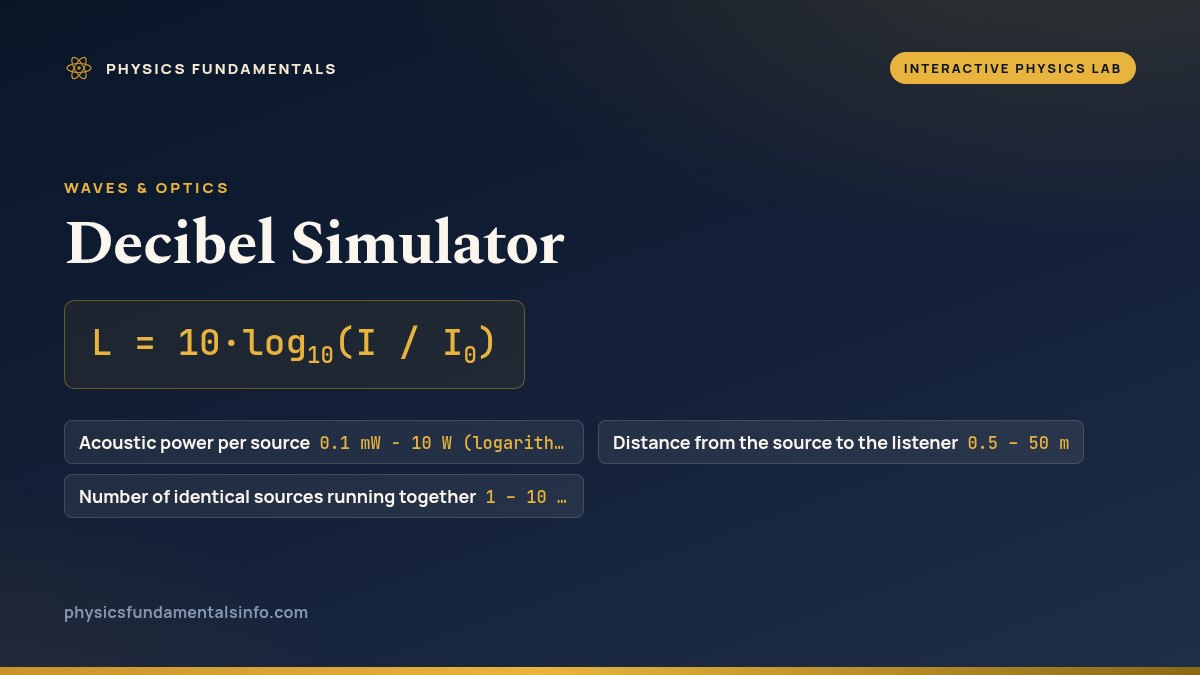
The decibel compresses a range of sound intensities of about a trillion to one into a scale running from 0 to roughly 140, using L = 10·log10(I / I0). Drag the sliders below to set the acoustic power, the listening distance and the number of sources, and watch the intensity and the level respond at completely different speeds.
Decibel and Sound Intensity
One point source spraying its power over an ever-larger sphere. Move the sliders and watch the intensity race through powers of ten while the decibel ladder strolls: ten times the power is +10 dB, a second source is +3 dB, double the distance is −6 dB.
What Is the Decibel Simulator?
The decibel simulator is a free interactive physics lab that runs in your browser — nothing to install and no sign-up. Drag the power, distance and source-count sliders and watch the sound level update live using L = 10 log10(I/I0). It reports sound level, sound intensity and change from pinned level as you drag the sliders.
| Control | Range | Step |
|---|---|---|
| Acoustic power per source | 0.1 mW - 10 W (logarithmic) | — |
| Distance from the source to the listener | 0.5 – 50 m | 0.5 |
| Number of identical sources running together | 1 – 10 source | 1 |
What Each Slider Changes, and Why the Two Readouts Disagree
The simulator runs its calculation in two stages, and watching them separately is the whole point. The acoustic power slider sets P, the energy the source pushes out every second; the distance slider sets r, how far away the listener stands; the sources slider sets n, how many identical machines are running at that one spot. From those three the sim first works out the intensity actually arriving at the listener, I = n·P / (4πr²) — the power spread thin across the surface of a sphere — and only then converts that intensity into a level with L = 10·log10(I / I0).
Keep an eye on both readouts as you drag. The intensity line is written in scientific notation and its exponent turns over constantly: a small nudge of the power slider is multiplying the number, not adding to it. The decibel line barely stirs by comparison. That mismatch is not a display quirk, it is the logarithm earning its keep — and it is why the power slider itself is spaced logarithmically, so that twenty of its notches make exactly one decade of power and exactly ten decibels of level.
Three buttons turn the model into a proof rather than a toy. Each one pins the current level before it acts, so the change from pinned level readout lands on the textbook figure with nothing taken on trust: ten times the power gives +10.00 dB, double the distance gives −6.02 dB, double the sources gives +3.01 dB. You can also pin by hand and then move a slider yourself to check the same arithmetic. Where a button would shove a slider past its end stop, the readout still reports the true, smaller change and says why.
The source slider is where intuition usually breaks. Switching on a second identical machine genuinely doubles the acoustic energy in the air, and the level answers with three decibels — a shift most listeners can barely detect. Follow the algebra in the full guide to the decibel formula, put a specific case through the decibel calculator, or check what power actually measures before you feed it into the top slider. For the wave carrying all this energy in the first place, see transverse and longitudinal waves.
Frequently asked questions
Why does doubling the sources add only 3 dB?
Because decibels are logarithms of a ratio, and two identical sources at one point deliver twice the intensity, not twice the level. The extra level is 10 x log10(2) = 3.01 dB, no matter how loud the first source was. Levels never add directly: 60 dB plus 60 dB is 63 dB. Set the source slider to 2 in the simulator and the change-from-pinned readout lands on exactly +3.01 dB.
Why does the level drop 6 dB when I double the distance?
A point source spreads its power over the surface of a sphere, and that surface grows with the square of the radius, so the simulator divides by 4 x pi x r squared. Double the distance and the same energy covers four times the area, leaving a quarter of the intensity. A quarter of the intensity is 10 x log10(0.25) = -6.02 dB. This only holds outdoors with nothing to reflect the sound back.
What is I0 and why is 0 dB not silence?
I0 is the reference intensity, fixed by convention at 1 x 10^-12 W/m2, roughly the quietest sound a healthy young ear can detect at 1 kHz. A decibel figure is always a comparison against it, so 0 dB simply means the intensity equals I0 exactly. It is the bottom of the human hearing scale, not an absence of sound.
Can the simulator show a negative decibel level?
Yes, and it will display it rather than clamping it to zero. A negative level just means the intensity has fallen below the reference I0, which is perfectly physical - it is a sound too quiet for a typical ear to notice. The sliders in this simulator stay above that point, but the underlying calculation handles it, and the ladder marker parks at the end of its drawn scale while the printed number keeps its true value.
Does the simulator use intensity or pressure?
Intensity, in watts per square metre, using L = 10 log10(I/I0). A real sound level meter measures pressure fluctuations instead and uses Lp = 20 log10(p/p0) with p0 = 20 micropascals. The factor of 20 appears because intensity is proportional to pressure squared. The two references are matched so that both scales put the threshold of hearing at 0 dB.
References & formula source
- Halliday, Resnick & Walker — Fundamentals of Physics, Chapter 17 (Waves — II: Sound), sound intensity and the decibel scale.
- Young & Freedman — University Physics with Modern Physics, §16.3 (Sound Intensity).
- NIOSH — Criteria for a Recommended Standard: Occupational Noise Exposure, on the 85 dBA exposure limit.
- Further reading: Decibel — Wikipedia