Power in physics is the rate at which work is done or energy is transferred, calculated as power equals work divided by time (P = W/t = Fv). Its SI unit is the watt (W), equal to one joule per second. A higher power means the same work is finished in less time.
Two cars climb the same hill. Both reach the top, so both do the same work against gravity. Yet a sports car roars up in seconds while a loaded van grinds up slowly. That difference — the one you can hear — is power.
Power answers a deceptively simple question: not just how much work gets done, but how fast. It is why a 2,000 W kettle boils before a 1,000 W one, and why every engine on Earth is quoted in horsepower. Get power straight, and a whole shelf of everyday machines suddenly makes sense.
What Is Power in Physics?
Imagine two builders hauling identical loads of bricks up to the same scaffold. One sprints up in a minute; the other plods up in five. They transfer the same energy — but the sprinter is five times more powerful.
Power in physics is the rate of doing work: how quickly energy is converted from one form into another. Two machines can do exactly the same work, and the one that finishes sooner has the greater power.
Because power is a rate, the clock counts as much as the joules. Halve the time a job takes and you double the power, even though not a single joule of work has changed.
Power is also a scalar quantity — it has size but no direction. You will see exactly why further down: it comes from combining a force and a velocity in a way that cancels the direction out.
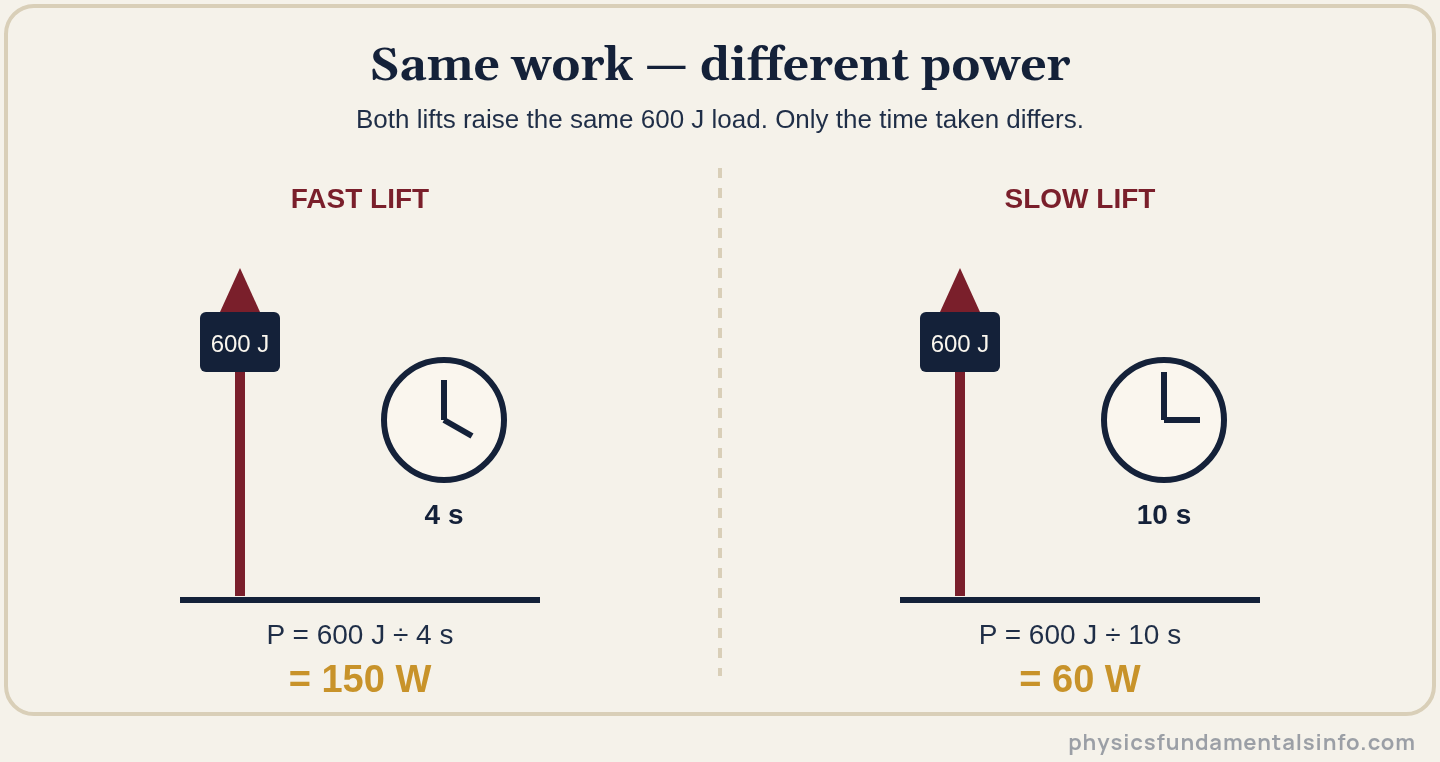
Same 600 J of work, two different times — and two very different power outputs.
The Power Formula: P = W/t and P = Fv
The defining equation of power is short enough to memorise in one breath:
Here W is the work done in joules and t is the time in seconds. When a force pushes something that is already moving, there is a second, equally important form:
This one says power equals the force multiplied by the object’s velocity in the direction of that force. It is the version engineers reach for whenever something travels at a steady speed — a car cruising, a conveyor belt running, an aircraft in level flight.
What each symbol means
- P — power, measured in watts (W), where 1 W = 1 joule per second (J/s) = 1 kg·m2/s3.
- W — work done (or energy transferred), measured in joules (J).
- t — time taken, measured in seconds (s).
- F — force along the direction of motion, measured in newtons (N).
- v — velocity (speed in the force’s direction), measured in metres per second (m/s).
The watt, the SI unit of power, is named after the Scottish engineer James Watt (1736–1819), whose improved steam engine helped drive the Industrial Revolution.
A worked feel for the unit: a 60-watt bulb converts 60 joules of electrical energy into light and heat every second. A 6 kW shower pours 6,000 joules into heating the water each second — a thousand times faster than a tiny LED night-light.
How Power Works: Turning Work Into Watts
The two formulas look different, but they are the same idea wearing two hats. Watch them collapse into each other.
Start with the definition of work for a constant force: force times the distance moved in the force’s direction, W = F·d. Now ask how fast that work is being done — divide by time.
- Work done by a constant force: W = F d.
- Power is work over time: P = W/t = F d / t.
- Distance over time is just velocity: d/t = v.
- So the time-rate of doing work becomes P = F v.
That is the whole trick. “Work per second” and “force times speed” are two routes to the same number.
There is a still more general statement. Power is the rate of change of energy, written P = ΔE/t. Work is one way to move energy around, but the definition holds for heat, light, electrical energy — any energy transfer at all.
One practical consequence is worth flagging. If the power stays constant, you can rearrange the formula to find the energy delivered over any stretch of time: W = P × t. That is exactly the calculation behind your electricity bill.
Average Power vs Instantaneous Power
Power rarely stays perfectly steady. A car accelerating onto a motorway pours out far more power in the first few seconds than when it settles into a cruise. So which “power” do we mean?
Average power spreads the total work over the whole time: P̅ = W/t. It is the single figure that captures an entire journey or job — total energy, divided by total time.
Instantaneous power is the power at one precise moment, found from the force and velocity at that instant: P = Fv. It is what a power meter reads right now, before the next moment changes it.
An analogy makes the split obvious. Average power is your average speed over a road trip; instantaneous power is the number on the speedometer at any given second. Useful in different ways, and often very different in value.
Real-World Examples of Power
Once you start looking, power ratings are stamped on almost everything around you.
Appliances on the label
Every plug-in device carries a wattage: a 10 W LED bulb, a 1,000 W microwave, a 2,200 W kettle. The number tells you how fast it converts electrical energy — and, on the bill, how fast it spends your money.
Engines and horsepower
A family car engine delivers roughly 100 kW — about 134 horsepower. At a steady cruise the engine’s job is pure P = Fv: it supplies just enough force to balance drag and friction at your chosen speed. Engineers from the earliest days of flight have sized engines this way; the Wright brothers calculated the power their 1903 engine needed from the expected drag force and flight speed.
Your own body
Sprint up a flight of stairs and you might briefly produce 500–700 W — most of one horsepower. You cannot hold it, though. Sustained over an hour your body manages only a few hundred watts, which is exactly why a short stair-dash leaves you breathless.
Power stations and turbines
Step up the scale and the units grow. A large wind turbine is rated around 3 MW (3 million watts); a single nuclear reactor unit produces roughly 1 GW (a billion watts) — enough to supply a small city.

To anchor your intuition, here are typical power outputs across that range (approximate values):
| Source / device | Approximate power output |
|---|---|
| Bright LED bulb | ~10 W |
| Human body at rest | ~100 W |
| Microwave oven | ~1,000 W (1 kW) |
| Electric kettle | ~2,200 W (2.2 kW) |
| Family car engine | ~100,000 W (100 kW) |
| Large wind turbine | ~3,000,000 W (3 MW) |
| Single nuclear reactor unit | ~1,000,000,000 W (1 GW) |
Power vs Energy vs Work: How They Connect
These three words get muddled constantly, yet the relationship is clean. Energy is the capacity to do work. Work is energy actually transferred by a force. Power is how fast that transfer happens.
One sentence ties them together: power is work (or energy) per unit of time, and conversely, energy is power multiplied by time. Watts measure the rate; joules measure the amount.
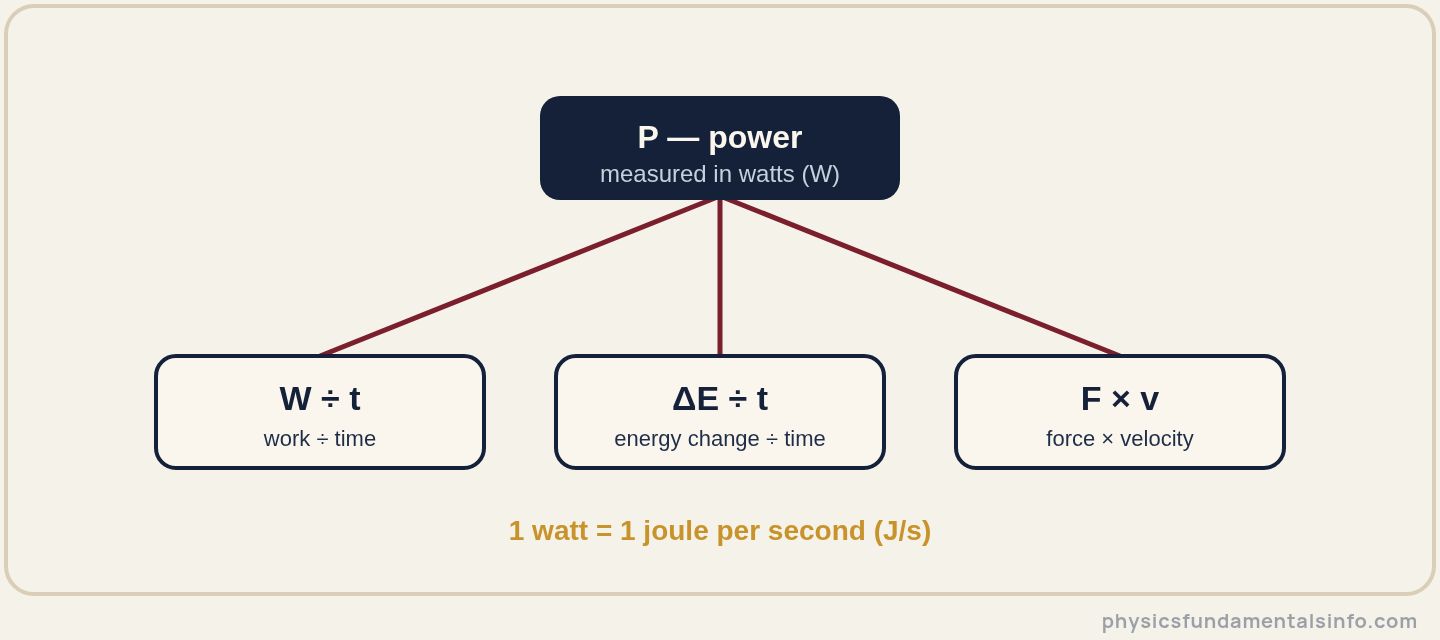
Three equivalent ways to write power — all giving an answer in watts.
The connection reaches into the worked problems too. To find average power from a speed change, you often calculate the change in kinetic energy first, then divide by the time taken.
The P = Fv form leans on two ideas covered elsewhere: the force comes from Newton’s second law, and v must be the true velocity in the force’s direction, not just any speed.
Power is not only mechanical. In a circuit, electrical power is P = V I (voltage times current), which combines with Ohm’s law to give P = I2R and P = V2/R. Same concept — energy per second — in a different costume.
Common Misconceptions About Power
A few sticky errors trip up almost everyone learning power. Clear these and the topic clicks.
“Power and energy are the same thing”
They are not. Energy (joules) is the total amount transferred; power (watts) is the rate of transfer. A torch and a lightning bolt can release similar energy — but the bolt does it in microseconds, so its power is astronomically higher.
“A kilowatt-hour is a unit of power”
It is a unit of energy. A kilowatt-hour is power × time — 1,000 watts sustained for one hour — which equals 3.6 million joules. Watts are the rate; kilowatt-hours are the total you actually pay for.
“More force always means more power”
Only if something moves. Push as hard as you like against a brick wall: it does not budge, no work is done, and the mechanical power delivered to it is zero. Because P = Fv, a huge force with zero velocity gives zero power. (Your muscles still burn energy — but that is physiology, not mechanical work on the wall.)
“Watts and watt-hours are interchangeable”
They measure different things. A watt is a rate (joules per second); a watt-hour is an amount of energy. Multiplying a wattage by the hours it runs converts one into the other — never treat them as the same quantity.
Worked Problems
Show Solution
Solution:
Step 1: Use the definition of power. P = W / t.
Step 2: Substitute with units. P = 24,000 J ÷ 8.0 s.
Step 3: Solve. P = 3,000 W.
Answer: 3,000 W (3.0 kW)
Show Solution
Solution:
Step 1: Rearrange the power formula for energy. W = P × t.
Step 2: Substitute with units. W = 1,500 W × 90 s.
Step 3: Solve. W = 135,000 J.
Answer: 135,000 J (135 kJ)
Show Solution
Solution:
Step 1: The work done against gravity is W = mgh.
Step 2: Substitute with units. W = 25 kg × 9.81 m/s2 × 2.0 m = 490.5 J.
Step 3: Divide by time. P = 490.5 J ÷ 5.0 s = 98.1 W.
Answer: 98 W (2 s.f.)
Show Solution
Solution:
Step 1: Work done against gravity. W = mgh.
Step 2: Substitute with units. W = 65 kg × 9.81 m/s2 × 3.5 m = 2,231.8 J.
Step 3: Divide by time. P = 2,231.8 J ÷ 4.2 s ≈ 531 W.
Answer: ≈ 530 W — about 0.7 horsepower, a realistic burst for a short sprint.
Show Solution
Solution:
Step 1: At constant speed, use P = Fv.
Step 2: Substitute with units. P = 2,400 N × 30 m/s.
Step 3: Solve. P = 72,000 W.
Answer: 72,000 W (72 kW, roughly 97 hp)
Show Solution
Solution:
Step 1: The work done equals the gain in kinetic energy. W = ½mv2 − 0.
Step 2: Substitute with units. W = ½ × 1,200 kg × (25 m/s)2 = 375,000 J.
Step 3: Divide by time. P = 375,000 J ÷ 8.0 s = 46,875 W.
Answer: ≈ 47,000 W (47 kW)
Show Solution
Solution:
Step 1 (a): Convert horsepower to watts. P_out = 0.50 × 745.7 W = 372.85 W.
Step 2 (b): Efficiency = output ÷ input, so input = output ÷ efficiency.
Step 3: Substitute. P_in = 372.85 W ÷ 0.80 = 466 W.
Answer: (a) ≈ 373 W output; (b) ≈ 470 W input