Thermal expansion is the increase in a material’s length, area or volume as its temperature rises, because its atoms vibrate more vigorously and their average spacing grows. For solids, the change in length follows ΔL = αL0ΔT, where α is the coefficient of linear expansion. Cooling reverses the effect, causing thermal contraction.
On a blazing July afternoon, the Eiffel Tower stands taller than it did on New Year’s Day — by roughly the height of a coffee mug. Nobody added any iron. The Sun did all the work.
That quiet growing and shrinking is happening all around you: in railway tracks, power lines, jam-jar lids and the ocean itself. This guide unpacks the physics, hands you the one-line formula engineers actually use, and lets you test it in an interactive lab.
What Is Thermal Expansion?
Picture a crowd standing still on a dance floor. Everyone fits comfortably. Now turn the music up: the same people, swaying and jumping, suddenly need far more room, and the crowd spreads outward.
Atoms in a solid behave the same way. Raise the temperature and they jiggle harder about their fixed positions, nudging their neighbours a little further away. Multiply that tiny extra elbow room by trillions of atomic layers and the whole object measurably grows.
More precisely, thermal expansion is the tendency of matter to change its dimensions in response to a change in temperature — expanding when heated and, for almost every material, contracting when cooled. Note that it is temperature doing the driving, not heat directly; if that distinction feels slippery, our guide to heat vs temperature untangles it.
Solids expand the least, liquids noticeably more, and gases most of all. The effect is small per degree — but it is relentless, and it ignores whatever stands in its way.
The Thermal Expansion Formula
For a rod, wire, rail or beam, the working equation is a single line:
- ΔL — change in length, in metres (m)
- α — coefficient of linear expansion, in per degree Celsius (°C−1), identical to per kelvin (K−1) because only temperature differences enter
- L0 — original length, in metres (m)
- ΔT — temperature change, in °C or K
A quick taste of the numbers: warm a 2.00 m aluminium rod (α = 23 × 10−6 °C−1) by 50 °C and it grows by ΔL = 23 × 10−6 × 2.00 × 50 = 2.3 mm. The final length is simply L = L0 + ΔL = L0(1 + αΔT). You can check any combination in seconds with our Thermal Expansion Calculator.
Area and Volume Expansion
Because every dimension grows at once, surfaces and volumes have their own versions of the law:
Why 3α? Each of the three dimensions stretches by a factor (1 + αΔT), and cubing that gives 1 + 3αΔT to an excellent approximation when αΔT is tiny — which it always is in everyday conditions.
Liquids have no shape of their own, so only β is quoted: about 2.1 × 10⁻⁴ °C−1 for water at room temperature and roughly 9.6 × 10⁻⁴ °C−1 for petrol — ten to fifty times a typical solid. Gases outdo everything: at constant pressure an ideal gas expands in proportion to its absolute temperature, an effective β of about 3.7 × 10⁻³ K−1 near 0 °C.
One honest caveat. α itself drifts slowly with temperature, so ΔL = αL0ΔT is a superb approximation for moderate swings — tens of degrees around everyday conditions — but engineers reach for tabulated data at cryogenic or furnace extremes.
Reading about expansion is one thing; watching it is better. Pick a material, drag the temperature and watch the rod grow:
How Does Thermal Expansion Work?
Here is the puzzle. If heating simply made atoms vibrate harder, nothing should grow — a vibration swings as far inward as outward, and the average position would stay put.
Neighbouring atoms behave like masses joined by a spring, vibrating about an equilibrium spacing in near-simple harmonic motion. If the bond were a perfect spring obeying Hooke’s law, hotter would just mean wider swings around the same average — and no expansion at all.
Real bonds are lopsided. Squeeze two atoms together and they resist ferociously; pull them apart and the attraction gives way far more gently. So an energetic atom swings further into the roomy outward side than into the cramped inward side, and its average separation drifts outward. That drift, a fraction of a picometre per bond, is thermal expansion.
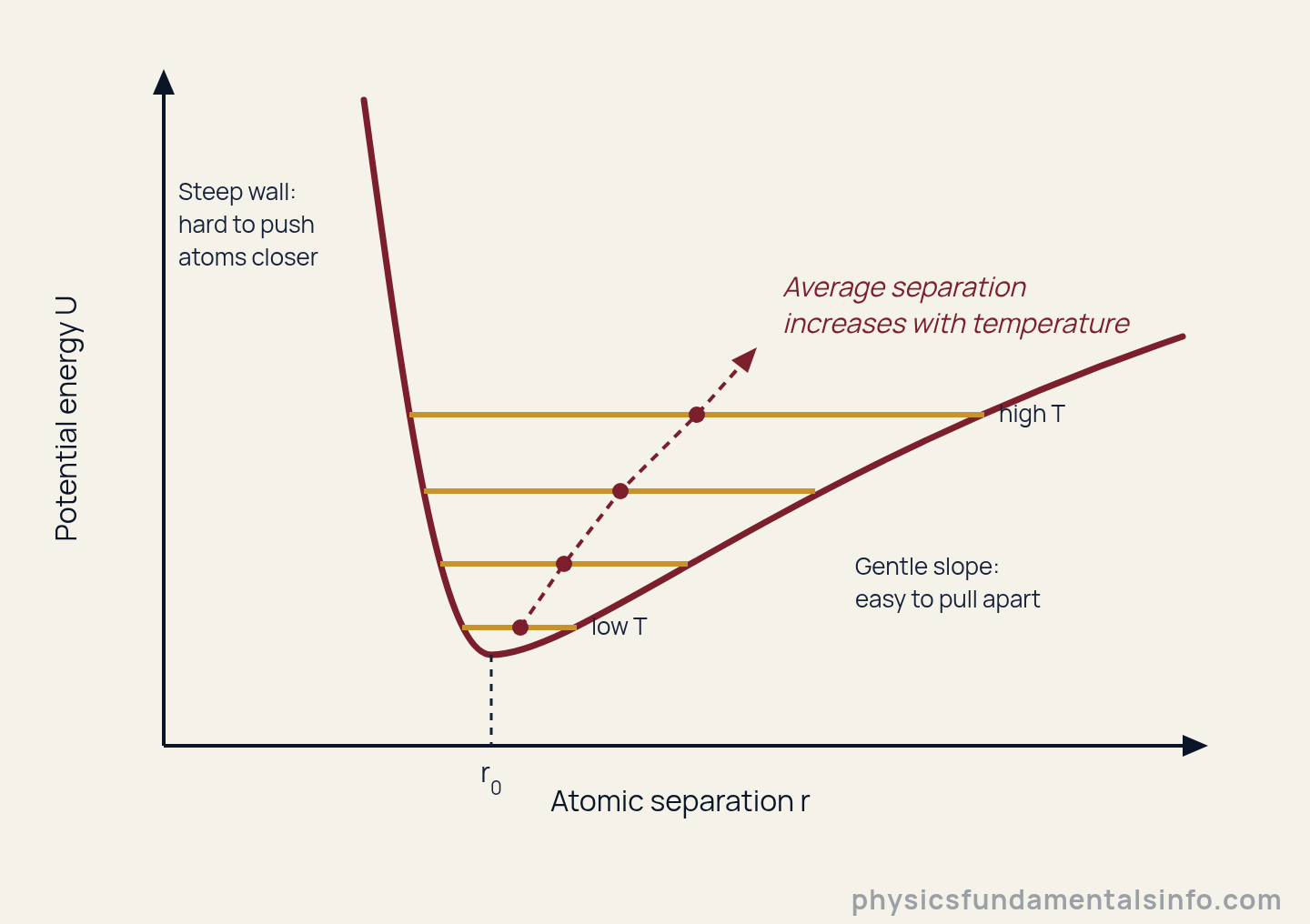
The lopsided energy valley between neighbouring atoms. Hotter atoms (higher gold levels) swing between wider limits, and the midpoint of each swing (dashed line) drifts to the right — the material expands.
The same picture explains the pecking order. Liquids hold their molecules with weaker, floppier bonds, so they expand more than solids. Gas molecules barely interact at all, so gases expand most of all.
And a delicious footnote: a handful of engineered materials, such as zirconium tungstate, actually shrink as they warm across a huge temperature range, because heating twists their lattice units inward. Physics keeps exceptions on hand to keep everyone humble.
Thermal Expansion Coefficients of Common Materials
The coefficient α is a material’s personality: how eagerly it responds to a degree of warming. Here are typical values near room temperature.
| Material | α (×10−6 °C−1) | Worth knowing |
|---|---|---|
| Fused quartz | 0.5 | Lab glassware that shrugs off thermal shock |
| Invar (Fe–Ni alloy) | ≈1.2 | Engineered not to move — precision instruments, clock pendulums |
| Pyrex (borosilicate glass) | 3.3 | Why oven dishes survive temperature jumps ordinary glass cannot |
| Ordinary glass | ≈9 | Boiling water in a cold tumbler can crack it via uneven expansion |
| Steel / iron | 11–13 | The workhorse value behind rails, bridges and rebar |
| Concrete | ≈12 | Matches steel almost exactly — the quiet reason reinforced concrete works |
| Copper | 17 | Hot-water pipework needs room to creak and move |
| Brass | 19 | Paired with steel in bimetallic strips |
| Aluminium | 23 | Roughly double steel — allow for it in window frames and cladding |
| Lead | 29 | One of the most expansive common metals |
| Ice (at 0 °C) | 51 | Even ice expands as it warms — right up until it melts |
Values are typical near 20 °C and shift slightly with alloy, composition and source. For engineering work, always use the datasheet for your exact material.
For liquids the quoted figure is β: roughly 210 × 10−6 °C−1 for water at room temperature, 182 × 10−6 for mercury and about 960 × 10−6 for petrol. That last number is why a brim-full fuel tank weeps on a hot afternoon — worked problem 5 below puts a litre figure on it.
Real-World Examples of Thermal Expansion
The Eiffel Tower — a giant thermometer
Run the formula on 300 m of iron with α = 12 × 10−6 °C−1 and a 40 °C seasonal swing in metal temperature: ΔL = 12 × 10−6 × 300 × 40 ≈ 0.14 m. That is roughly 14 cm of vertical growth every summer — consistent with engineering analyses that put the figure at 12–15 cm. The Tower is, in effect, a 330-metre thermometer.
Bridges that breathe
The same arithmetic scales up fast for bridges. A 1 km steel span facing a 40 °C swing needs almost half a metre of breathing room — enough to crumple the deck if it has nowhere to go.
That is what expansion joints are for: the comb-toothed metal strips your car thuds over at each end of a bridge. They let the deck grow and shrink freely instead of grinding against its abutments.
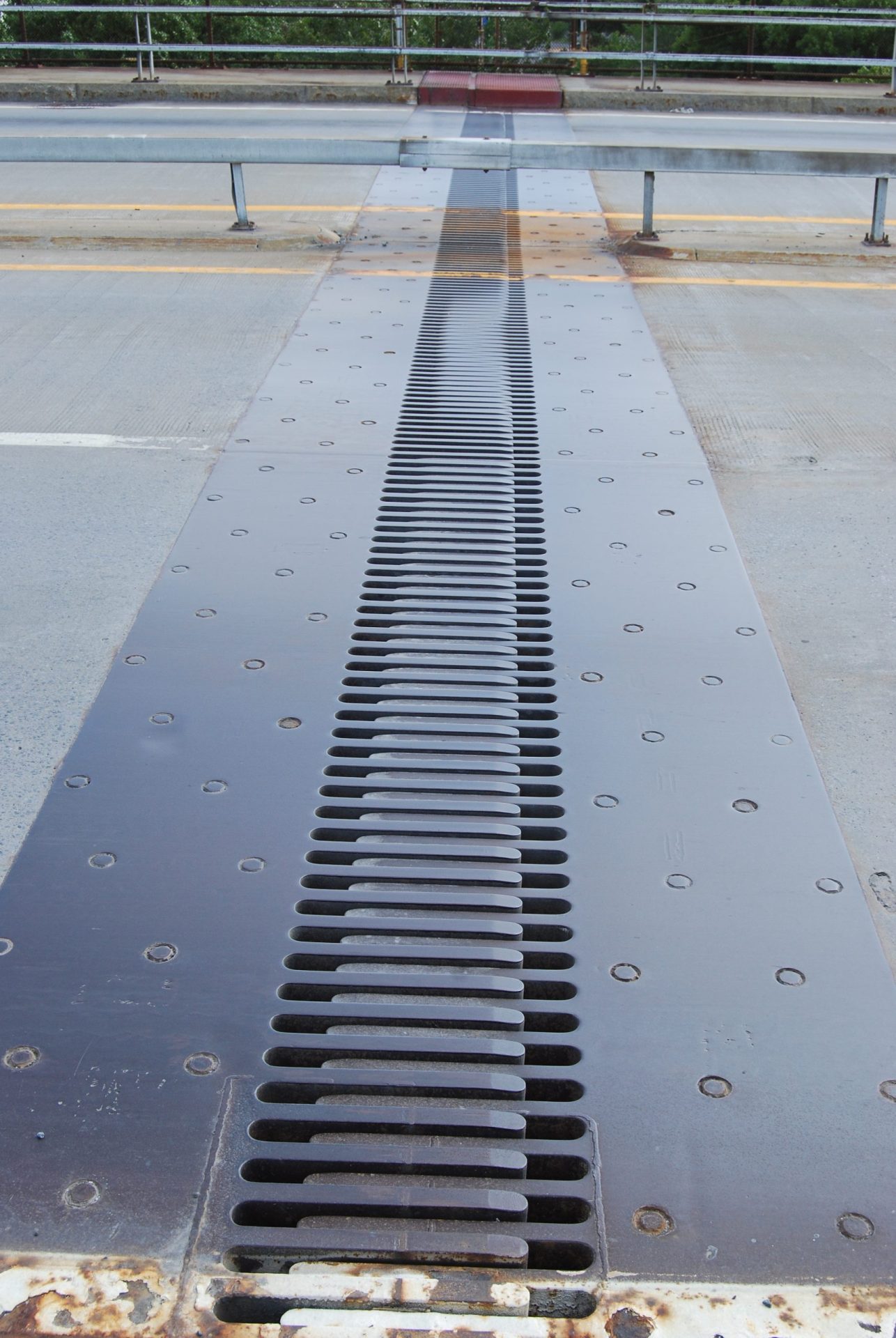
Railway tracks and sun kinks
Old jointed track left small gaps between rails — the source of the classic clickety-clack — precisely so summer heat had somewhere to go. Modern continuous-welded rail takes the opposite approach: it is stretched and clamped at a chosen neutral temperature, so hot weather builds compression in the steel instead of movement.
Push past the design limit in a heatwave and the track can buckle sideways into a “sun kink”, which is why rail operators impose speed restrictions on extreme days.
Bimetallic strips
Bond a strip of brass to a strip of steel and warm them: the brass expands about one and a half times as much, so the strip has no choice but to curl. That reliable curl opened and closed the contacts in classic thermostats, kettle cut-outs and car indicator flashers for decades.
The stuck jar lid
Run a stubborn jar lid under hot water and it twists free. The thin metal lid heats faster and expands more than the glass beneath it, loosening its grip — the same trick, scaled up, lets engineers heat a seized bearing to slide it off a shaft.
The rising sea
The oceans absorb more than 90% of the extra heat trapped by greenhouse gases, and warm water simply takes up more room than cold. According to NASA’s sea-level monitoring, thermal expansion alone accounts for roughly a third of the rise measured by satellites since 2004 — no added water required.
Why Water Breaks the Rules
Between 0 °C and 4 °C, water does the opposite of almost everything else: warm it and it contracts; cool it and it expands. Fresh water is densest at about 4 °C, as the USGS water-science data confirms — this is water’s famous anomalous expansion.
Freezing is stranger still. Hydrogen bonds lock the molecules into an open hexagonal lattice with more empty space than the liquid had, so ice occupies about 9% more volume — which is why it floats, and why an unlagged pipe bursts in a hard frost.
The consequences are life-sized. In winter, the densest 4 °C water sinks to the bottom of a lake while ice forms only at the top, insulating everything below; fish overwinter in liquid water beneath a frozen lid. Were water ordinary, lakes would freeze from the bottom up.
Common Misconceptions About Thermal Expansion
“Heating a ring makes the hole shrink”
It feels intuitive — surely the metal expands inward and squeezes the gap? In fact every dimension of an object scales up together, exactly like enlarging a photograph, so the hole grows along with everything else.
Mechanics rely on this daily: heat a seized nut or a bearing and its bore widens enough to break free.
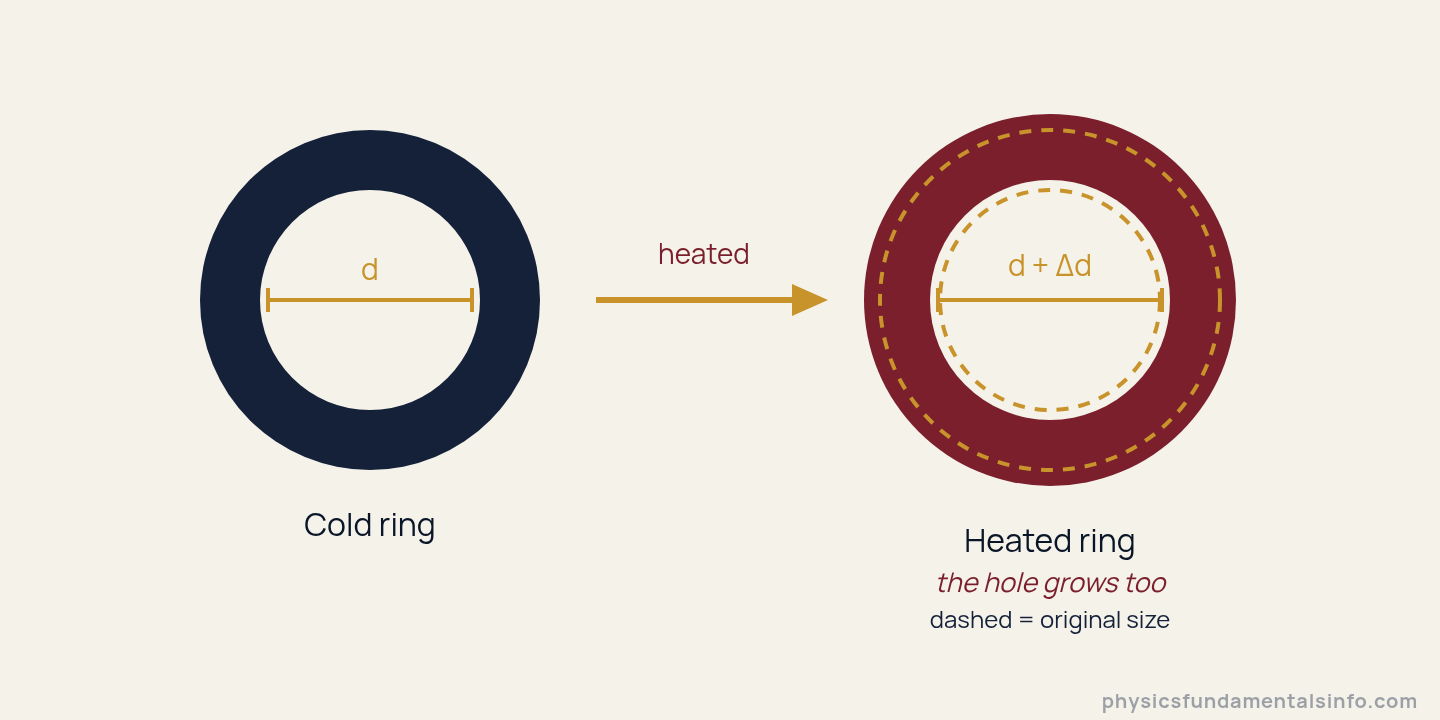
Heat a ring and every dimension scales up — outer edge and inner hole alike. Expansion enlarges the whole picture; it never squeezes the gaps.
“Everything expands when heated”
Most things, not everything. Water between 0 °C and 4 °C contracts as it warms; a stretched rubber band pulls shorter when heated, thanks to its writhing polymer chains; and negative-thermal-expansion ceramics such as zirconium tungstate shrink over enormous temperature ranges.
“The atoms themselves get bigger”
They don’t. Each atom stays the same size; it is the average spacing between atoms that grows, because their vibrations are lopsided. Expansion is a story about gaps, not about swelling particles.
“The effect is so tiny it can’t matter”
Per degree it is tiny — parts per million. But block the movement and the forces are brutal: a rigidly clamped material develops thermal stress σ = EαΔT, so structural steel denied just 30 °C of expansion carries about 72 MPa of compression, roughly a third of the way to yielding mild steel. Small displacement, enormous force.
How Thermal Expansion Connects to Other Thermodynamics Ideas
Temperature is, at heart, a measure of the average kinetic energy of a material’s particles. Thermal expansion is simply the geometry of matter responding to that energy — the shape of the bond deciding what jiggling atoms do to the space between them.
Heating a material therefore does two jobs at once: it raises the temperature by an amount set by the material’s specific heat capacity, and it nudges the dimensions outward. Liquid-in-glass thermometers exploit the second job to measure the first.
Zoom out further and expansion is where thermodynamics starts doing work: a gas expanding against a piston trades internal energy for mechanical output, the bookkeeping governed by the laws of thermodynamics.
Worked Problems
Work through these in order — each one adds a new twist. Carry the units and keep α in its full ×10−6 form until the final line.
Show Solution
Solution:
Step 1: Linear expansion applies: ΔL = αL0ΔT, with ΔT = 35 − 5 = 30 °C.
Step 2: Substitute: ΔL = (12 × 10−6 °C−1)(25.0 m)(30 °C).
Step 3: ΔL = 9.0 × 10⁻³ m.
Answer: ΔL = 9.0 mm — about the width of a pencil, from sunshine alone.
Show Solution
Solution:
Step 1: ΔT = 170 − 20 = 150 °C, and L = L0(1 + αΔT).
Step 2: ΔL = (23 × 10−6 °C−1)(2.000 m)(150 °C) = 6.9 × 10⁻³ m = 6.9 mm.
Step 3: L = 2.000 m + 0.0069 m.
Answer: L = 2.0069 m (an increase of 6.9 mm).
Show Solution
Solution:
Step 1: Rearrange ΔL = αL0ΔT for the unknown: ΔT = ΔL / (αL0).
Step 2: Substitute: ΔT = (0.0100 m) / [(17 × 10−6 °C−1)(12.000 m)].
Step 3: ΔT = 0.0100 / (2.04 × 10⁻⁴) °C = 49.0 °C.
Answer: ΔT(max) ≈ 49 °C.
Show Solution
Solution:
Step 1: A hole expands exactly as if it were made of the surrounding material, so Δd = αd0ΔT with ΔT = 200 °C.
Step 2: Δd = (12 × 10−6 °C−1)(12.00 mm)(200 °C) = 0.029 mm.
Step 3: d = 12.00 mm + 0.029 mm.
Answer: d ≈ 12.03 mm — the hole gets BIGGER, not smaller.
Show Solution
Solution:
Step 1: Both expand; the spill is the difference. ΔT = 20 °C, and for the steel tank β(tank) = 3α = 36 × 10−6 °C−1.
Step 2: Petrol: ΔV = (9.6 × 10⁻⁴)(60.0 L)(20) = 1.152 L. Tank: ΔV = (36 × 10−6)(60.0 L)(20) = 0.043 L.
Step 3: Overflow = 1.152 − 0.043 = 1.109 L.
Answer: about 1.1 litres spills — the liquid wins by a factor of nearly thirty.
Show Solution
Solution:
Step 1: Blocked expansion is equivalent to compressing the rail by strain ε = αΔT, so σ = EαΔT.
Step 2: Substitute: σ = (200 × 109 Pa)(12 × 10−6 °C−1)(30 °C).
Step 3: σ = 7.2 × 10⁷ Pa.
Answer: σ = 72 MPa of compression — roughly a third of mild steel’s yield stress, from a warm day.
Show Solution
Solution:
Step 1: The period is T = 2π√(L/g), so T ∝ √L and a small length change gives ΔT/T = ½(ΔL/L) = ½αΔθ, with Δθ = 15 °C.
Step 2: Fractional slowing = ½(19 × 10−6)(15) = 1.43 × 10⁻⁴. A longer pendulum swings slower, so the clock runs slow.
Step 3: Time lost per day = (1.43 × 10⁻⁴)(86 400 s) = 12.3 s.
Answer: about 12.3 seconds lost per day — why precision clocks used low-α invar pendulums.