Hooke’s Law states that the force needed to stretch or compress a spring is directly proportional to how far it is stretched or compressed, written as F = kx. Here k is the spring constant (the spring’s stiffness) and x is the extension in metres. The law holds only within the spring’s elastic limit.
Push down on a car’s bonnet and it bounces straight back. Click a retractable pen and feel the tiny resistance under your thumb. Draw a bow and it strains against you — harder the further you pull. Three different objects, one identical piece of physics underneath.
That physics is Hooke’s Law: the simple rule connecting how hard you push or pull a springy object to how far it moves. Get it straight and a surprising amount of the world opens up — kitchen scales, the suspension under your car, even the way atoms wobble inside a solid.
What Is Hooke’s Law?
Picture hanging a weight on a spring. Add one mass and it droops a little. Hang a second, identical mass and it droops twice as far. That doubling is the whole idea — the stretch keeps pace, exactly, with the force.
Stated precisely: the force F needed to stretch or compress a spring by a distance x is given by F = kx, where k is a fixed number called the spring constant. Plot force against extension and you get a straight line through the origin.
There’s one catch, and it matters. This tidy proportionality holds only while the spring stays within its elastic limit. Stretch it too far and the rule collapses — we’ll come back to exactly where and why.
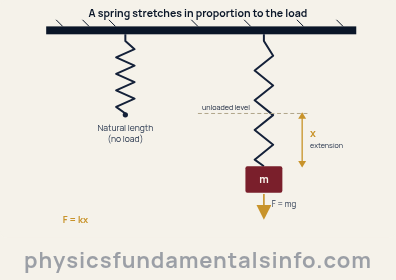
Hang a mass and the spring extends by x. Double the load and the extension doubles — the essence of Hooke’s Law.
A short history
The law is named after Robert Hooke (1635–1703), one of the sharpest experimental minds of the scientific revolution. He said he had known the relationship since 1660.
To stake his claim while keeping rivals guessing, he first published it in 1676 as a scrambled Latin anagram, then revealed the answer in 1678: ut tensio, sic vis — “as the extension, so the force.” Nearly 350 years on, it still underpins every spring scale and clock balance wheel ever built.
The Hooke’s Law Formula
At its core, Hooke’s Law is a single, friendly equation.
Every symbol earns its place. Here is what each one means, with its SI unit:
- F — the force applied to the spring (or the restoring force the spring exerts back), measured in newtons (N).
- k — the spring constant, a measure of stiffness, measured in newtons per metre (N/m).
- x — the extension or compression, measured from the spring’s natural (unstretched) length, in metres (m).
The restoring-force form: F = −kx
You’ll often meet the same law carrying a minus sign.
This version describes the spring’s restoring force — the force the spring pushes back with on whatever is deforming it. The minus sign is a direction flag, not a smaller number: the spring always acts back toward its rest position, opposite to the displacement.
In practice, reach for F = kx when you only want sizes — how much force, how much stretch. Bring in the minus sign when direction matters, such as when you derive an oscillation. By Newton’s third law, that restoring pull is the spring’s equal-and-opposite reply to your push.
How Hooke’s Law Works
Why should a coil of cold steel obey such a tidy rule? The answer hides at the scale of atoms.
Zoom into the metal and you find atoms locked in a lattice by electromagnetic bonds. Each bond behaves like a microscopic spring of its own. Stretch the coil and you nudge every atom a little way from its resting position.
For small nudges, each bond pulls back with a force proportional to how far it has been shifted. Add up billions of these tiny proportional tugs and the whole spring obeys F = kx. Step through the cycle:
- At rest, the spring sits at its natural length and the net force on it is zero.
- Apply a force and the coils separate, storing energy in the stretched bonds.
- The spring answers with a restoring force of size kx, pulling back toward equilibrium.
- Release the force and that stored energy drives the spring back to its natural length.
Want to feel the proportionality for yourself? Hang masses on the virtual spring below and watch the extension climb in a perfectly straight line — until you push past the limit.
The Spring Constant Explained
The spring constant k is the heart of Hooke’s Law. It answers one blunt question: how much force does this spring demand for every metre of stretch?
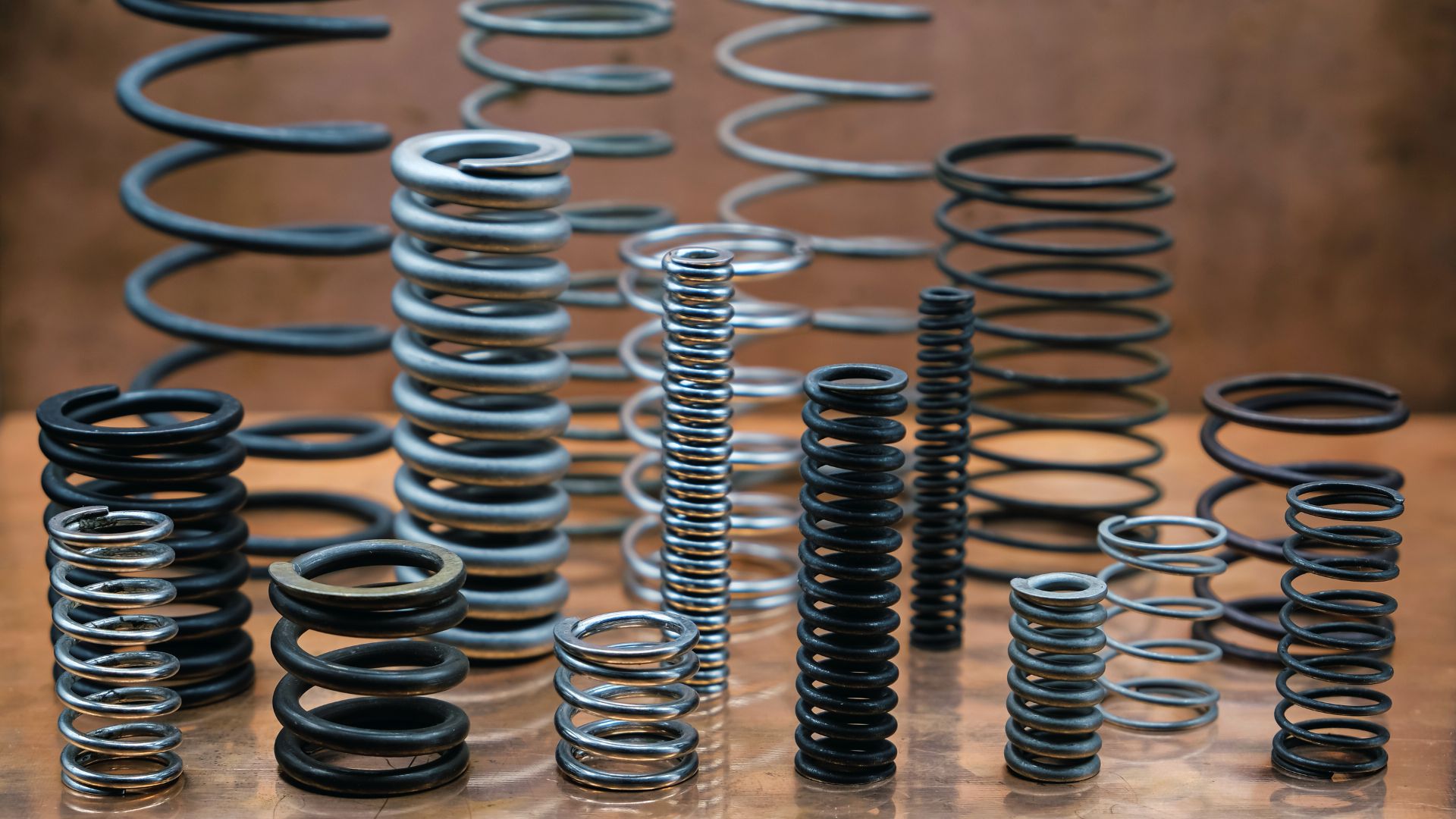
A stiff spring — picture the coil under a car’s suspension — has a large k, often thousands of newtons per metre. A floppy spring like a Slinky has a tiny k and sags under its own weight. Same law, wildly different k.
You don’t have to look k up; you can measure it. Hang known weights, record the extension each one causes, and plot force against extension. The result is a straight line through the origin, and its gradient is k.
A quick sanity check keeps you honest here. A classroom spring usually lands in the tens of newtons per metre; a vehicle suspension spring runs to the tens of thousands. If your answer comes out at, say, 0.5 N/m for a steel spring, something has gone wrong.
One common lab slip: plotting extension up the vertical axis by mistake. Force goes on the y-axis, so the gradient reads as k — flip the axes and you’ll accidentally calculate 1/k instead.
Springs in Series vs Parallel
Combine two springs and the effective stiffness changes in a way that surprises people. Join them end-to-end (in series) and the pair becomes softer; sit them side-by-side (in parallel) and the pair becomes stiffer.
| Arrangement | Effective spring constant | Stiffness vs one spring | Extension under the same load | Everyday example |
|---|---|---|---|---|
| Single spring | k | Reference | x | A lone door spring |
| Series (end to end) | 1/k = 1/k1 + 1/k2 | Softer (smaller k) | Larger | Two springs joined in a line |
| Parallel (side by side) | k = k1 + k2 | Stiffer (larger k) | Smaller | Mattress coils sharing a load |
Elastic Potential Energy in a Spring
Stretching a spring takes work, and that work doesn’t vanish. It’s banked as elastic potential energy, ready to be released the instant you let go.
- E — the elastic potential energy stored, in joules (J).
- k — the spring constant, in newtons per metre (N/m).
- x — the extension or compression, in metres (m).
Why the ½, and why x squared? Because the force itself grows as you stretch, you can’t simply multiply force by distance. The stored energy equals the area under the force–extension line — a triangle of base x and height kx, which works out to ½kx2.
That square is the punchline. Stretch a spring twice as far and it stores four times the energy. It’s exactly why a fully drawn bow launches an arrow with so much more bite than a half-drawn one, and the same idea behind the work done in compressing any spring.
Real-World Examples of Hooke’s Law
This isn’t a textbook curiosity. Hooke’s Law is quietly doing its job all around you:
- Bathroom and kitchen scales: your weight compresses a spring, and because the squash is proportional to the force, the dial or sensor can read it off as a tidy linear number.
- Vehicle suspension: coil springs swallow bumps, their k tuned so the car settles smoothly back to ride height instead of bouncing for ages.
- Retractable pens and clothes pegs: small springs store a little energy on a click or a squeeze and release it just as readily.
- Archery bows and trampolines: drawing or stretching banks elastic energy (½kx2) that is handed straight back as motion.
- Mechanical clocks: the hairspring on a balance wheel obeys Hooke’s Law to keep steady time — historically, the law’s first killer application.
The Limits of Hooke’s Law
Hooke’s Law is a promise the spring keeps only up to a point. Plot force against extension and the first stretch of the graph is a flawless straight line — proportional, predictable, obedient. Push further and that line begins to bend.
Two thresholds mark the breakdown:
Limit of proportionality
The point where the straight line ends. Beyond it, extension is no longer exactly proportional to force, even though the spring may still spring back to shape.
Elastic limit
A little further along. Stretch past this and the spring is permanently deformed — it won’t return to its natural length when released. The change is now plastic, not elastic.
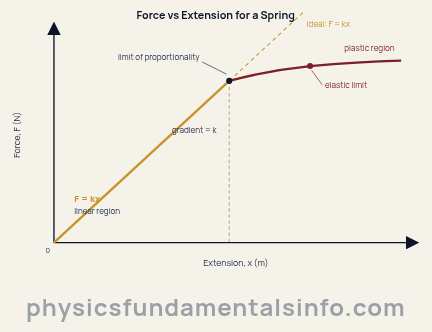
Inside the linear region the spring obeys F = kx with a constant gradient k. Past the limit of proportionality the real curve bends away from the ideal dashed line.
For nearly all exam and lab work you stay comfortably inside that linear region, and Hooke’s Law behaves beautifully. Just don’t trust it for a spring you’ve visibly over-stretched.
How Hooke’s Law Relates to Simple Harmonic Motion
Here Hooke’s Law becomes the doorway to one of physics’ biggest ideas. Attach a mass to a spring, pull it, and let go. It doesn’t simply snap back — it overshoots, springs the other way, and oscillates.
The reason sits in that minus sign. The restoring force F = −kx is always proportional to displacement and always points home. Any force with that exact signature produces simple harmonic motion — smooth, repeating, sinusoidal swing.
- T — the period, the time for one full oscillation, in seconds (s).
- m — the oscillating mass, in kilograms (kg).
- k — the spring constant, in newtons per metre (N/m).
Notice what’s missing: the amplitude. The period depends only on the mass and the stiffness, not on how far you pull the spring. Stiffer spring, faster wobble; heavier mass, slower wobble.
As it swings, energy sloshes back and forth — elastic potential energy at the turning points becoming kinetic energy as it races through the middle. For a deeper treatment of the mass-on-a-spring oscillator, Georgia State University’s HyperPhysics is an excellent reference.
Common Misconceptions About Hooke’s Law
“Hooke’s Law works no matter how far you stretch the spring”
It doesn’t. The law holds only within the elastic limit. Stretch beyond it and force and extension stop being proportional — and the spring may never fully recover.
“The spring constant changes as you stretch the spring”
For an ideal spring inside its limit, k is fixed — a property of the spring itself, not of how far it happens to be stretched. That’s exactly why the force–extension graph is a straight line with one constant gradient.
“The minus sign means the force is negative or weaker”
The minus sign in F = −kx is purely about direction, not size. It says the restoring force points opposite to the displacement. That force can be very large indeed.
“Hooke’s Law only applies to metal coil springs”
Coil springs are just the friendliest example. The same linear law describes stretched wires, bent beams, and even the bonds between atoms — anything that deforms elastically by a small amount. (Rubber bands are the famous exception: they wander off the straight line almost at once.)
Worked Problems
Show Solution
Solution:
Step 1: Start from Hooke’s Law, F = kx, and rearrange for k: k = F / x.
Step 2: Substitute with units: k = 5.0 N ÷ 0.10 m.
Step 3: Solve: k = 50 N/m.
Answer: k = 50 N/m
Show Solution
Solution:
Step 1: Use Hooke’s Law directly: F = kx.
Step 2: Substitute: F = 250 N/m × 0.12 m.
Step 3: Solve: F = 30 N.
Answer: F = 30 N
Show Solution
Solution:
Step 1: Rearrange F = kx for the extension: x = F / k.
Step 2: Substitute: x = 18 N ÷ 120 N/m.
Step 3: Solve: x = 0.15 m.
Answer: x = 0.15 m (15 cm)
Show Solution
Solution:
Step 1: The stretching force is the weight of the mass: F = mg, then k = F / x.
Step 2: Find the force: F = 0.40 kg × 9.81 m/s2 = 3.924 N. Then k = 3.924 N ÷ 0.080 m.
Step 3: Solve: k = 49.05 N/m.
Answer: k ≈ 49 N/m
Show Solution
Solution:
Step 1: Use the elastic energy formula: E = ½kx2.
Step 2: Substitute: E = ½ × 150 N/m × (0.10 m)2 = ½ × 150 × 0.010.
Step 3: Solve: E = 0.75 J.
Answer: E = 0.75 J
Show Solution
Solution:
Step 1: Rearrange E = ½kx2 for the constant: k = 2E / x2.
Step 2: Substitute: k = (2 × 0.96 J) ÷ (0.080 m)2 = 1.92 ÷ 0.0064.
Step 3: Solve: k = 300 N/m. Then the force is F = kx = 300 N/m × 0.080 m = 24 N.
Answer: k = 300 N/m and F = 24 N
Show Solution
Solution:
Step 1: Parallel springs add directly: k = k1 + k2. Series springs add as reciprocals: 1/k = 1/k1 + 1/k2.
Step 2: Parallel: k = 200 + 600 = 800 N/m. Series: 1/k = 1/200 + 1/600 = 3/600 + 1/600 = 4/600.
Step 3: Solve the series case: k = 600 ÷ 4 = 150 N/m.
Answer: parallel = 800 N/m; series = 150 N/m
Show Solution
Solution:
Step 1: For a mass on a spring, the period is T = 2π√(m/k).
Step 2: Substitute: T = 2π√(0.50 kg ÷ 200 N/m) = 2π√(0.0025).
Step 3: Solve: √0.0025 = 0.050, so T = 2π × 0.050 = 0.314 s.
Answer: T ≈ 0.31 s
Frequently Asked Questions
What is Hooke's Law in simple terms?
Hooke’s Law says a spring stretches (or squashes) in proportion to the force you apply — pull twice as hard and it extends twice as far. In symbols it is F = kx, where k is the spring’s stiffness and x is the extension. It only works up to the spring’s elastic limit, beyond which the spring deforms permanently.
What does the spring constant k tell you?
The spring constant k measures a spring’s stiffness — how much force is needed for each metre of extension, given in newtons per metre (N/m). A large k means a stiff spring that barely moves under load; a small k means a soft spring that stretches easily. You can read it straight off the gradient of a force–extension graph.
Why is there a negative sign in F = −kx?
The negative sign appears when F stands for the spring’s restoring force rather than the force you apply. It shows the spring always acts back toward its natural length — opposite to the displacement. Stretch it to the right and it pulls left; compress it left and it pushes right. The applied-force version, F = kx, simply drops the sign.
What is the elastic limit of a spring?
The elastic limit is the maximum stretch a spring can take and still spring back to its original length. Within it, Hooke’s Law holds and the deformation is fully reversible. Push past it and the spring is permanently deformed — it no longer returns completely, and force stops being proportional to extension.
Does Hooke's Law apply to all springs and materials?
No — Hooke’s Law is an approximation that holds only for small deformations within a material’s limit of proportionality. Real springs obey it well across their normal working range, but stretch them too far and the relationship turns non-linear. Rubber bands, for example, drift away from Hooke’s Law almost immediately.
Who discovered Hooke's Law?
The English scientist Robert Hooke (1635–1703) discovered it, saying he had known the relationship since 1660. He first published it in 1676 as a Latin anagram, then revealed the answer in 1678 as “ut tensio, sic vis” — “as the extension, so the force.” It remains the foundation of elasticity and spring design today.
What are the units of the spring constant?
The spring constant is measured in newtons per metre (N/m) in SI units. This falls straight out of F = kx: rearranging gives k = F / x, so force in newtons divided by extension in metres yields N/m. A spring rated at 100 N/m needs 100 newtons of force to stretch it one full metre.