The gas laws are the relationships between the pressure, volume, temperature and amount of a gas. Boyle’s, Charles’s, Gay-Lussac’s and Avogadro’s laws, together with the combined gas law, are not separate rules: each is the ideal gas equation PV = nRT with two of those four quantities held fixed. Every ratio form needs absolute temperature in kelvin.
An aerosol can carries a warning about heat. A hot-air balloon climbs when the burner fires. Put your thumb over a syringe nozzle and push, and the plunger shoves back harder than you expected.
Three everyday scenes, three different gas laws — and the arithmetic was never the hard part. Choosing is. Reach for the wrong relation and the true answer can sit a fifth above the number you wrote down; work in degrees Celsius instead of kelvin and you can be out by more than a factor of three.
What Is a Gas Law?
A gas law is a rule that says how the pressure, volume, temperature and amount of a gas trade against one another while the rest of them are held still. Four quantities describe the gas, and each named law simply says which of them are pinned while the rest do the moving.
- Pressure P. How hard the gas pushes outwards on whatever contains it. The SI unit is the pascal; this page works in kilopascals, and the air around you sits near 100 kPa.
- Volume V. The space the gas fills, in litres here, cubic metres in strict SI, where 1 L = 0.001 m3.
- Temperature T. Always the absolute temperature, in kelvin — which is not the same thing as heat, and never a Celsius reading dropped into a ratio.
- Amount n. How much gas is actually in there, in moles. This is the one people forget, and forgetting it causes more wrong answers than any algebra slip.
Hold two of those four still and the other two have only one way to move. That is all a gas law is: a shortcut for the case where you already know what is not changing.
Which is also why there is no sense in memorising four unrelated formulae. There are not four laws here. There is one equation wearing four masks, and the algebra that proves it takes a single line.
The Five Relations at a Glance
Here is the whole family in one place: the five ratio relations, and the equation all of them come from. Read the second column first, because what is held — not the shape of the formula — is what tells you which row your question is in.
| Law | What is held | The relation | Rearranged for the unknown | Our tool |
|---|---|---|---|---|
| Boyle’s law | amount n and temperature T | P1V1 = P2V2 | P2 = P1V1 ÷ V2 | Boyle’s Law Calculator |
| Charles’s law | amount n and pressure P | V1 ÷ T1 = V2 ÷ T2 | V2 = V1T2 ÷ T1 | Charles’s Law Calculator |
| Gay-Lussac’s law | amount n and volume V | P1 ÷ T1 = P2 ÷ T2 | P2 = P1T2 ÷ T1 | Gay-Lussac’s Law Calculator |
| Avogadro’s law | pressure P and temperature T | V1 ÷ n1 = V2 ÷ n2 | V2 = V1n2 ÷ n1 | Avogadro’s Law Calculator |
| The combined gas law | amount n only | P1V1 ÷ T1 = P2V2 ÷ T2 | V2 = P1V1T2 ÷ (P2T1) | Ideal Gas Law Simulator, free mode, with the amount left alone |
| The ideal gas law | nothing at all | PV = nRT | n = PV ÷ (RT) | the Ideal Gas Law Calculator, linked in the next section |
Notice what the second column is doing: every ratio row names two quantities, the combined law names one, and the ideal gas law names none, because it holds nothing. That is not padding. “Boyle’s law holds the temperature” is half a condition: it holds the amount of gas too, and a sample that leaks obeys neither Boyle nor anything else on the list.
The One Equation Behind All of Them
Every relation in that table comes from one equation, the ideal gas law.
Each symbol, with the unit this page uses:
- P is pressure, in kilopascals (kPa). The SI unit is the pascal, Pa.
- V is volume, in litres (L). The SI unit is the cubic metre, m3.
- n is the amount of gas, in moles (mol).
- T is the absolute temperature, in kelvin (K).
- R is the gas constant, 8.314 J/(mol·K) to four figures.
R is not measured. It is the product of the Avogadro constant and the Boltzmann constant, 6.02214076 × 10²³ per mole and 1.380649 × 10⁻²³ J/K, which are two of the constants the SI fixes exactly — so the NIST reference value for the molar gas constant carries no uncertainty at all.
The units hide a small gift, too. One kilopascal times one litre is exactly one joule, so kilopascals and litres go straight into PV = nRT with R in J/(mol·K) and no conversion factor anywhere.
Now hold two quantities still and watch the equation collapse. If n and T never change, nRT is a fixed number, so PV has to be that same fixed number before and after — which is P1V1 = P2V2, Boyle’s law, in one line.
The others fall out the same way. Hold n and P, and V ÷ T is what stays fixed; hold n and V, and it is P ÷ T; hold P and T, and it is V ÷ n. Hold only the amount and you keep PV ÷ T, the combined gas law.
This page stops there on purpose: the full treatment of the equation belongs on the ideal gas law, term by term, not here. To push numbers through it, the Ideal Gas Law Calculator rearranges PV = nRT for whichever of P, V, n and T you set it to solve for.
The simulator above is the whole argument in one tool. It carries its own heading, a cylinder of nitrogen with three sliders — amount, temperature and volume — and four mode buttons, three of which freeze something different while the fourth freezes nothing. It is a tall tool, so it scrolls with the page rather than sitting inside one screen.
- Boyle, hold T. The temperature slider greys out. From the opening 1.00 mol at 273.15 K in 22.711 L, where the pressure readout says 100.00 kPa, halving the volume to 11.356 L reads 199.99 kPa and doubling it to 45.422 L reads 50.00 kPa. The amount slider stays live, so P1V1 = P2V2 holds only while you leave it alone.
- Charles, hold P. Here the greyed-out slider is the volume, badged “held”, and the sim then moves the volume itself to keep the pressure where it was: 22.711 L at 273.15 K, 29.101 L at 350 K, 45.422 L at 546.30 K, with the pressure readout unmoved at 100.00 kPa. What is held is the pressure, not the slider wearing the badge.
- Gay-Lussac, hold V. The volume slider greys out. Double the temperature, 273.15 K to 546.30 K, and the pressure readout doubles too, 100.00 kPa to 200.00 kPa — exactly, because that temperature step is an exact doubling.
- Free, all free. Nothing is frozen. This is the full PV = nRT, and it is also where the combined gas law lives, as long as you leave the amount alone.
One limit is worth knowing before you trust Charles mode. The volume slider stops at 50.000 L, and in Charles mode the volume runs into that stop near 601 K; past it the pressure is not held any more and climbs, reading 108.09 kPa at 650 K and 133.03 kPa at 800 K. The mode holds the pressure only while the piston still has room to move.
There is no Avogadro mode, either. This sim freezes the temperature, the pressure or the volume, never the amount — so to watch volume track the number of moles with the pressure and temperature both held, use the Avogadro’s law simulator instead. You can still drag this one’s amount slider and read the molar volume as you go, but nothing is holding P and T for you while you do it.
Two details about the tool itself. Its gas is a fixed setting, nitrogen, and its molecular-speed readout depends on temperature alone, so it moves when you change T and at no other time. Reset puts everything back to free mode at 1.00 mol, 273.15 K and 22.711 L.
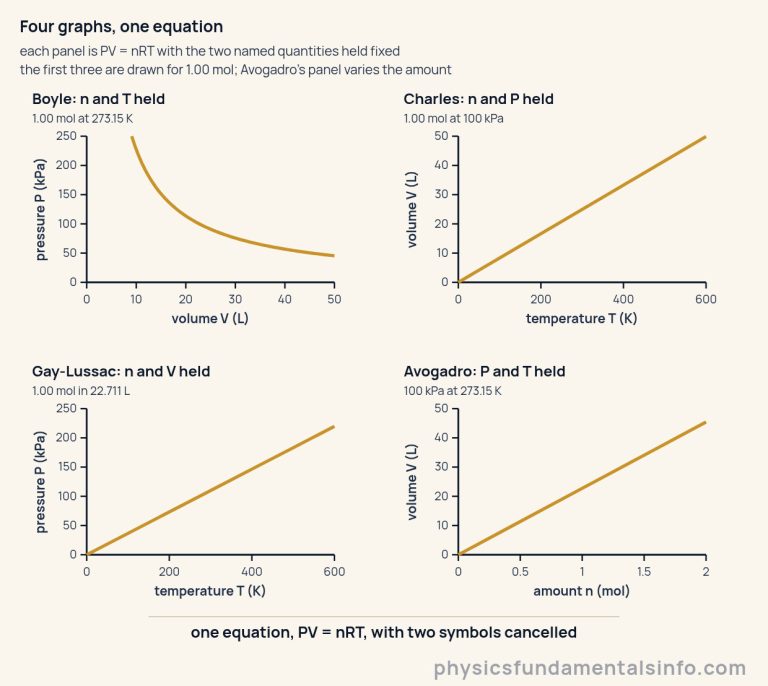
Graph the four simple laws and the family resemblance is hard to miss. Three of them are straight lines through the origin of their axes; only Boyle’s bends, and it bends because there one quantity is the reciprocal of the other.
How Do I Know Which Gas Law to Use?
List what changed and what stayed fixed, then read the row off the table below. The held quantities choose the law; the wording of the question does not.
- Write out all four quantities for the starting state and the finishing state, with every temperature converted to kelvin before anything else happens.
- Mark which ones changed.
- Mark which ones the question says stayed fixed — and check that the amount of gas is one of them, unless you are told gas was added or lost.
- Match that pattern below. Two of P, V and T moving means no simple ratio law will do; an amount that moves is Avogadro’s law only when the pressure and the temperature both hold still, and otherwise sends you back to PV = nRT.
| What changed | What stayed fixed | Use this |
|---|---|---|
| pressure and volume | amount and temperature | Boyle: P1V1 = P2V2 |
| volume and temperature | amount and pressure | Charles: V1 ÷ T1 = V2 ÷ T2 |
| pressure and temperature | amount and volume | Gay-Lussac: P1 ÷ T1 = P2 ÷ T2 |
| volume and amount | pressure and temperature | Avogadro: V1 ÷ n1 = V2 ÷ n2 |
| pressure, volume and temperature | amount only | combined: P1V1 ÷ T1 = P2V2 ÷ T2 |
Problem 5 below is the case worth drawing, because two things move at once. A 2.00 L sample at 100.0 kPa and 298.15 K is compressed to 250.0 kPa and then heated to 423.15 K.
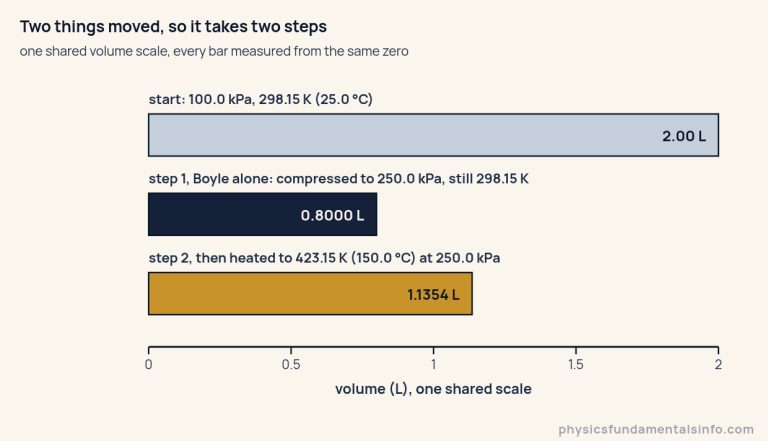
Run either law on its own here and you get a wrong answer with no warning attached. That is what the next section is about.
The Two Mistakes That Wreck Gas-Law Answers
Almost every bad gas-law answer comes from one of two places, and neither is an algebra slip. Both are mistakes of choosing.
Mistake 1: using a ratio law whose held quantity did not stay held
Take 1.00 mol of gas in 20.0 L at 300 K, where the pressure reads 124.72 kPa. Compress it to 10.0 L, but let it warm to 360 K on the way. Boyle’s law, handed only the two volumes, returns 249.43 kPa. The truth is 299.32 kPa.
The gap is not random. It is exactly the temperature ratio Boyle’s law had no way of knowing about: 249.43 × 1.2000 = 299.32. Say it either way round, but say it carefully — the true pressure is 20.0 % above the Boyle answer, and the Boyle answer is 16.7 % below the truth.
The fix is the combined law, which keeps the temperature in view and gives 299.32 kPa as well. One note on the figures, because rounding bites here: the 249.43 kPa is twice the unrounded starting pressure, not twice the rounded 124.72 kPa printed above.
Whenever you reach for Boyle’s law, then, the question to ask is not “did the volume change” but “did anything else”.
Mistake 2: putting a Celsius reading into a ratio
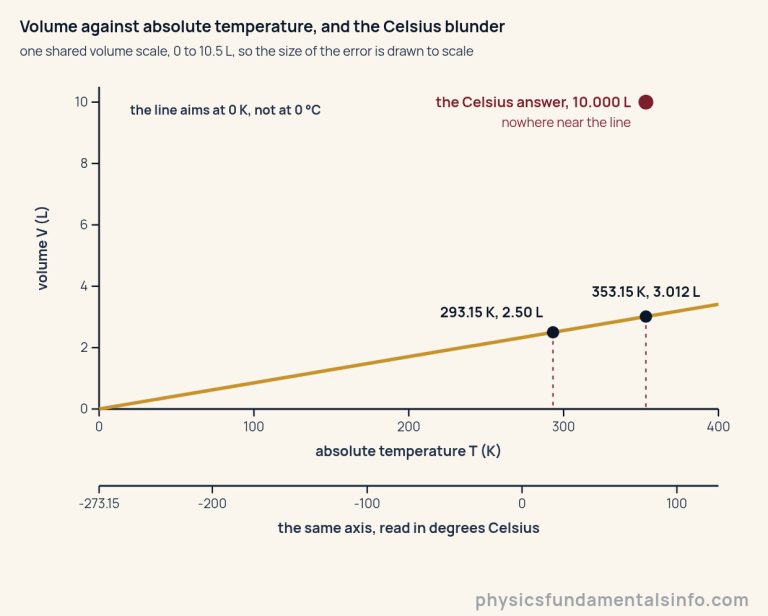
A 1.00 L balloon at 27 °C is warmed to 54 °C at constant pressure. In kelvin, 300.15 K to 327.15 K, the answer is 1.0900 L. Divide 54 by 27 instead and you get 2.0000 L, an answer 83.5 % too big.
Doubling a Celsius reading is not doubling the temperature. The ratio laws are ratios of absolute temperature, and the Celsius scale starts nearly 273 degrees above absolute zero, so a ratio taken on it is a ratio of two numbers that both have an offset buried in them.
Standard Conditions Are Not One Number
“At STP” is not a value until somebody says which conditions are meant. One mole of an ideal gas fills a different volume under each convention, and all three figures below are correct.
| Conditions | Volume of one mole | Where you meet it |
|---|---|---|
| 273.15 K (0 °C) and 100 kPa | 22.71095 L/mol | IUPAC standard conditions; the simulator’s opening volume slider setting, 22.711 L, is this figure rounded |
| 273.15 K (0 °C) and 101.325 kPa (one atmosphere) | 22.41397 L/mol | the older convention, and the source of the familiar 22.4 L/mol |
| 298.15 K (25 °C) and 100 kPa | 24.78957 L/mol | room-temperature work, where 22.4 L/mol would be wrong by about a tenth |
Each row is the same equation with different numbers in it: V = RT ÷ P, one mole at a time. Quote the conditions with the figure, every time, and this whole category of confusion disappears.
Where You Meet the Gas Laws
The pattern to look for is a gas that is trapped, or pushed, or heated, with something obviously held fixed. Once you can name what is held, you have already picked the law.
- The warning on an aerosol can. A rigid can of fixed volume, heated: pressure rises with absolute temperature, which is Gay-Lussac’s law and the reason the label says what it says.
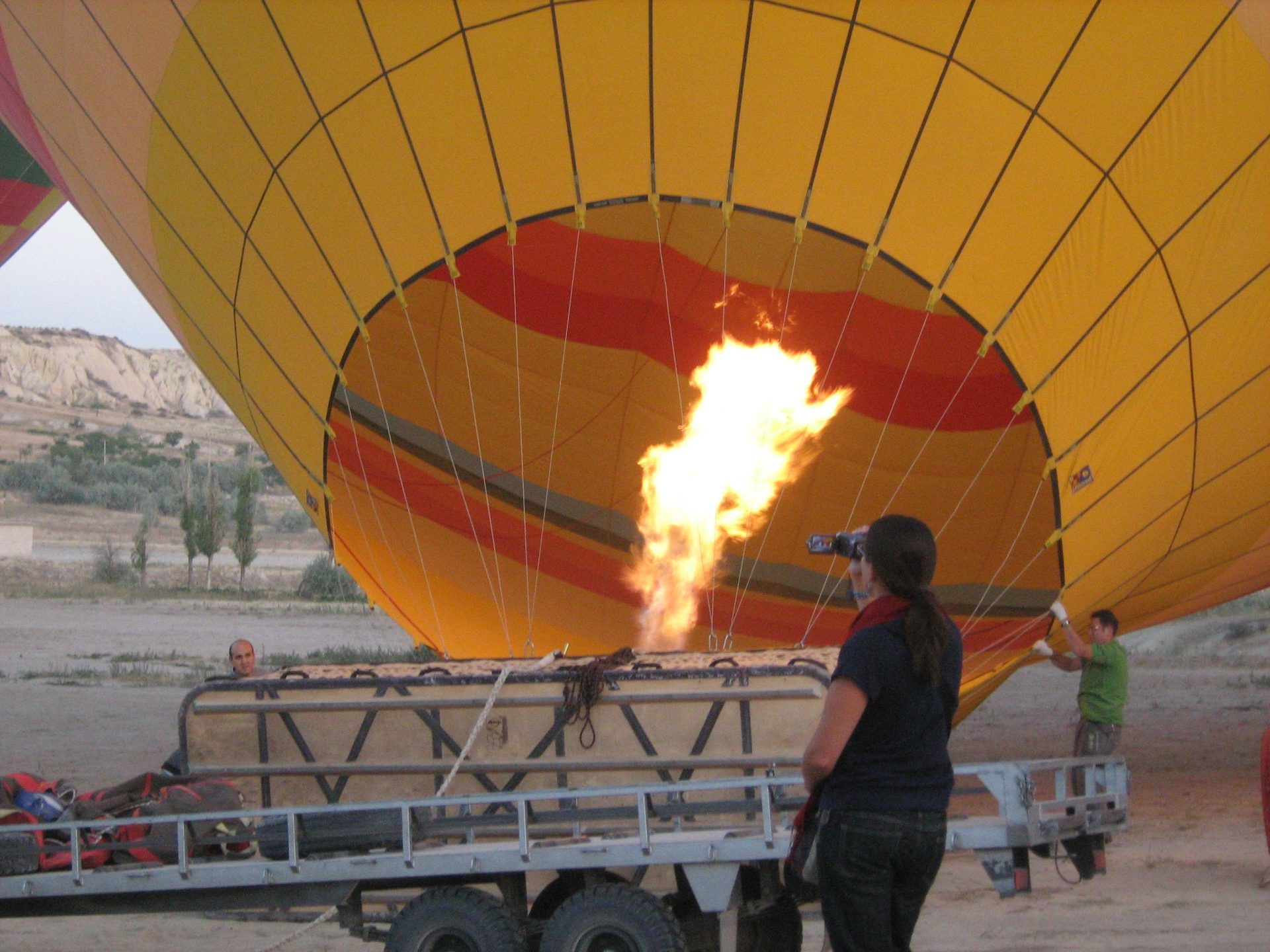
- A hot-air balloon. The burner heats air that stays at the pressure of the air around it, so that air expands. An inflated envelope cannot grow, though, and it is open at the bottom, so the surplus spills out of the mouth, leaving fewer, hotter molecules inside and air less dense than the air outside. That is Charles’s law lifting a basket — and notice what is not held here: the amount of gas in the envelope falls as it heats.
- Your own lungs. Your diaphragm drops, your chest cavity gets bigger, the pressure inside falls below the air outside, and air moves in. Boyle’s law, every breath you take.
- A bicycle pump with a thumb over the outlet. The gas has nowhere to go, so squeezing it into a smaller volume raises the pressure; the barrel also warms, which is the part Boyle’s law alone does not describe.
- A weather balloon climbing. Outside pressure falls, outside temperature falls, and both act on the same envelope at once — the combined law’s natural habitat.
Where the Gas Laws Stop Working
Every relation on this page inherits the same three assumptions, because they all come from the same equation: molecules that take up no space themselves, no forces between them, and collisions that lose nothing.
Real gases break all three. They do it worst at high pressure, at low temperature, and anywhere near condensing — which is to say, exactly where the molecules are close enough to notice each other.
The simulator will not warn you about this, and that is worth seeing for yourself. Push it to 5.00 mol in 1.000 L at 800 K and it prints 33,258 kPa, about 328 atmospheres, with a molar volume of 0.20 L/mol against 22.71 L/mol at 273.15 K and 100 kPa. That is more than a hundred times more crowded than the state it opened in.
The arithmetic is right. The physics is not: no real gas obeys PV = nRT in that region, so the number is a correct answer to a question about an ideal gas and nothing more. Treat any gas-law answer at extreme pressure or near a condensation point as an estimate, and say so.