
Carnot efficiency is the maximum fraction of heat energy that any engine can convert into work while operating between two fixed temperatures. It equals one minus the cold reservoir temperature divided by the hot reservoir temperature, with both measured in kelvin. No real engine, however well built, can exceed this limit.
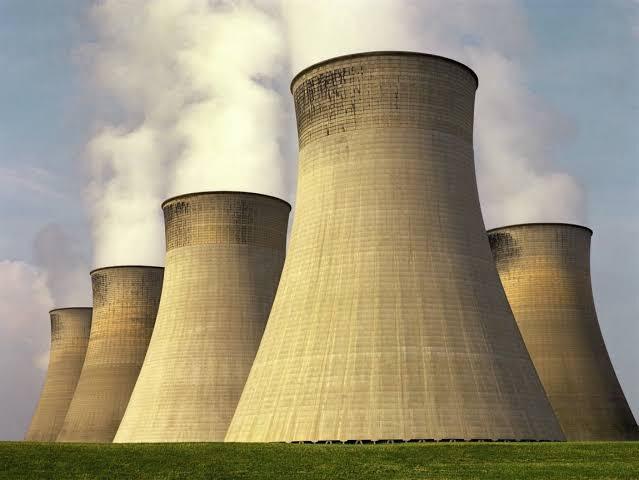
Drive past a power station and you will see white plumes drifting from the cooling towers. That is not pollution. That is the plant deliberately throwing away roughly half the energy it just paid for, because physics gives it no other option.
It is not bad engineering either. It is a ceiling worked out in 1824 by a French engineer in his twenties, before anyone knew what heat actually was — and two centuries of materials science have not moved it by a single percentage point.
What Is Carnot Efficiency?
Carnot efficiency is the highest thermal efficiency any engine can reach when it runs between a hot reservoir at temperature Th and a cold reservoir at temperature Tc. It is a ceiling, not a target — and it depends on nothing except those two temperatures.
Strip any heat engine down and it does the same three things. It takes heat in from something hot, turns part of that heat into useful work, and dumps the leftover into something cold.
That third step is the one students want to delete. You cannot. Without somewhere cold to reject heat into, the working fluid never returns to its starting state and the engine cannot run a second cycle.
So the honest question is never “how do I stop wasting heat?” It is “what is the smallest fraction I am forced to throw away?” Carnot answered exactly that.
Carnot’s Theorem, in Plain Words
Sadi Carnot proved two claims that still stand. First: no engine working between two given reservoirs can beat a reversible engine working between the same two. Second: every reversible engine between those reservoirs has the same efficiency, regardless of how it is built or what fluid is inside it.
Together those give a universal speed limit. It applies to a steam turbine, a jet engine, a Stirling engine and a hypothetical machine nobody has invented yet.

Every heat engine sits between two reservoirs. Efficiency is W divided by Qh — and Qc can never be zero.
The Carnot Efficiency Formula
The Carnot efficiency formula is one minus the ratio of the two absolute temperatures. Here it is:
Two rearrangements are worth memorising, because exam questions and real design work use them constantly:
Every Symbol, With Its SI Unit
| Symbol | Quantity | SI unit |
|---|---|---|
| η (eta) | Carnot efficiency — the maximum work-per-unit-heat | dimensionless, 0 to 1 (multiply by 100 for %) |
| Th | Absolute temperature of the hot reservoir | kelvin (K) |
| Tc | Absolute temperature of the cold reservoir | kelvin (K) |
| Qh, Qc | Heat absorbed from hot, heat rejected to cold, per cycle | joule (J) |
| W | Net work output per cycle, W = Qh − Qc | joule (J) |
How Do You Calculate Carnot Efficiency?
Three steps, in this order:
- Convert both temperatures to kelvin. T(K) = T(°C) + 273.15. Skip this and your answer will be wrong, often by more than double.
- Divide the cold temperature by the hot one. That ratio Tc/Th is the fraction you are forced to throw away.
- Subtract from 1. Multiply by 100 if you want a percentage.
Worth doing by hand a few times so the kelvin step becomes automatic. After that, our Carnot Efficiency Calculator will do the conversion and the arithmetic for you, and it also rearranges the formula to solve for either reservoir temperature when you already know the efficiency you are aiming at.
Why Kelvin, and Only Kelvin
The formula divides one temperature by another, so the zero point of your scale is not cosmetic — it changes the answer completely. Celsius puts zero at the freezing point of water, which is an arbitrary place to start counting.
Kelvin starts at absolute zero, the genuine bottom of the temperature scale, which is why NIST describes it as an absolute scale where 0 K equals −273.15 °C. Only on that scale does the ratio Tc/Th mean anything physical.
A quick sanity check that catches most slips: if your engine’s efficiency comes out above about 90%, you almost certainly forgot to convert. Real reservoir pairs rarely allow it. If you are hazy on why absolute temperature behaves so differently from everyday heat, the difference between heat and temperature is the thing to fix first.
How the Carnot Cycle Reaches That Limit
The Carnot cycle hits the ceiling by using only four reversible steps — two isothermal, where heat crosses at a vanishingly small temperature difference, and two adiabatic, where no heat crosses at all. Nothing is ever wasted by pushing heat down a temperature gap.
Follow a gas through one full loop:
- a to b — isothermal expansion at Th. The gas touches the hot reservoir, absorbs Qh and expands while staying at Th, pushing the piston out.
- b to c — adiabatic expansion. The reservoir is removed. The gas keeps expanding and cools itself to Tc by doing work on the piston.
- c to d — isothermal compression at Tc. The gas touches the cold reservoir and is squeezed, rejecting Qc while holding at Tc.
- d to a — adiabatic compression. Insulated again, the gas is compressed back to its starting volume and warms to Th. Ready to repeat.
The two isothermal legs obey Boyle’s law, since pressure and volume trade off at fixed temperature. The two adiabatic legs are steeper, because the gas is losing internal energy as well as expanding — behaviour that falls straight out of the ideal gas law.
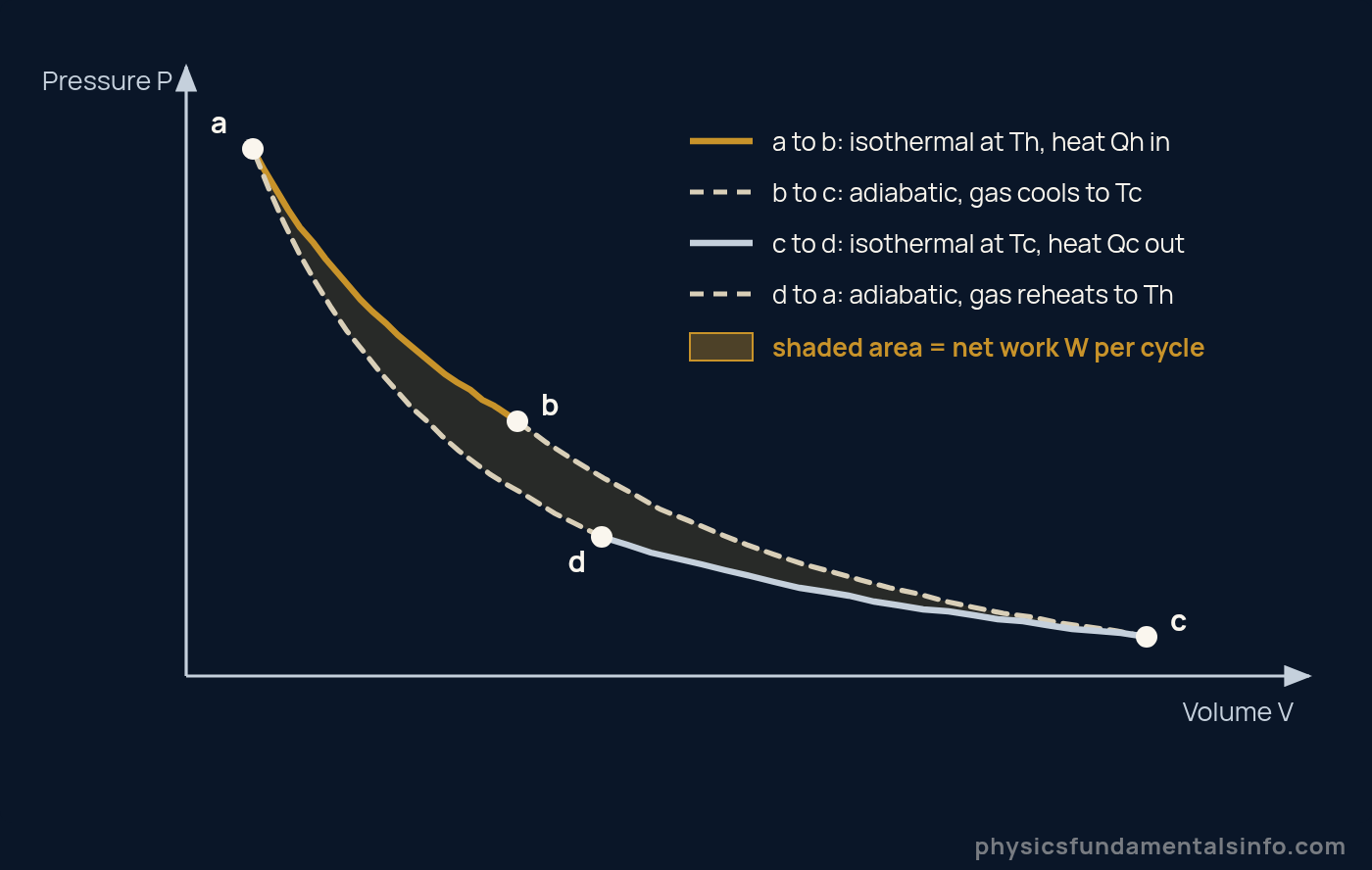
The Carnot cycle on a pressure–volume diagram. Drawn to scale for a diatomic ideal gas — the adiabats really are steeper than the isotherms.
Where the Formula Actually Comes From
On the two isothermal legs the heat exchanged works out proportional to the reservoir temperature. For a reversible cycle that gives a strikingly clean result:
Since the gas ends each cycle exactly where it started, its internal energy is unchanged, so W = Qh − Qc. Divide W by Qh, substitute the relation above, and Q drops out entirely — leaving 1 − Tc/Th. If you want to see every integral, the University of Virginia keeps a full derivation of the Carnot cycle online.
That cancellation is the whole story. The mass of gas, the pressure, the cylinder size — all gone. Only the two temperatures survive.
The Cleanest Picture: a Rectangle
Plot the same cycle against entropy instead of volume and the shape becomes a perfect rectangle. Heat in is the top edge times its width; heat out is the bottom edge times the same width; work is the area in between.
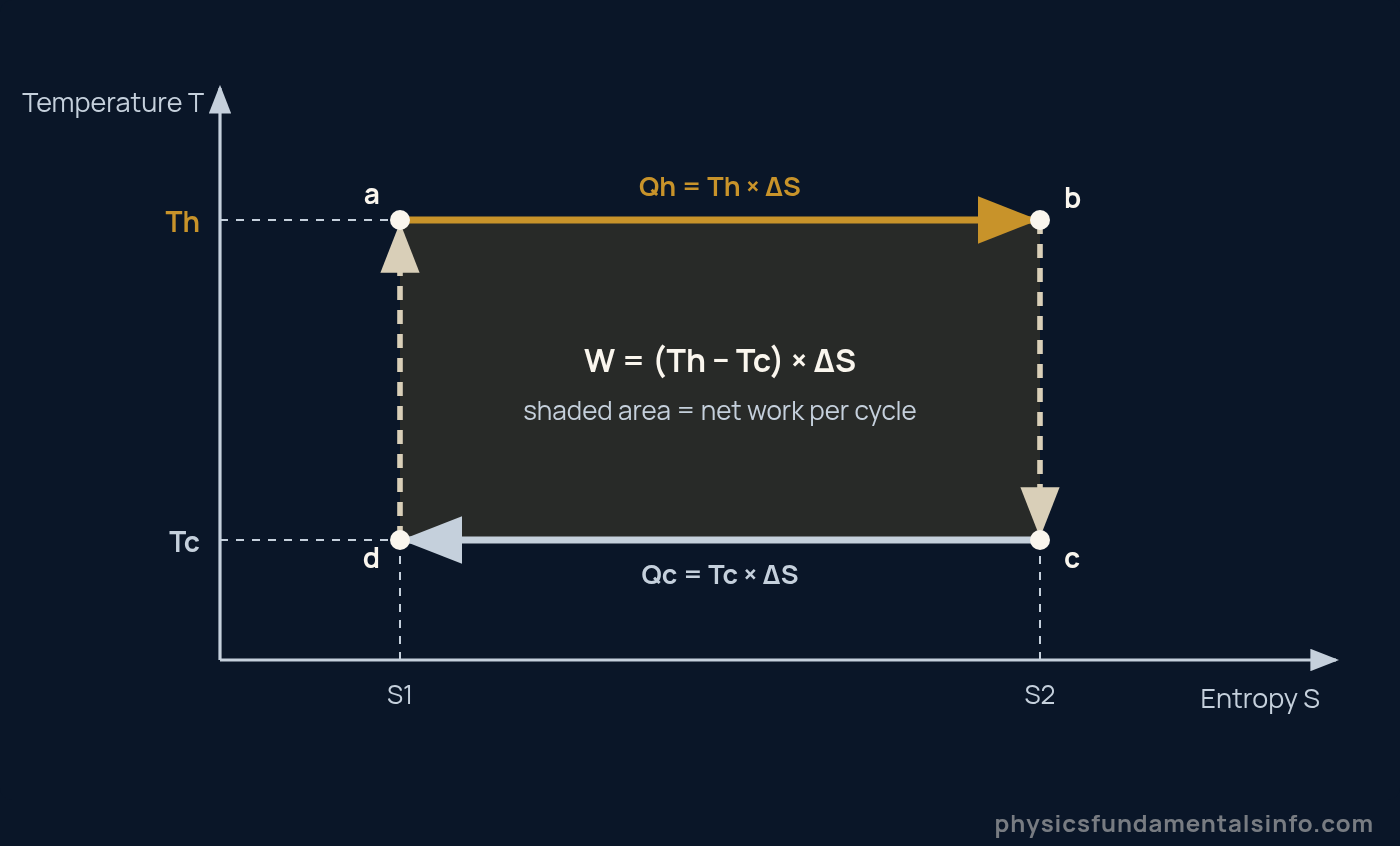
On temperature–entropy axes the Carnot cycle is a rectangle. Divide the shaded area by the area beneath the top edge and you get 1 − Tc/Th in one line.
Look at the rectangle and the formula is almost visual. Work divided by heat in equals height divided by total height — which is exactly (Th − Tc)/Th.
Why Can’t Real Engines Reach Carnot Efficiency?
Real engines cannot reach Carnot efficiency because a Carnot engine has to be perfectly reversible, and reversibility demands that heat crosses each boundary at an infinitesimally small temperature difference. Push that to the limit and the cycle takes forever.
Here is the trap. Heat only flows quickly when there is a big temperature gap. A Carnot engine insists on almost no gap at all, so heat trickles in, the cycle crawls, and the power output falls to zero.
A perfectly Carnot-efficient engine would be perfectly useless. It would produce infinitely little work per second.
The Number Engineers Actually Design Against
Once you accept that a plant must deliver power in finite time, a different and far more realistic ceiling appears. Optimise a simple engine for maximum power output rather than maximum efficiency and you get the endoreversible, or Curzon–Ahlborn, result:
That number is startlingly close to what real thermal plants achieve. It is one of those results that makes the whole subject feel less abstract — the gap between theory and practice was never really a gap, just the wrong theory.
Everything Else That Eats the Rest
- Finite-rate heat transfer. Boiler tubes and condensers need real temperature gradients to move heat at all, and every gradient generates entropy — the practical face of conduction, convection and radiation.
- Friction and turbulence. Bearings, blades and flowing fluid all convert useful work back into low-grade heat.
- Incomplete combustion. Some fuel leaves unburnt or partly burnt, so it never enters the cycle as heat at all.
- Parasitic loads. Feed pumps, fans, emissions equipment and control systems all draw power from the plant’s own output.
- Non-ideal cycles. Rankine, Otto, Diesel and Brayton cycles do not use Carnot’s four steps; each has its own, lower, ideal efficiency before any real losses are counted.
Real-World Examples of Carnot Efficiency
Carnot ceilings in real plant range from about 83% for a modern gas turbine down to under 7% for an ocean-thermal system — and every real machine lands well below its own ceiling. The pattern is easiest to see side by side.
| Technology | Th (K) | Tc (K) | Carnot ceiling | At max power 1 − sqrt(Tc/Th) |
Typical real efficiency |
|---|---|---|---|---|---|
| Gas turbine combined cycle | 1773 | 300 | 83.1% | 58.9% | ~55–64% |
| Petrol car engine (peak in-cylinder) | 2500 | 300 | 88.0% | 65.4% | ~25–40% |
| Coal steam plant (supercritical) | 873 | 300 | 65.6% | 41.4% | ~33–45% |
| Nuclear PWR (secondary steam) | 573 | 300 | 47.6% | 27.6% | ~33% |
| Geothermal binary (ORC) | 423 | 300 | 29.1% | 15.8% | ~10–13% |
| Ocean thermal (OTEC) | 298 | 278 | 6.7% | 3.4% | ~3% net |
Reservoir temperatures are representative design values, not fixed constants — an individual plant will differ. Carnot and max-power columns are calculated from the temperatures shown; the last column is a typical operating range.
Reading the Table Properly
Notice how badly the Carnot column predicts reality, and how well the max-power column does. A supercritical coal plant has a 65.6% ceiling but lands near 41.4% — almost exactly the endoreversible figure.
The nuclear row breaks that pattern in the other direction: about 33% real against a 27.6% max-power estimate. No contradiction. Curzon–Ahlborn assumes you are squeezing out maximum power, and a plant tuned for fuel cost rather than raw output can sit above it. Only the Carnot column is a genuine bound.
The car engine row is the one to be careful with. A 2,500 K peak flame temperature exists for a few milliseconds per cycle, not continuously, so 88% is a fantasy ceiling rather than a design target. This is why quoting a Carnot number for a piston engine is close to meaningless.
OTEC is the honest extreme. Twenty kelvin between warm surface water and cold deep water gives you 6.7% before a single pump is switched on — which is why the technology lives or dies on parasitic losses.
Fleet data backs the pattern up. The US Energy Information Administration’s heat-rate figures show combined-cycle gas plants converting fuel to electricity far more efficiently than the older simple-cycle and coal fleet — precisely because the gas turbine pushes Th so much higher.
Should You Raise the Hot Side or Cool the Cold Side?
Cooling the cold reservoir by one kelvin always buys more efficiency than heating the hot reservoir by one kelvin — by exactly a factor of Th/Tc. Most students guess the opposite, and so do most people designing their first cycle.
The calculus is short. Differentiating η = 1 − Tc/Th gives a gain of 1/Th per kelvin removed from the cold side, against Tc/Th2 per kelvin added to the hot side.
Divide one by the other and everything cancels but Th/Tc. For an engine running at 600 K over 300 K, cooling is twice as effective, kelvin for kelvin. Problem 7 below works the numbers.
So Why Does Industry Chase Hotter Turbines?
Because you rarely get to choose Tc. The cold reservoir is a river, the sea, or the air outside, and none of them will negotiate. You can shave a few kelvin with a better condenser and that is the end of it.
Th, by contrast, is a materials problem — and materials problems can be solved with money. Single-crystal superalloy blades and ceramic thermal-barrier coatings exist for exactly this reason.
There is a satisfying everyday consequence. On a hot day, Tc rises, so every thermal power station on the grid loses a little efficiency and output at precisely the moment the air conditioning demand peaks. The physics and the load curve are working against each other.
Common Misconceptions About Carnot Efficiency
1. “It Depends on the Fuel or the Working Fluid”
It does not. Carnot’s second claim was that all reversible engines between the same two reservoirs share one efficiency, whatever is inside them.
Helium, steam, carbon dioxide, an exotic organic fluid — same ceiling. The working fluid changes how closely you can approach it, never where it sits.
2. “You Can Use Celsius If You Are Consistent”
Consistency does not save you here, because the formula takes a ratio. Steam at 227 °C exhausting to 27 °C looks like 1 − 27/227 = 88.1% in Celsius, and is actually 40.0% in kelvin.
That is not a rounding error. It is more than double, and it is the single most common mistake in exam scripts on this topic.
3. “A Perfect Carnot Engine Would Be 100% Efficient”
Only if Tc were absolute zero, or Th were infinite. Neither is available: the third law of thermodynamics forbids reaching 0 K in any finite number of steps.
Read the formula literally. Efficiency reaches 1 only when the ratio Tc/Th reaches 0, and it never does.
4. “The Carnot Limit Caps Solar Cells, Fuel Cells and Batteries”
It does not, because none of them is a heat engine. A hydrogen fuel cell converts chemical energy directly into electrical energy without absorbing heat from a hot reservoir and dumping it into a cold one, so 1 − Tc/Th simply does not describe it.
Those devices have their own thermodynamic ceilings, set by different physics. Applying Carnot to them is a category error, not a conservative estimate.
5. “Carnot Efficiency and Thermal Efficiency Are the Same Thing”
Thermal efficiency is what a machine actually delivers, measured as work out over heat in. Carnot efficiency is the unreachable ceiling above it.
The ratio of the two has its own name — second-law or exergetic efficiency — and it is the fairer way to judge a design. A geothermal plant at 12% against a 29.1% ceiling is doing better engineering than the number alone suggests.
How Carnot Efficiency Relates to Entropy, Heat Pumps and the Second Law
Carnot efficiency is the second law of thermodynamics written as a number you can calculate. The laws of thermodynamics say total entropy never decreases; Carnot’s formula says exactly how much that costs you in lost work.
The bridge is the relation Qh/Th = Qc/Tc. Each side is an entropy transfer, and their equality means the reversible cycle creates no new entropy at all.
Every real process breaks that equality by generating entropy, and each joule-per-kelvin generated is work you will never get back. That is the whole content of the second law for engineers.
Run It Backwards and You Get a Fridge
Reverse the Carnot cycle and it stops producing work and starts consuming it — moving heat from cold to hot instead. That is a refrigerator, or a heat pump, depending on which end you care about.
The performance measure flips too. Instead of an efficiency below 1, you get a coefficient of performance that is usually far above it:
Both blow up as the two temperatures converge, which is the real reason a heat pump outperforms an electric heater so dramatically in mild weather and struggles in a hard frost.
Temperature Itself Is Defined By This Ratio
Here is the deepest consequence. Because all reversible engines between two reservoirs give the same Qh/Qc, that ratio can be used to define the temperature scale, with no reference to mercury, gas or any particular substance.
The thermodynamic temperature scale was built on precisely this idea. Carnot’s engine is not just a machine — it is a thermometer with no working parts.
Worked Problems
Show Solution
Solution:
Step 1: The ceiling is the Carnot efficiency, η = 1 − Tc/Th. Both temperatures are already in kelvin, so no conversion is needed.
Step 2: η = 1 − (300 K)/(500 K) = 1 − 0.600
Step 3: η = 0.400
Answer: 0.400, or 40.0%
Show Solution
Solution:
Step 1: Convert both temperatures using T(K) = T(°C) + 273.15.
Th = 227 + 273.15 = 500.15 K; Tc = 27 + 273.15 = 300.15 K
Step 2: η = 1 − (300.15 K)/(500.15 K) = 1 − 0.6001
Step 3: η = 0.3999. Using Celsius straight from the question would give 1 − 27/227 = 0.881, or 88.1%.
Answer: 40.0%. The Celsius shortcut returns 88.1% — wrong by more than a factor of two.
Show Solution
Solution:
Step 1: η = 1 − Tc/Th = 1 − 300/600 = 0.500
Step 2: W = η × Qh = 0.500 × 2400 J = 1200 J
Step 3: Qc = Qh − W = 2400 J − 1200 J = 1200 J.
Check the reversibility condition: Qh/Th = 2400/600 = 4.00 J/K and Qc/Tc = 1200/300 = 4.00 J/K. Equal, as a reversible cycle requires.
Answer: η = 50.0%, W = 1.20 kJ per cycle, Qc = 1.20 kJ per cycle
Show Solution
Solution:
Step 1: Rearrange η = 1 − Tc/Th to make Tc the subject: Tc = Th(1 − η)
Step 2: Tc = 800 K × (1 − 0.65) = 800 K × 0.35
Step 3: Tc = 280 K, which is 280 − 273.15 = 6.9 °C
Answer: 280 K, about 6.9 °C — colder than most rivers, which is why 65% is not a realistic target for a steam plant.
Show Solution
Solution:
Step 1: Carnot ceiling, ηCarnot = 1 − 300/850 = 1 − 0.3529 = 0.6471, or 64.7%
Step 2: Actual efficiency, η = 0.60 × 0.6471 = 0.3882, or 38.8%
Step 3: Heat input rate = W/η = 500 MW / 0.3882 = 1288 MW.
Waste heat rate = 1288 MW − 500 MW = 788 MW.
Answer: about 1.29 GW of heat in, 788 MW rejected as waste heat — more than the useful electrical output.
Show Solution
Solution:
Step 1: Claimed efficiency, η = W/Qh = 350 J / 1000 J = 0.350, or 35.0%
Step 2: Carnot ceiling for those reservoirs, η = 1 − 300/400 = 0.250, or 25.0%
Step 3: 35.0% exceeds 25.0%, so the claim breaks Carnot’s theorem. Entropy confirms it: Qc = 1000 − 350 = 650 J, so the total entropy change is −1000/400 + 650/300 = −2.500 + 2.167 = −0.333 J/K. Total entropy would fall, which the second law forbids.
Answer: Impossible. The most work available from 1000 J across those reservoirs is 0.250 × 1000 J = 250 J.
Show Solution
Solution:
Step 1: Baseline, η = 1 − 300/600 = 0.500, or 50.00%
Step 2: Raise Th to 650 K: η = 1 − 300/650 = 0.5385, or 53.85%. That is a gain of 3.85 percentage points.
Step 3: Lower Tc to 250 K: η = 1 − 250/600 = 0.5833, or 58.33%. That is a gain of 8.33 percentage points, about 2.2 times better. For very small changes the ratio is exactly Th/Tc = 2; a finite 50 K step beats that slightly because η is linear in Tc but not in Th.
Answer: Cooling the cold side wins, by roughly a factor of two.
Show Solution
Solution:
Step 1: A heat pump is a reversed Carnot cycle, so COP(heating) = Th/(Th − Tc)
Step 2: Th = 20 + 273.15 = 293.15 K; Tc = 0 + 273.15 = 273.15 K; the difference is 20.0 K
Step 3: COP = 293.15 K / 20.0 K = 14.66
Answer: 14.7 — ideally each joule of electricity would deliver 14.7 J of heat indoors. Real air-source heat pumps manage roughly 3 to 4, which is still far better than any resistive heater.