Avogadro’s law states that at a fixed pressure and temperature the volume of a gas is proportional to the amount of gas in it, so V1/n1 = V2/n2. Double the moles and you double the volume. Equal volumes of any two gases under the same conditions hold equal numbers of molecules.
Push more air into a balloon and it answers in the only way it can: by getting bigger. The gas inside is no hotter than it was and no more tightly packed — the skin simply stretches until the pressure inside matches the room again.
That one-for-one bargain between how much gas you have and how much room it takes up is Avogadro’s law. It is why a lungful, a party balloon and a gas holder the size of a house all run on the same arithmetic — and why a litre of helium and a litre of carbon dioxide hold exactly the same number of molecules while weighing wildly different amounts.
What Is Avogadro’s Law?
Avogadro’s law says that the volume a gas occupies is proportional to the number of molecules in it, provided the pressure and the temperature are held still.
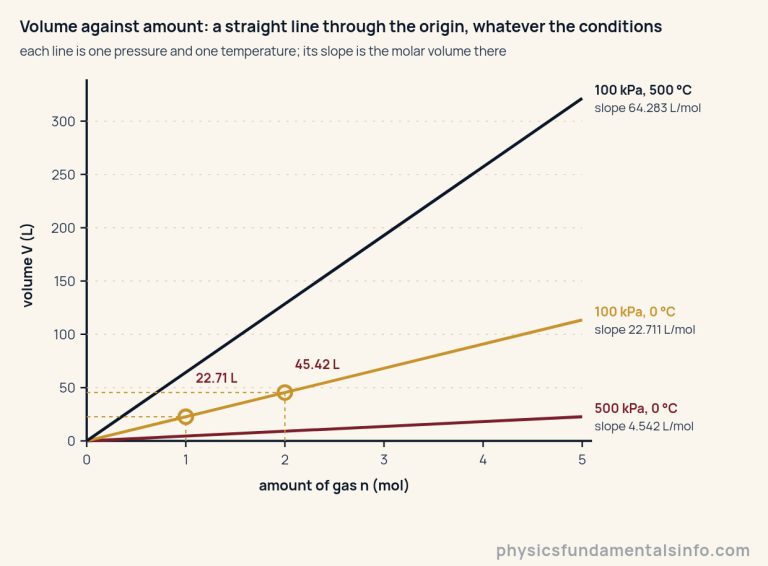
Everything hangs on that word proportional. Not “roughly tracks”, not “tends to increase with” — proportional, in the strict sense that plotting volume against amount gives a straight line through the origin. No molecules, no volume.
Three things are worth separating before the algebra starts.
- What is held still: the pressure and the temperature. Both have to be the same before and after, or the comparison is meaningless.
- What moves together: the amount of gas, measured in moles, and the volume it fills. Triple one and you triple the other.
- What never enters the sum: which gas it is. Helium, air, carbon dioxide, a mixture you invented yourself — the volume per mole is identical.
That last point is the one students find hardest to believe, and it is the heart of the law. A carbon dioxide molecule is about eleven times heavier than a helium atom, yet at the same pressure and temperature the two gases demand exactly the same room per mole.
The idea started life as a hypothesis in the early nineteenth century: equal volumes of gases, compared at the same pressure and temperature, contain equal numbers of particles. Chemistry largely ignored it for roughly half a century. It is the reason a measured volume of gas can stand in for a count of molecules at all.
Here is what the proportionality looks like as a table of readings, for air at 100 kPa and 0 °C.
| Amount of gas (mol) | Volume (L) | Mass of air (g) | Molecules | V/n (L/mol) |
|---|---|---|---|---|
| 0.10 | 2.271 | 2.896 | 6.022e22 | 22.711 |
| 0.50 | 11.36 | 14.48 | 3.011e23 | 22.711 |
| 1.00 | 22.71 | 28.96 | 6.022e23 | 22.711 |
| 2.00 | 45.42 | 57.92 | 1.204e24 | 22.711 |
| 3.00 | 68.13 | 86.88 | 1.807e24 | 22.711 |
| 5.00 | 113.6 | 144.8 | 3.011e24 | 22.711 |
One column is doing the real work. Volume, mass and molecule count all climb in step, but V/n sits at 22.711 L/mol and refuses to move, and that frozen column is Avogadro’s law.
A caution about arithmetic on that table, since it catches people out. The volume, mass and molecule columns are each rounded to four figures for display, while V/n was worked out before any rounding, so dividing the two rounded columns can leave the final digit adrift — 45.42 divided by 2.00 gives 22.71, not 22.711.
The Avogadro’s Law Formula, and the One Thing That Has to Stay Constant
The formula is V1/n1 = V2/n2: the volume divided by the amount of gas is the same before and after, so long as the pressure and the temperature have not moved between the two readings.
| Symbol | What it is | SI unit | Worth knowing |
|---|---|---|---|
| V1 | the volume the gas fills to begin with | cubic metre, m3 | litres are the practical unit; the ratio is unit-free, so both volumes may be in millilitres if you prefer |
| n1 | the amount of gas sitting in that volume | mole, mol | a molecule count in disguise: one mole is 6.02214076e23 of them |
| V2 | the volume once gas has been added or drawn off | cubic metre, m3 | read at the same pressure and temperature as V1, or the law has nothing to say |
| n2 | the amount of gas afterwards | mole, mol | larger than n1 when gas goes in, smaller when it comes out |
| Vm | the molar volume: the room one mole takes up under those conditions | cubic metre per mole, m3/mol | it is R T / P, and it is identical for every gas at that pressure and temperature |
There is a second way to write the same law, and it is often the more useful one. Multiply the molar volume by the amount of gas and you have the volume outright.
R is the molar gas constant, 8.31446261815324 J/(mol K), exact in the SI. T is the absolute temperature in kelvin and P the pressure in pascals, so a molar volume comes out in cubic metres per mole and is then usually quoted in litres per mole. This is the piece of the ideal gas law that Avogadro’s law is carved out of: fix P and T in PV = nRT and V is left proportional to n.
If you already have three of the four quantities, the arithmetic is one division and one multiplication, and our Avogadro’s law calculator will grind it out: type in the volume and amount you started with plus whichever of the other two you know, and it returns the missing one. It never asks for a pressure or a temperature, because it works on the ratio, where both cancel.
Now the condition that the formula hides, and the one most worth remembering. Avogadro’s law needs the pressure to be free to stay constant, which means the container must be able to change size — a piston, a balloon skin, the roof of a gas holder, a chest.
Pump gas into a rigid steel bottle and the volume cannot move at all, so the pressure climbs instead. That is PV = nRT at constant volume, a different question with a different answer, and no amount of Avogadro’s law will rescue it.
The lab below puts two such cylinders side by side, with the amount of gas in each, the pressure they work against and the temperature they share all under your control. The thing worth hunting for is the invariance: choosing a different gas moves the mass and the density and leaves every volume exactly where it was.
Frozen on the page, the same arrangement looks like the diagram below: two identical cylinders, the same pressure pushing down on both pistons, and twice as much gas on the right as on the left.

Why a Mole Fills 22.4 Litres, and Why Our Tools Say 22.711
Both figures are correct, and they differ because they are quoted at different pressures. A molar volume is meaningless without the pressure and the temperature it belongs to.
22.414 L/mol is the volume one mole of an ideal gas occupies at 0 °C and 1 atm, which is 101.325 kPa. That is the older convention, and it is the number printed in most textbooks — usually rounded to the 22.4 L everybody remembers.
22.711 L/mol is the same temperature at IUPAC’s standard pressure of 100 kPa. Lower pressure, more room, bigger number. Nothing has been corrected and no one has made a mistake; the reference pressure simply changed underneath the tradition, and both conventions are still in daily use.
The gap is easy to pin down, because Vm = R T / P makes the molar volume inversely proportional to pressure. Drop the pressure by a factor of 1.01325 and the volume grows by the same factor, which is 1.325 % — the whole of the 22.4-against-22.711 puzzle, in one division. Squeezing a gas at fixed temperature is the province of Boyle’s law, and this is its fingerprint.
Temperature pulls the other way, and far harder. T is the absolute temperature in kelvin, which is why 0 °C is 273.15 K and not zero, and why warming a gas at constant pressure inflates it — a change governed by Charles’s law rather than this one. It is the temperature that matters here, not how much heat went in, and the difference between heat and temperature is worth having straight before you use these figures.
| Condition | Pressure | Temperature | Molar volume V/n (L/mol) |
|---|---|---|---|
| IUPAC standard conditions (STP) | 100 kPa | 0 °C (273.15 K) | 22.711 |
| The older standard, at 1 atm | 101.325 kPa | 0 °C (273.15 K) | 22.414 |
| Standard ambient (SATP) | 100 kPa | 25 °C (298.15 K) | 24.790 |
| A warm room, at 1 atm | 101.325 kPa | 20 °C (293.15 K) | 24.055 |
| Body temperature, at 1 atm | 101.325 kPa | 37 °C (310.15 K) | 25.450 |
| Flue gas in a furnace | 100 kPa | 500 °C (773.15 K) | 64.283 |
Read the last row and the reason for all this fuss becomes obvious. A mole of flue gas takes up nearly three times the room a mole of the same gas takes at 0 °C, so anyone who quotes “22.4 L” for a hot stack is out by a factor that dwarfs the 1.325 % everybody argues about.
Avogadro’s Law Is Not Avogadro’s Number
They are two different things that happen to share a name, and confusing them is the single commonest error on this topic.
The law is the proportionality above: at one pressure and temperature, volume follows amount. It is a statement about how gases behave, and you can apply it all day without knowing how many molecules are actually in there.
The number is 6.02214076e23 per mole — the count of entities in one mole, and nothing to do with volume at all. Since the redefinition of the mole it has been exact by definition rather than measured, so the SI definition of the mole now fixes the count and the CODATA entry for the Avogadro constant carries no uncertainty on it.
That has a neat consequence for any molecule count you work out. N = n × NA is exact arithmetic; the only uncertainty in “1.204e24 molecules” comes from how well you knew the 2.00 mol in the first place.
A quick test of whether the two are straight in your head: the law would still be true if a mole had been defined as some other number of particles, because the volume per mole would simply come out different. The proportionality is the physics. The number is bookkeeping.
Equal Volumes, Very Different Masses
Equal volumes of two gases at the same pressure and temperature hold equal numbers of molecules, not equal masses — and the difference between those two statements is where most marks are lost.
Take 2.00 mol of each of three gases at 100 kPa and 0 °C. Each one fills 45.42 L and each one contains 1.204e24 molecules. Put them on a balance, though, and helium weighs 8.006 g, air 57.92 g and carbon dioxide 88.02 g.
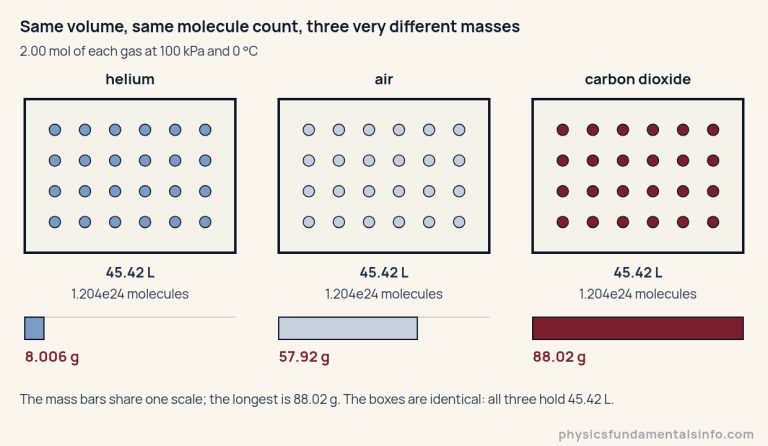
Mass follows molar mass, and molar mass is the one property the volume side of the law never asks about. Air is worth a footnote here: it is a mixture, so its 28.96 g/mol is a conventional mean molar mass for dry air rather than the molar mass of any one substance.
Density falls straight out of the same idea, because one mole has mass M and volume Vm. Divide and you get the density: at 100 kPa and 0 °C that is 0.17626 g/L for helium and 1.27516 g/L for air, which is why a helium balloon rises and an air-filled one does not.
Common Misconceptions About Avogadro’s Law
Four beliefs account for most of the wrong answers on this topic, and every one of them can be tested in the lab above in under a minute.
“Equal volumes of gases have equal masses”
They have equal molecule counts, which is a different claim entirely. Swap helium for carbon dioxide at the same pressure, temperature and amount and the volume does not stir, while the mass climbs by a factor of 10.9943 — the whole law in one comparison.
“Avogadro’s law only works at standard temperature and pressure”
It works at any pressure and any temperature, so long as both states share them. Standard conditions are a convention for quoting molar volumes, not a restriction on the law. At 500 °C the volume still doubles when the amount doubles; each mole simply occupies 64.283 L there instead of 22.711 L.
“Pumping gas into a sealed bottle is Avogadro’s law in action”
It is not, and this is the most expensive misconception of the four. A rigid container fixes the volume by construction, so adding gas raises the pressure and leaves the volume untouched. A sealed fizzy drink, a compressed-gas cylinder and a car tyre all belong in this category: put more gas in and what moves is the gauge, not the walls.
“This is the gas law about heating things”
That one is Charles’s law. The four classical gas laws are easy to tell apart once you ask which quantity is being varied: the amount of gas here, the temperature in Charles’s law, the pressure in Boyle’s law, and pressure against temperature in a rigid vessel for Gay-Lussac’s.
Where You Meet Avogadro’s Law
Anywhere a container is free to change size while gas goes in or comes out, you are watching Avogadro’s law happen.
- A breath. Your chest expands, more air molecules come in, and the lungful is a volume standing in for a number of molecules at body temperature and room pressure.
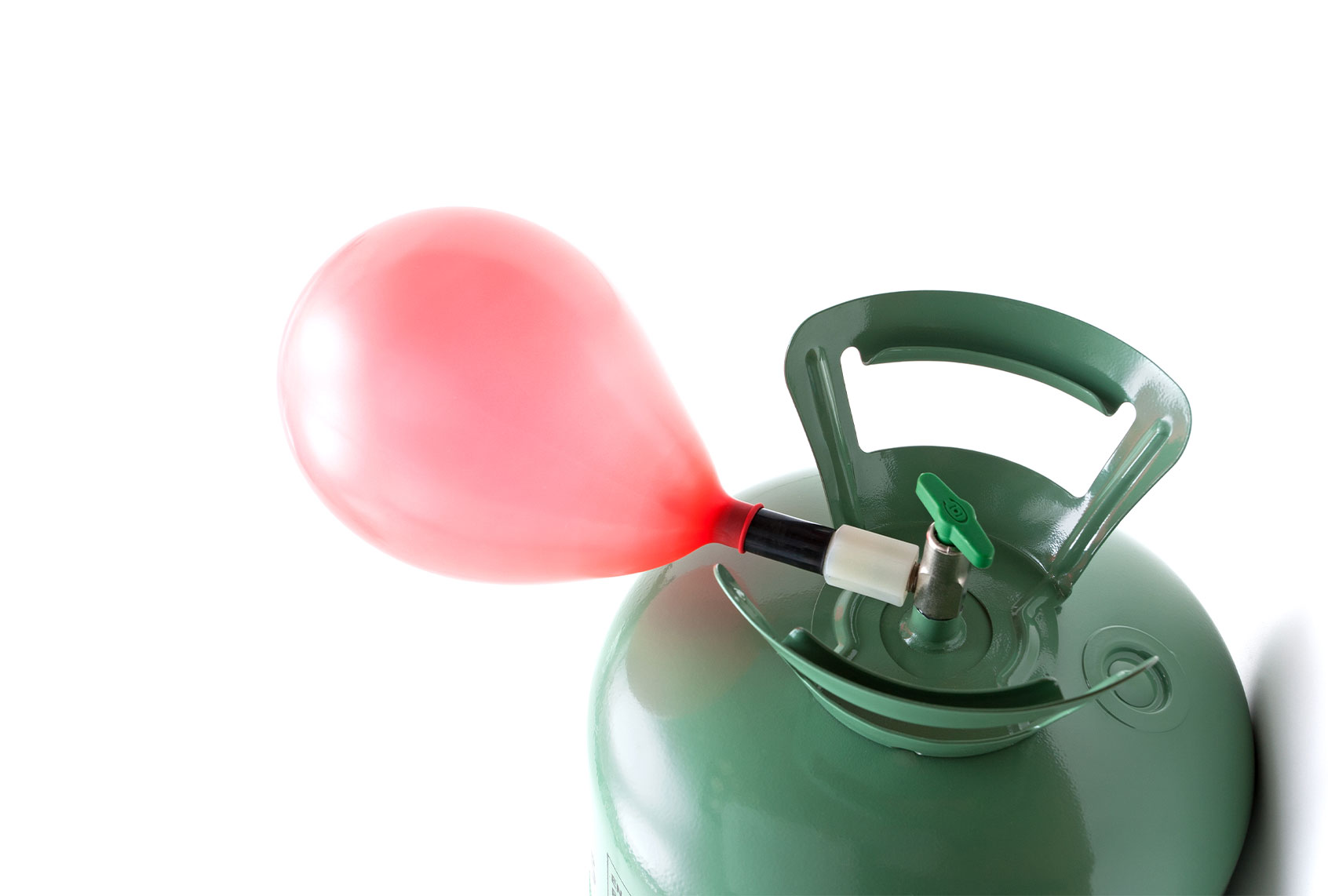
- A balloon at a party. Helium goes in from a cylinder and the skin grows to match, holding the inside pressure at roughly the pressure of the room throughout.
- Dough rising. Yeast turns sugar into carbon dioxide, so the number of gas molecules trapped in the dough goes up, and the dough swells against the air above it.
- A gas syringe on a school bench. The plunger is a free piston, so the scale reading is a direct proxy for how much gas the reaction has made.
- Lift. A balloon and the air it pushed aside hold the same number of molecules; the lift is the mass difference that follows from their molar masses.
In practice the first thing to check in any of these is whether the pressure genuinely held still. A syringe whose plunger sticks is no longer a constant-pressure device, and a balloon stretched hard enough to strain its skin is pushing its own pressure up as it grows.
Where Avogadro’s Law Breaks Down
The law is exact for an ideal gas and only approximate for a real one, and it fails outright in four recognisable situations.
- Under hard compression. Real molecules take up room and pull on one another, neither of which the straight line through the origin knows about. The departure grows as a gas is squeezed, and it is a qualitative statement here because nothing on this page measures it.
- Near condensation. Cooling a gas at constant pressure shrinks it in proportion to its absolute temperature, the gas relative of thermal expansion, until it stops being a gas at all. Carbon dioxide is already a solid near -78 °C at ordinary pressures.
- When the two readings do not share conditions. A volume measured in a cold store and another measured in a warm laboratory cannot be compared, and neither can a raw reading set against one already reduced to standard conditions.
- When the amount changes behind your back. Gas leaking through a balloon skin, dissolving into a liquid beneath it, or being consumed in a reaction all move n without anybody deciding to.
Treat any figure a gas-law tool gives you at an extreme setting as the volume an ideal gas would occupy there, rather than a prediction about a real sample. That distinction costs nothing to state and saves a great deal of embarrassment.