The nuclear model of the atom puts all of the positive charge and almost all of the mass at a tiny central point, with the electrons somewhere outside it. Alpha scattering forces it: a diffuse atom can bend a 5 MeV alpha particle by at most 0.0181 degrees, while a point nucleus turns it right around.
Fire something at a cloud of mist and it comes out the other side. Fire it at a ball bearing and, once in a while, it comes straight back at you. That is the whole experiment, and the only question worth asking is how often “once in a while” should be.
The answer is arithmetic, not storytelling. Two pictures of the atom were on the table in 1909, and they disagree about the biggest possible deflection by a factor of roughly ten thousand — which is a gap no amount of careful counting could blur.
What Is the Nuclear Model?
The nuclear model says the atom’s positive charge and nearly all its mass sit in a central nucleus thousands of times smaller than the atom, with the electrons occupying the space around it.
Nothing about that is obvious. An atom is electrically neutral and roughly an Angstrom across, and the simplest way to build one is to smear the positive charge through the whole volume and dot the electrons into it. That was the serious alternative, and it was not silly — it is just wrong, for a reason you can calculate in two lines.
How the modern picture of the atom was pieced together, and how its protons, neutrons and electrons are counted, is set out in the atomic structure guide. This page does something narrower: it takes the probe, works the deflection arithmetic, and sees which atom survives it.
The probe is an alpha particle — charge +2e, emitted with a few MeV of kinetic energy by an alpha-decaying source. Here it is only a tool, and every number below treats it as one.
Be clear about what the model is before using it. Seven things are assumed rather than measured: a point nucleus, a target too heavy to recoil, pure Coulomb repulsion with no screening by the target’s electrons, a non-relativistic alpha, a single scattering event, no nuclear force, and classical trajectories. The last section says where each one gives way.
The Nuclear Model Formula: One Length Sets Every Angle
Two expressions do all the work, and the second one is just the first divided by two.
- theta — the scattering angle, in degrees: the angle between the direction the alpha arrived on and the direction it leaves on.
- b — the impact parameter, in femtometres (fm). It is the aim: how far off centre the alpha’s original straight line passes the nucleus.
- alpha — the Rutherford length, in femtometres. Exactly half of d, and the only length the geometry needs.
- d — the head-on distance of closest approach, in femtometres, for an alpha aimed dead centre at that energy.
- E — the alpha’s kinetic energy, in MeV. Use conservation of energy on a head-on shot and all of it becomes electrostatic potential energy at the turning point, which is where d comes from.
- Z — the target’s proton number, a plain count. Gold is 79. z is the probe’s charge number, fixed at 2.
- k e2 — 1.439965 MeV·fm. This single combination is why an energy in MeV and a distance in femtometres need no conversion factor at all.
Run the numbers for a 5.0 MeV alpha on gold and d comes out at 45.50 fm, so alpha is 22.75 fm. Those two figures govern everything that follows, and you can work any one of the angle, the aim or the energy from the other two with the Rutherford scattering calculator rather than by hand.
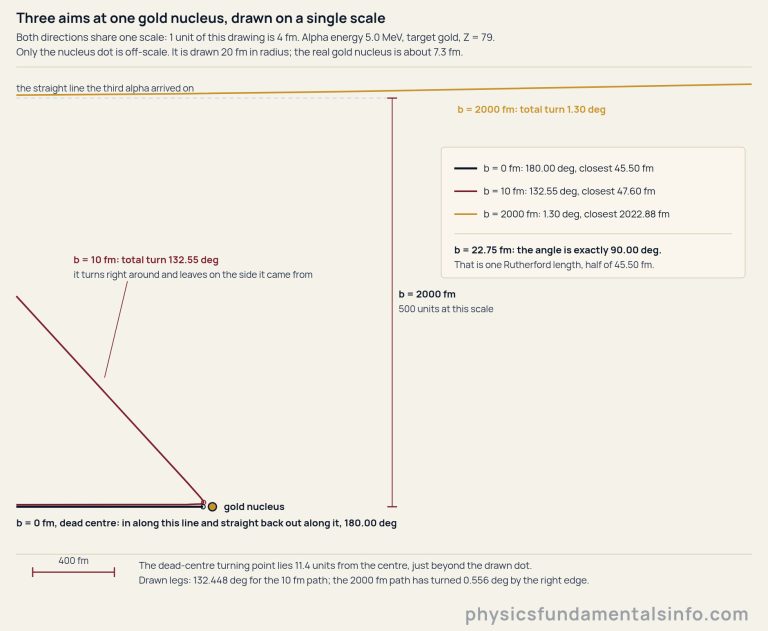
One consequence is worth memorising because it is exact. Aim exactly one Rutherford length off centre, b = alpha, and the deflection is exactly 90 degrees — at every energy, on every target. Aim dead centre, b = 0, and it is exactly 180 degrees.
How One Aim Becomes an Angle
The alpha and the nucleus repel each other with an inverse-square force, so the path is a hyperbola with the nucleus just outside its bend, and the ratio alpha over b fixes how sharp that bend is.
Watch what happens as you walk the aim inwards. At 2000 fm the alpha hardly notices the nucleus at all: 1.30 degrees, and the closest it ever gets is 2022.88 fm, which is barely less than the aim itself. At 10 fm the same alpha comes back out on the side it arrived from.
Here is the part that trips people up. The impact parameter is not the miss distance. At 20 fm of aim the alpha reaches 53.04 fm at closest approach, more than twice as far out as it was aimed, because the nucleus has been pushing it away the whole journey.
Both exact anchors live in the table below. Change the energy and nothing about the shape of the argument moves — four times the energy simply shrinks every distance by four.
| Case | Alpha energy E | Target | Aim b | Deflection theta | Closest approach | Rate relative to 90 deg | Thomson’s 1910 average for a spread-out atom |
|---|---|---|---|---|---|---|---|
| Dead centre at gold | 5.0 MeV | gold, Z = 79 | 0 fm | 180.00 deg | 45.50 fm | 0.25 | 0.00711 deg |
| A near miss that turns right around | 5.0 MeV | gold, Z = 79 | 10 fm | 132.55 deg | 47.60 fm | 0.36 | 0.00711 deg |
| The glancing hit that is almost all of them | 5.0 MeV | gold, Z = 79 | 2000 fm | 1.30 deg | 2022.88 fm | 1.49e+7 | 0.00711 deg |
| A light nucleus barely deflects it | 5.0 MeV | aluminium, Z = 13 | 10 fm | 41.05 deg | 14.42 fm | 16.54 | 0.00117 deg |
| Raise the energy, shrink the approach | 20.0 MeV | gold, Z = 79 | 0 fm | 180.00 deg | 11.38 fm | 0.25 | 0.00178 deg |
Read the last column against the fifth. Whatever the energy and whatever the target, the spread-out atom’s average stays stuck in the third decimal place while a point nucleus walks the whole range from 1 degree to 180. That column is an average and not a best case, so Test 1 below does the harder comparison: it gives the absolute ceiling for the same sphere, 0.018105 degrees, and that loses too.
One warning about the simulator below, because it is easy to mistake for evidence. It measures nothing: you hand it an energy, a target and an aim, and it draws the consequence. What it is genuinely for is holding two of those three still and watching the third do something you would not have guessed.
Test 1: What a Plum-Pudding Atom Could Never Do
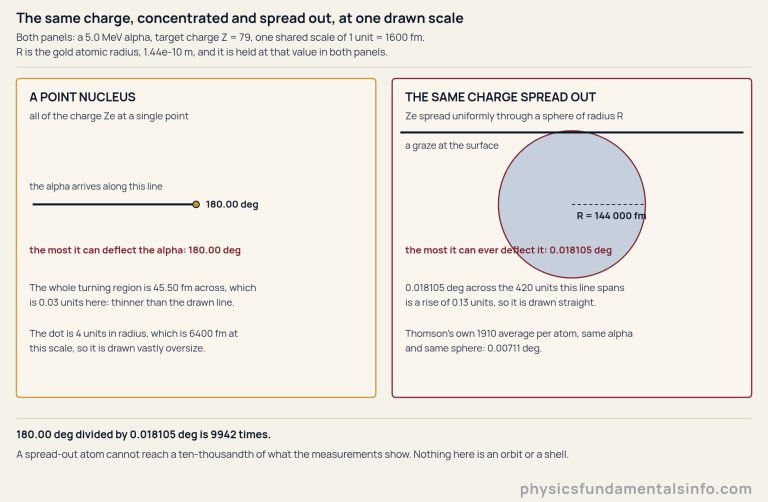
A uniformly charged sphere of radius 1.44e-10 m carrying the charge of 79 protons can deflect a 5.0 MeV alpha particle by at most 0.018105 degrees, which is 9942 times smaller than the backward deflections that were actually seen.
The reason is the shell theorem. Outside a uniform sphere of charge the field is exactly that of a point charge at the centre, so the hardest the alpha can ever be pushed is when it grazes the surface — and at the surface the whole atom is 144 000 fm away rather than 45. Push the alpha inside and it gets worse, not better: the enclosed charge falls away as it goes.
Work the impulse through a straight chord and three numbers drop out, all of them multiples of the same Rutherford length that runs the scattering law. That is what makes the comparison fair rather than rhetorical.
- Thomson’s own 1910 average deflection per atom, for this alpha and this sphere: 0.00711 degrees.
- The largest deflection from a chord passing inside the sphere: 0.00905 degrees — exactly 4/pi times the average.
- The absolute ceiling, grazing the surface: 0.018105 degrees, exactly twice the chord maximum.
- A point nucleus, aimed anywhere within one Rutherford length: anything from 90 degrees up to 180.00 degrees.
Across a whole ladder of twelve energies and six targets the spread-out ceiling never once reaches 0.106 degrees. Shrink the atomic radius to half an Angstrom and the worst case anywhere is still only 0.30 degrees. The conclusion does not hang on the radius anyone chooses.
Could many small deflections add up? That is the right question, and it is the one Thomson’s 1910 paper asked. As the standard account of the Rutherford scattering experiments sets it out, the net deflection from one atom is about 0.008 degrees once the electrons are included, so a random walk through 10 000 atoms gives about 0.8 degrees, and the chance of reaching 90 degrees that way is exp(-12656). That random-walk chain is quoted from that source, not computed here.
A number like exp(-12656) is not small. It is absent.
Test 2: Why the Rate Collapses as the Angle Opens
The count rate goes as one over the fourth power of the sine of half the angle, so a 10 degree deflection happens 15 087 times as often as a 150 degree one.
Normalise everything to the rate at 90 degrees and the energy and the target drop out of the expression completely. One table then covers every state the model can reach, which is exactly why it is worth drawing.
| Deflection theta | Rate relative to 90 deg | Deflection theta | Rate relative to 90 deg |
|---|---|---|---|
| 1 deg | 4.31e+7 | 45 deg | 11.66 |
| 5 deg | 6.91e+4 | 60 deg | 4.00 |
| 10 deg | 4332.67 | 90 deg | 1.00 |
| 20 deg | 274.95 | 120 deg | 0.44 |
| 30 deg | 55.71 | 150 deg | 0.29 |
Two ratios in that table are worth carrying around. A 10 degree deflection is 4332.7 times as common as a 90 degree one, and 15 086.6 times as common as a 150 degree one.
Now you can see why the work took from 1906 to 1913. Finding the rare hard deflections was never a matter of cleverness; it was a matter of sitting in a darkened room counting faint scintillations for long enough that a one-in-thousands event showed up at all. The law is steep, and steep laws cost time.
Test 3: How Rare a Backward Bounce Should Be
A point nucleus predicts that roughly one alpha particle in seven thousand should turn through more than 90 degrees in a thin gold foil, and the standard account of these experiments, linked under Test 1 above, reports that Geiger and Marsden measured about one in eight thousand — agreement to 13 per cent. The predicted figure rests on reference values for gold that this page has not fetched from a source, so treat it as verify-before-use; the measured one is the firm one.
That is the test the other two set up. Thomson’s atom does not predict a small number here and lose by a factor of a few; it predicts exp(-12656), a probability with no physical meaning at all. The nuclear model predicts a number of the right size, and the number was there.
The estimate itself is simple. Any alpha aimed within b of a nucleus turns through more than the angle that b corresponds to, so the fraction beyond an angle is the number of nuclei per unit volume, times the foil thickness, times the area of that circle. For the 1.5 micrometre foil used in the standard analysis, a number density built from those same unfetched reference values makes the foil 5840 atoms thick, which is the figure quoted here.
You meet two counts for one foil on this page, so take them together. The account linked under Test 1 above makes that same 1.5 micrometre foil about ten thousand atoms thick on its own treatment rather than this one, and the random-walk verdict it supports survives either count.
Two limits on that prediction, both honest rather than decorative. Those unfetched reference values named above are the density and the molar mass of gold. The second limit is the method: the single-scattering assumption breaks below about 4.35 degrees, where the predicted fraction exceeds a tenth, so no rarity figure on this page refers to any angle smaller than 90 degrees.
The exact count-rate ratios belong to the calculator rather than to this page. What belongs here is the shape of the result: two models, one predicting a measurable rate and one predicting nothing, and an experiment that settled it.
What the Scattering Measurement Actually Proves
It gives an upper bound on the nuclear radius at one particular energy, and not the radius itself.
The logic is tight and it is worth stating slowly. The alpha turned round at d under nothing but Coulomb repulsion, which means every scrap of the positive charge it was fighting lay inside d. It does not mean the charge fills d, and a higher-energy alpha pushes closer and returns a tighter bound from the very same experiment.
| Alpha energy | Head-on closest approach d | What it establishes | How loose that is |
|---|---|---|---|
| 1 MeV | 227.51 fm | the gold nucleus is smaller than 227.51 fm | 31 times too loose |
| 5 MeV | 45.50 fm | the gold nucleus is smaller than 45.50 fm | 6.2 times too loose |
| 10 MeV | 22.75 fm | the gold nucleus is smaller than 22.75 fm | 3.1 times too loose |
| 20 MeV | 11.38 fm | the gold nucleus is smaller than 11.38 fm | 1.6 times too loose |
The last column compares each bound with about 7.3 fm, which the source cited above gives as the true radius of the gold nucleus. Even the tightest bound in the table overshoots it by more than half again, and the 5 MeV bound overshoots by a factor of six.
That is not a disappointment; it is the honest shape of the answer. A single number, read off one experiment, shrank the home of the positive charge from 1.44e-10 m to under 45.50 fm, a factor of more than three thousand, without ever claiming to have measured a nucleus.
Common Misconceptions About the Nuclear Model
Four beliefs that survive because each of them is nearly right.
The Gold Foil Experiment Measured the Size of the Nucleus
It bounded it. At 5 MeV the bound is 45.50 fm and the real radius is about 7.3 fm, so the experiment was wrong about the size by a factor of six while being exactly right about the conclusion. Any figure for d quoted without the energy beside it is meaningless, because the two are inversely proportional.
Lots of Alpha Particles Bounced Back
Hardly any did, and that is the point. The overwhelming majority pass within thousands of femtometres and are deflected by a degree or two, which at the detector looks like going straight through. The rare hard deflection was remarkable precisely because the rate falls so steeply with angle.
The Impact Parameter Is How Close the Alpha Gets
It is where the alpha was heading, not where it arrived. An alpha aimed 20 fm off centre at 5 MeV never gets nearer than 53.04 fm, and an alpha aimed dead centre is the only one whose closest approach equals the head-on figure. The gap between aim and approach is the force doing its work.
The Plum-Pudding Model Was Qualitatively Wrong
It was quantitatively wrong, which is a much stronger statement. It gives a definite ceiling of 0.018105 degrees for this alpha and misses the observation by a factor of 9942. Models that fail by a factor of ten thousand are not nearly right.
Where the Nuclear Model Stops Being Trustworthy
The arithmetic above is exact to the last digit a computer holds. What is approximate is the physics underneath it, and six of its simplifications deserve naming.
- The nucleus is a point, and that is the assumption under test. Every distance here treats the target charge as sitting at one mathematical spot. It stops being usable once the alpha would arrive at the nuclear surface, which for gold means about 32.58 MeV — where d falls to the 6.98 fm that the empirical rule R = 1.2 fm x A1/3 gives for gold-197.
- There is no nuclear force in the relation at all. Pure electrostatic repulsion is the only thing bending the path, so above that energy the deflections simply stop following this law and nothing in the formula warns you.
- The target does not recoil. Gold is 49 times the alpha’s mass, so treating it as fixed is comfortable; aluminium is the weakest case on the ladder, and no correction for it is applied or estimated here.
- The electrons are absent. That is tolerable for the large-angle events, which happen deep inside the electron cloud where the nucleus dominates. It is not tolerable at very small angles, where the alpha sees a screened charge instead of a bare one.
- Relativity is left out, and the cost is only in the speed. The alpha runs at 5.18 per cent of light speed at 5 MeV and 10.36 per cent at 20 MeV, where the non-relativistic speed is 0.40 per cent high. No angle is touched, because theta depends on alpha over b and alpha is built from the kinetic energy rather than the speed.
- The trajectories are classical. The alpha is treated as a particle on a definite path with a definite aim, which is not what a quantum particle does, and this page makes no claim about why the treatment survives.
There is one more failure, and it is the famous one: an electron orbiting this nucleus would radiate and spiral in within a fraction of a second, so the nuclear model cannot explain why atoms last — which is the problem the Bohr model was built to solve.
Worked Problems
Every figure below is recomputed from the givens stated inside its own problem, and the constant k e2 = 1.439965 MeV·fm with z = 2 is used throughout. All eight assume the model’s seven idealisations: point nucleus, no recoil, bare Coulomb repulsion, non-relativistic alpha, one encounter, no nuclear force, classical paths.