The photoelectric effect is the emission of electrons from a metal surface when light at or above a threshold frequency shines on it. Each photon carries energy E = hf; if that exceeds the metal’s work function φ, an electron escapes with maximum kinetic energy K = hf − φ.
Shine a bright red lamp on a strip of caesium and nothing happens — not one electron stirs, no matter how long you wait. Swap in a faint violet beam and electrons leap off the surface in under a nanosecond.
That small act of rebellion cracked nineteenth-century physics wide open. Explaining it earned Einstein his only Nobel Prize, and the same physics now counts single photons inside PET scanners and night-vision goggles.
What Is the Photoelectric Effect?
Picture a metal as a crowd of loosely held electrons, each needing a little energy to break free of the surface. Light can supply that energy — but, as the twentieth century discovered, only in a very particular way.
Precisely: the photoelectric effect is the release of electrons (called photoelectrons) from a material, usually a metal, when electromagnetic radiation of sufficiently high frequency strikes it. Below a cut-off called the threshold frequency, nothing is emitted at all. Above it, electrons leave immediately, with energies set by the light’s colour rather than its brightness.
From a Spark-Gap Oddity to a Quantum Revolution
Heinrich Hertz stumbled on the effect in 1887, noticing that ultraviolet light made sparks jump more easily between electrodes. A year later Wilhelm Hallwachs showed UV light strips negative charge from a zinc plate, and in 1899 J. J. Thomson identified the escaping particles as electrons.
Then came the puzzle. In 1902 Philipp Lenard varied the light’s brightness a thousandfold — and the electrons’ energies did not budge. Classical wave theory had no answer. The stage was set for a 26-year-old patent clerk.
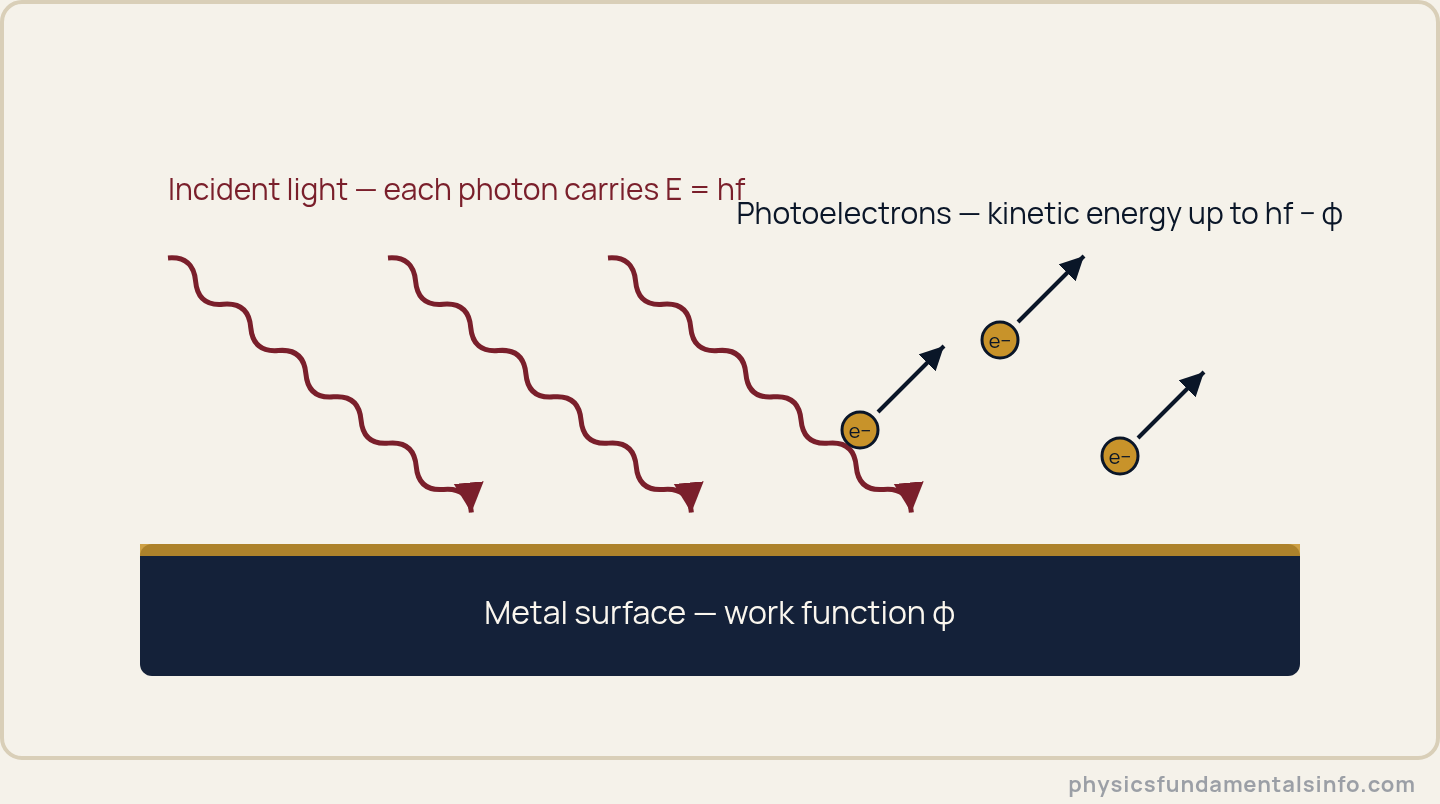
One photon in, at most one electron out: the whole photoelectric effect in a single picture.
The Photoelectric Effect Formula
Einstein’s photoelectric equation is pure energy bookkeeping. One photon hands its entire energy to one electron; the electron pays the escape cost and keeps the change as motion.
- Kmax — maximum kinetic energy of an emitted photoelectron, in joules (J)
- h — the Planck constant, 6.626 × 10⁻³⁴ joule-seconds (J·s); its exact value, 6.62607015 × 10⁻³⁴ J·s, has been fixed by definition in the SI since 2019
- f — the frequency of the incident light, in hertz (Hz)
- φ (phi) — the work function of the metal, in joules (J); in practice almost always quoted in electronvolts
An electronvolt (eV) is the energy an electron gains crossing one volt: 1 eV = 1.602 × 10⁻¹⁹ J. Atomic-scale energies land at a few eV, so the unit keeps the numbers humane.
Because frequency and wavelength are tied through the speed of light (c = fλ), the photon energy can be written either way:
A shortcut worth memorising: with λ in nanometres, the photon energy in electronvolts is almost exactly
Two more relations complete the toolkit. Setting Kmax = 0 gives the threshold frequency and threshold wavelength — the dimmest colour that still works:
And in the lab, Kmax is measured by applying a reverse voltage until even the fastest electrons turn back. That voltage is the stopping potential V0:
Prefer to skip the arithmetic? Feed any frequency and work function into our Photoelectric Effect Calculator and it returns the maximum kinetic energy and threshold instantly.
How the Photoelectric Effect Works
The mechanism runs in five short steps:
- Light arrives not as a smooth wave of energy but as discrete packets — photons — each carrying E = hf.
- A photon is absorbed by a single electron in an all-or-nothing event. One photon, one electron.
- The electron spends φ of that energy breaking through the surface barrier.
- Whatever remains becomes kinetic energy, up to Kmax = hf − φ.
- If hf is less than φ, the electron cannot escape, and the borrowed energy dissipates as heat almost instantly.
Think of the work function as a toll bridge that accepts only a single coin. A coin worth more than the toll gets you across with change; a fistful of undersized coins gets you nowhere, because the booth won’t let you combine them.
Why is Kmax a maximum rather than the energy of every electron? Only electrons freed right at the surface keep the full change. Those knocked loose deeper down lose energy in collisions on the way out, so real photoelectrons emerge with a spread of energies up to the Kmax ceiling.
And intensity? Brightness is simply photons per second. Turn it up and more electrons leave each second — the photocurrent rises — but each individual electron is no faster than before.
Try it yourself below: drag the wavelength across the threshold and watch the emission switch off, then crank the intensity and notice what changes — and what stubbornly doesn’t.
The 3 Rules of Photoelectric Emission
By 1905, careful experiments had distilled the effect into three stubborn rules. Each one, on its own, was fatal to the idea that light is only a wave.
Rule 1 — Below the Threshold, Nothing Happens
Every metal has a threshold frequency f0. Light below it ejects no electrons — at any brightness, for any duration. A wave theory predicted the opposite: keep pouring in energy and electrons must eventually shake loose, whatever the colour.
Rule 2 — Energy Follows Frequency, Never Brightness
Above threshold, Kmax climbs linearly with frequency and ignores intensity completely. Lenard’s thousandfold brightness test left the electron energies untouched. Waves said the opposite again: a bigger wave should hit harder and fling electrons out faster.
Rule 3 — Emission Is Instantaneous
Electrons appear within roughly a nanosecond of the light arriving, even when the beam is feeble. Classically, a dim wave would need to trickle energy into an atom-sized target for seconds or longer before one electron had saved up enough to escape. No such delay has ever been observed.
Einstein’s Answer — and Millikan’s Reluctant Proof
In 1905, the same year he published special relativity, Einstein proposed that light itself is grainy: it travels as quanta of energy hf, later named photons. All three rules then follow in one line — the photoelectric equation.
The idea was so radical that Robert Millikan spent a decade trying to disprove it. By 1916 his own precision data traced exactly the straight line Einstein predicted, and its gradient handed physics one of the era’s best measurements of the Planck constant.

Plot Kmax against frequency and every metal yields a parallel line: the gradient is the Planck constant, the x-intercept is the threshold f0, and extending the line backwards reveals −φ.
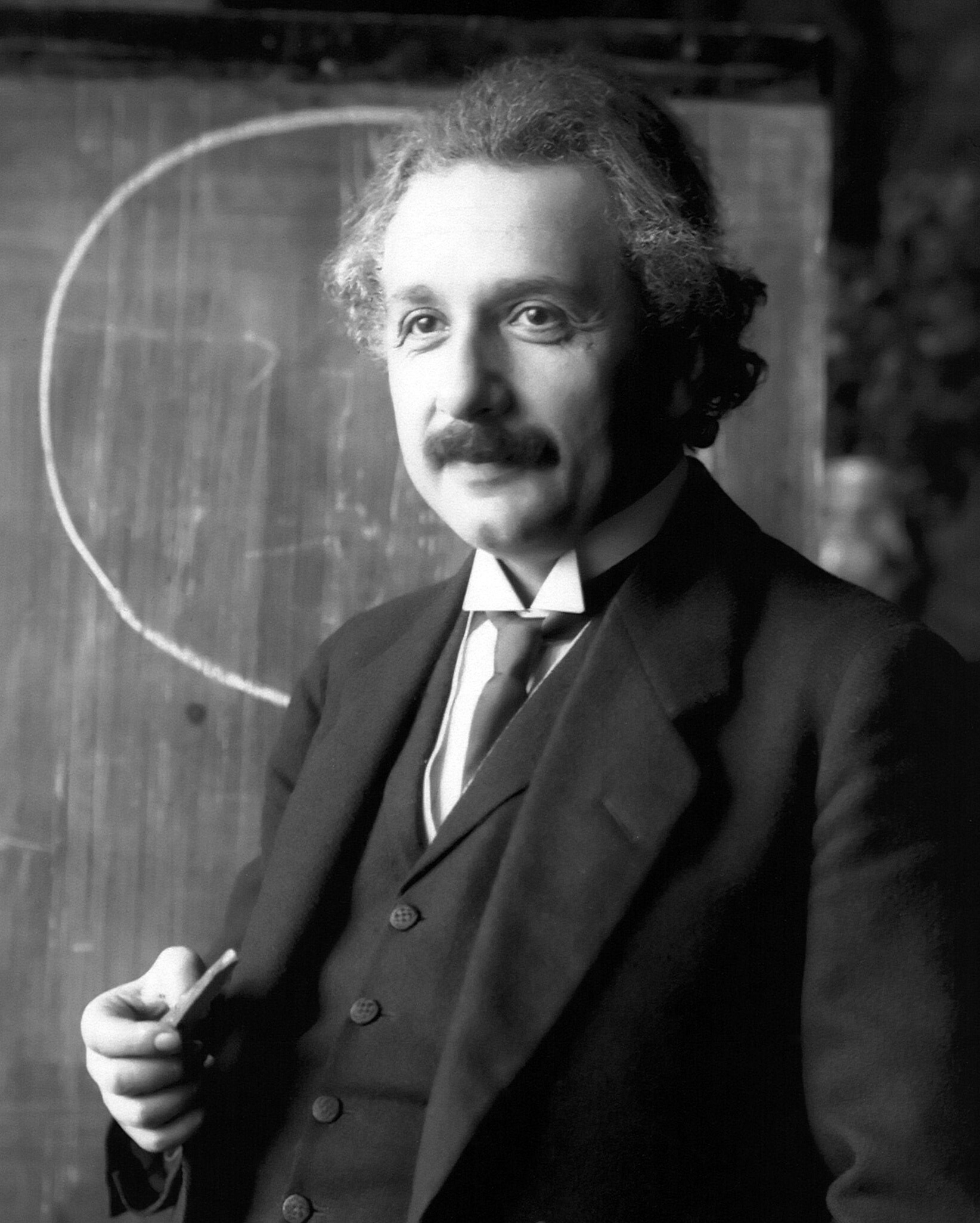
The verdict arrived from Stockholm: the 1921 Nobel Prize in Physics went to Einstein specifically for discovering the law of the photoelectric effect — relativity is not mentioned. The prize was held in reserve for a year and handed over in 1922; Millikan collected his own in 1923.
Threshold Frequency, Work Function and Real Metals
What sets the exit toll? The work function measures how tightly a surface grips its outermost electrons, and it depends on the element and even on how clean the surface is. That is why quoted values are typical, not sacred.
The pattern below explains a lot of engineering. Caesium’s toll is so low that ordinary visible light clears it — which is exactly why caesium compounds coat the photocathodes inside light detectors — while gold demands deep ultraviolet.
| Metal | Work function φ (eV) | Threshold frequency f0 (×1014 Hz) | Threshold wavelength λ0 (nm) | Does visible light work? |
|---|---|---|---|---|
| Caesium | ≈ 2.1 | ≈ 5.1 | ≈ 590 | Yes — orange light and bluer |
| Sodium | ≈ 2.3 | ≈ 5.6 | ≈ 539 | Yes — green light and bluer |
| Calcium | ≈ 2.9 | ≈ 7.0 | ≈ 428 | Only violet |
| Zinc | ≈ 4.3 | ≈ 10.4 | ≈ 288 | No — ultraviolet only |
| Copper | ≈ 4.7 | ≈ 11.4 | ≈ 264 | No — ultraviolet only |
| Gold | ≈ 5.1 | ≈ 12.3 | ≈ 243 | No — ultraviolet only |
Typical values for clean surfaces; real work functions shift with surface preparation and contamination.
Notice the sanity check hiding in that table: every work function sits at a few electronvolts, the same scale as visible and near-UV photons. In practice, that is why the effect straddles the visible–ultraviolet border — and if your homework answer gives a Kmax of 50 eV from visible light, a decimal point has slipped somewhere.
Georgia State University’s HyperPhysics keeps a useful reference on the photoelectric effect and early stopping-potential data if you want to dig into the original measurements.
Real-World Examples of the Photoelectric Effect
Photomultiplier tubes. A single photon strikes a caesium-coated photocathode, ejects one electron, and cascading electrodes multiply it into a measurable pulse. PET scanners in hospitals have long relied on them, and Japan’s Super-Kamiokande neutrino observatory watches for faint flashes with more than 11,000 of these tubes.
Night-vision goggles. Image-intensifier tubes convert scarce nighttime photons into photoelectrons, multiply them thousands of times, then splash them onto a phosphor screen. The eerie green scene you see is Einstein’s equation running at video speed.
Surface chemistry (XPS). X-ray photoelectron spectroscopy fires photons of known energy at a sample and measures the ejected electrons’ kinetic energies. Run the photoelectric bookkeeping backwards and the binding energies reveal which elements — and which chemical states — occupy the top few nanometres of a material.
The glowing lunar horizon. Sunlight photoemits electrons from Moon dust, leaving the sunlit surface positively charged. Mutual repulsion can loft fine grains above the ground — the favoured explanation for the faint horizon glow that Surveyor landers photographed in the 1960s.
From CMOS camera sensors and motion-activated burglar alarms to next-generation medical imaging, the photoelectric effect shapes a surprising range of everyday technology — all traceable to Einstein’s 1905 insight.
One family of look-alikes deserves care: camera sensors and solar panels absorb photons too, but their electrons never leave the material. That distinction is misconception territory — so let’s go there.
Common Misconceptions About the Photoelectric Effect
“Brighter light gives the electrons more energy”
This is the classic exam trap. Intensity is photon count, so brighter light releases more electrons per second — a larger current — while each electron’s maximum energy stays fixed by the frequency. Only changing the colour changes Kmax.
“Below the threshold, you just need to wait longer”
No amount of patience helps. An electron cannot bank energy from successive photons: each undersized packet dissipates almost immediately, so emission never begins. (Only in extreme laser fields can an electron catch two photons at once — irrelevant for ordinary light.)
“Solar panels run on the photoelectric effect”
Close, but no. Solar cells use the photovoltaic effect: absorbed photons promote electrons across an internal energy gap in a semiconductor, creating a voltage while everything stays inside the material. In the true photoelectric effect, electrons are ejected out of the surface entirely.
“Every photoelectron leaves with Kmax“
Kmax is a ceiling, not a standard issue. Electrons freed beneath the surface lose energy in collisions on the way out, so measured photoelectrons span a whole range of energies up to that maximum.
How the Photoelectric Effect Relates to Other Quantum Ideas
Max Planck introduced energy quanta in 1900 as a mathematical fix for blackbody radiation — and privately doubted they were real. Einstein’s move was to take the graininess literally: light does not merely get emitted in lumps, it is lumps in flight.
Confirmation kept coming. In 1923 Arthur Compton showed X-ray photons bouncing off electrons like billiard balls, carrying momentum as well as energy. A year later, Louis de Broglie flipped the logic: if waves act like particles, particles should act like waves — the birth of matter waves, which Problem 8 below puts to work.
The same photon bookkeeping powers atomic physics. Electrons in atoms occupy discrete energy levels, and a photon is absorbed or emitted only when its hf matches the jump — the photoelectric effect’s one-photon, one-electron rule, replayed inside every atom.
So the effect is more than a curiosity. It is the hinge on which physics swung from the classical wave picture to wave–particle duality — the strange, precise heart of the quantum world.
Worked Problems
Work through these in order — they climb from photon energy to a full Millikan-style analysis. Throughout, take h = 6.63 × 10⁻³⁴ J·s, c = 3.00 × 10⁸ m/s, e = 1.60 × 10⁻¹⁹ C and 1 eV = 1.60 × 10⁻¹⁹ J.
Show Solution
Solution:
Step 1: A photon’s energy is E = hf.
Step 2: E = (6.63 × 10⁻³⁴ J·s)(7.5 × 10¹⁴ Hz) = 4.97 × 10⁻¹⁹ J.
Step 3: Convert to electronvolts: E = (4.97 × 10⁻¹⁹ J) ÷ (1.60 × 10⁻¹⁹ J/eV) = 3.1 eV.
Answer: E ≈ 4.97 × 10⁻¹⁹ J ≈ 3.1 eV
Show Solution
Solution:
Step 1: Convert φ to joules: φ = 4.3 × (1.60 × 10−19 J) = 6.88 × 10⁻¹⁹ J.
Step 2: Threshold frequency: f0 = φ / h = (6.88 × 10⁻¹⁹ J) ÷ (6.63 × 10⁻³⁴ J·s) = 1.04 × 10¹⁵ Hz.
Step 3: Threshold wavelength: λ0 = c / f0 = (3.00 × 10⁸ m/s) ÷ (1.04 × 10¹⁵ Hz) = 2.89 × 10⁻⁷ m.
Answer: f0 ≈ 1.04 × 10¹⁵ Hz, λ0 ≈ 289 nm (ultraviolet)
Show Solution
Solution:
Step 1: Photon energy: E = hc/λ = (6.63 × 10⁻³⁴ J·s)(3.00 × 10⁸ m/s) ÷ (420 × 10−9 m) = 4.74 × 10⁻¹⁹ J = 2.96 eV.
Step 2: Apply Einstein’s equation: K = E − φ = 2.96 eV − 2.30 eV = 0.66 eV.
Step 3: Convert: K = 0.66 × (1.60 × 10−19 J) = 1.06 × 10⁻¹⁹ J.
Answer: K ≈ 0.66 eV ≈ 1.06 × 10⁻¹⁹ J
Show Solution
Solution:
Step 1: Photon energy: E = hc/λ = (1.989 × 10⁻²⁵ J·m) ÷ (250 × 10−9 m) = 7.96 × 10⁻¹⁹ J = 4.97 eV.
Step 2: Maximum kinetic energy: K = 4.97 eV − 4.70 eV = 0.27 eV.
Step 3: The stopping potential satisfies eV0 = K, so V0 = K/e = 0.27 eV ÷ e = 0.27 V.
Answer: V0 ≈ 0.27 V
Show Solution
Solution:
Step 1: Kinetic energy relates to speed by K = ½mv2, so v = √(2K/m).
Step 2: v = √(2 × 1.06 × 10−19 J ÷ 9.11 × 10⁻³¹ kg) = √(2.33 × 10¹¹ m2/s2).
Step 3: v = 4.8 × 10⁵ m/s. Sanity check: that is about 0.16% of the speed of light, so the non-relativistic formula is safe.
Answer: v ≈ 4.8 × 10⁵ m/s
Show Solution
Solution:
Step 1: For each reading, eV0 = hc/λ − φ. Subtracting the two equations eliminates φ: e(V1 − V2) = hc(1/λ1 − 1/λ2).
Step 2: 1/λ1 − 1/λ2 = 1/(3.00 × 10−7 m) − 1/(4.00 × 10−7 m) = 8.33 × 10⁵ m−1, and e(V1 − V2) = (1.60 × 10⁻¹⁹ C)(1.03 V) = 1.65 × 10⁻¹⁹ J.
Step 3: h = (1.65 × 10⁻¹⁹ J) ÷ [(3.00 × 10⁸ m/s)(8.33 × 105 m−1)] = 6.59 × 10⁻³⁴ J·s.
Step 4: Back-substitute: φ = hc/λ1 − eV1 = 6.59 × 10⁻¹⁹ J − 2.08 × 10⁻¹⁹ J = 4.51 × 10⁻¹⁹ J = 2.8 eV.
Answer: h ≈ 6.59 × 10⁻³⁴ J·s (within about 1% of the accepted value) and φ ≈ 4.5 × 10⁻¹⁹ J ≈ 2.8 eV
Show Solution
Solution:
Step 1: Photon energy: E = hc/λ = (1.989 × 10⁻²⁵ J·m) ÷ (450 × 10−9 m) = 4.42 × 10⁻¹⁹ J (about 2.76 eV — above caesium’s 2.1 eV work function, so emission occurs).
Step 2: Photons per second: N = P/E = (2.0 × 10⁻³ W) ÷ (4.42 × 10⁻¹⁹ J) = 4.5 × 10¹⁵ s−1.
Step 3: Electrons per second: n = N × 10−5 = 4.5 × 10¹⁰ s−1.
Step 4: Current: I = ne = (4.5 × 10¹⁰ s−1)(1.60 × 10⁻¹⁹ C) = 7.2 × 10⁻⁹ A.
Answer: I ≈ 7.2 nA
Show Solution
Solution:
Step 1: Photon energy: E = hc/λ = (1.989 × 10⁻²⁵ J·m) ÷ (200 × 10−9 m) = 9.95 × 10⁻¹⁹ J = 6.22 eV.
Step 2: Maximum kinetic energy: K = 6.22 eV − 5.10 eV = 1.12 eV = 1.79 × 10⁻¹⁹ J.
Step 3: Momentum: p = √(2mK) = √(2 × 9.11 × 10−31 kg × 1.79 × 10−19 J) = 5.71 × 10⁻²⁵ kg·m/s.
Step 4: De Broglie wavelength: λ = h/p = (6.63 × 10⁻³⁴ J·s) ÷ (5.71 × 10⁻²⁵ kg·m/s) = 1.16 × 10⁻⁹ m.
Answer: λ ≈ 1.16 nm — roughly ten atomic diameters, which is why such electrons diffract off crystals