Classical Mechanics

Conservation of Energy Explained

Definition

Conservation of energy states that energy is never created or destroyed, only converted from one form into another, so the total in a closed system stays constant. In mechanics that means kinetic energy plus potential energy holds steady, ½mv² + mgh, as long as nothing leaks away as heat, sound or deformation.

Let go of a ball at the top of a slide and it arrives at the bottom moving fast. Carry it back up and you pay for every metre yourself. Nothing in that exchange is free, and nothing in it vanishes.

That symmetry is the whole of this topic. Height turns into speed and speed turns back into height, and once you can count what went in you already know what comes out — no forces, no timings, no calculus.

What Is Conservation of Energy?

Conservation of energy is the rule that the total energy of a closed system never changes: energy moves between forms and between objects, but the books always balance.

The word “closed” is carrying most of the weight in that sentence. Draw a boundary around whatever you are studying, and the rule says the total inside it is fixed unless something crosses the line. Draw the boundary carelessly and the law will look broken when it is only being misread.

In mechanics the accounting usually runs to two entries, both of them ordinary forms of energy. Kinetic energy is what a body has because it is moving; potential energy is what it has because of where it sits. Slide down a hill and the second becomes the first.

Three things have to be true before you can use the rule to get a number.

  • You have named the system. A ball alone, or a ball and the Earth, or a ball, the Earth and the track — the answer depends on which you mean, so say it before you start.
  • You have a start state and an end state. Energy balances compare two snapshots. What happened between them is exactly what you are allowed not to know.
  • You have accounted for anything that left. Friction, drag, a squashy impact — each of these moves energy out of the mechanical account, and pretending otherwise is much the commonest source of a wrong answer in this topic.

Why does this beat another formula? Because it lets you skip the middle. Work and forces want to know what is happening at every instant; an energy balance wants only the two ends of the journey, which is why an introductory course such as MIT’s OpenCourseWare classical mechanics course teaches force and the conservation laws side by side as two routes to the same answers.

One number recurs below. Take g = 9.81 m/s2 throughout — the conventional surface value rounded to three figures, and the figure the simulator on this page uses. Real local gravity runs from roughly 9.78 to 9.83 m/s2, so treat three significant figures as the ceiling on every answer here.

The Conservation of Energy Formula

For a body moving under gravity with nothing lost, the kinetic and potential energy at the start add up to the kinetic and potential energy at the end.

½mv12 + mgh1 = ½mv22 + mgh2

Real tracks are not frictionless. The honest version carries one more term on the right — everything that left the mechanical account along the way.

½mv12 + mgh1 = ½mv22 + mgh2 + Eloss
Symbol What it is SI unit Worth knowing
mmass of the bodykgdivides out of every term when Eloss is zero, and only then
v1, v2speed at the start and at the endm/sspeeds, not velocities; the equation is blind to direction
h1, h2height at the start and at the endmonly the difference h1 – h2 ever enters, so the zero is yours to pick
ggravitational field strengthm/s29.81 m/s2 throughout this page; the nominal lunar surface value is about 1.62 m/s2, so g is an input rather than a constant of nature
Elossmechanical energy that left the accountJheat, sound, deformation; it can be zero but never negative

Working that balance by hand is four lines of algebra every single time. The conservation of energy calculator takes the seven quantities in the table above — the mass, both speeds, both heights, the energy lost and g — and solves the same equation for whichever one you nominate: either speed, either height, the energy lost to friction, or the mass. That loss term is the piece the kinematics tools do not carry.

One habit saves more marks here than any other. Fix the zero of height before you write anything down, then measure both heights from it and never move it again. Because only h1 – h2 appears, the floor, the bench top and sea level are all equally valid choices — but only if you stick to one.

The simulator below is that balance with the algebra taken out. One slider sets the release height of a 1 kg ball in a frictionless valley, and four readouts track its kinetic energy, its potential energy, the total and its speed. The same sim runs on its own page as the conservation of energy simulator.

Conservation of Energy Lab

How the Energy Swap Actually Works

The swap works because gravity does the same amount of work on a falling body whichever way the trade is running. Fall through a height h and gravity does mgh of work on you; that work has to show up somewhere, and with nothing to rub against it shows up as speed.

Follow a 1 kg ball down a 3.00 m drop and the accounting is easy to watch. It begins with 29.43 J of potential energy and no motion at all. A third of the way down it has converted 9.81 J, so it holds 19.62 J of potential and 9.81 J of kinetic energy — and at the bottom the whole 29.43 J is kinetic.
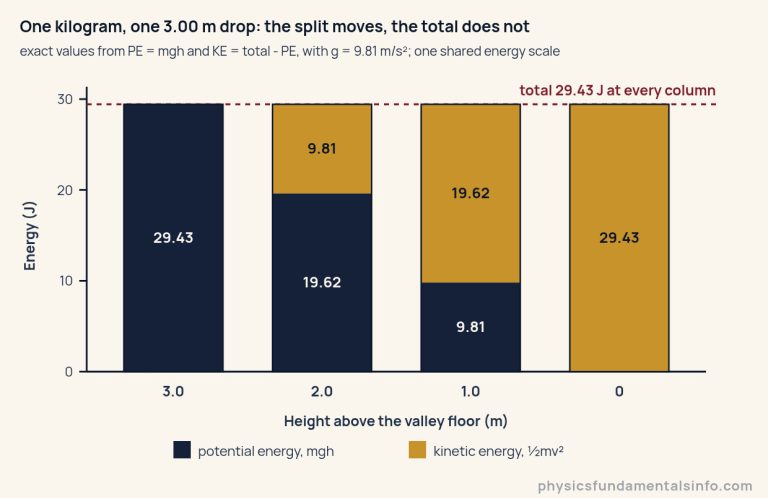
Four stacked bars on one shared energy scale, one for each height of a one kilogram ball on a 3.00 metre drop. At 3.0 metres the bar is 29.43 joules of potential energy and no kinetic energy. At 2.0 metres it is 19.62 joules of potential energy with 9.81 joules of kinetic energy stacked on top. At 1.0 metre it is 9.81 joules of potential energy with 19.62 joules of kinetic energy. At the floor it is 29.43 joules of kinetic energy and no potential energy. All four bars reach the same dashed line at 29.43 joules. The vertical axis is energy in joules, ticked 0, 10, 20 and 30; the horizontal axis is height above the valley floor in metres.
Figure 1. The same 1 kg ball at four heights on one 3.00 m drop. Every column reaches 29.43 J because nothing is lost; only the split between the two stores moves. These are exact values computed from PE = mgh, not readings taken off the simulator.

Run the simulator above and the same trade plays out on screen. Two habits of the tool are worth knowing before they confuse you: its ball is a fixed 1 kg model sliding on a frictionless valley with g fixed at 9.81 m/s2, and every readout is rounded to one decimal place.

Drop height Kinetic energy, at rest Potential energy, at rest Total energy Speed at the valley floor
0.5 m0.0 J4.9 J4.9 J3.1 m/s
1.2 m0.0 J11.7 J11.8 J4.9 m/s
2.0 m0.0 J19.6 J19.6 J6.3 m/s
3.0 m0.1 J29.4 J29.4 J7.7 m/s
5.0 m0.1 J49.0 J49.1 J9.9 m/s

Three details in that table repay a sentence each. The 1.2 m row prints 0.0 J and 11.7 J beside a total of 11.8 J, because each of the three numbers is rounded on its own — the quantities add up perfectly, the printed strings need not.

The 3.0 m and 5.0 m rows read 0.1 J before anything has been released, because the ball is parked a hair off the release point so that it has somewhere to start sliding from. A clean zero on the first frame is the wrong thing to expect here.

And whether a printed ratio lands cleanly depends on which readout you take it from. Quadrupling the height quadruples the energy and doubles the speed as quantities, but one decimal place does not always carry that across. Both energy columns run 4.9 J to 19.6 J between the 0.5 m and 2.0 m rows; at 0.9 m and 3.6 m the potential-energy column reads 8.8 J then 35.2 J, while the total at 3.6 m reads 35.3 J. Do the scaling from the formula rather than from the screen.

Why the Mass Cancels, and When It Stops Cancelling

The mass cancels because every term in the lossless balance carries exactly one factor of m — and it stops cancelling the moment a fixed amount of energy is taken out.

Write the balance out and the point is hard to miss. In ½mv12 + mgh1 = ½mv22 + mgh2, dividing every term by m simply deletes it. A 50 g ball and a 50 kg boulder released from the same shelf, with nothing lost on the way down, arrive at the floor at the same speed, and problem 1 below works that case through without the mass ever appearing.

Now put a fixed loss into the same sum. Drop a ball 1.80 m and let 3.00 J go to drag: a 2.00 kg ball lands at 5.68 m/s while a 4.00 kg ball lands at 5.82 m/s, against 5.94 m/s for the ideal case. The heavier body arrives faster, because the same 3.00 J is a smaller slice of its larger store.

So “mass never matters” is half a rule. It is exact when nothing is lost and wrong whenever something is — which, outside a physics question, is always.

Why the Path Does Not Change the Answer

The route makes no difference to the arrival speed, because gravity’s work depends only on the change in height and not at all on how the body got there.

Drop a ball 1.80 m, roll it down a straight ramp through the same 1.80 m, or send it down a curved slide: all three reach the floor at 5.94 m/s. That is the most useful consequence in the whole topic, because it lets you answer questions about shapes you could never write a force equation for.
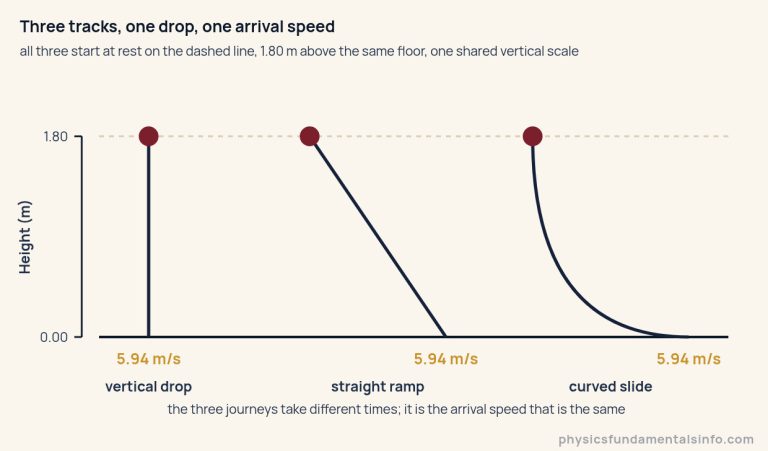
Three tracks drawn side by side on one shared vertical scale, each starting from rest at the same dashed release line 1.80 metres above a common floor. The first is a straight vertical drop, the second a straight ramp, the third a curved slide that starts vertical and flattens out. A gold label under the bottom of each track reads 5.94 metres per second. The vertical axis is height in metres, ticked at 0 and 1.80. A line underneath notes that the three journeys take different times and only the arrival speed is the same.
Figure 2. Three routes from rest at 1.80 m down to the same floor, drawn on one shared vertical scale. All three arrive at 5.94 m/s because only the height difference enters the balance. The three journeys do not take the same time, and the figure makes no claim that they do.

Equal speeds are not equal times, and exam questions love that gap. The vertical drop gets there first by a wide margin; the shallow slide dawdles. Energy tells you how fast a body arrives and never when.

Forces that behave this way have a name: conservative. Gravity is one, an ideal spring is another, and for both of them the work done depends on the endpoints alone. Friction is not conservative — which is precisely why it needs a term of its own on the right-hand side.

Where the Energy Goes When It Is Lost

Energy that leaves the mechanical account has not disappeared; it has become heat, sound and permanent deformation, three forms that height and speed cannot see.

A bouncing ball measures the loss for you, with no instruments at all. Drop one from 2.00 m, watch it rebound to 1.40 m, and 30.0 % of its mechanical energy has gone in a single impact lasting a tiny fraction of a second.
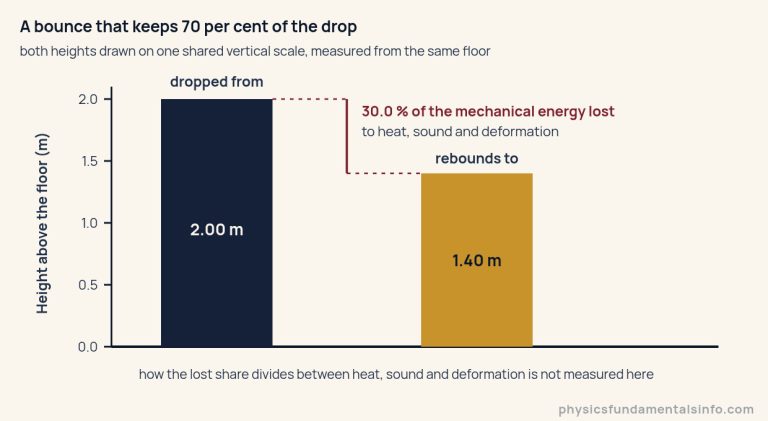
Two vertical bars on one shared height scale above a common floor. The left bar, labelled dropped from, stands at 2.00 metres. The right bar, labelled rebounds to, stands at 1.40 metres. A bracket between the two bar tops marks the 0.60 metre gap and is labelled 30.0 per cent of the mechanical energy lost to heat, sound and deformation. The vertical axis is height above the floor in metres, ticked 0.0, 0.5, 1.0, 1.5 and 2.0.
Figure 3. A ball dropped from 2.00 m rebounding to 1.40 m, both heights on one shared scale. The 0.60 m gap is 30.0 % of the mechanical energy the ball started with. How that share divides between heat, sound and deformation is not measured here, and no split is claimed.

It is tempting to read the rebound ratio as the energy ratio. It is not. The coefficient of restitution for that bounce is a ratio of speeds, sqrt(1.40/2.00) = 0.837, while the energy ratio is 0.700 — energy goes as the square of speed, so the two figures can never agree.

Here is where the bigger statement of the law lives. Mechanical energy is conserved only in the frictionless idealisation; total energy, heat included, is conserved always. Write “energy is conserved” beside a frictionless number without that qualifier and the next real experiment will embarrass you.

Where You Meet Conservation of Energy

The pattern to watch for is a store being emptied into motion, or motion being banked back into a store.
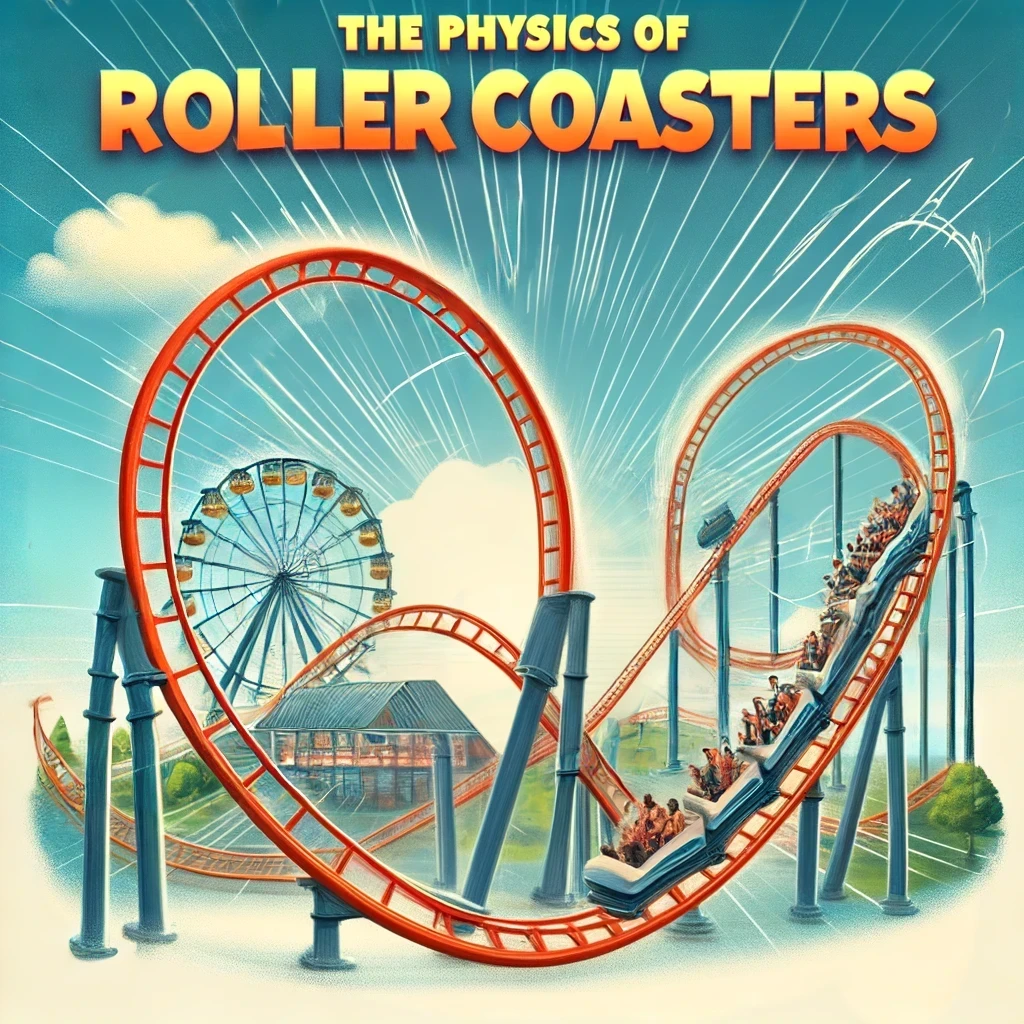
Roller coaster starting its first drop, the everyday picture of conservation of energy trading height for speed
The chain lift pays once. Every hill after it is bought out of the same account.
  • A roller coaster. The chain lift does the work once, at the start. Every hill after it is paid for out of that one deposit, which is why the hills get lower as the ride goes on.
  • A pendulum or a swing. The string does no work at all, because its pull is always sideways to the motion, so the bob trades height for speed and back again on a fixed budget.
  • A pumped-storage power station. Cheap overnight electricity pumps water uphill; at peak demand the same water runs back down through the turbines. The US Department of Energy’s pumped storage hydropower page describes the two-reservoir arrangement that makes it work.
  • A drawn bow or a compressed spring. The store here is elastic potential energy, ½kx2 rather than mgh, but the balance is written exactly the same way.
  • Regenerative braking. An electric car slowing down pushes much of its kinetic energy back into the battery instead of turning all of it into hot brake discs. Same law, better bookkeeping.

Notice what none of those five does. Not one of them creates energy; each only moves it between stores that were already stocked.

Common Misconceptions About Conservation of Energy

Four beliefs cause most of the trouble here, and each is worth naming out loud.

“We are running out of energy”

Not in the physicist’s sense. The energy in a tank of petrol is all still there after you burn it, spread thinly through warm exhaust, warm engine and warm road. What runs out is energy in a concentrated, useful form — the quantity is conserved, the usefulness is not.

“Mechanical energy is always conserved”

Only when nothing removes it. Air resistance, a rough track, a warm bearing and a squashy impact all move energy out of the mechanical account, so a real experiment always finds less kinetic plus potential energy at the end than at the start. The total is still conserved; it is the mechanical sub-total that leaks away, which is why a real pendulum eventually stops.

“Conservation of energy is the same rule as conservation of momentum”

They are two different conserved quantities with two different conditions: energy is a scalar in joules that holds steady when nothing crosses the system boundary, while conservation of momentum is a vector rule in kg·m/s that holds when no net external force acts. A collision can conserve momentum perfectly and still lose most of its kinetic energy to heat and sound.

“A heavier ball hits the ground harder, so it must be faster”

Harder, yes. Faster, only once you let the air in — with nothing lost they arrive together, because the mass divides out. Put a fixed loss in the sum and the heavier ball does arrive faster, as the drag figures further up show, and ½mv2 still contains an m, so it carries more kinetic energy either way. Speed and energy are separate questions, and this equation answers them separately.

Worked Problems

Problem 1
A 0.50 kg ball is released from rest 1.80 m above the floor and falls freely. Taking g = 9.81 m/s², how fast is it moving when it reaches the floor?
Show Solution
Solution: Step 1: Nothing is lost, so the balance is ½mv12 + mgh1 = ½mv22 + mgh2. The ball starts at rest, so v1 = 0, and the floor is the natural zero of height, so h2 = 0. Step 2: What survives is mgh1 = ½mv22. Every term carries the mass, so divide through by m: gh1 = ½v22, which rearranges to v22 = 2gh1. Step 3: Substitute, carrying the units. v22 = 2 × 9.81 m/s2 × 1.80 m = 35.316000 m2/s2. Step 4: Take the square root. v2 = sqrt(35.316000) = 5.942727 m/s. Answer: 5.94 m/s. The 0.50 kg never entered the working, which is the whole point of this one.
Problem 2
The same 0.50 kg ball, released from rest 1.80 m above the floor. Find its potential energy at the top and its kinetic energy at the floor, and show that the two agree.
Show Solution
Solution: Step 1: Potential energy at the release point, measured from the floor. PE1 = mgh1 = 0.50 kg × 9.81 m/s2 × 1.80 m = 8.829000 J. Step 2: Kinetic energy at the floor, using the unrounded v22 = 35.316000 m2/s2 from problem 1. KE2 = ½mv22 = 0.5 × 0.50 kg × 35.316000 m2/s2 = 8.829000 J. Step 3: The two agree to every digit shown, which is the balance itself: all of the potential energy at the top has become kinetic energy at the floor. Step 4: Watch when you round. Feed the rounded 5.94 m/s back in instead and you get 5.942 = 35.2836 m2/s2, then 0.5 × 0.50 × 35.2836 = 8.820900 J, which is wrong in the third figure. Round once, at the end. Answer: 8.829 J at the top and 8.829 J at the floor.
Problem 3
A skater crosses level ice at 6.00 m/s and coasts up a frictionless ramp. How high do they rise before coming to rest?
Show Solution
Solution: Step 1: Balance the bottom of the ramp against the highest point, with the bottom as the zero of height. The skater is momentarily at rest at the top, so ½mv12 = mgh2. Step 2: Divide by m and rearrange: h2 = v12 / (2g). Step 3: Build the two pieces. v12 = 6.002 = 36.0000 m2/s2, and 2g = 2 × 9.81 = 19.6200 m/s2. Step 4: Divide. h2 = 36.0000 / 19.6200 = 1.834862 m. Answer: 1.83 m, measured vertically. The ramp’s angle was never given because it is never needed.
Problem 4
A roller coaster car passes a point 25.0 m above the ground at 4.00 m/s. Treating the track as frictionless, how fast is it moving at a point 8.0 m above the ground?
Show Solution
Solution: Step 1: Rearrange the lossless balance for the final speed: v22 = v12 + 2g(h1 – h2). Step 2: The height dropped is h1 – h2 = 25.0 – 8.0 = 17.0 m, so 2g(h1 – h2) = 2 × 9.81 × 17.0 = 333.5400 m2/s2. Step 3: Add what the car already had. v12 = 4.002 = 16.0000 m2/s2, so v22 = 16.0000 + 333.5400 = 349.5400 m2/s2. Step 4: Take the root of the full figure, not a truncated one. v2 = sqrt(349.5400) = 18.695989 m/s. Answer: 18.7 m/s. The car’s mass was never given, and the shape of the track between the two points is irrelevant.
Problem 5
A pendulum bob hangs on a light 1.20 m string. It is pulled aside until the string is 35 degrees from the vertical and released from rest. How fast is the bob moving at the lowest point of the swing?
Show Solution
Solution: Step 1: The string only steers. Its tension is always perpendicular to the motion, so it does no work, and the balance is gh = ½v2 with h measured from the lowest point. Step 2: Get h from the geometry. The bob hangs L cosθ below the pivot when the string is at θ, and L below it at the bottom, so h = L(1 – cosθ). Here cos 35° = 0.81915204, so 1 – 0.81915204 = 0.18084796. Step 3: Multiply by the length. h = 1.20 m × 0.18084796 = 0.21701755 m. Step 4: Now the speed. 2gh = 2 × 9.81 × 0.21701755 = 4.257884 m2/s2, so v = sqrt(4.257884) = 2.063464 m/s. Step 5: This is the problem that punishes early rounding. Round h to 0.22 m first and you get 2 × 9.81 × 0.22 = 4.3164, then sqrt(4.3164) = 2.077595, which prints as 2.08 m/s and is wrong. Answer: 2.06 m/s. Neither the bob’s mass nor the string’s length beyond the h it sets ever enters the speed.
Problem 6
A 45.0 kg sled is moving at 8.00 m/s across level snow and slides to a stop. Take the coefficient of kinetic friction as 0.12. How far does it travel?
Show Solution
Solution: Step 1: The height never changes, so the whole balance collapses to kinetic energy in equals energy out: ½mv2 = Eloss, and here the loss is friction doing work over a distance d. Step 2: The kinetic energy to be removed. ½mv2 = 0.5 × 45.0 kg × 64.0000 m2/s2 = 1440.0000 J, since 8.002 = 64.0000. Step 3: The friction force on level ground. f = μmg = 0.12 × 45.0 × 9.81 = 52.9740 N. Step 4: Distance is energy divided by force. d = 1440.0000 / 52.9740 = 27.183146 m. Step 5: Notice the mass drop out. Setting ½mv2 = μmgd gives d = v2 / (2μg), and with 2 × 0.12 × 9.81 = 2.354400 that is 64.0000 / 2.354400 = 27.183146 m — the same answer with no mass anywhere in it. Answer: 27.2 m. Take μ = 0.12 as a figure chosen for this problem, not a measured property of snow.
Problem 7
A ball is dropped from 2.00 m onto a hard floor and rebounds to 1.40 m. What fraction of its mechanical energy did the bounce remove, and what is the coefficient of restitution?
Show Solution
Solution: Step 1: At the top of each flight the ball’s mechanical energy is mgh, so for the same ball the fraction kept is just the height ratio: 1.40 / 2.00 = 0.70000000. Step 2: The fraction lost is therefore 1 – 0.70000000 = 0.30000000, which is 30.0 %. Step 3: In joules per kilogram of ball that is g(h1 – h2) = 9.81 × 0.60 = 5.886000 J/kg, using h1 – h2 = 2.00 – 1.40 = 0.60 m. The ball’s mass is not given and the fraction does not need it. Step 4: The coefficient of restitution is a ratio of speeds, not of energies. Downward: sqrt(2 × 9.81 × 2.00) = sqrt(39.2400) = 6.264184 m/s. Upward: sqrt(2 × 9.81 × 1.40) = sqrt(27.4680) = 5.240992 m/s. Step 5: Divide them. e = 5.240992 / 6.264184 = 0.836660, which is also sqrt(0.70000000) = 0.836660, because energy goes as the square of speed. Answer: 30.0 % of the mechanical energy is gone, 5.886 J for every kilogram of ball, and e = 0.837. That 0.837 is not the energy fraction, and it belongs to this ball on this floor rather than to the ball alone.
Problem 8
A spring of stiffness 240 N/m is compressed by 0.150 m and released, launching a 0.300 kg trolley up a frictionless ramp. How fast does the trolley leave the spring, and how high does it climb?
Show Solution
Solution: Step 1: Two stores, one balance. Elastic potential energy becomes kinetic energy as the spring pushes, and that kinetic energy becomes gravitational potential energy on the way up the ramp. Step 2: The energy stored in the spring. ½kx2 = 0.5 × 240 N/m × 0.022500 m2 = 2.700000 J, since 0.1502 = 0.022500. Step 3: All of it is kinetic as the trolley leaves. ½mv2 = 2.700000 J gives v2 = 5.400000 / 0.300 = 18.000000 m2/s2, where 5.400000 is 2 × 2.700000, so v = sqrt(18.000000) = 4.242641 m/s. Step 4: Up the frictionless ramp the same 2.700000 J becomes mgh. With 0.300 × 9.81 = 2.943000, the height is h = 2.700000 / 2.943000 = 0.917431 m. Answer: 2.700 J stored, 4.24 m/s leaving the spring and 0.917 m up the ramp. Note the division of labour: ½kx2 belongs to the Hooke’s law calculator, since the conservation of energy calculator carries no spring term, while the climb from a known speed is exactly the balance this page has been writing all along.

Frequently Asked Questions

What is the formula for conservation of energy?
The mechanical form is ½mv1² + mgh1 = ½mv2² + mgh2: kinetic plus potential energy at the start equals kinetic plus potential energy at the end. When friction or drag removes energy, an E loss term is added to the right-hand side. Divide every term by the mass and it disappears, which is why a light body and a heavy one behave identically in the ideal case.
Can energy be created or destroyed?
No. Energy can be converted from one form into another and handed from one object to another, but the total in a closed system stays exactly the same. Burning petrol does not consume energy; it spreads a concentrated chemical store into warm exhaust, warm engine and warm road. What a power station sells is not energy but energy in a useful, concentrated form.
Is mechanical energy always conserved?
No, only when nothing removes it. Kinetic plus potential energy holds constant on a frictionless path, but air resistance, a rough surface and a squashy impact all move energy into heat, sound and deformation. Total energy is still conserved; it is the mechanical sub-total that falls, and that is why a real pendulum eventually comes to rest.
Why does the mass cancel in conservation of energy problems?
Because every term in the lossless balance carries one factor of the mass, so dividing through removes it. A heavy ball and a light one dropped from the same shelf reach the floor at the same speed. It stops being true once a fixed amount of energy is lost: with 3.00 J going to drag on a 1.80 m drop, a 2.00 kg ball lands at 5.68 m/s and a 4.00 kg ball at 5.82 m/s.
What is the difference between conservation of energy and conservation of momentum?
They are different quantities obeying different conditions. Energy is a scalar measured in joules and is conserved when nothing crosses the system boundary; momentum is a vector measured in kg·m/s and is conserved when no net external force acts. A collision can conserve momentum perfectly while turning most of its kinetic energy into heat and sound.
Does the shape of a slope change the speed at the bottom?
No. On a frictionless track only the change in height enters the energy balance, so a vertical drop, a straight ramp and a curved slide starting from the same height all arrive at the same speed — 5.94 m/s from 1.80 m. The times are wildly different, though. Energy tells you how fast the body arrives, never when it gets there.
Where does the energy go when a ball bounces lower each time?
Into heat, sound and permanent deformation of both the ball and the floor. A ball dropped from 2.00 m that rebounds to 1.40 m has lost 30.0 % of its mechanical energy in one impact, almost all of it during the brief moment of contact. The energy is not gone from the universe, only from the part of the account that height and speed can see.
P

Written by PhysicsFundamentals Editorial Team

Articles on PhysicsFundamentalsinfo.com are researched, written, and fact-checked by our editorial team. Every piece is reviewed for accuracy before publishing, with formulas and worked examples checked against standard physics references.

View All Authors →