Atomic structure is the arrangement of the particles inside an atom: protons and neutrons packed into a tiny central nucleus, with electrons in shells around it. The number of protons, the atomic number Z, identifies the element; the mass number A = Z + N counts protons plus neutrons; and the balance of protons against electrons sets the charge.
Every atom in your body, from the carbon in your skin to the oxygen in the water you drink, is assembled from no more than three kinds of particle. What makes one atom oxygen and another carbon is not some special ingredient. It is a count.
Change the number of protons and you have a different element. Change the neutrons and you get a heavier or lighter version of the same element; change the electrons and the atom picks up a charge. Those three rules, and the odd fact that nearly all of an atom’s mass sits in a nucleus tens of thousands of times smaller than the atom itself, are what this guide builds up, using real isotope data from NIST and a lab in which you can assemble any atom from hydrogen to calcium.
What Is Atomic Structure?
Atomic structure is the way an atom’s particles are arranged: protons and neutrons packed into a tiny central nucleus, with electrons spread through the much larger space around it. The number of protons, called the atomic number Z, decides which element the atom is. The neutrons and electrons then settle the rest: which isotope it is, whether it carries a charge, and how it bonds.
Think of every atom as a card carrying three numbers. Carbon-12 reads 6, 6, 6: six protons, six neutrons, six electrons. Alter the first number and the card describes a different element altogether; the other two only fine-tune the one you already have.
An atom is electrically neutral when its electrons exactly balance its protons, because a proton and an electron carry equal and opposite charges. The neutron, as its name suggests, carries no charge at all. Its job is done inside the nucleus, as the section on isotopes explains.
The Three Particles Inside an Atom
An atom contains three kinds of particle: positively charged protons and uncharged neutrons in the nucleus, and negatively charged electrons outside it. Protons and neutrons have almost the same mass, while an electron is about 1,836 times lighter than a proton.
| Particle | Relative charge | Charge (C) | Mass (kg) | Mass (u) | Where it is found |
|---|---|---|---|---|---|
| Proton | +1 | +1.602 × 10⁻¹⁹ | 1.67262 × 10⁻²⁷ | 1.00727647 | in the nucleus |
| Neutron | 0 | 0 | 1.67493 × 10⁻²⁷ | 1.00866492 | in the nucleus |
| Electron | -1 | -1.602 × 10⁻¹⁹ | 9.10938 × 10⁻³¹ | 0.000548580 | in shells around the nucleus |
The masses are NIST’s CODATA 2022 recommended values, rounded. The charge needs no rounding caveat: since 2019 the SI has fixed the elementary charge e at exactly 1.602176634 × 10⁻¹⁹ C. Carbon-12 also anchors the mass column: the unified atomic mass unit u is defined as one twelfth of the mass of a carbon-12 atom, which is why carbon-12 weighs exactly 12 u in every table.
Two facts in that table do most of the work. The proton-to-electron mass ratio, 1.00727647 / 0.000548580 = 1836.15, means a carbon atom’s six electrons add only about 0.03 % to its particle mass, as Problem 6 shows. And every free particle’s electric charge is a whole number of e, so the proton’s +1 cancels the electron’s -1 exactly and an atom with equal numbers of each shows no charge at all.
Atomic Number, Mass Number and the Formula A = Z + N
Two counts label every nucleus: the atomic number Z, which is the number of protons, and the mass number A, which is the total number of protons and neutrons. The neutron number N is the difference between them, and a separate rule gives the charge.
- A — mass number: the number of nucleons (protons plus neutrons). A pure count, with no unit.
- Z — atomic number: the number of protons. It fixes the element; Z = 6 is always carbon.
- N — neutron number: the number of neutrons, N = A – Z.
- e — the elementary charge, 1.602176634 × 10⁻¹⁹ C. The net charge comes out in coulombs (C); in units of e it is simply Z minus the number of electrons.
Nuclear notation packs the two labels round the chemical symbol, with A top left and Z bottom left: 126C for carbon-12, 3717Cl for chlorine-37. In words the name and the mass number are enough. The name already implies Z, so “carbon-14” tells you the nucleus holds 6 protons and 14 – 6 = 8 neutrons.
The charge rule is pure bookkeeping. Each proton brings +e and each electron brings -e, so a sodium atom that has lost one of its 11 electrons carries (11 – 10) × e = +1.602 × 10⁻¹⁹ C, and chemists write it Na+.
A common student slip is to treat the mass number as the atom’s mass. A counts particles, while the mass in u is close to A but equal to it only for carbon-12, which is exact by definition. Sodium-23 has A = 23 and a NIST mass of 22.989769 u.
Try the three counts in the lab below, which opens on carbon-12. Add one neutron and the element stays carbon, the mass number becomes 13, and the lab reports carbon-13 as 1.07 % of natural carbon atoms. Add a proton instead and the atom becomes nitrogen and, with only six electrons still in place, a positive ion.
How Are the Nucleus and the Electron Shells Arranged?
The nucleus sits at the centre and the electrons fill shells around it in order, holding 2, 8, 8 and 2 electrons across the first 20 elements, from hydrogen to calcium. In this simple model each shell fills before the next one starts, so the arrangement follows directly from the electron count.
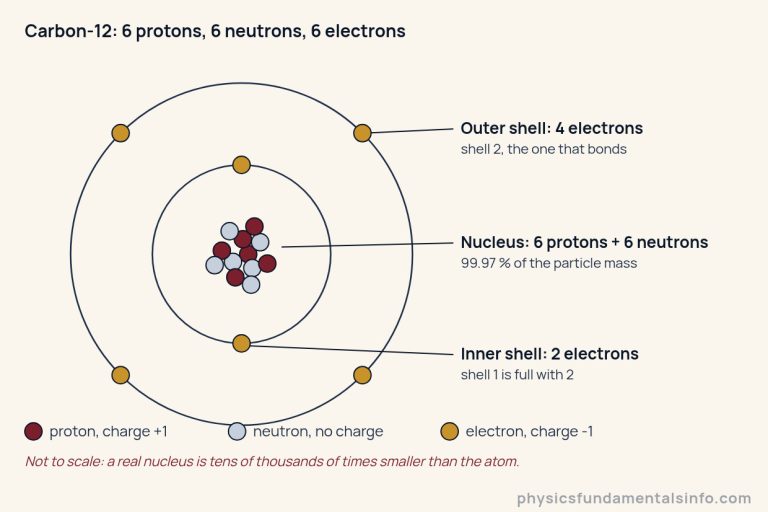
Carbon’s arrangement is written 2, 4. Sodium, with 11 electrons, is 2, 8, 1; aluminium, with 13, is 2, 8, 3; chlorine, with 17, is 2, 8, 7. Calcium closes the simple pattern at 2, 8, 8, 2, a total of 20.
The shells also lay out the periodic table. The number of occupied shells is the element’s period, and the outer-shell count sets its group: in groups 1 and 2 the group number is the outer-shell count, and in groups 13 to 18 it is the outer-shell count plus 10, so chlorine’s 7 outer electrons put it in group 17. Helium is the one exception, sitting with the other noble gases in group 18 because its first shell is already full at 2.
Outer electrons are the ones that react. Sodium sheds its lone outer electron easily and becomes Na+, arranged 2, 8; chlorine picks one up to become Cl–, arranged 2, 8, 8. Both ions end with complete outer shells, which is the shell model’s account of why table salt forms.
The simple pattern stops at calcium. From scandium, element 21, the next electrons go into an inner set of states before the fourth shell completes, so scandium is 2, 8, 9, 2, and a proper description needs the orbitals of quantum mechanics.
The Bohr model postulates which energies are allowed, without explaining why, and gives the energy levels of an atom that has a single electron:
Here n is the shell number (1, 2, 3 and so on) and Z the proton count, and the formula applies only to a nucleus holding one electron, such as H, He+ or Li2+. To find the energy level of a hydrogen-like atom for any n and Z, or the photon released by a jump between two levels, use the Bohr model calculator. This guide leaves the levels there and stays with what the atom is made of.
Isotopes and Ions: What Changes When the Counts Change?
Changing the neutron count gives an isotope, the same element with a different mass number, while changing the electron count gives an ion, the same atom with a net charge. The proton count is the one number you cannot change without changing the element.
Isotopes: same protons, different neutrons
Isotopes share Z and differ in N. Hydrogen-1, deuterium and tritium all have one proton, with 0, 1 and 2 neutrons; carbon-12, carbon-13 and carbon-14 all have six protons, with 6, 7 and 8 neutrons. Chemically they behave almost identically, because chemistry is run by the electrons and those are unchanged.
| Isotope | Protons Z | Neutrons N | Mass number A | Share of the element’s atoms in nature (NIST) | Neutral-atom mass (u, NIST) |
|---|---|---|---|---|---|
| Hydrogen-1 | 1 | 0 | 1 | 99.9885 % | 1.007825 |
| Hydrogen-2 (deuterium) | 1 | 1 | 2 | 0.0115 % | 2.014102 |
| Hydrogen-3 (tritium) | 1 | 2 | 3 | not listed (radioactive) | 3.016049 |
| Carbon-12 | 6 | 6 | 12 | 98.93 % | 12.000000 (exact) |
| Carbon-13 | 6 | 7 | 13 | 1.07 % | 13.003355 |
| Carbon-14 | 6 | 8 | 14 | not listed (radioactive) | 14.003242 |
| Chlorine-35 | 17 | 18 | 35 | 75.76 % | 34.968853 |
| Chlorine-37 | 17 | 20 | 37 | 24.24 % | 36.965903 |
The percentages and masses are NIST’s Atomic Weights and Isotopic Compositions, rounded to six decimal places for the masses. The percentages describe a representative natural mix, and real samples vary a little from it. Tritium and carbon-14 have no entry because they are radioactive: the traces in nature are made and destroyed continually, so they have no fixed share to tabulate.
An unstable nucleus sheds its imbalance by emitting radiation, and the types of radiation it can give off, alpha, beta and gamma, are a subject of their own. Figure 2 shows the other side of the story, the isotopes that do last long enough to be part of the natural mix.
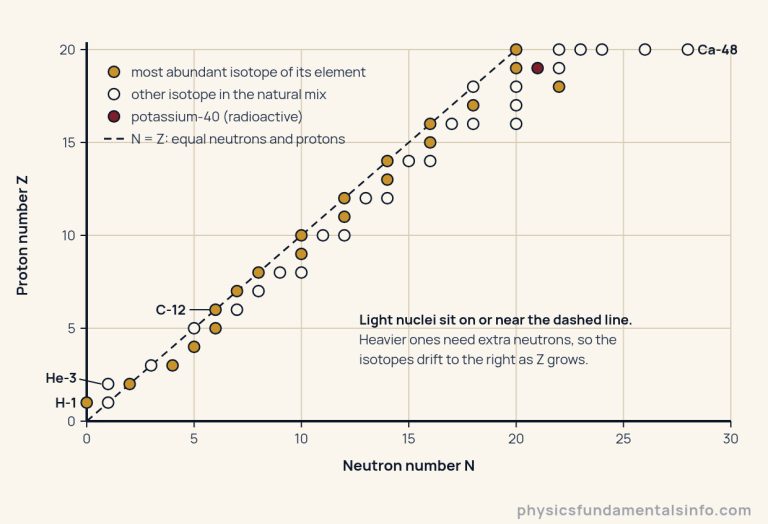
Why do heavier nuclei need spare neutrons? Protons repel one another, as Coulomb’s law describes, and at nuclear distances that push is enormous. The strong nuclear force, which pulls protons and neutrons together over a very short range, holds the nucleus in one piece, and extra neutrons add that pull without adding any repulsion. Only hydrogen-1, a lone proton, manages with no neutrons at all.
Ions: same nucleus, different electrons
Ions keep the neutral atom’s Z and N and differ only in their electrons. Lose electrons and the atom becomes a positive ion, a cation; gain them and it becomes a negative ion, an anion. The nucleus is untouched either way, which is why an ion is still the same element.
Magnesium gives up two electrons to become Mg2+, with 12 protons and 10 electrons. Oxygen takes two to become the oxide ion O2-, with 8 protons and 10 electrons, and nitrogen can take three to become N3-. Simple negative ions rarely carry more than three extra electrons, because each newcomer is repelled by the electrons already there.
How Big Is an Atom Compared With Its Nucleus?
An atom’s radius is of the order of 10-10 m, while its nucleus has a radius of a few femtometres (1 fm = 10-15 m), so the nucleus is tens of thousands of times smaller than the atom. An empirical rule gives the nuclear radius from the mass number alone:
- R — the radius of the nucleus, in femtometres (fm).
- A — the mass number, the number of protons plus neutrons.
- 1.2 fm — an empirical constant fitted to scattering experiments, so R is an estimate, not an exact size.
Because the radius grows only as the cube root of A, nuclei vary surprisingly little in size: hydrogen-1 comes out at 1.20 fm, carbon-12 at 2.75 fm and calcium-40 at 4.10 fm. The volume, which goes as R³, simply rises in step with A. Each nucleon takes up about the same room, like marbles packed into a bag.
Now picture an aluminium atom scaled up until its nucleus is a 5 mm peppercorn. The whole atom would be a sphere about 200 m across, the size of a large stadium, and the nucleus would fill roughly one part in 60 trillion of it. Yet that peppercorn would carry 99.97 % of the particle mass; Problem 7 does the arithmetic.
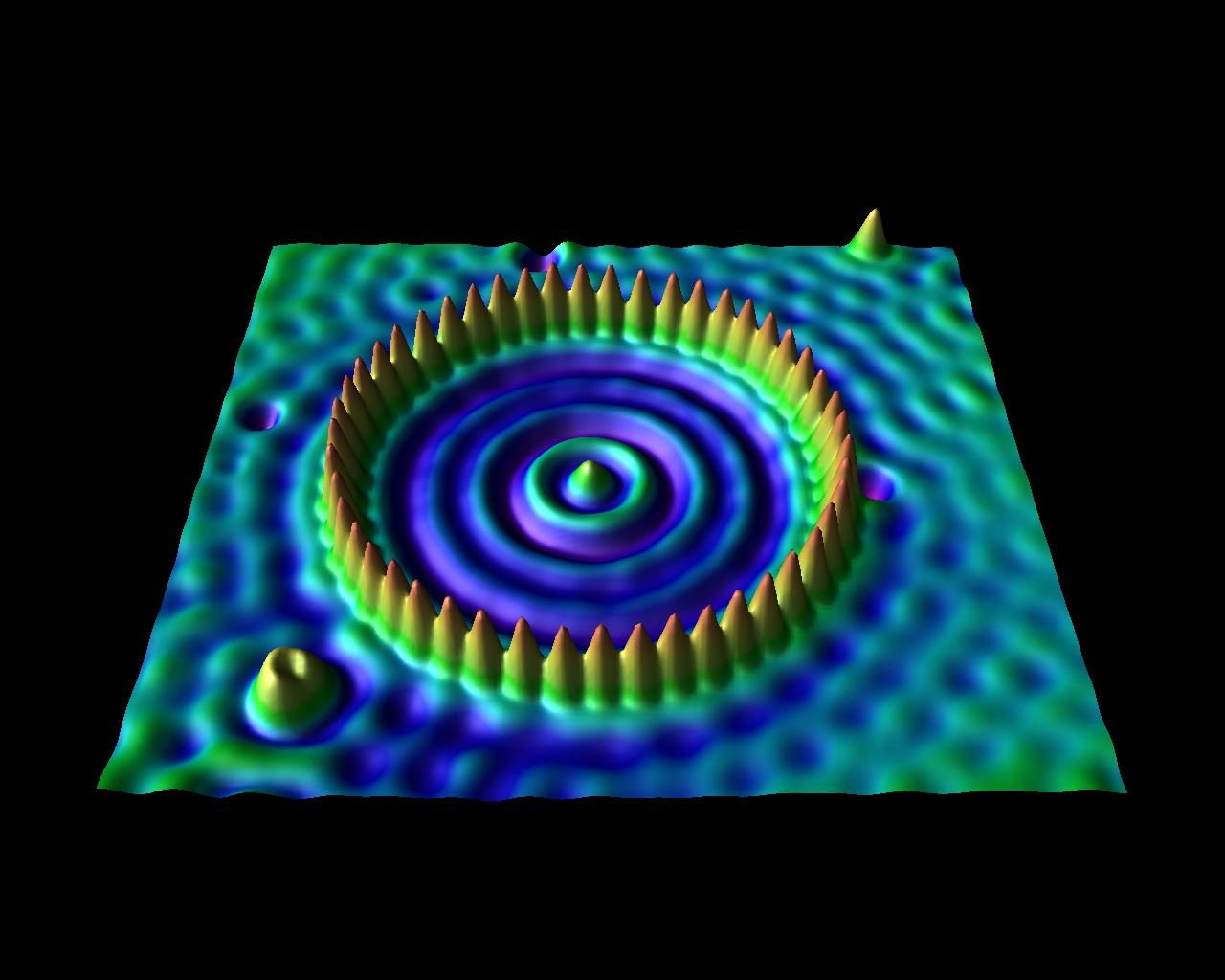
A scanning tunnelling microscope makes the atomic scale visible. It maps a surface by the tiny current that flows between a sharp tip and the atoms beneath it, and the bumps in its images are individual atoms. The nuclei inside them are far too small for any microscope to show.
How Was the Structure of the Atom Discovered?
The structure of the atom was worked out in four main steps between 1897 and 1932: Thomson discovered the electron, Rutherford’s scattering experiments revealed the nucleus, Bohr explained the electron energy levels and Chadwick discovered the neutron. Quantum mechanics then replaced the electron orbits with orbitals.
Thomson and the electron (1897)
Studying cathode rays, Thomson showed they were streams of tiny negatively charged particles, far lighter than any atom. If atoms contained them, atoms had parts. He pictured the atom as a sphere of positive charge with electrons dotted through it, the so-called plum-pudding model.
Rutherford and the nucleus (1911)
Rutherford’s team, Hans Geiger and Ernest Marsden, fired alpha particles at a very thin sheet of gold foil. Most sailed straight through, but a small fraction bounced back almost the way they had come, which a spread-out pudding of charge could never do. Rutherford concluded that the positive charge and nearly all the mass sit in a tiny, dense nucleus.
Bohr and the energy levels (1913)
Rutherford’s atom had a flaw: an electron circling a nucleus should radiate energy and spiral inwards. Bohr’s answer was to allow only certain energy levels, which also explained the sharp lines in hydrogen’s spectrum. His model survives in the shell counting used above.
Chadwick and the neutron (1932)
One puzzle remained. A helium nucleus has about four times the mass of hydrogen but only twice the charge, so something neutral had to make up the difference. Chadwick identified that particle, the neutron, completing the three-particle picture this guide uses. From the mid-1920s quantum mechanics had already recast the electrons as spread-out orbitals rather than tiny orbiting balls.
Real-World Examples of Atomic Structure
Salt and batteries: ions at work
A grain of table salt is a lattice of Na+ and Cl– ions held together by the attraction between opposite charges. In a lithium-ion battery, Li+ ions shuttle between the electrodes as the battery charges and discharges. Both depend on atoms that have gained or lost electrons while keeping their nuclei.
Mass spectrometry and chlorine’s two isotopes
A mass spectrometer turns atoms or molecules into ions and sorts them by mass-to-charge ratio. Feed it chlorine atoms and it shows two peaks, at 35 and 37, in a ratio of about 3 to 1, which is the 75.76 % and 24.24 % of the isotope table made visible. Chemists use the same trick to spot chlorine in an unknown compound.
Radiocarbon dating
Living things keep topping up their carbon, including a trace of carbon-14, from the air and their food. After death the top-ups stop, and the carbon-14 already present decays away at a steady, known rate. Measuring how much is left dates the sample, and the half-life is the clock behind it.
The numbers on a periodic table
The relative atomic mass printed under each symbol is an abundance-weighted average over the natural isotopes, which is why chlorine shows about 35.45 rather than a whole number (Problem 5 works it out). The values on IUPAC’s periodic table come from the work of its Commission on Isotopic Abundances and Atomic Weights.
Common Misconceptions About Atomic Structure
Misconception 1: electrons orbit the nucleus like planets
Electrons do not circle the nucleus on tracks. The shells in Figure 1 count electrons into energy levels, and quantum mechanics describes each electron as a spread-out orbital that gives only the probability of finding it at each place. The planetary picture also fails on its own terms, since an orbiting charge should radiate and spiral inwards, a collapse real atoms never undergo.
Misconception 2: adding neutrons or electrons makes a new element
Only the proton count decides the element. Add neutrons and you get another isotope of the same element; add or remove electrons and you get an ion of it. Carbon-14 is still carbon and Na+ is still sodium, which is why the lab keeps the element’s name fixed while you move the neutron and electron sliders.
Misconception 3: the periodic-table mass is the mass of one atom
Chlorine’s 35.45 u is an average over the natural mix. Every real chlorine atom has a mass of either about 34.97 u or about 36.97 u, and not one of them weighs 35.45 u.
Misconception 4: atom diagrams show the right proportions
They cannot. Drawn to true scale on this page, the nucleus in Figure 1 would be far smaller than a single screen pixel, so every textbook diagram inflates it by a factor of thousands to make it visible at all.