How far a nucleus bends an alpha particle is decided by one ratio: work out the Rutherford length alpha = k z Z e² / (2E) for your energy and target, divide it by the aim, and the angle is twice the arctangent of that. This free Rutherford scattering calculator runs the relation in all three directions — angle from aim, aim from angle, energy from both — and prints the closest approach and the count rate beside the answer. Point Solve for at the angle, the impact parameter or the alpha energy.
Load a real case
Every button writes all four boxes in their default units, so whichever quantity the Solve for menu is pointing at, the remaining three already agree with it. The line underneath quotes back whatever the widget works out from that, so nothing in it is stored text.
Pick a case above, or type your own numbers.
What Is the Rutherford Scattering Calculator?
The Rutherford scattering calculator is a free online tool for the classical deflection of an alpha particle by a single nucleus. The relation it solves is theta = 2 arctan(alpha / b), where alpha = k z Z e2 / (2E) is the Rutherford length and z = 2 because the probe is an alpha particle. Give it any suitable pair of an alpha energy, a target atomic number, an impact parameter and a scattering angle, and it returns the missing one in whichever unit that box was set to.
The impact parameter carries half the head-on distance, not all of it. That factor of two is the step most often dropped, and it has one clean consequence worth memorising: an aim equal to the Rutherford length produces exactly 90 degrees, at every energy and every target. On gold at 5 megaelectronvolts that aim is 22.7514 femtometres, which is half of 45.50, and anyone getting 45.50 there has the factor wrong.
The head-on distance is an upper bound on the nuclear radius, and only for the energy used. It is not a nuclear size, it is never printed here without the energy beside it, and raising the energy pushes closer and tightens it, from 227.51 femtometres at 1 megaelectronvolt to 11.38 at 20. The true gold nuclear radius is around 7.3 femtometres, so even the tightest of those three is loose by a factor of roughly 1.6.
Asking for the energy behind a 180-degree deflection is the one question this tool refuses, and that refusal is the most useful thing on the page. A dead-centre hit returns along its own path at any energy whatsoever, so the angle alone fixes nothing at all, and the same applies to an aim of zero because that forces 180 degrees. The tool declines and names the reason underneath rather than printing the meaningless figure near zero that the arithmetic actually produces there.
Three readings sit beside the headline, all worked out from the complete state with the solved value substituted back, and a fourth appears in the energy mode. They are the closest approach for the aim you gave, the head-on distance with its energy attached, the count rate relative to 90 degrees, and the alpha speed as a percentage of the speed of light. The count rate depends on the angle alone, because normalising the inverse-fourth-power law to 90 degrees removes the energy and the target from it completely.
What the model leaves out, the page says. The nucleus is a point that does not recoil, the target electrons are absent so nothing is screened, each alpha meets one nucleus once, and there is no nuclear force in the relation at all. The speed is worked out without relativity, which costs 0.40 per cent at 20 megaelectronvolts and affects no angle on the page, because the angle depends on the ratio of the Rutherford length to the aim and that length is built from the kinetic energy rather than from the speed.
| Symbol | Quantity | Default unit | Also accepts | Example value |
|---|---|---|---|---|
| E | Alpha energy | MeV | — | 5 |
| Z | Target atomic number | protons | — | 79 |
| b | Impact parameter | fm | pm, m | 20 |
| theta | Scattering angle | deg | rad | 97.364841 |
How to use the Rutherford scattering calculator
- Choose the unknown. The Solve for menu opens on Scattering angle, and the other two choices are Impact parameter and Alpha energy.
- Type the alpha energy. It takes MeV and opens on 5.0 MeV. The preset menu also holds 4.85, 8.29 and 20 MeV, and the box accepts 0.01 to 100 MeV.
- Set the target atomic number.
Zis a plain count of protons from 1 to 118, with presets for aluminium, copper, silver, gold, lead and uranium. It is the one box that is an input in every mode. - Type the impact parameter. It takes fm, pm or m and opens on 20 fm. This is the aim — the perpendicular distance from the nucleus to the alpha's original line — and zero means dead centre.
- Read the answer. The headline always carries six significant figures, in the unit that box was showing. Set the unit first, point Solve for at the target second and type your figures last — switching the target wipes every box back to its default and only the unit menus survive it.
- Read the closest-approach chip. It is how close the alpha really gets on this aim, always further out than a head-on hit would reach, and it equals the head-on figure only at dead centre.
- Read the head-on chip as a bound. It is printed with the energy it belongs to on purpose: it is an upper bound on the nuclear radius at that energy and not a nuclear size.
- Read the count-rate chip. It is the rate for this angle relative to 90 degrees, and it depends on the angle alone — the energy and the target cancel out of it completely.
- Try the refusal. Point Solve for at the alpha energy and set the angle to 180 degrees: the page declines and explains itself underneath the widget rather than printing a number.
- Open Show working. The steps give the relation, the boxes read in base units, the Rutherford length, the closest approach against the head-on bound, the count rate, the alpha speed, the assumptions and every unit conversion.
This page exists for the one step that turns an energy, a charge and an aim into an angle. The nuclear model guide is the prose half of it, where the argument is made and the problems are worked. How the experiment came to be done at all, and what the discovery narrative looked like, belongs to the atomic structure guide instead.
Three mistakes account for most wrong answers here. The first is dropping the factor of two and using the head-on distance where the Rutherford length belongs, which doubles every aim; the second is reading the head-on chip as a nuclear radius rather than as a bound on one. The third is expecting the energy mode to answer a backscatter, which it cannot, because nothing about the energy survives in a straight-back hit.
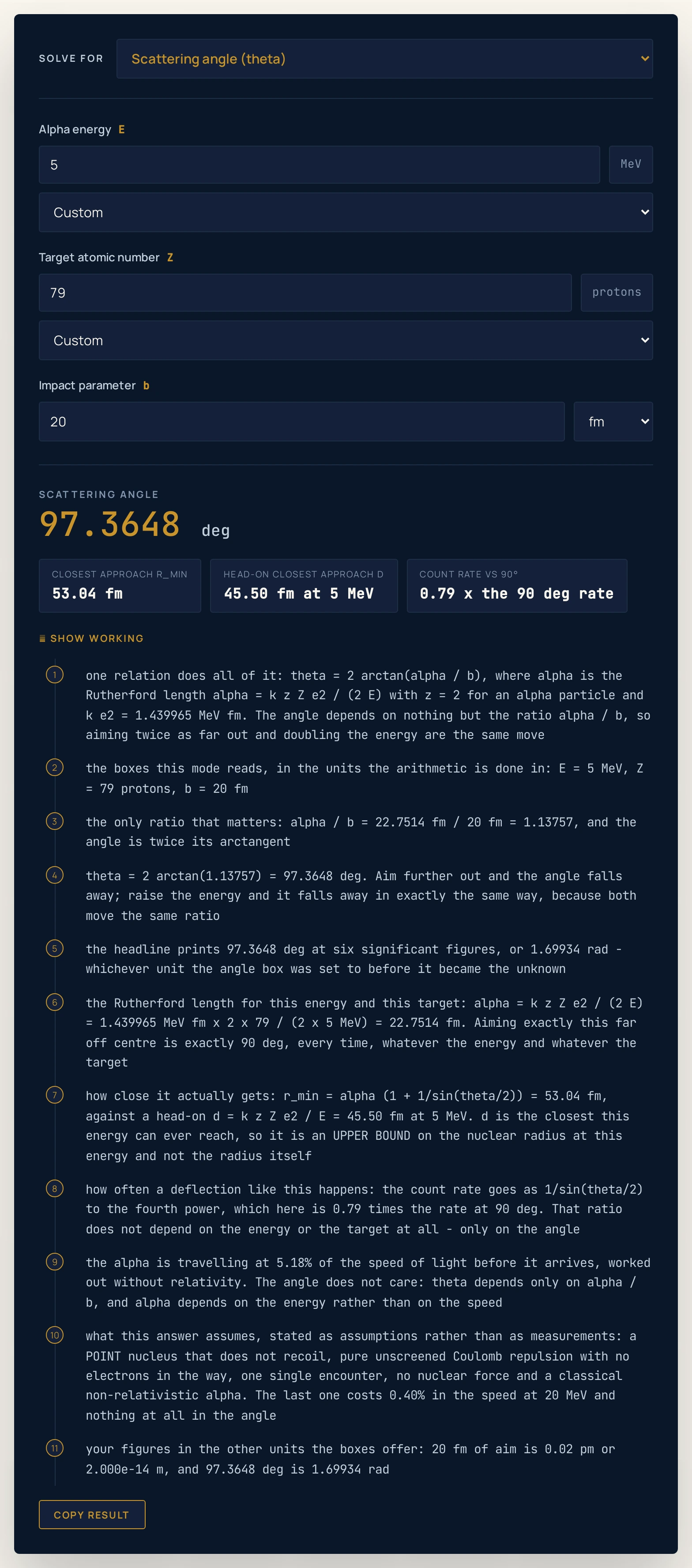
97.3648 deg, and the two distance chips are the whole point of the measurement — the alpha got to 53.04 fm, while a head-on hit at this energy would have reached 45.50 fm. The Coulomb's law guide is the force law behind both figures.Worked example: change one thing at a time
The table starts at the defaults, moves the unknown through all three modes, then loads the five real cases, inverts four measured angles, walks every unit menu, and finally reaches the entries the calculator declines. Every answer and chip cell was read out of the running widget rather than worked out by hand. Where a cell and the tool ever part company, believe the tool.
| Step | Solving for | What you type | Headline answer | Closest approach r_min | Head-on closest approach d | Count rate vs 90 deg |
|---|---|---|---|---|---|---|
| The page as it opens | Scattering angle | 5 MeV, Z = 79, b = 20 fm | 97.3648 deg | 53.04 fm | 45.50 fm at 5 MeV | 0.79 x the 90 deg rate |
| The same state, solved for the aim | Impact parameter | 5 MeV, Z = 79, theta = 97.364841 deg | 20 fm | 53.04 fm | 45.50 fm at 5 MeV | 0.79 x the 90 deg rate |
| The same state, solved for the energy | Alpha energy | Z = 79, b = 20 fm, theta = 97.364841 deg | 5 MeV | 53.04 fm | 45.50 fm at 5 MeV | 0.79 x the 90 deg rate |
| Aim dead centre at gold | Scattering angle | 5 MeV, Z = 79, b = 0 fm | 180 deg | 45.50 fm | 45.50 fm at 5 MeV | 0.25 x the 90 deg rate |
| A near miss that turns right around | Scattering angle | 5 MeV, Z = 79, b = 10 fm | 132.546 deg | 47.60 fm | 45.50 fm at 5 MeV | 0.36 x the 90 deg rate |
| The glancing hit that is almost all of them | Scattering angle | 5 MeV, Z = 79, b = 2000 fm | 1.30351 deg | 2022.88 fm | 45.50 fm at 5 MeV | 1.49e+7 x the 90 deg rate |
| A light nucleus barely deflects it | Scattering angle | 5 MeV, Z = 13, b = 10 fm | 41.0509 deg | 14.42 fm | 7.49 fm at 5 MeV | 16.54 x the 90 deg rate |
| Raise the energy, shrink the approach | Scattering angle | 20 MeV, Z = 79, b = 0 fm | 180 deg | 11.38 fm | 11.38 fm at 20 MeV | 0.25 x the 90 deg rate |
| A slow alpha on the heaviest natural target | Scattering angle | 1 MeV, Z = 92, b = 50 fm | 138.645 deg | 274.08 fm | 264.95 fm at 1 MeV | 0.33 x the 90 deg rate |
| The exact 90 degree anchor, inverted | Impact parameter | 5 MeV, Z = 79, theta = 90 deg | 22.7514 fm | 54.93 fm | 45.50 fm at 5 MeV | 1.00 x the 90 deg rate |
| A ten degree glance, inverted | Impact parameter | 5 MeV, Z = 79, theta = 10 deg | 260.05 fm | 283.79 fm | 45.50 fm at 5 MeV | 4332.67 x the 90 deg rate |
| A hard backscatter, inverted | Impact parameter | 5 MeV, Z = 79, theta = 150 deg | 6.09623 fm | 46.31 fm | 45.50 fm at 5 MeV | 0.29 x the 90 deg rate |
| A fast alpha on aluminium, inverted | Impact parameter | 20 MeV, Z = 13, theta = 45 deg | 2.25965 fm | 3.38 fm | 1.87 fm at 20 MeV | 11.66 x the 90 deg rate |
| A full backscatter is dead centre exactly | Impact parameter | 5 MeV, Z = 79, theta = 180 deg | 0 fm | 45.50 fm | 45.50 fm at 5 MeV | 0.25 x the 90 deg rate |
| The aluminium case, solved for the energy | Alpha energy | Z = 13, b = 10 fm, theta = 41.050874 deg | 5 MeV | 14.42 fm | 7.49 fm at 5 MeV | 16.54 x the 90 deg rate |
| The glancing case, solved for the energy | Alpha energy | Z = 79, b = 2000 fm, theta = 1.3035053 deg | 5 MeV | 2022.88 fm | 45.50 fm at 5 MeV | 1.49e+7 x the 90 deg rate |
| The aim typed in picometres | Scattering angle | 5 MeV, Z = 79, b = 0.02 pm | 97.3648 deg | 53.04 fm | 45.50 fm at 5 MeV | 0.79 x the 90 deg rate |
| The aim typed in metres | Scattering angle | 5 MeV, Z = 79, b = 2e-14 m | 97.3648 deg | 53.04 fm | 45.50 fm at 5 MeV | 0.79 x the 90 deg rate |
| The angle box set to radians | Scattering angle | 5 MeV, Z = 79, b = 20 fm, angle box in rad | 1.69934 rad | 53.04 fm | 45.50 fm at 5 MeV | 0.79 x the 90 deg rate |
| The angle typed in radians, inverted | Impact parameter | 5 MeV, Z = 79, theta = 1.5707963267948966 rad | 22.7514 fm | 54.93 fm | 45.50 fm at 5 MeV | 1.00 x the 90 deg rate |
| The bounce-back that fixes no energy | Alpha energy | Z = 79, b = 20 fm, theta = 180 deg | no answer | - | - | - |
| An aim of zero fixes no energy either | Alpha energy | Z = 79, b = 0 fm, theta = 90 deg | no answer | - | - | - |
| A zero angle is declined | Impact parameter | 5 MeV, Z = 79, theta = 0 deg | no answer | - | - | - |
| A negative aim is declined | Scattering angle | 5 MeV, Z = 79, b = -20 fm | no answer | - | - | - |
| A zero energy is declined | Scattering angle | 0 MeV, Z = 79, b = 20 fm | no answer | - | - | - |
| An atomic number past 118 is declined | Scattering angle | 5 MeV, Z = 119, b = 20 fm | no answer | - | - | - |
| An atomic number of zero is declined | Alpha energy | Z = 0, b = 20 fm, theta = 90 deg | no answer | - | - | - |
| An angle past 180 degrees is declined | Impact parameter | 5 MeV, Z = 79, theta = 181 deg | no answer | - | - | - |
Rows 1 to 3 are one state — a 5 MeV alpha on gold aimed 20 fm out — with the Solve for menu in each of its three positions. All three chip columns are identical down all three rows, because the chips describe the state rather than the mode. That is not free: they are worked out from the answer substituted back, so the mode in which the energy is the unknown still has an energy to take a head-on distance from.
Rows 4 to 8 are the five real cases, and rows 4 and 8 are the cleanest pair on the page. Both are dead centre at gold, and four times the energy tightens the head-on bound from 45.50 fm to 11.38 fm — a factor of exactly four, because that distance is inversely proportional to the energy. Row 7 is the other exact scaling: the same energy and aim at aluminium gives 7.49 fm, which is 45.50 fm scaled by 13 over 79.
Rows 10 to 14 invert measured angles back into aims, and row 10 is the check worth memorising. At 90 degrees the tangent is 1, so the aim is the Rutherford length exactly: 22.7514 fm, which is half of 45.50 fm. Row 14 is the other exact case, where a full backscatter inverts to 0 fm rather than to the 1.39e-15 fm the cotangent would actually return.
Rows 15 and 16 run the energy mode on two of the real cases and both come back to 5 MeV, which is the round trip of rows 7 and 6. Rows 17 to 20 change nothing but the units: 20 fm typed as 0.02 pm or 2e-14 m gives the identical 97.3648 deg, and the same angle reads 1.69934 rad if the angle box was showing radians.
Rows 21 and 22 are the refusal worth understanding, and the page explains itself underneath the widget in both cases. Rows 23 to 28 are the ordinary refusals: a zero angle, a negative aim, a zero energy, an atomic number past 118, an atomic number of zero, and an angle past 180 degrees. In every one of them the answer is words rather than an infinity or a NaN, and the Coulomb's law calculator is the place to go if what you actually wanted was the force at a given separation rather than a deflection.
Formula and symbol reference
One relation does all the work: theta = 2 arctan(alpha / b), with alpha = k z Z e² / (2E) and z = 2. Everything else on this page is that relation rearranged, or a quantity derived from the state it describes.
The constant that makes it a one-line calculation is k e² = 1.439965 MeV·fm, which is why an energy in MeV and a distance in femtometres need no conversion factors at all. The head-on distance is d = k z Z e² / E, and the Rutherford length is half of it. That halving is the step most often dropped, and the electric potential guide is where the energy-to-distance step it comes from is set out.
Reading the relation backwards gives b = alpha / tan(theta / 2) and E = k z Z e² / (2 b tan(theta / 2)). The first always has an answer for an angle between 0 and 180 degrees; the second has none at 180 degrees exactly, which is the single refusal on the page. Getting d at all is an energy-conservation argument, set out in the conservation of energy guide, and the kinetic energy that goes into it is the kinetic energy guide.
| Symbol | Meaning | SI unit | Values used on this page |
|---|---|---|---|
| theta | Scattering angle — the angle between the direction the alpha came in on and the direction it leaves on. Spelled out as a word everywhere on this page, because the result label and every chip label are uppercased by CSS and that destroys a Greek letter | degree | Boxes take deg or rad: 97.364841 deg is the default, which is 1.69934 rad; 180 deg is dead centre. |
| b | Impact parameter — the perpendicular distance from the nucleus to the line the alpha was travelling along before it felt anything. The aim, not the miss distance | metre | Boxes take fm, pm or m: 20 fm is the default, which is 0.02 pm and 2e-14 m; 0 fm is allowed and means dead centre. |
| E | Kinetic energy the alpha arrives with. The angle depends on it only through the Rutherford length, so the energy and the aim are interchangeable in the arithmetic | joule | Boxes take MeV: 5.0 MeV is the default, with presets at 4.85, 8.29 and 20 MeV. The box accepts 0.01 to 100 MeV. |
| Z | Atomic number of the target nucleus, as a count of protons. The only property of the target that enters the relation, and the one box that is an input in every mode | dimensionless | A plain count from 1 to 118: 79 is the default, with presets at 13, 29, 47, 79, 82 and 92. |
| z | Charge number of the probe, fixed at 2 because the probe is an alpha particle by definition. A stated constant rather than a field | dimensionless | Fixed at 2 throughout, and never varied on this page. |
| alpha | The Rutherford length, half the head-on distance of closest approach. Aiming exactly this far off centre gives exactly 90 degrees, at every energy and every target | metre | A derived quantity: 22.7514 fm at 5 MeV on gold, which is half of 45.50 fm. |
| d | Head-on distance of closest approach, k z Z e² / E. An upper bound on the nuclear radius at that energy, and never the radius itself | metre | A chip, printed with its energy: 45.50 fm at 5 MeV on gold, 11.38 fm at 20 MeV, 7.49 fm at 5 MeV on aluminium. |
| r_min | Closest approach for a given aim, alpha times one plus the reciprocal of the sine of half the angle. Always further out than d, and equal to it only at dead centre | metre | A chip: 53.04 fm at the defaults, 45.50 fm at dead centre, 2022.88 fm on the glancing preset. |
| k e² | The combination that makes every distance on this page a one-line calculation, built from the CODATA 2018 elementary charge and vacuum permittivity | MeV femtometre | Printed as 1.439965 MeV·fm in every step; the arithmetic carries the unrounded 1.439964548 it is rounded from. |
The physics: why one ratio decides everything
The alpha and the nucleus repel each other with an inverse-square force, so the path is a hyperbola with the nucleus at the outer focus. All of the geometry of that hyperbola is set by a single length, and that length is alpha = k z Z e² / (2E). Once you have it, the angle follows from the aim alone.
That is why the energy and the aim are interchangeable here. Doubling the energy halves the Rutherford length, and halving the Rutherford length does exactly what doubling the aim does, so the two moves give the identical angle. Doubling the target atomic number is the opposite move, because the length is proportional to Z.
The head-on distance is the quantity the whole experiment was really about. Fire the alpha straight in and all of its kinetic energy turns into electrostatic potential energy at the turning point, giving d = k z Z e² / E — and the fact that the alpha turned round there under Coulomb repulsion alone means every scrap of the positive charge was inside it. The Coulomb's law simulator is where that force law can be pushed around on its own.
Two things follow from d that are easy to confuse. It is an upper bound on the nuclear radius, and it is a bound only for the energy used: at 5 MeV on gold it is 45.50 fm, at 10 MeV it is 22.75 fm, and at 20 MeV it is 11.38 fm. The real gold nucleus has a radius of about 7.3 fm, so even the tightest of those three is around 1.6 times too loose.
The count rate is the other half of the story, and it behaves far more violently than the angle does. It goes as one over the fourth power of the sine of half the angle, so a 10 degree deflection is 4332.7 times as common as a 90 degree one. Normalising to 90 degrees removes the energy and the target from the expression entirely, which is why a single chip covers every state this calculator can reach.
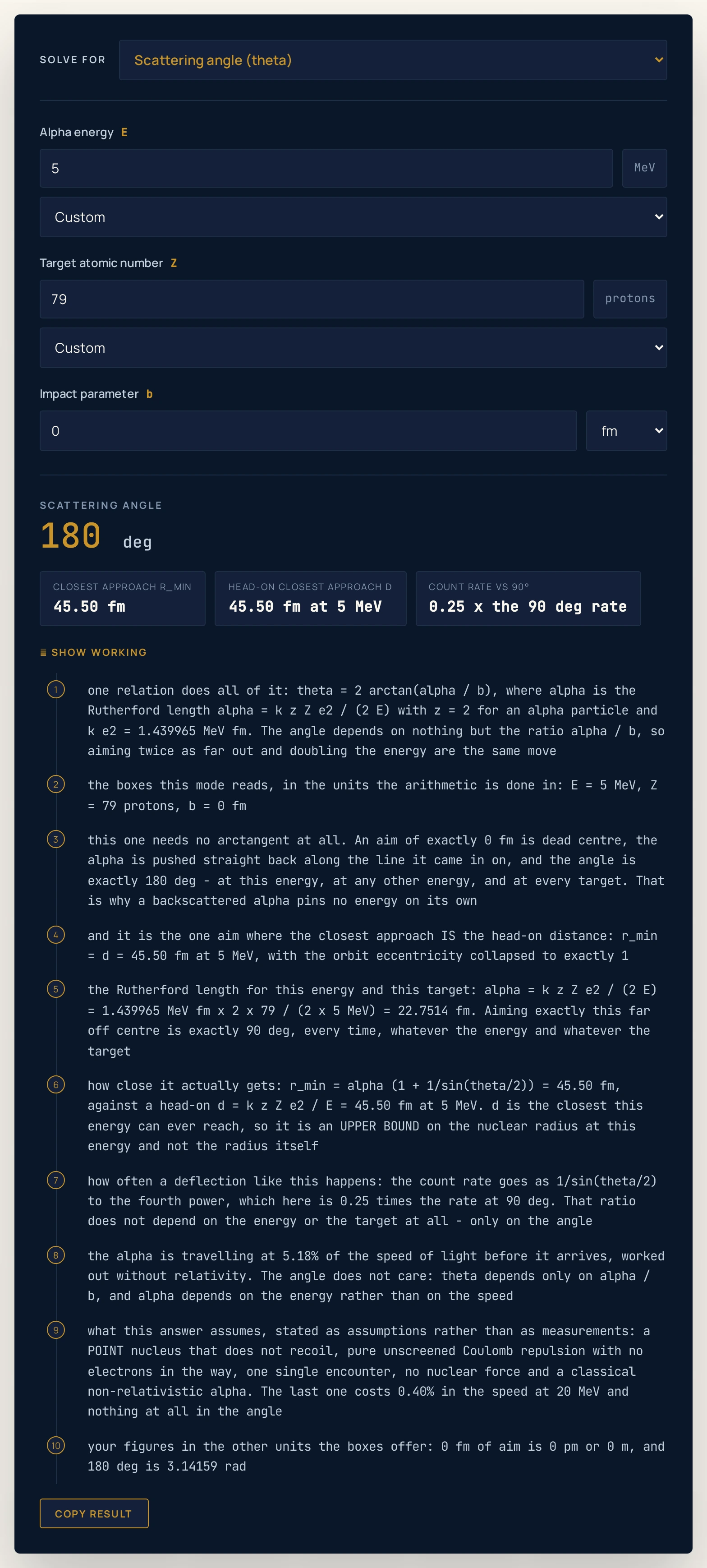
b = 0 fm the closest approach is the head-on distance, 45.50 fm at 5 MeV. This is also the state that pins no energy at all, which is why the energy mode refuses it. Where the alpha itself comes from is the alpha decay guide.Where the point-nucleus model breaks down
The arithmetic here is exact to the last digit a double can hold. What goes wrong is physical: a nucleus treated as a point that does not move, a target stripped of its electrons, and a force law with nothing in it but electrostatics.
- The nucleus is a point, and that is the assumption being tested
- Every distance on this page is computed as though all the target's positive charge sat at one mathematical point. That is deliberate rather than careless: the whole argument is about how concentrated the charge is, and the model is the thing under test. It stops being usable once the alpha would reach the nuclear surface, which for gold is at about 32.58 MeV.
- There is no nuclear force in the relation at all
- Pure Coulomb repulsion is the only thing bending the path. Once an alpha gets close enough to feel the strong interaction the deflections stop following this law, and nothing on this page warns you about that except the energy you typed. The companion lab stops its energy ladder at 20 MeV for exactly this reason, well below the 32.58 MeV where the head-on distance reaches the empirical radius of around 6.98 fm.
- The head-on distance is a bound, and only for one energy
- This is the single most misread figure on the page, which is why the chip prints the energy beside it. It is not a nuclear radius and it is not a nuclear diameter. A higher energy pushes closer and gives a tighter bound, so quoting one without its energy says nothing at all; at 1 MeV on gold the bound is
227.51 fm, five times looser than the 5 MeV figure. - The target does not recoil
- The nucleus is treated as infinitely heavy and perfectly fixed, which is a good approximation for gold and a worse one the lighter the target gets. Aluminium is the weakest case the preset menu offers, and the angle there is the one most affected. Nothing on this page corrects for it, and no figure for the size of that correction is printed or estimated.
- No electrons, no screening
- The target's electrons are simply absent from the model. That is tolerable because the large-angle events this relation is interesting for happen well inside the electron cloud, where the nucleus dominates. It is not tolerable at very small angles, where an alpha passing far out is being deflected by a screened charge rather than a bare one.
- One encounter, not a foil
- Everything here describes a single alpha meeting a single nucleus once. A real foil is thousands of atoms thick, so small deflections accumulate and the single-encounter picture stops holding at small angles. Counting what a real foil does is a different calculation and no fraction for it is published here.
- Relativity is left out, and the cost is in the speed only
- The alpha speed chip uses the non-relativistic expression, which is 0.40 per cent high at 20 MeV and better than that everywhere below. No angle on this page is affected by it, because the angle depends only on the ratio of the Rutherford length to the aim, and that length is built from the kinetic energy rather than from the speed. The speeds involved run from a few per cent of light speed to about a tenth of it.
- The paths are classical
- The alpha is treated as a particle on a definite trajectory with a definite aim, which is not what a quantum particle does. The relation survives that treatment better than it has any right to, but this page makes no claim about why, and it does not present itself as a quantum calculation. Nothing from the quantum account of the atom is used here or needed here.
- A refusal in the energy mode is an answer, not a fault
- Ask for the energy behind a 180 degree deflection and there genuinely is not one, because every energy produces that angle at dead centre. The same goes for an aim of zero, which forces 180 degrees. The page declines, names the reason underneath the widget, and never prints an infinity or a NaN — the formula at that angle actually returns a finite figure near
3.48e-16 MeV, which would be far worse than refusing. - Rounding the angle moves the energy answer
- The energy mode is the sensitive direction, and the page measures that rather than hiding it. The defaults carry the angle to eight figures as
97.364841 degprecisely so that all three modes close on the same state; type the displayed97.3648 deginstead and the energy comes back as 5.00000357 MeV, which still prints as5but is not the figure the other boxes hold. Keep the digits you have, especially near 180 degrees. - The calculator measures nothing — you supply the numbers
- Three quantities go in, one relation is used, and the answer describes the alpha and the target you described. The case names are shorthand for the four figures behind them and are not claims about any particular experiment, apparatus or sample.
Where this relation is actually used
- Turning a measured angle into a distance of closest approach
- Point Solve for at the impact parameter and the question inverts into the one an experiment can actually answer: you counted alphas at an angle, and you want to know how close they came. At 150 degrees on gold at 5 MeV the aim was
6.09623 fmand the alpha reached46.31 fm, barely outside the head-on bound. That gap between the aim and the approach is the thing a reader usually has backwards. - Putting an upper bound on a nuclear size from one number
- Load aim dead centre at gold and the head-on chip gives
45.50 fm at 5 MeV. That alone establishes that all the positive charge in a gold atom sits inside a region more than three thousand times smaller than the atom. It does not establish the radius, and the honest way to quote it is as a bound with its energy attached. - Deciding which energy a measurement needs
- Because the head-on distance is inversely proportional to the energy, the bound tightens in step with it:
227.51 fmat 1 MeV,45.50 fmat 5 MeV,11.38 fmat 20 MeV. Typing energies into the first mode is the fastest way to see how much energy a given bound would cost. Past about 32.58 MeV on gold the exercise stops meaning anything, because the alpha arrives at the nuclear surface. - Comparing targets at a fixed energy
- Switch the
Zpreset from gold to aluminium at the same energy and aim and the angle drops from132.546 degto41.0509 deg, while the head-on bound falls from45.50 fmto7.49 fm. The second ratio is exactly 13 over 79, because that distance is directly proportional to the target charge. A light nucleus is a poor backscatterer and this is the arithmetic of why. - Judging whether a reported deflection is plausible
- Point Solve for at the alpha energy and the page becomes a consistency test. An angle and an aim that came from different states will return an energy that does not match the one claimed, and an exact backscatter will return nothing at all. That last case is the useful one: an alpha source of known energy aimed dead centre tells you about the charge it met, never about its own energy.
- Seeing why the large-angle counts were so hard to get
- The count-rate chip at 10 degrees reads
4332.67 x the 90 deg rateand at 150 degrees it reads0.29. Those two figures are a factor of 15086.6 apart, which is why finding the rare hard deflections was a matter of patience rather than cleverness. The ratio is the same at every energy and every target, so it is a property of the law and not of any apparatus. - Recognising the same shape of problem somewhere else
- An inverse-square force, a hyperbolic path and one length that sets the whole geometry is a pattern rather than a fact about nuclei. The electric potential calculator is the nearest relative, because the head-on distance here is nothing but a potential-energy balance solved for a separation. Its subject is a voltage rather than a deflection, but the algebra of the turning point is the same algebra.
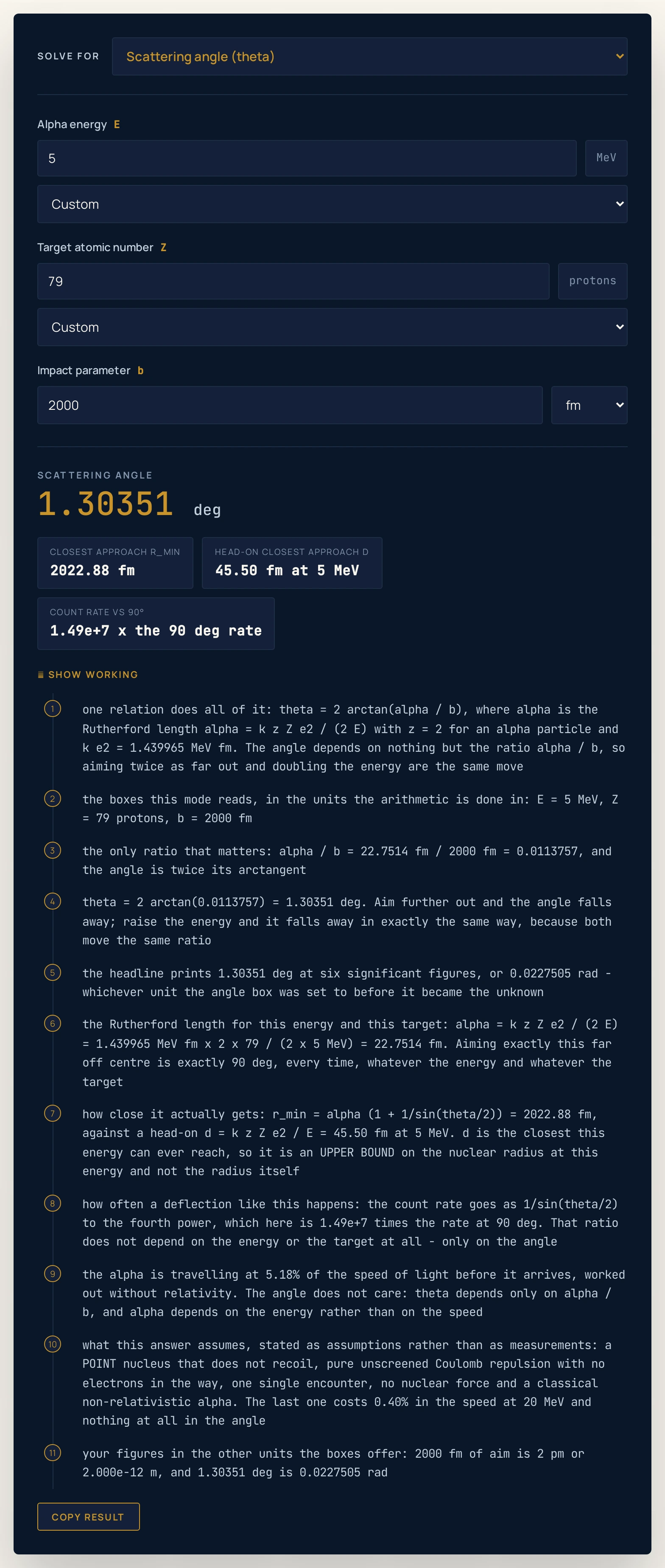
1.30351 deg — and the count-rate chip reads 1.49e+7 x the 90 deg rate. That single figure is why almost every alpha fired at a foil appears to go straight through, and why the few that do not were worth noticing.Where to go next
For the argument this arithmetic supports, the problems worked through and what the counting actually proved, read the nuclear model guide, which this tool is the calculating half of. The atomic structure guide is the wider story of how the picture of the atom was put together, and the Bohr model guide is what came next once the nucleus was established.
Four more posts pick up the pieces this page uses but does not explain. The Coulomb's law guide is the force law underneath everything here, the electric potential guide is where the energy-to-distance step comes from, the conservation of energy guide is the step that gives the head-on distance, and the kinetic energy guide is the energy the alpha arrives with. Where the alpha itself comes from is the alpha decay guide, and the types of radiation guide is where it sits among the others.
Three tools sit next to this one. The Coulomb's law calculator gives the force at a separation, the electric potential calculator gives the potential that sets the turning point, and the alpha decay energy calculator gives the energy a source emits. The Coulomb's law simulator and the alpha decay simulator are the interactive versions of the first and the last.
The full physics lab library and the calculator index are open too.
Frequently asked questions
What does the Rutherford scattering calculator work out?
It solves theta = 2 arctan(alpha / b) for any one of three quantities: the angle an alpha particle is deflected through, the impact parameter it was aimed at, or the kinetic energy it arrived with. Beside the answer it prints how close the alpha actually gets, the head-on distance of closest approach with the energy it belongs to, and the count rate relative to 90 degrees.
What is the impact parameter, exactly?
It is the perpendicular distance from the nucleus to the straight line the alpha was travelling along before the Coulomb force bent it. It is the aim rather than the miss distance: the alpha never actually gets that close, and the closest-approach chip beside the answer tells you how close it did get. An impact parameter of zero means dead centre, which is the one aim that sends the alpha straight back.
Why does the calculator refuse to give me an energy when the angle is 180 degrees?
Because a dead-centre hit comes straight back at any energy whatever, so that one measurement determines nothing. A 1 MeV alpha and a 100 MeV alpha aimed dead centre both return along the line they came in on, and the calculator cannot tell them apart from the angle. The page declines and says so rather than printing a number, because the formula at that angle returns a finite but meaningless figure near zero.
Is the head-on distance the size of the nucleus?
No, and that distinction is the whole result rather than a quibble. It is an upper bound on the nuclear radius, and only for the energy used: the alpha turned round there under pure Coulomb repulsion, so all the positive charge must be inside it. At 5 MeV on gold the bound is 45.50 fm while the nucleus is around 7.3 fm, so that bound is roughly six times too loose.
Why is the impact parameter for 90 degrees exactly the Rutherford length?
Because tan of 45 degrees is exactly 1, so b = alpha / tan(theta / 2) collapses to b = alpha at 90 degrees. The Rutherford length alpha is half the head-on distance, which is the factor of two most commonly dropped: at 5 MeV on gold it is 22.7514 fm, not 45.50 fm. Entering 90 degrees and checking you get that figure is the fastest way to confirm the arithmetic is right.
Does raising the energy or aiming further out do the same thing?
Yes, and that is worth knowing because it halves the number of cases to remember. The angle depends on nothing but the ratio alpha / b, and alpha is inversely proportional to the energy, so doubling the energy and doubling the aim give the identical angle. Doubling the target atomic number is the opposite move, because alpha is proportional to Z.
Why does the count-rate chip change so violently with the angle?
Because the rate goes as one over the fourth power of the sine of half the angle, which falls away extremely fast. A 10 degree deflection is 4332.7 times as common as a 90 degree one and 15086.6 times as common as a 150 degree one. That spread is why counting the large-angle events took years of work with the apparatus of the day.
Does the calculator allow for relativity?
No, and the cost of that is measured rather than ignored. The alpha speed chip uses the non-relativistic expression, which is 0.40 per cent high at 20 MeV, the fastest case the companion lab reaches. The angles are completely untouched by it, because the angle depends only on alpha over b and alpha depends on the energy rather than on the speed.
When does this model stop being true at all?
When the alpha gets close enough to the nucleus for the nuclear force to matter, which pure Coulomb repulsion knows nothing about. For gold that happens at around 32.58 MeV, where the head-on distance falls to the empirical nuclear radius of about 6.98 fm. Below that energy the Coulomb-only treatment holds, and above it the deflections stop following this relation.
Why is there no box for the alpha charge?
Because the probe is an alpha particle by definition, so its charge number is fixed at 2 and stated as a constant beside the formula. Changing it would make the page about something other than alpha scattering. The target charge is the quantity that varies, and that is the Z box.
References & formula source
- The relation solved on this page is the classical Rutherford scattering law for a point charge: with alpha = k z Z e squared divided by twice the kinetic energy, the deflection is theta = 2 arctan(alpha / b), the impact parameter inverts as b = alpha / tan(theta / 2), and the closest approach is alpha times one plus the reciprocal of the sine of half the angle. It is stated here rather than derived. The constant k e squared is 1.439965 MeV femtometre, built from the CODATA 2018 elementary charge and vacuum permittivity.
- The impact parameter carries the Rutherford length alpha, which is HALF the head-on distance of closest approach, and that factor of two is the most commonly dropped step in the derivation. The clean consequence is that an impact parameter equal to alpha gives exactly 90 degrees at every energy and every target, which is the cheapest check that an implementation is correct. An independent reference written before this page existed asserts that anchor, the two closest-approach identities on all 1008 states of the companion lab ladders, and both inverse directions round-tripped to one part in ten million, and runs 58,767 checks with 0 failures.
- The head-on distance of closest approach is an upper bound on the nuclear radius and only for the energy used, never the radius itself. The alpha is turned round there by pure Coulomb repulsion alone, so the positive charge it is repelled by must lie inside that distance; a higher energy pushes closer and tightens the bound. At 5 MeV on gold the bound is 45.50 femtometres against a true nuclear radius of about 7.3 femtometres, so it is roughly six times too loose, and every figure for it on this page is printed with the energy it belongs to.
- The count rate quoted beside the answer is the Rutherford angular law normalised to 90 degrees, so it is 0.25 divided by the fourth power of the sine of half the angle. The normalisation is a presentation choice; the inverse fourth power is the physics. Normalising this way removes the energy and the target from the expression entirely, which is why one figure describes every state the calculator can reach, and the independent reference proves that independence across the whole ladder.
- The model is classical, non-relativistic and single-encounter, with a point nucleus that does not recoil, no screening by the target electrons and no nuclear force. Each of those is a stated assumption rather than a measurement. The non-relativistic speed is 0.40 per cent high at the fastest case on the companion lab ladder, and it affects only the speed figure: the angle depends on the ratio of the Rutherford length to the impact parameter, and that length depends on the kinetic energy rather than on the speed.
- The Coulomb-only treatment fails once the alpha reaches the nuclear surface, because the nuclear force is not in the relation at all. For gold the head-on distance falls to the empirical nuclear radius of about 6.98 femtometres at 32.58 MeV, so the companion lab stops its energy ladder well below that. This calculator will still answer above it arithmetically while being physically wrong there, which is why the energy is a stated input rather than a hidden assumption.
- Every figure quoted in the prose and the tables above is either a string this calculator printed for the inputs named beside it, or a constant the cluster physics contract fixes, or a ratio the unit tests assert. Where a cell and the running widget ever part company, believe the widget. Anything this page declines to put a number on is declined because the model cannot produce one, not because the figure was omitted for brevity.
- Further reading: Rutherford scattering — Wikipedia