E mc2 explained simply: Einstein’s equation says that energy (E) equals mass (m) multiplied by the speed of light squared (c2), so mass and energy are the same thing measured in different units. Because c2 is enormous, even a tiny mass holds a colossal amount of energy — one gram is equivalent to a nuclear bomb.
You have seen it on T-shirts, on chalkboards in films, on mugs and murals — E = mc2 is the one equation almost everyone can recognise. Yet ask what it actually means, and most people stall somewhere around “energy, mass, and Einstein.”
The real answer is stranger and simpler than the legend. It says the phone in your hand, the coffee cooling on your desk, and you yourself are all dense parcels of stored energy. Here is what that truly means — with the maths made friendly and every number checked.
What Is E=mc2, and What Does It Actually Mean?
E = mc2 means that mass and energy are two forms of the same thing, joined by the speed of light squared. Put plainly: mass is frozen energy, and energy has mass.
Add energy to an object and it gets very slightly heavier; take energy away and it gets lighter. The equation is simply the exchange rate between the two currencies.
Before 1905, physicists kept two separate ledgers — one for mass, one for energy — and each was thought to be conserved on its own. Einstein showed the two ledgers are really one account. Nothing is lost when mass “becomes” energy; it is the same quantity wearing a different coat.
This is not just blackboard theory, either. Laboratory tests have confirmed E = mc2 to within about four parts in ten million — one of the most precisely verified relationships in physics.
The three meanings hiding in one equation
Physicists often unpack E = mc2 into three linked ideas. First, every object with mass has a built-in rest energy, even sitting perfectly still.
Second, if a system loses mass, that missing mass reappears as energy — this is what lights the stars and powers reactors. Third, pumping energy into a system increases its mass. All three are the same sentence read from different angles.
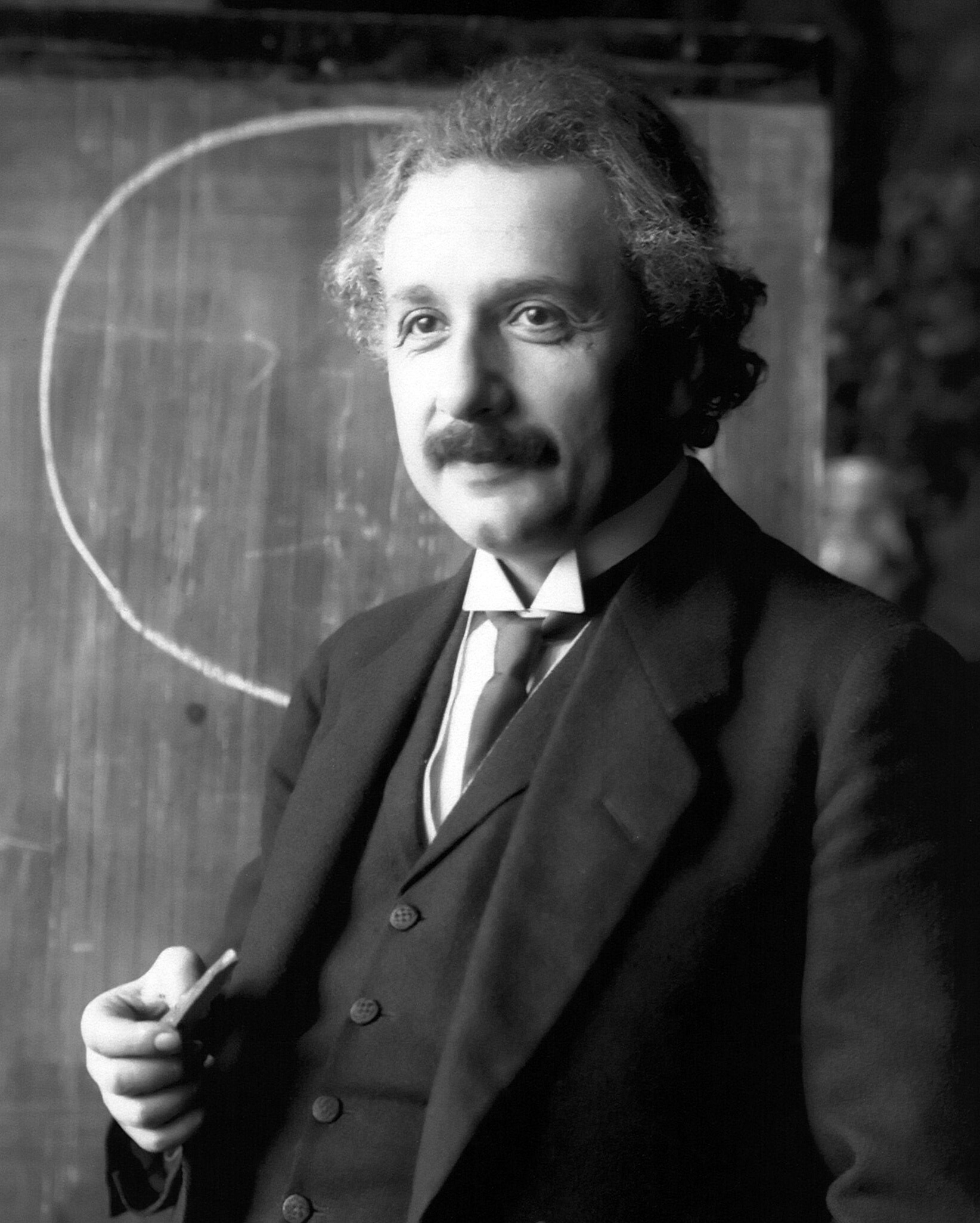
The E=mc2 Formula and Its Variables
The famous form of the equation is short enough to fit on a stamp, yet every symbol is doing real work:
Here is what each part means, with its proper SI unit:
- E — energy, measured in joules (J).
- m — mass, measured in kilograms (kg).
- c — the speed of light in a vacuum, in metres per second (m/s), fixed by definition at exactly 299,792,458 m/s.
- c2 — that speed squared, about 8.99 × 10¹⁶ m2/s2. This is the vast multiplier that turns a pinch of mass into a mountain of energy.
Want the number without the arithmetic? Drop a mass or an energy straight into our E = mc2 Calculator and read the equivalent value at once, in joules and in tonnes of TNT.
The half of the equation most people never see
Here is a surprise: E = mc2 is really the special case for an object at rest. The complete relation from special relativity also carries a momentum term:
Now p is momentum (kg·m/s). For something standing still, p = 0 and the whole thing collapses back to E = mc2. For a massless particle such as a photon, m = 0 and it becomes E = pc — which is exactly why light carries energy despite having no mass at all.
Why Is the Speed of Light Squared?
The speed of light is squared because energy, by its very definition, is a mass multiplied by a velocity squared. It is not a trick to make the answer look bigger.
Think of everyday kinetic energy, ½mv2: a mass times a speed squared. Rest energy follows the same shape, with the speed being the universe’s ultimate limit — the speed of light. The squaring drops straight out of the units of energy.
And it is that squaring that makes the results so staggering. c is about 300 million metres per second, so c2 is a seventeen-digit number. Multiply any modest mass by that, and the joules pile up at a dizzying rate.
A single gram — the mass of a raisin — holds around 9 × 10¹³ joules if fully converted. That is roughly the energy of the Hiroshima bomb, packed into less than a gram of matter.
How E=mc2 Works: Where the Energy Comes From
The energy comes from a tiny loss of mass during a reaction, known as the mass defect. Track the mass carefully before and after, and a little always goes missing.
When protons and neutrons bind into a nucleus, the bound nucleus weighs slightly less than the loose particles did. That missing mass, Δm, does not vanish — it is released as energy equal to Δm·c2. The tighter the binding, the more mass is shed and the more energy pours out.
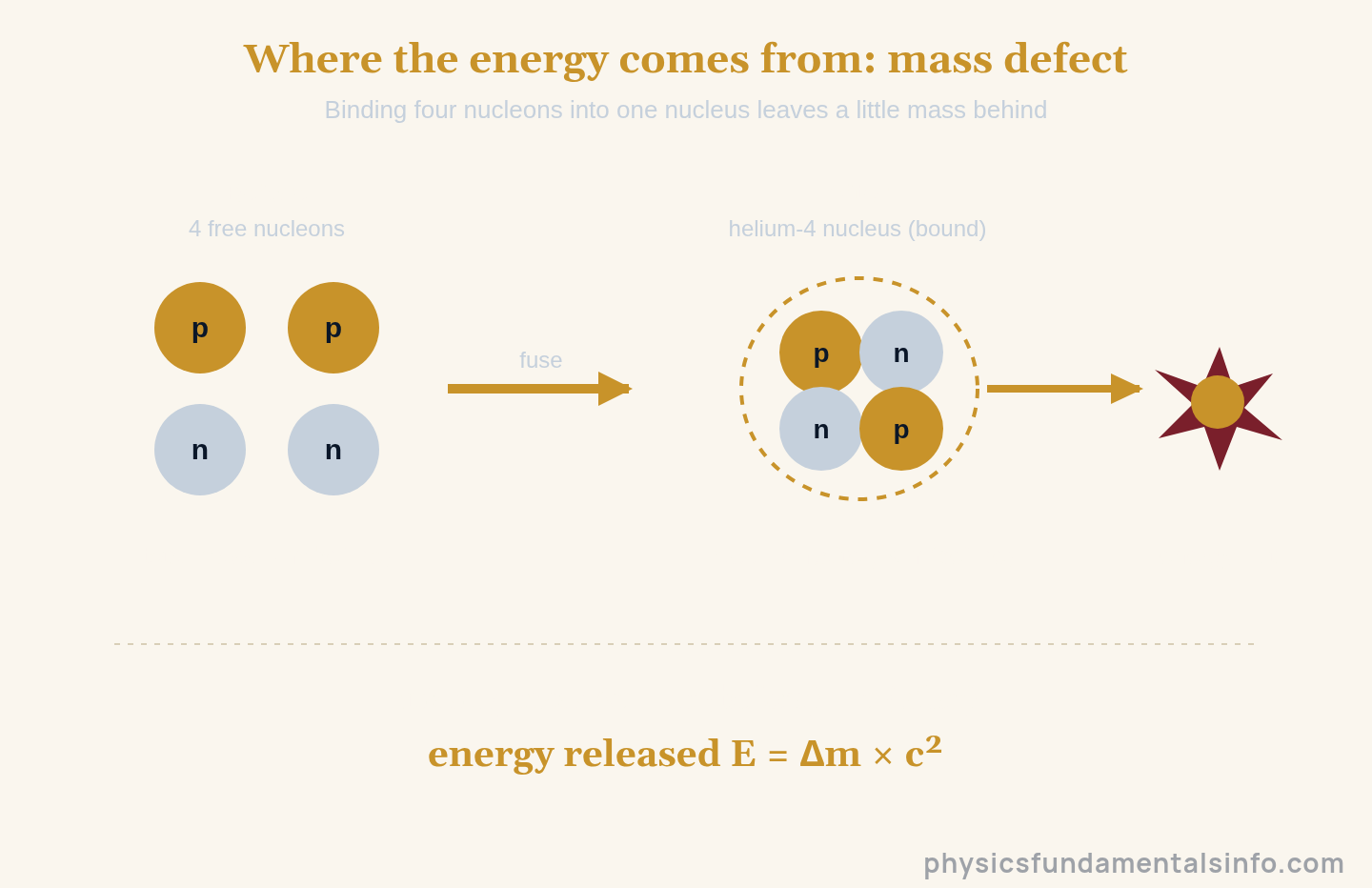
Mass defect: fusing free nucleons into a bound helium-4 nucleus loses a sliver of mass (Δm) that leaves as energy, E = Δm·c2. The same idea powers stars, reactors and bombs.
The same accounting runs in reverse, too. Heat a block of metal and its mass rises by an unimaginably small amount, because you have added energy. We never notice, because dividing that energy by c2 gives a mass change far too tiny to weigh.
At low speeds, the full energy formula even hides the familiar kinetic energy term inside it. Expand E = γmc2 for small velocities and you recover mc2 plus ½mv2 — rest energy and ordinary kinetic energy, reunited in a single expression.
E=mc2 Explained with Real-World Examples
E = mc2 is not an abstraction — it runs the Sun, powers cities, and turns up in hospitals. Here are five places it is quietly at work.
1. The Sun and every star
In the Sun’s core, hydrogen fuses into helium, and the helium weighs a hair less than the hydrogen did. The Sun turns that lost mass into sunlight, shedding roughly 4 million tonnes of mass every second — with enough fuel to keep going for billions of years.
2. Nuclear power
Reactors split heavy uranium nuclei in a process called fission. Only about 0.09% of the fuel’s mass becomes energy, yet that sliver releases millions of times more energy per kilogram than burning coal. Compare the two mechanisms in our guide to nuclear fission and fusion.
3. Nuclear weapons
The same physics, released all at once, gives an atomic bomb its terrible yield. The Hiroshima explosion converted well under a gram of matter into energy. It is the clearest — and grimmest — demonstration of how much energy c2 keeps hidden inside mass.
4. PET scans and antimatter
Inside a hospital PET scanner, an electron meets its antimatter twin, a positron, and the pair annihilate completely — 100% of their mass converted into gamma rays. Detecting those rays lets doctors map living tissue, running E = mc2 at full efficiency.
5. Particle accelerators
Machines like the LHC smash particles together at almost the speed of light. The kinetic energy of that collision condenses into brand-new, heavier particles — energy becoming mass, the equation read backwards. Even radioactive decay works this way, as unstable nuclei shed mass as energy.
How lopsided are these processes? The table below shows the energy squeezed from a single gram of matter, depending on how much of its mass is actually converted.
| Process on 1 gram of matter | Mass turned into energy | Energy released (approx.) | Where you see it |
|---|---|---|---|
| Matter–antimatter annihilation | 100% | 9.0 × 10¹³ J (~21.5 kilotons of TNT) | PET scanners; theoretical rockets |
| Nuclear fusion (hydrogen → helium) | ~0.7% | ~6 × 10¹¹ J | The Sun and stars; hydrogen bombs |
| Nuclear fission (uranium-235) | ~0.09% | ~8 × 10¹⁰ J | Power reactors; early atomic bombs |
| Chemical burning (petrol) | negligible (~10−8 %) | ~4.6 × 10⁴ J | Car and lorry engines |
| Chemical explosive (TNT) | negligible | ~4.2 × 10³ J | Mining and demolition |
The lesson is stark: nuclear processes tap thousands to millions of times more of an object’s mass than chemistry ever can. That single column of percentages is the whole story of the atomic age.
Common Misconceptions About E=mc2
Because it is so famous, E = mc2 attracts more myths than almost any equation in science. Let us clear up four of the most common.
“It only applies to nuclear bombs”
Not so. E = mc2 applies to anything with energy — a stretched spring, a warm cup of tea, and a charged battery all carry a trace of extra mass. Nuclear reactions are simply the only everyday process that converts enough mass for the effect to be obvious.
“Mass is destroyed and turned into energy”
Nothing is destroyed. Mass and energy are the same quantity, so what looks like “destruction” is really conversion between two forms of one conserved thing. The books always balance in the end.
“The equation is Einstein’s whole theory of relativity”
E = mc2 is one result of special relativity, not the entire theory. It sits alongside time dilation, length contraction, and the constant speed of light — related ideas, but genuinely distinct ones.
“c2 is just a conversion factor with no meaning”
c2 is not an arbitrary number bolted on to fix the units. It falls out of the geometry of space and time itself, and its sheer size is precisely why mass is such a concentrated form of energy.
How E=mc2 Relates to Nuclear Physics and Everyday Energy
E = mc2 is the bridge between the abstract idea of energy and the concrete world of nuclei and stars. It shows up wherever mass and energy trade places.
In nuclear physics it explains binding energy and why fusion and fission release so much power. As the US Department of Energy explains, this mass–energy relationship is exactly why fusion can produce such vast energy from so little fuel. In astrophysics it explains why stars shine and how long they can last.
It even rewrote a rule students learn early on: mass is not separately conserved. What is conserved is the grand total of mass-energy — a single quantity that Einstein’s little equation lets us convert between at will.
Worked Problems
Show Solution
Solution:
Step 1: Use mass–energy equivalence, E = m·c2.
Step 2: Substitute with units: E = (1 kg) × (3.00 × 10⁸ m/s)2 = 1 × 9.00 × 1016 kg·m2/s2.
Step 3: Since 1 kg·m2/s2 = 1 J, E = 9.00 × 10¹⁶ J.
Answer: E ≈ 9.0 × 10¹⁶ J (about 90 petajoules — enough to power a large city for weeks).
Show Solution
Solution:
Step 1: Convert mass to kilograms: 1 g = 1 × 10⁻³ kg.
Step 2: Apply E = m·c2 = (1 × 10⁻³ kg) × (3.00 × 10⁸ m/s)2.
Step 3: E = 1 × 10−3 × 9.00 × 1016 = 9.0 × 10¹³ J.
Answer: E ≈ 9.0 × 10¹³ J — roughly the energy of the Hiroshima bomb, from one raisin’s worth of mass.
Show Solution
Solution:
Step 1: Rearrange E = m·c2 to solve for mass: m = E / c2.
Step 2: Substitute: m = (3.6 × 10¹⁴ J) / (9.00 × 10¹⁶ m2/s2).
Step 3: m = 4.0 × 10⁻³ kg.
Answer: m = 4.0 × 10⁻³ kg = 4.0 grams of mass converted.
Show Solution
Solution:
Step 1: Power is energy per second, so 3.8 × 1026 J is radiated every second. Find the mass with m = E / c2.
Step 2: m = (3.8 × 1026 J) / (9.00 × 10¹⁶ m2/s2).
Step 3: m ≈ 4.2 × 10⁹ kg.
Answer: About 4.2 × 10⁹ kg — roughly 4 million tonnes of mass every single second.
Show Solution
Solution:
Step 1: The energy comes from the mass defect: E = Δm·c2.
Step 2: E = (3.2 × 10⁻²⁸ kg) × (9.00 × 10¹⁶ m2/s2) = 2.88 × 10⁻¹¹ J.
Step 3: Convert to MeV: E = (2.88 × 10⁻¹¹ J) ÷ (1.6 × 10⁻¹³ J/MeV) ≈ 180 MeV.
Answer: E ≈ 2.9 × 10⁻¹¹ J ≈ 180 MeV per fission — and a single gram of uranium holds billions of such nuclei.
Show Solution
Solution:
Step 1: Rest energy is E = m·c2.
Step 2: E = (9.11 × 10⁻³¹ kg) × (9.00 × 10¹⁶ m2/s2) = 8.2 × 10⁻¹⁴ J.
Step 3: Convert: E = (8.2 × 10⁻¹⁴ J) ÷ (1.6 × 10⁻¹³ J/MeV) ≈ 0.51 MeV.
Answer: E ≈ 8.2 × 10⁻¹⁴ J ≈ 0.51 MeV — the standard rest energy of an electron.