Alpha decay is a heavy nucleus throwing out an alpha particle, a helium-4 nucleus of two protons and two neutrons, so the mass number falls by four and the proton number by two. The released energy is the mass that disappears, Q = (Mp – Md – MHe) × 931.494 MeV, split between the alpha and the recoiling daughter.
If the smoke alarm on your ceiling is an ionisation model, there is a speck of americium-241 inside it, quietly firing helium nuclei into a small air gap at about five per cent of the speed of light. That is the working principle of the whole device. Granite worktops do something slower and fainter; so does the uranium scattered through ordinary soil.
Alpha decay throws out the heaviest and the most easily stopped of the three common radiations — and the strangest thing about it is the timing. Two nuclei can differ by a factor of two in the energy they release and still differ by twenty-four powers of ten in how long they take to release it.
What Is Alpha Decay?
Alpha decay is a nucleus shedding a tightly bound bundle of two protons and two neutrons, which drops its mass number by four and its proton number by two and turns the atom into a different element two places down the periodic table.
That bundle is an alpha particle, and it is not merely “helium”. It is a helium-4 nucleus: the two electrons a neutral helium atom carries are not part of it and stay behind in the wreckage. Getting that right matters, because the arithmetic further down leans on exactly which electrons belong where.
Three things are worth separating before any algebra.
- What leaves: one alpha particle, every time. Not four loose nucleons, and not a shower of fragments.
- What is left: a daughter nucleus with four fewer nucleons, two of them protons — so it is a different chemical element, and it recoils.
- What is released: energy, because the parent weighs more than the daughter and a helium-4 nucleus put together. That surplus is called Q.
Why an alpha and not something else? Because helium-4 is extraordinarily well bound for its size. Four nucleons leaving as a single alpha take less mass with them than four nucleons leaving one at a time, and the difference is what comes back as energy.
Try the alternative and the sum turns round. A heavy nucleus that evaporated four separate nucleons would have to be given energy to do it; the mass of the products exceeds the mass of the parent. Alpha decay happens because one particular bundle is a bargain, not because big nuclei are somehow too unwieldy to hold together.
The Alpha Decay Equation, and What Each Symbol Means
Two equations carry almost all of the topic. The first is pure bookkeeping and needs no numbers at all.
Uranium-238 obeys it in one line: 238 becomes 234, 92 becomes 90, and 146 becomes 144, so the leftover nucleus is thorium-234. Nothing in that step depends on measurement. Count the nucleons out and count them back in.
The second equation is where the measured masses come in, and it is the one that decides whether the decay can happen at all.
| Symbol | What it is | SI-based unit | Worth knowing |
|---|---|---|---|
| Mp | the atomic mass of the parent atom, nucleus and electrons together | unified atomic mass unit, u | 238.050786936 for uranium-238; the tables publish atomic masses, not nuclear ones |
| Md | the atomic mass of the daughter atom left behind | unified atomic mass unit, u | 234.043599801 for thorium-234, four nucleons and two protons lighter |
| MHe | the atomic mass of helium-4 | unified atomic mass unit, u | 4.002603254, a measured constant; the two electrons it carries are the two the daughter no longer needs |
| Q | the decay energy: the mass that disappears, turned into energy | megaelectronvolt, MeV | 4.270 for uranium-238; positive means the decay is energetically open, negative means it is shut |
| Talpha | the kinetic energy the alpha particle flies away with | megaelectronvolt, MeV | 4.198 for uranium-238; this, not Q, is what an alpha detector measures |
| Trecoil | the kinetic energy left in the daughter nucleus | kiloelectronvolt, keV | 71.8 for thorium-234; small, and never zero |
One detail in that table does a lot of quiet work: these are atomic masses, electrons included, and the electrons cancel by themselves. The parent atom brings Z of them to the sum, the daughter takes away Z minus two, and the neutral helium-4 atom on the right carries off precisely the two that are left over. No separate electron term is needed, and none should be added.
The arithmetic is one subtraction and one multiplication, and it is unforgiving, because the whole answer hides in the last digits of two numbers above 200. If you would rather not do it by hand, our alpha decay energy calculator takes the parent and daughter atomic masses in u and returns Q in MeV together with the alpha’s kinetic energy and the daughter’s recoil.
The lab below does the other half of the job: pick one of twelve real alpha emitters and watch the bookkeeping and the energies move together, with a Geiger-Nuttall plot of all twelve beside it.
Where the Energy Comes From: Q Is the Mass That Disappears
Weigh a uranium-238 atom, weigh the thorium-234 atom and the helium-4 atom it turns into, and the second pair comes up short. The shortfall for uranium-238 is 0.004583881 u, roughly one part in 52,000 of the atom it started as, and multiplying it by 931.494 MeV per unified mass unit gives 4.270 MeV.
That is a strikingly small fraction of the mass to be so consequential. It is also why the input precision matters: round either atomic mass to five decimals and you have thrown away a chunk comparable to the entire answer.
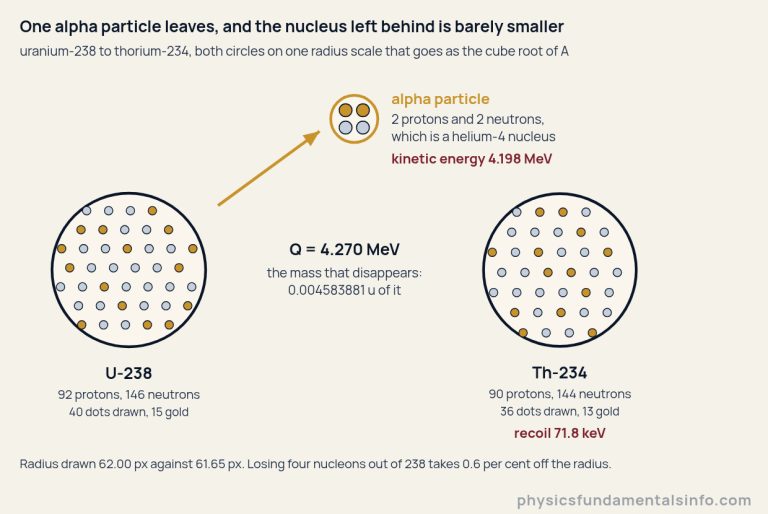
How good is the mass arithmetic? For uranium-238 the Q these measured atomic masses produce and the Q the evaluated tables list agree to better than 0.001 keV. Across all twelve emitters in the table further down, the worst disagreement is 0.0014 keV.
Precision has a floor here, and it is set by the measurement rather than by the calculator. The quoted uncertainties on these Q values run from 0.06 to 2.12 keV, and on the parent atomic masses from 1.19 to 2.09 micro-u, so Q is quoted to three decimals of a MeV — the nearest keV — and the recoil to 0.1 keV. Nothing on this page claims better.
A positive Q is necessary. It is nowhere near sufficient, and that is the single most useful thing to understand about alpha decay.
Take bismuth-209. Its alpha Q is positive at 3.137 MeV, alpha emission is the only decay mode listed against it, and it still manages a half-life of 2.01e19 years — more than a billion times the age of the Earth. The energy bookkeeping opened that door long ago; getting out is the hard part, because the alpha has to cross an electrical barrier taller than its own energy and can do so only by quantum-mechanical tunnelling. How long that takes is not something a mass difference can tell you, and nothing on this page computes a barrier height or a tunnelling probability.
How the Energy Splits Between the Alpha and the Daughter
Momentum has to balance as well as energy. The alpha and the daughter leave back to back with equal and opposite momenta, and that forces the kinetic energy to divide in inverse proportion to their masses, so the light alpha takes nearly all of it and the heavy daughter keeps a small, real remainder.
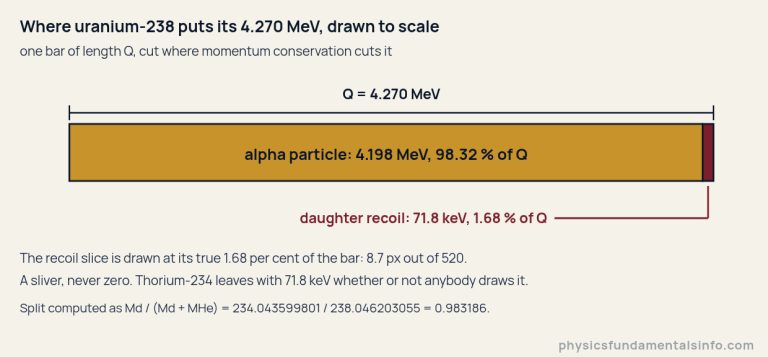
So “the alpha carries the energy released” is wrong, and wrong by a measurable amount. Across the twelve emitters below, the daughter keeps between 70.4 and 169.1 keV.
The alpha’s share is close to 98 per cent everywhere in that set, but it is not a constant: it runs from 98.09 per cent for polonium-210 up to 98.34 per cent for americium-241. It is simply the mass ratio Md / (Md + MHe), so it climbs steadily with the mass of the daughter: the heavier the leftover nucleus, the smaller the slice it keeps.
That recoil is worth more attention than its 1.68 per cent suggests. A thorium-234 nucleus born with 71.8 keV is torn out of whatever chemical bond it was sitting in and leaves ionised — which is why an alpha emitter embedded in a solid slowly damages it, and why the decay products of radon do not stay politely where they were made.
Why Alpha Half-Lives Run from Nanoseconds to Billions of Years
Here are twelve real alpha emitters, in order of increasing decay energy. Read the first column and the last together, because the pairing is the whole story.
| Parent | Daughter | Decay energy Q (MeV) | Alpha kinetic energy (MeV) | Daughter recoil (keV) | Measured half-life |
|---|---|---|---|---|---|
| Th-232 | Ra-228 | 4.082 | 4.011 | 70.4 | 14.0 billion years |
| U-238 | Th-234 | 4.270 | 4.198 | 71.8 | 4.468 billion years |
| U-235 | Th-231 | 4.678 | 4.598 | 79.7 | 704 million years |
| Th-230 | Ra-226 | 4.770 | 4.687 | 83.0 | 75,400 years |
| Ra-226 | Rn-222 | 4.871 | 4.784 | 86.3 | 1,600 years |
| Pu-239 | U-235 | 5.245 | 5.157 | 87.8 | 24,110 years |
| Po-210 | Pb-206 | 5.408 | 5.304 | 103.1 | 138.376 days |
| Rn-222 | Po-218 | 5.590 | 5.490 | 100.8 | 3.8235 days |
| Am-241 | Np-237 | 5.638 | 5.544 | 93.6 | 432.6 years |
| Rn-220 | Po-216 | 6.405 | 6.288 | 116.5 | 55.6 seconds |
| Po-214 | Pb-210 | 7.834 | 7.687 | 146.5 | 163.46 microseconds |
| Po-212 | Pb-208 | 8.954 | 8.785 | 169.1 | 294.3 nanoseconds |
Every figure in that table comes from one source: the evaluated ground-state table published by the IAEA live chart of nuclides, which is where the atomic masses, Q values, half-lives and spin-parities used throughout this article were taken from. Q was recomputed from the masses and agrees with the tabulated Q values to better than 0.002 keV; the alpha energy and the recoil then follow from that Q and those same masses.
One caution about doing sums on those columns. The recoil was worked out from the full masses, not by subtracting the two rounded energy columns — for thorium-232 that subtraction gives 4.082 – 4.011 = 0.071 MeV, or 71 keV, against the 70.4 keV the unrounded figures produce. Rounded inputs, rounded-off answer.
Now the pairing. Polonium-212 releases 8.954 MeV against thorium-232’s 4.082 MeV, a factor of 8.954 / 4.082 = 2.19. Their half-lives are 294.3 nanoseconds and 14.0 billion years, which is a factor of 1.5e24, or 24.18 powers of ten. A factor of two in energy; a factor of a million million million million in lifetime.
Plot the logarithm of the half-life against one over the square root of Q and that ferocious relationship straightens out into a line. This is the Geiger-Nuttall relationship, and on our twelve points it looks like this.
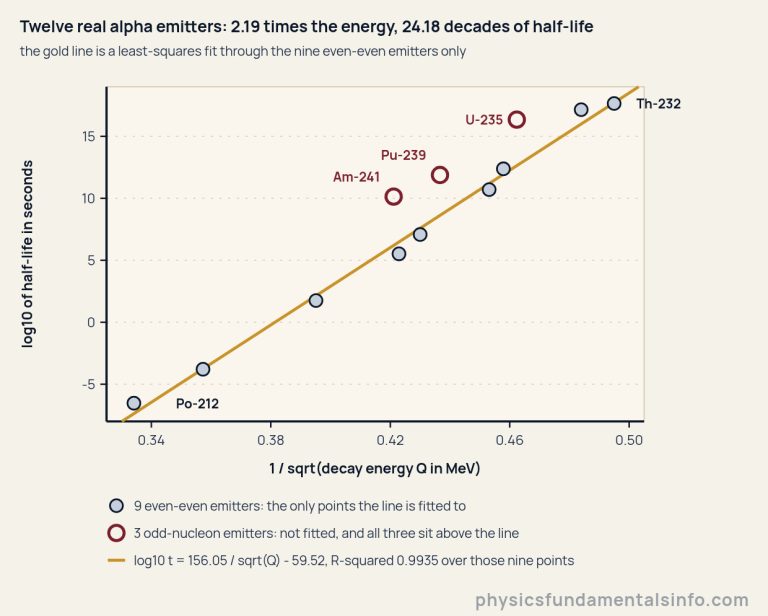
The fit is tight where it is meant to be. The furthest of the nine even-even emitters from the line is uranium-238, which sits 1.15 decades above it.
Two warnings come with that line, and they matter. It is an empirical least-squares fit to nine of the twelve points drawn above, not a derivation from first principles and not a universal constant; and it says nothing reliable about any nuclide outside that set of twelve. Use it to read the shape of the relationship, not to predict a half-life.
Half-life itself is a separate measurement with its own meaning, and the guide to half-life covers what it does and does not tell you about a single nucleus.
Why Some Emitters Are Far Slower Than Their Energy Suggests
Three of the twelve sit conspicuously above the line: uranium-235 by 3.719 decades, plutonium-239 by 3.261 and americium-241 by 3.935. Every one of the three has an odd number of protons or an odd number of neutrons, and every one of the nine that fall on the line is even-even.
The fetched spin-parity column says the same thing in shorthand. All nine even-even parents here are 0+, while uranium-235 is 7/2-, plutonium-239 is 1/2+ and americium-241 is 5/2-. An alpha particle carrying angular momentum away has a harder job than one that does not, and such decays are described as hindered.
The separation is clean rather than marginal. The worst even-even emitter is out by a factor of 14; the best-behaved odd-nucleon one is out by a factor of about 1,800. There is no overlap at all.
That is as far as this page will take the explanation. Attaching a mechanism beyond “the alpha has to carry angular momentum away” would mean quoting a barrier calculation, and no barrier was calculated here.
Alpha, Beta and Gamma: What Actually Changes
The three classical radiations differ in what leaves the nucleus, and therefore in what the bookkeeping does afterwards.
| Decay | What leaves the nucleus | Mass number A | Proton number Z | Neutron number N | The element |
|---|---|---|---|---|---|
| Alpha | a helium-4 nucleus: 2 protons and 2 neutrons bound together | falls by 4 | falls by 2 | falls by 2 | changes, two places down |
| Beta-minus | an electron and an antineutrino | unchanged | rises by 1 | falls by 1 | changes, one place up |
| Gamma | a photon, with nothing else leaving | unchanged | unchanged | unchanged | unchanged |
Alpha is the only one of the three that changes the mass number, and it is the only one that moves the element two places at once. In beta decay the nucleon count holds still while a neutron turns into a proton, so A is untouched and Z creeps up by one. Gamma emission changes no count whatever: the same nuclide simply drops to a lower energy state and a photon leaves.
The three also behave completely differently once they are outside the nucleus, and the guide to alpha, beta and gamma radiation sets their penetrating power side by side. In short: an alpha particle is heavy, doubly charged and stopped by a sheet of paper or a short distance of air, which is why the hazard from an alpha emitter is an internal one — a source inhaled or swallowed, with no paper in between.
Gamma rays often turn up as a companion to alpha decay rather than an alternative to it. If the daughter is left in an excited state, the alpha comes out with less than the full Q and the balance is emitted as a gamma ray afterwards, which is why a real emitter usually shows a small group of alpha energies rather than one.
Where You Meet Alpha Decay
Alpha decay is not exotic. It is in the ceiling, in the ground, and in the power supply of anything that has been sent far enough from the Sun.
- Ionisation smoke alarms. Americium-241 fires alphas carrying up to 5.544 MeV into a small air gap; the ions they make carry a current, and smoke entering the gap disturbs it.
- Radon indoors. Radium-226 in rock and soil decays to radon-222, a gas that seeps into buildings, and radon’s own short-lived descendants are alpha emitters too.
- Radioisotope heat and power. An alpha is absorbed within a very short distance, so its kinetic energy becomes heat almost immediately — the basis of radioisotope heater units and thermoelectric generators.
- Alpha spectroscopy. Each emitter produces a sharp, characteristic alpha energy, so measuring the energy identifies which nuclide a sample contains.
- Dating rocks and minerals. Uranium and thorium decay chains are alpha-driven, and the helium that accumulates from those alphas can itself be counted as a clock.
The decay chains are where alpha decay really shows its character. Uranium-238 does not stop at thorium-234; the daughter of one step is the parent of the next, and the whole chain grinds down through radium and radon before it finally stops at a stable isotope of lead.
Common Misconceptions About Alpha Decay
Four ideas about alpha decay get repeated often enough to be worth correcting outright.
- “The alpha particle carries the energy released.” It carries most of it. Momentum conservation hands the daughter 70 to 170 keV across the emitters above, and that recoil is what makes alpha emitters chemically destructive in the material around them.
- “An alpha particle is helium.” It is a helium-4 nucleus. The neutral atom’s two electrons are not part of it; they are the two that let the formula be written with atomic masses in the first place.
- “A positive Q means the nucleus will decay soon.” Q decides whether a decay is allowed, never when it happens. Bismuth-209 is the standing counter-example, with 2.01e19 years to its name.
- “Alpha emitters are harmless because paper stops them.” Paper stops them from outside. The hazard is an emitter that has got inside, where there is no paper, and that is exactly why radon matters.
The simple picture has limits of its own, and three of them are worth naming.
First, alpha emission is rarely the only channel. Uranium-238 is listed as 100 per cent alpha with a spontaneous-fission branch of 0.0000545 per cent; thorium-232’s fission branch is 0.0000000011 per cent and americium-241’s is 0.00000000036 per cent. Rarer still, radium-226 emits a carbon-14 nucleus in 0.0000000032 per cent of its decays and thorium-230 a neon-24 nucleus in 0.000000000058 per cent — cluster decay, sitting quietly in the same data file. Spontaneous fission is a different process from the neutron-induced fission used in reactors, though the fragments look similar.
Second, every number here is an evaluated measurement rather than a constant of nature. Masses, Q values, half-lives and branching ratios are compiled and re-evaluated by data centres such as the National Nuclear Data Center, and they carry uncertainties that occasionally move.
Third, the fitted line above is a description of twelve points, not a law of physics. It was fitted to nine of them, it is quoted with an R-squared, and it earns no authority outside the set it was drawn from.