Capacitance is the amount of electric charge a component stores for every volt of potential difference across it, defined by C = Q/V and measured in farads. One farad equals one coulomb per volt. A charged capacitor also stores energy equal to half the capacitance multiplied by the voltage squared.
Press the shutter on a camera with a built-in flash and you sometimes hear a faint rising whine before it fires. That is a capacitor filling up. The battery cannot dump its energy fast enough to make a bright flash, so it trickles charge into a capacitor for a second or two, and the capacitor releases the lot in about a thousandth of a second.
The numbers are worth sitting with. A typical AA cell holds roughly 10 kJ of energy; a camera flash capacitor holds around 9 J — about a thousand times less. Yet the capacitor wins, because it can hand that energy over thousands of times faster. Capacitance is the property that decides how much charge a component can park, and how much energy comes back out.
What Is Capacitance?
Capacitance is the charge a conductor stores for every volt applied to it, written C = Q/V. A component with a large capacitance accepts a lot of charge without its voltage climbing much; a small one fills up almost immediately.
Think of a spring. Push on a stiff spring and it barely moves; push on a floppy one and it travels a long way for the same force. Voltage is the push, stored charge is the movement, and capacitance is the floppiness — how much charge you get per volt of push.
The precise definition depends slightly on what you are measuring:
- An isolated conductor — C is the charge on it divided by its potential relative to a point infinitely far away.
- A capacitor (two conductors separated by an insulator) — Q is the magnitude of the charge on each plate, and V is the potential difference between them.
The second case is the one you meet in circuits, and it hides a subtlety worth flagging early. A “charged” capacitor holds +Q on one plate and -Q on the other, so its total charge is zero. It has not stored charge so much as pulled charge apart and held it there.
The Capacitance Formula: C = Q/V
The defining formula for capacitance divides the charge stored on one plate by the potential difference across the capacitor.
| Symbol | Quantity | SI unit |
|---|---|---|
| C | Capacitance | farad (F) |
| Q | Charge stored on one plate | coulomb (C) |
| V | Potential difference across the plates | volt (V) |
Rearranged, the same relationship gives you Q = CV and V = Q/C. If you want the arithmetic done for you while you check your own working, our Capacitance Calculator solves for capacitance, charge or voltage and returns the stored energy alongside.
Here is the point that trips people up. Capacitance is not set by Q or V — it is fixed by the capacitor’s geometry and the insulator inside it. Double the voltage and you double the charge; the ratio between them does not budge.
The Parallel-Plate Formula
For the simplest capacitor — two flat plates facing each other — capacitance follows directly from the geometry:
- ε0 — the vacuum permittivity, 8.854 × 10⁻¹² farads per metre (F/m)
- εr — relative permittivity (dielectric constant) of the insulator, a dimensionless number
- A — the overlapping area of one plate, in square metres (m2)
- d — the separation between the plates, in metres (m)
This formula assumes the plates are large compared with their spacing, so the field between them is uniform and edge effects are negligible. Real capacitors deviate slightly, but for teaching and for most design work it is accurate enough.
Capacitance of a parallel-plate capacitor depends on plate area, separation and the insulator between the plates.
How Much Energy Does a Capacitor Store?
A charged capacitor stores energy equal to half the charge times the voltage — not the full QV. The same quantity can be written three equivalent ways, and which one you reach for depends on what you already know.
- U — energy stored, in joules (J)
- C — capacitance, in farads (F)
- V — potential difference across the capacitor, in volts (V)
- Q — charge on one plate, in coulombs (C)
Where the Half Comes From
Why half? Because the voltage is not constant while the capacitor charges — it climbs from zero to V as charge piles up.
The very first packet of charge crosses an empty capacitor and does almost no work against the field. The last packet has to fight its way across the full voltage. Averaged over the whole process, each unit of charge crosses an average potential of V/2, which is exactly where the factor of one half comes from.
Formally, moving a small charge dq across the instantaneous voltage q/C costs dW = (q/C) dq. Integrating from 0 to Q gives U = Q²/(2C), and substituting Q = CV recovers the other two forms.
Voltage rises in proportion to stored charge, so the energy is the triangular area under the line, not the full rectangle QV.
A quick sanity check you can use in an exam: if you ever write U = QV, you have claimed the capacitor charged at full voltage from the very start. It did not.
What Changes a Capacitor’s Capacitance?
Three things set the capacitance of a parallel-plate capacitor: plate area, plate separation, and the insulating material between the plates. Each acts in a way you can reason out physically.
- Larger plate area raises capacitance. More room for charge to spread out means less crowding, so less voltage builds up per unit of charge added.
- Smaller separation raises capacitance. The opposite charges pull on each other more strongly across a narrow gap, holding more charge in place at the same voltage.
- A dielectric raises capacitance. The insulator’s molecules polarise and partly cancel the field between the plates, so the voltage drops and C rises by the factor εr.
That third effect is why real capacitors are not just two bits of metal in air. Choosing the right dielectric buys you a factor of thousands.
| Material between the plates | Relative permittivity εr (approx.) | Effect on C |
|---|---|---|
| Vacuum | 1 (exactly) | Baseline |
| Dry air | 1.0006 | Indistinguishable from vacuum |
| Paper | 3.5 | About 3.5× |
| Mica | 5 | About 5× |
| Water (20 °C) | 80 | About 80× |
| Barium titanate ceramic | 1,000 and above | Thousands of times |
In practice, electrolytic capacitors reach hundreds of microfarads by a different trick: an oxide layer only a few hundred nanometres thick. Because d sits on the bottom of the formula, making it tiny sends C soaring — which is also why those capacitors have modest voltage ratings and fail loudly when you exceed them.
The lab below lets you move all three variables at once. Change the plate area, the gap and the dielectric, and watch capacitance, stored charge and stored energy respond.
Real-World Examples of Capacitance
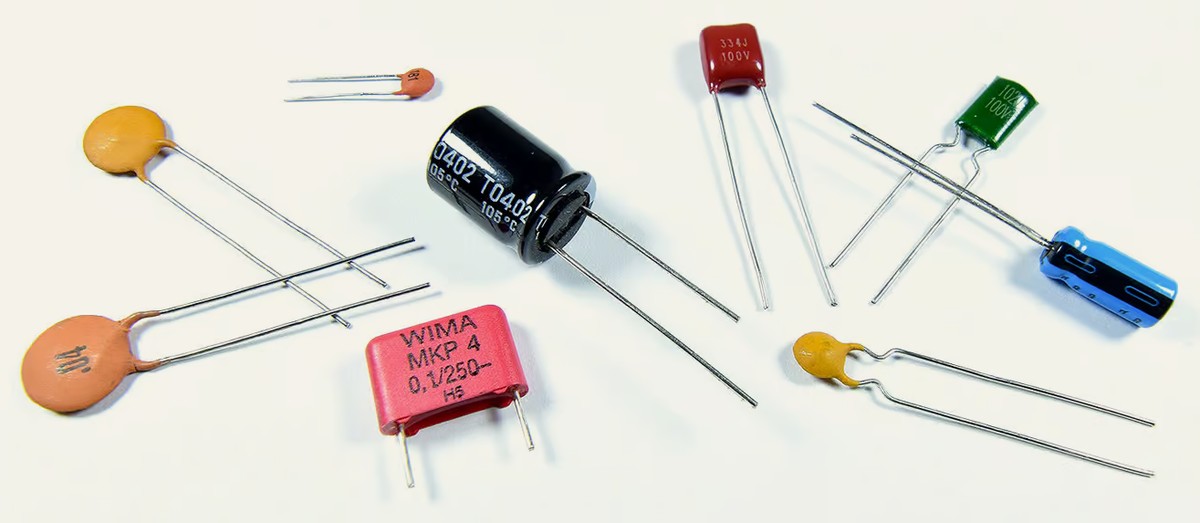
Capacitance shows up wherever charge needs to be stored briefly, released quickly, or sensed. Five cases give a feel for the range.
1. Camera Flash
A flash capacitor of roughly 200 µF charged to about 300 V stores around 9 J. The battery takes a second or two to fill it; the xenon tube empties it in about a millisecond, which is what makes the flash bright rather than merely warm.
2. Defibrillator
A defibrillator typically charges a capacitor of about 100 µF to roughly 2,000 V, storing 200 J. Note how strongly the voltage dominates — because U depends on V2, doubling the voltage quadruples the energy delivered.
3. Smoothing in a Power Supply
Rectified mains voltage arrives as a lumpy series of humps. A large capacitor across the output charges on each peak and discharges gently between them, flattening the ripple into something a circuit can actually run on.
4. Capacitive Touchscreens
Your phone screen carries a grid of tiny capacitors. A fingertip is conductive enough to alter the capacitance at one node by around a picofarad, and the controller reads that change as a touch — which is why gloves usually fail.
5. Supercapacitors
A 3,000 F supercapacitor rated at 2.7 V stores about 10.9 kJ, roughly 3 watt-hours. That is small next to a battery of the same mass, but it can be charged and discharged in seconds and survives hundreds of thousands of cycles — useful for regenerative braking and backup power.
| Where you find it | Typical capacitance | In farads |
|---|---|---|
| DRAM memory cell | 10–30 fF | ~2 × 10-14 |
| Touchscreen node change from a finger | ~1 pF | 10-12 |
| Ceramic decoupling capacitor | 100 nF | 10-7 |
| Camera flash capacitor | ~200 µF | 2 × 10⁻⁴ |
| Earth, treated as an isolated sphere | ~710 µF | 7.1 × 10⁻⁴ |
| Supercapacitor | up to 3,000 F | 3 × 10³ |
That last row is worth a second look. The entire planet, treated as an isolated conducting sphere, has a capacitance comparable to a large electrolytic capacitor you could hold between two fingers — a reminder that the farad is an enormous unit.
Common Misconceptions About Capacitance
Myth 1: A Capacitor Stores Charge
A charged capacitor has zero net charge. One plate carries +Q and the other -Q, so what the capacitor really does is separate charge and hold it apart. What it stores is energy, in the electric field between the plates.
Myth 2: A Bigger Capacitance Means More Charge
Only at the same voltage. Capacitance is charge per volt, so a 1 µF capacitor at 100 V holds ten times the charge of a 10 µF capacitor at 1 V. Always check what voltage each component is sitting at before comparing.
Myth 3: The Energy Stored Is QV
It is half that. Because voltage climbs from zero to V during charging, the average voltage each unit of charge crosses is V/2. Writing U = QV instead of ½QV is one of the most common ways to lose marks on this topic.
Myth 4: Capacitance Depends on the Voltage You Apply
It does not. C is fixed by area, separation and dielectric — the geometry of the thing. Raising the voltage raises the stored charge in exact proportion, leaving the ratio Q/V unchanged.
How Capacitance Relates to Charge, Voltage and Current
Capacitance ties together three quantities you have already met: charge, potential difference, and the field that connects them. Each one gives a different handle on the same physics.
The V in C = Q/V is the ordinary potential difference across the plates, and the charge separation that produces it is the same effect at work in everyday static electricity. Between the plates sits a uniform electric field of strength E = V/d — for a 12 V supply across a 0.1 mm gap, that is 120,000 V/m.
Charging is not instantaneous, either. Charge arrives as a current, and since electric current is the rate of charge flow, the capacitor fills at a speed set by whatever resistance is in the way. The product RC is the time constant, the time to reach about 63% of the final voltage.
Capacitors in Series and Parallel
Here is a rule that catches almost everyone: capacitors combine the opposite way round to resistors.
- In parallel — capacitances add: Ctotal = C1 + C2 + … The plate areas effectively combine.
- In series — reciprocals add: 1/Ctotal = 1/C1 + 1/C2 + … The total is always smaller than the smallest one.
If that feels backwards, check it against how series and parallel circuits behave with resistors and the symmetry becomes obvious rather than arbitrary.
Worked Problems
Show Solution
Show Solution
Show Solution
Show Solution
Show Solution
Show Solution
Show Solution
Frequently Asked Questions
What is capacitance in simple terms?
What is the SI unit of capacitance?
What is the formula for energy stored in a capacitor?
Why is the energy stored half QV and not QV?
Does capacitance change with voltage?
Why does adding a dielectric increase capacitance?
Key Takeaways
- Capacitance is charge stored per volt: C = Q/V, measured in farads (1 F = 1 C/V).
- For parallel plates, C = ε0εrA/d — more area and less separation both raise C.
- Stored energy is U = ½CV² = ½QV = Q²/(2C), never the full QV.
- A charged capacitor carries no net charge; it separates charge and stores energy in the field.
- Capacitors add in parallel and combine reciprocally in series — the reverse of resistors.