Velocity vs speed comes down to direction: speed is a scalar measuring only how fast an object moves (distance ÷ time), while velocity is a vector measuring how fast and in what direction it moves (displacement ÷ time). Speed has magnitude only; velocity has magnitude and direction.
Picture two runners who both finish a 400-metre lap in exactly 80 seconds. They ran at the same speed — yet if you ask where each one ended up relative to where they started, the answer is “nowhere.” That gap between how fast you move and where you actually end up is the whole story of speed versus velocity.
It sounds like hair-splitting, but it decides real outcomes: whether a pilot reaches the right airport, why a satellite never falls despite never slowing down, and how your sat-nav guesses your arrival time. Get the distinction right once and a surprising amount of physics suddenly clicks into place.
What Is the Difference Between Speed and Velocity?
Start with the everyday meaning, then sharpen it. Speed answers one question — how fast? It is a scalar: a quantity with size but no direction, like temperature or mass.
Velocity answers two questions at once: how fast, and which way? That makes it a vector — a quantity carrying both a magnitude and a direction. The magnitude of an object’s velocity is simply its speed.
So the relationship is tidy. Speed is the “how fast” part of velocity with the direction stripped away. A car doing 90 km/h has a speed; the same car doing 90 km/h due north has a velocity.
One consequence trips up almost everyone. Because velocity has direction, it can be positive or negative, and it can cancel itself out — speed cannot. A reading of “−5 m/s” is a velocity (5 m/s in the negative direction); a speed is always just 5 m/s.
The Speed and Velocity Formulas
Both quantities are built from a change in position over a change in time. But they disagree about what counts as “position change.”
Average speed uses the total path length you actually travelled:
Average velocity uses displacement — the straight-line change from start to finish, with direction:
Here every symbol has a job:
- v — average velocity, a vector, measured in metres per second (m/s).
- Δx — displacement (the change in position, also a vector), measured in metres (m). The Greek Δ (“delta”) means “change in”.
- Δt — the time interval, measured in seconds (s).
- distance — total path length actually covered, in metres (m); always positive.
Shrink the time interval to a single instant and you get instantaneous velocity — the value at one moment rather than averaged over a trip:
That limit is the derivative of position with respect to time. Its magnitude is the instantaneous speed — the number a speedometer shows. The same definitions are laid out at HyperPhysics, a long-standing university reference.
Velocity vs Speed: The Key Differences at a Glance
If you only remember one thing, remember this: speed throws away direction, velocity keeps it. Everything in the table below follows from that single fact.
| Feature | Speed | Velocity |
|---|---|---|
| Type of quantity | Scalar | Vector |
| What it tells you | How fast only (magnitude) | How fast and in which direction (magnitude + direction) |
| Based on | Distance travelled (total path length) | Displacement (straight-line change in position) |
| Can it be negative? | No — always zero or positive | Yes — a sign shows direction (in one dimension) |
| Over a round trip | Average speed is greater than zero | Average velocity is zero (displacement = 0) |
| SI unit & symbol | metres per second (m/s); written v or |v| | metres per second (m/s); written as a vector v (bold or with an arrow) |
How Can Speed Stay Constant While Velocity Changes?
Here is the question that separates a memorised definition from real understanding. Can something move at a perfectly steady speed and still have a changing velocity? Yes — and it happens every time anything travels in a curve.
Think of a car going round a roundabout at a constant 30 km/h. The speedometer needle never moves. But the direction the car points — and therefore its velocity — is swinging round the whole time.
Because velocity is changing, the car is accelerating, even though it is neither speeding up nor slowing down. That acceleration points toward the centre of the curve; physicists call it centripetal acceleration, and it is what you feel as the push toward the outside of a bend.
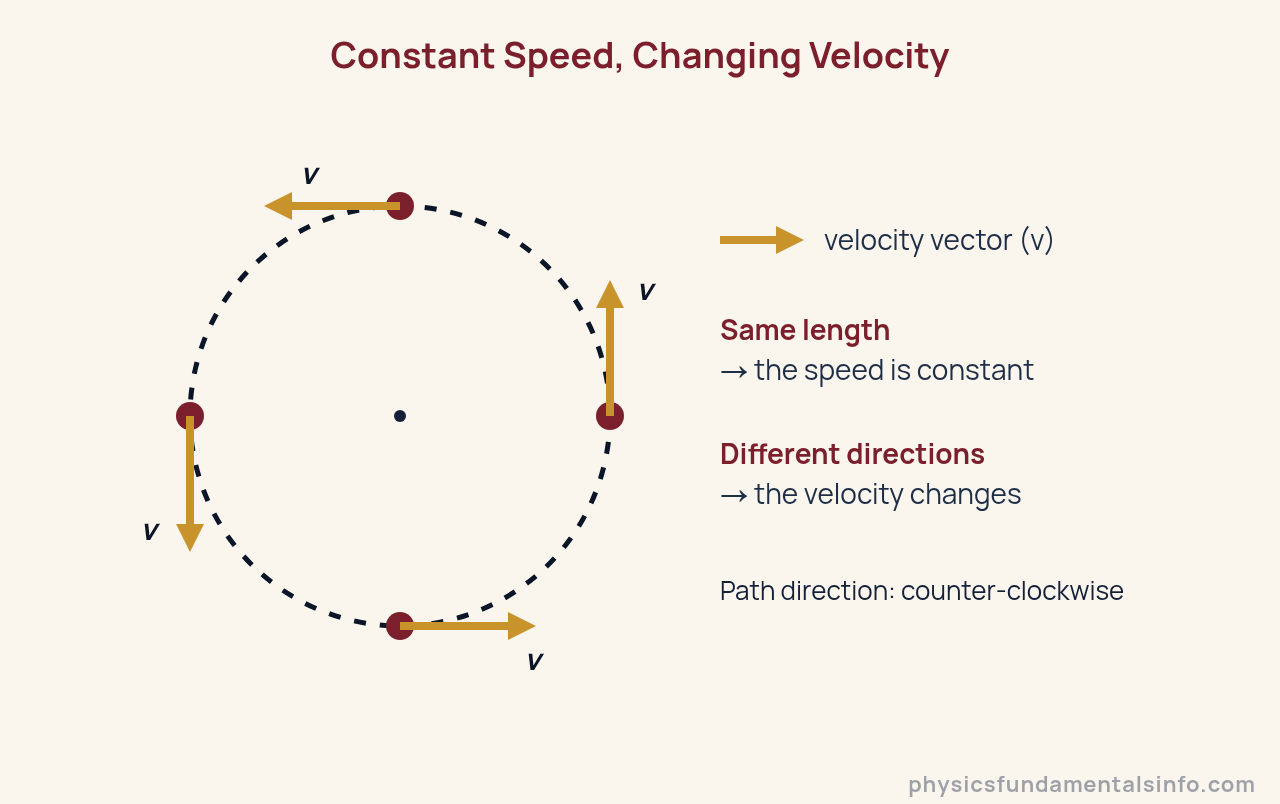
An object circling at a steady pace: every velocity arrow is the same length (speed is constant) but points a different way (velocity keeps changing) — which is why circular motion always involves acceleration.
The diagram makes the point statically; the lab below lets you see it move. Set a speed, watch the velocity arrow keep its length while it rotates, and notice the displacement readout return to zero on every full lap as the distance just keeps climbing.
Real-World Examples of Speed and Velocity
The distinction stops being abstract the moment you look at how things actually move.
The running track. Sprint one full lap and your average speed is healthy, but your average velocity is zero — you finished exactly where you began, so your displacement is nil.
The daily commute. Drive to work and home again and you might clock 40 km on the odometer (real distance, real average speed), yet your net displacement for the day is zero. Velocity-wise, you went nowhere.
The roundabout. Holding 30 km/h through the bend, your speed is constant while your velocity rotates continuously — the everyday face of acceleration without any change in pace.
The aircraft in wind. A plane’s airspeed might read a steady 250 knots, but a crosswind nudges its actual velocity sideways. Pilots plan around velocity — heading and speed together — because speed alone won’t get them to the right runway.
Average vs Instantaneous Speed and Velocity
So far we have mostly averaged over a whole journey. But motion rarely happens at one fixed rate, so physics needs two time-scales: the overall average and the snapshot.
Average velocity looks only at the endpoints — start here, finish there, divide the displacement by the time. The wandering path in between is ignored entirely. That is why average velocity can be exactly zero whenever you return to your starting point.
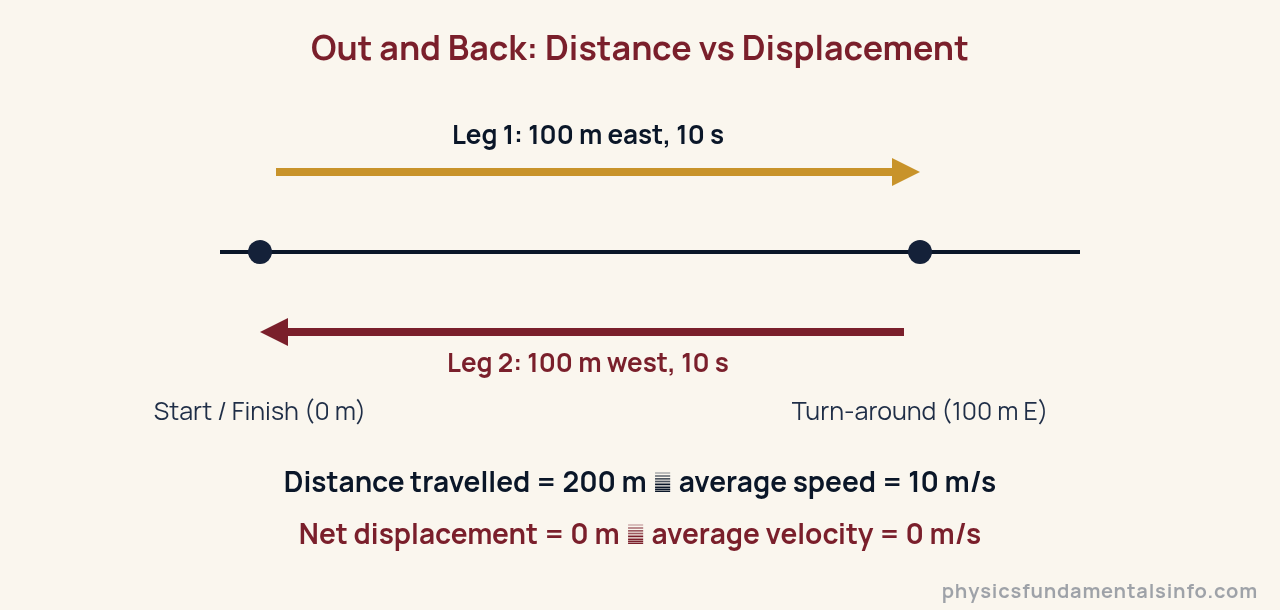
The same journey gives two very different answers: 200 m of ground covered (a real average speed) but no change in position (zero average velocity).
Our headline example shows it cleanly. Drive 100 m east in 10 s, then 100 m west in 10 s: you covered 200 m of distance, so your average speed is a brisk 10 m/s — but your displacement is zero, so your average velocity is 0 m/s.
Instantaneous velocity, by contrast, is the value right now — at this exact tick of the clock. Its magnitude is the instantaneous speed.
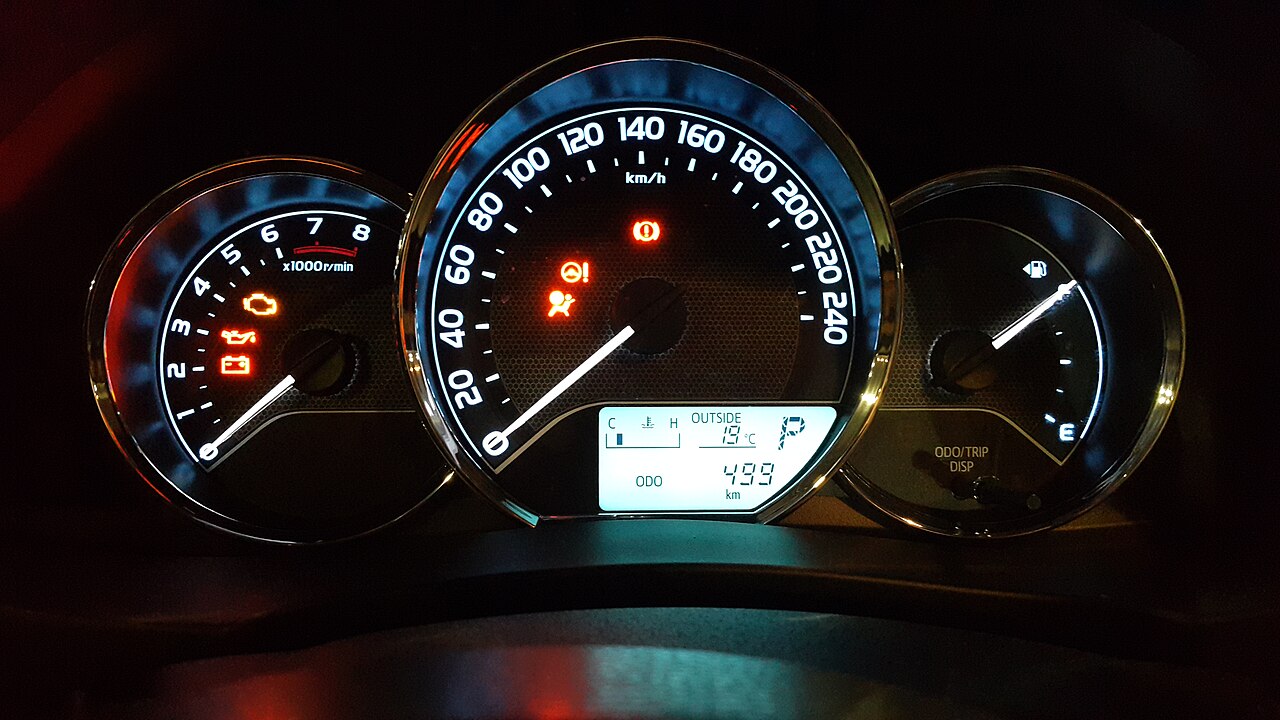
This is the difference between the speedometer and the trip computer. The speedometer shows your instantaneous speed; the trip computer’s “average speed since reset” is averaged over the whole drive. A common student slip is to assume average speed equals the magnitude of average velocity — true only for straight-line motion that never reverses.
Common Misconceptions About Speed and Velocity
“Speed and velocity mean the same thing.” In casual talk, maybe. In physics, no — one is a scalar, the other a vector, and that lets velocity do something speed never can: average out to zero.
“Constant speed means constant velocity.” Only on a straight road. The instant the path curves, the direction changes, so the velocity changes — which is exactly why circular motion is accelerated motion.
“Average speed is just the size of average velocity.” Not in general. Because distance is always at least as large as the magnitude of displacement, average speed is always greater than or equal to the magnitude of average velocity; the two match only for straight-line motion without a U-turn.
“A speedometer reads velocity.” It reads speed — magnitude only. It has no idea whether you are heading north or south. Pair it with a compass and you would finally be measuring velocity.
How Speed and Velocity Relate to Acceleration, Displacement and Energy
Velocity sits at the centre of a web of other ideas, which is why getting it right pays off everywhere.
Acceleration is defined as the rate of change of velocity — so any change in speed or direction is an acceleration. That link runs straight into Newton’s second law, which says the net force needed equals mass times that acceleration.
It also explains Newton’s first law: with no net force, an object keeps a constant velocity — not just a constant speed, but an unchanging direction too.
Speed, meanwhile, is what powers kinetic energy, which depends on the square of the speed (½mv2). Two cars moving at the same speed in opposite directions have identical kinetic energy, because energy doesn’t care about direction — only magnitude.
And whenever something slows down, a force is changing its velocity. Often that force is friction, quietly bleeding speed away until the motion stops.
Worked Problems
Show Solution
Solution:
Step 1: The path is a straight line with no reversal, so distance = magnitude of displacement = 100 m, and the time is t = 12.5 s.
Step 2 (average speed): average speed = distance / time = 100 m / 12.5 s.
Step 3: average speed = 8.0 m/s.
Step 4 (average velocity): average velocity = displacement / time = 100 m / 12.5 s = 8.0 m/s, directed due north.
Answer: average speed = 8.0 m/s; average velocity = 8.0 m/s due north — equal in size because the motion is a straight line.
Show Solution
Solution:
Step 1: Total distance = 100 m + 100 m = 200 m. Total time = 10 s + 10 s = 20 s.
Step 2 (average speed): average speed = total distance / total time = 200 m / 20 s = 10 m/s.
Step 3 (displacement): the car ends where it began, so the net displacement Δx = 0 m.
Step 4 (average velocity): average velocity = Δx / Δt = 0 m / 20 s = 0 m/s.
Answer: average speed = 10 m/s; average velocity = 0 m/s. Same journey, two very different numbers.
Show Solution
Solution:
Step 1: One lap means the distance travelled = 400 m over a time t = 80 s.
Step 2 (average speed): average speed = distance / time = 400 m / 80 s = 5.0 m/s.
Step 3 (displacement): start and finish are the same point, so displacement = 0 m.
Step 4 (average velocity): average velocity = 0 m / 80 s = 0 m/s.
Answer: average speed = 5.0 m/s; average velocity = 0 m/s.
Show Solution
Step 1 (distance): total distance = 3.0 km + 4.0 km = 7.0 km.
Step 2 (displacement): the two legs are at right angles, so use Pythagoras — magnitude of displacement = √(3.02 + 4.02) = √(9.0 + 16.0) = √25.0 = 5.0 km.
Step 3 (average speed): average speed = total distance / time = 7.0 km / 0.20 h = 35 km/h.
Step 4 (average velocity): magnitude = displacement / time = 5.0 km / 0.20 h = 25 km/h, directed at tan−1(4.0 / 3.0) ≈ 53° north of east.
Answer: distance = 7.0 km; displacement = 5.0 km; average speed = 35 km/h; average velocity = 25 km/h at about 53° north of east.
Show Solution
Solution:
Step 1 (a): No. The speed stays the same, but the direction of motion changes continuously, so the velocity vector is always changing — the object is accelerating.
Step 2 (b): Speed is a scalar and is held constant here, so after half a revolution the speed is still 4.0 m/s — only the direction has flipped.
Step 3 (c): one revolution covers the circumference, C = 2πr = 2π(2.0 m) = 12.57 m.
Step 4: time for one revolution T = C / speed = 12.57 m / 4.0 m/s = 3.14 s.
Answer: (a) no — velocity is not constant; (b) 4.0 m/s; (c) T ≈ 3.1 s.
Show Solution
Step 1 (positions): x(0) = 02 = 0 m and x(2.0) = (2.0)2 = 4.0 m, so displacement Δx = 4.0 − 0 = 4.0 m.
Step 2 (a — average velocity): average velocity = Δx / Δt = 4.0 m / 2.0 s = 2.0 m/s.
Step 3 (b — instantaneous velocity): differentiate, v = dx/dt = 2t; at t = 2.0 s, v = 2(2.0) = 4.0 m/s.
Step 4 (c): the particle speeds up the whole time (v = 2t grows with t), so its rate at the final instant (4.0 m/s) is larger than its average over the interval (2.0 m/s).
Answer: (a) 2.0 m/s; (b) 4.0 m/s; (c) the motion is accelerating, so the instantaneous value at the end exceeds the interval average.