Gravitational potential energy is the stored energy an object has because of its height above a reference point in a gravitational field. Near Earth’s surface it equals PE = mgh — the object’s mass (m) multiplied by the gravitational field strength g (about 9.81 m/s2) and its height (h). Lifting the object stores this energy; letting it fall releases the same amount.
Heave a loaded backpack onto a high shelf and you can feel the effort in your shoulders. That effort doesn’t simply vanish. It’s now locked away in the bag’s position, waiting — and the bag will hand every joule back the instant it slips off and thuds to the floor.
That hidden, height-based store is gravitational potential energy. It’s why a raised hammer can drive a nail, how water behind a dam can light a city, and where a roller coaster finds the speed for its first screaming drop. Understand it, and a huge slice of everyday physics falls into place.
What Is Gravitational Potential Energy?
Think of energy as a currency that’s never destroyed — it only changes form. Gravitational potential energy is the amount your “account” holds purely because of where an object sits in a gravitational field.
Raise an object and you do work against gravity. That work isn’t lost; it’s banked, ready to be withdrawn as motion the moment the object is let go.
More precisely, gravitational potential energy is the energy stored in an object due to its vertical position relative to a chosen reference level. The higher you lift a mass, the more energy it holds — and the harder it can hit on the way down.
Why “potential”?
The word potential is the clue: the energy is latent, not yet doing anything. It only becomes obvious when gravity is allowed to act and the store converts into kinetic energy, the energy of movement.
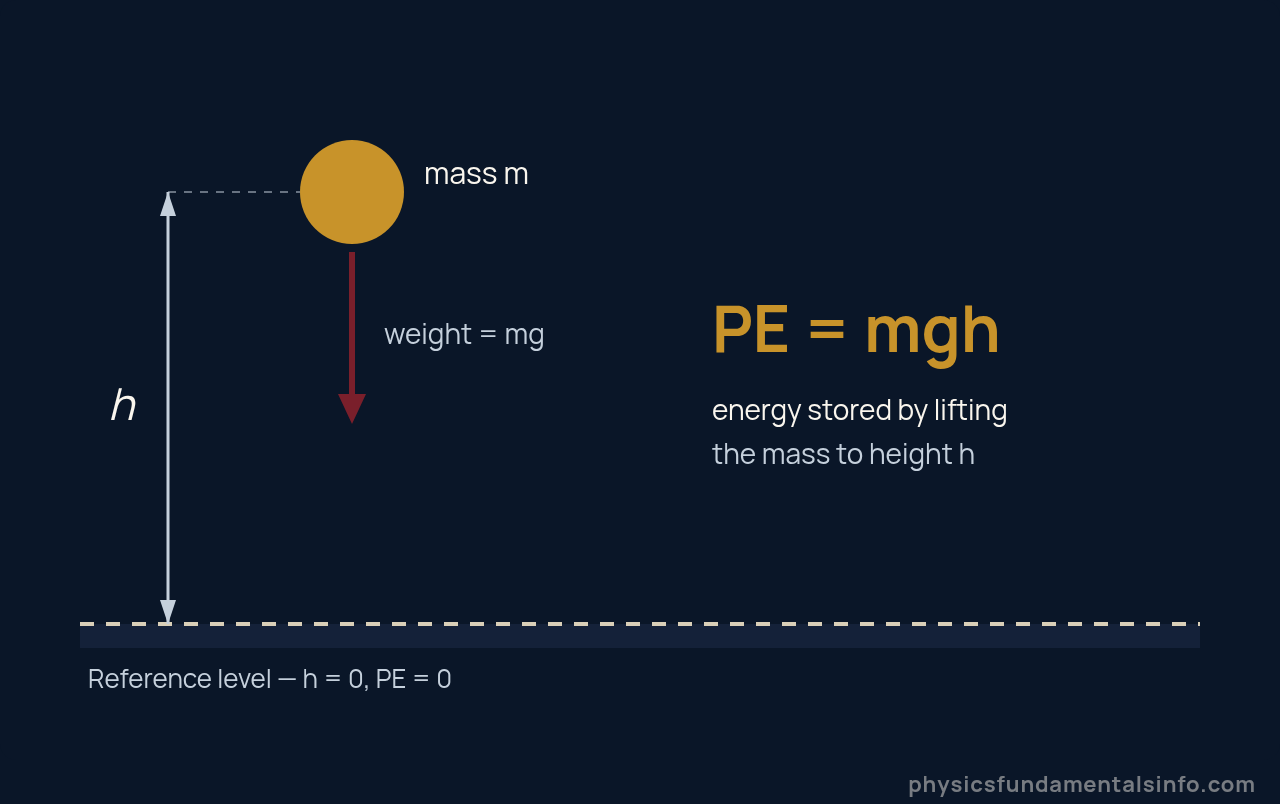
Lifting a mass m to height h above the reference level stores gravitational potential energy equal to mgh.
The Gravitational Potential Energy Formula (PE = mgh)
Near the Earth’s surface, gravitational potential energy is calculated with one compact equation:
Each symbol carries a specific meaning and a specific SI unit:
- PE — the gravitational potential energy, measured in joules (J).
- m — the object’s mass, in kilograms (kg).
- g — the gravitational field strength (the acceleration due to gravity), about 9.81 m/s2 near Earth’s surface. Its unit is metres per second squared (m/s2), the same as newtons per kilogram (N/kg).
- h — the height above your chosen reference level, in metres (m).
Multiply the three quantities and the answer arrives in joules. One joule is roughly the energy needed to lift a small apple (about 100 g) one metre. Newton’s second law is quietly hiding inside that g, because an object’s weight is simply mg.
The fuller picture: U = −GMm/r
PE = mgh is actually a close-up approximation. It works because g barely changes over the heights we meet in daily life. For large distances — satellites, planets, escape velocity — physicists reach for the general form:
- U — gravitational potential energy (J).
- G — the gravitational constant, 6.674 × 10⁻¹¹ N·m2/kg2.
- M and m — the two masses (kg).
- r — the distance between their centres (m).
Don’t let the minus sign alarm you — we’ll unpack it shortly. For anything from a dropped phone to a high-jumper, mgh is all you need.
How Gravitational Potential Energy Works
Where does PE = mgh come from? Lift an object steadily, with no change in speed, and the upward force you apply exactly balances its weight, mg.
The work done by that force is force × distance: mg × h. Energy is conserved, so the work you put in equals the energy now stored. That’s the entire derivation — PE = mgh.
Height is always relative
Here’s a point that trips people up. There is no absolute “zero” of height — you choose it. A book on a desk has one PE value measured from the desk, and a larger one measured from the floor below.
That sounds like a problem, but it isn’t. Physics only ever cares about changes in potential energy, and the change between two points is the same whatever reference you pick.
Why the path doesn’t matter
Gravity is a conservative force. That means the PE you gain depends only on the start and end heights — never on the route. Carry a crate straight up a ladder or wheel it up a long ramp; if it ends at the same height, the gravitational PE gained is identical.
In practice the ramp only feels easier because you spread the same energy over a longer push. You trade force for distance, not total work.
What the minus sign means
In the general form we set PE to zero infinitely far away and measure inward from there. Bringing a mass closer to a planet lets gravity do positive work, so the stored energy comes out negative. This “bound state” idea is explained clearly in HyperPhysics’ treatment of gravitational potential energy. Near the ground only differences matter, so PE = mgh stays reassuringly positive.
Drag the drop height in the lab above and watch the swap happen live: as the object falls, the potential-energy reading empties into the kinetic-energy reading while the total stays pinned in place.
Real-World Examples of Gravitational Potential Energy
Gravitational PE isn’t a textbook abstraction — it’s quietly running the world around you. Here are five places it shows up.
1. Water behind a hydroelectric dam
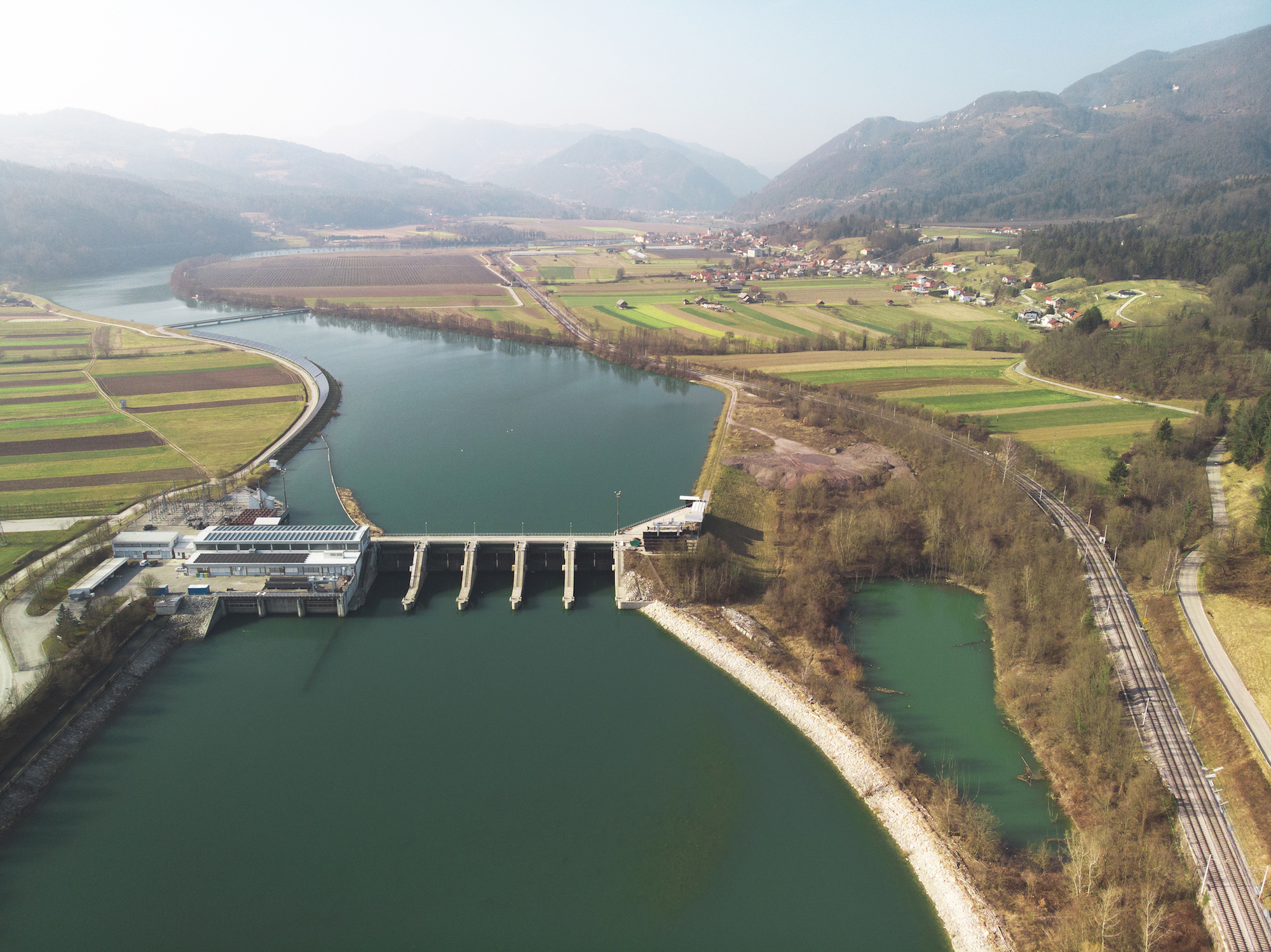
A reservoir is a giant battery of gravitational PE. Send the water down through turbines far below, and that stored energy becomes electricity for entire cities.
2. The first hill of a roller coaster
The slow, clanking climb does just one job: it loads the cars with gravitational PE. Every thrilling drop and loop afterwards is that energy being spent as speed.
3. A swinging pendulum
At the top of each swing a pendulum pauses, holding pure potential energy. It then trades that store during its simple harmonic motion — fastest at the bottom, where PE is lowest — before climbing and banking it again.
4. A pile driver or hammer
Raise a heavy mass, then let gravity turn its PE into one concentrated blow. The higher the lift, the harder the strike — which is exactly why you wind a hammer back and up before swinging.
5. Hiking, lifting, and climbing stairs
Every step you climb stores gravitational PE in your own body. It’s why coming back down feels effortless — gravity hands the energy straight back — and why a long climb leaves you breathless.
Gravitational Potential Energy vs Kinetic Energy
Potential and kinetic energy are partners. One is energy of position; the other is energy of motion — and a falling object constantly turns the first into the second.
| Property | Gravitational potential energy | Kinetic energy |
|---|---|---|
| Depends on | Height, mass and g | Speed and mass |
| Formula | PE = mgh | KE = ½mv2 |
| Source of the energy | Position in a gravitational field | Motion |
| SI unit | Joule (J) | Joule (J) |
| Scalar or vector? | Scalar | Scalar |
| When is it zero? | At the reference level (h = 0) | When the object is at rest |
| Everyday example | Water held high behind a dam | The same water rushing through the turbines |
The link between them is energy conservation. With no friction or air resistance, every joule of PE lost becomes a joule of kinetic energy gained, so the total never changes.
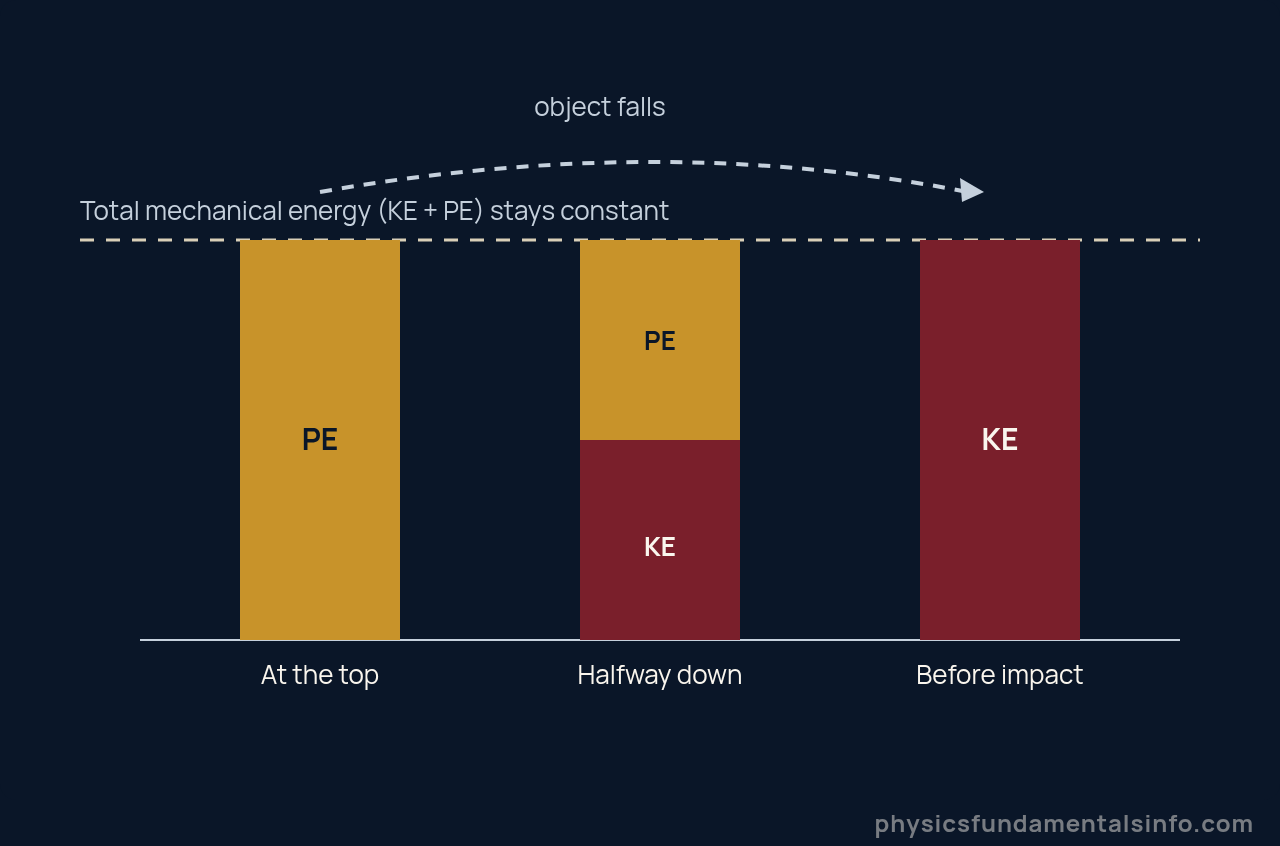
As the object falls, gravitational potential energy converts into kinetic energy while the total mechanical energy stays the same.
This is why a dropped ball speeds up smoothly: PE falls, KE rises, the total holds steady — until the ground stops it and the energy scatters as sound and heat.
Common Misconceptions About Gravitational Potential Energy
“Heavier objects always have more potential energy”
Not necessarily. PE depends on height just as much as mass. A 1 kg book on a high shelf can easily hold more gravitational PE than a 10 kg box sitting on the floor.
“Potential energy depends on the path you take”
It doesn’t. Because gravity is conservative, only the change in height counts. A winding mountain trail and a sheer cliff to the same summit store identical gravitational PE.
“PE = mgh works at any height”
Only near the surface. The formula assumes g is constant, which fails once you climb far enough that gravity noticeably weakens — for orbits and space travel you need the general −GMm/r form. The broader idea of gravitational energy covers both cases.
“An object at ground level has zero potential energy”
Only if you chose the ground as your reference. Pick the bottom of a well and that same object suddenly has positive PE. Zero is a choice, not a physical fact.
How Gravitational Potential Energy Relates to Work and Energy Conservation
Gravitational PE sits at the centre of a web of mechanics ideas. Tug any thread and the others move with it.
It is born from work done against gravity, and it is one member of the wider family of energy forms that can transform but never be destroyed.
Let an object fall and PE becomes kinetic energy. This PE–KE exchange is the engine behind both a swinging pendulum and a plunging roller coaster.
Add air resistance and the bookkeeping changes: some energy now leaks away as heat, which is why a real skydiver settles into a steady terminal velocity instead of falling ever faster.
The unifying rule is the conservation of mechanical energy: KE + PE stays constant whenever only gravity does work.
Worked Problems
Show Solution
Solution:
Step 1 — Use the formula: PE = mgh.
Step 2 — Substitute with units: PE = 2.0 kg × 9.81 m/s2 × 1.8 m.
Step 3 — Solve: PE = 35.3 J.
Answer: PE ≈ 35 J (2 s.f.)
Show Solution
Solution:
Step 1 — Rearrange PE = mgh for height: h = PE ÷ (mg).
Step 2 — Substitute: h = 24.5 J ÷ (0.50 kg × 9.81 m/s2) = 24.5 ÷ 4.905.
Step 3 — Solve: h = 4.99 m.
Answer: h ≈ 5.0 m
Show Solution
Solution:
Step 1 — Rearrange for mass: m = PE ÷ (gh).
Step 2 — Substitute: m = 588 J ÷ (9.81 m/s2 × 12 m) = 588 ÷ 117.7.
Step 3 — Solve: m = 5.0 kg.
Answer: m ≈ 5.0 kg
Show Solution
Solution:
Step 1 — Use the change in height: ΔPE = mg Δh, with Δh = 1 950 − 1 200 = 750 m.
Step 2 — Substitute: ΔPE = 65 kg × 9.81 m/s2 × 750 m.
Step 3 — Solve: ΔPE = 478 238 J.
Answer: ΔPE ≈ 4.8 × 10⁵ J (about 478 kJ)
Show Solution
Solution:
Step 1 — Apply energy conservation: all PE becomes KE, so mgh = ½mv2. The mass cancels.
Step 2 — Rearrange for speed: v = √(2gh) = √(2 × 9.81 m/s2 × 2.5 m).
Step 3 — Solve: v = √49.05 = 7.00 m/s.
Answer: v ≈ 7.0 m/s
Show Solution
Solution:
Step 1 — Conservation gives v = √(2g × drop), where the drop is the height already fallen.
Step 2a — At the bottom the drop is 40 m: v = √(2 × 9.81 × 40) = √784.8.
Step 3a — Solve: v = 28.0 m/s.
Step 2b — At 15 m the drop is 40 − 15 = 25 m: v = √(2 × 9.81 × 25) = √490.5.
Step 3b — Solve: v = 22.1 m/s.
Answer: (a) ≈ 28 m/s at the bottom; (b) ≈ 22 m/s at 15 m
Show Solution
Solution:
Step 1 — On the Moon: PE = mgh = 1.2 kg × 1.62 m/s2 × 3.0 m.
Step 2 — Solve: PE = 5.8 J.
Step 3 — On Earth (g = 9.81 m/s2): PE = 1.2 × 9.81 × 3.0 = 35.3 J — roughly six times larger.
Answer: ≈ 5.8 J on the Moon, about one-sixth of the ≈ 35 J on Earth
Show Solution
Solution:
Step 1 — Energy stored: PE = mgh = 2.0 × 106 kg × 9.81 m/s2 × 300 m.
Step 2 — Solve: PE = 5.89 × 10⁹ J (about 5.9 GJ).
Step 3 — Average power = energy ÷ time, with t = 4.0 h = 14 400 s: P = 5.886 × 10⁹ ÷ 14 400.
Answer: ≈ 5.9 × 10⁹ J stored; average power ≈ 4.1 × 10⁵ W (about 409 kW)