Moment of inertia is the rotational equivalent of mass: it measures how strongly an object resists a change to its spin about a chosen axis. It equals the sum of each mass element times the square of its distance from that axis, giving I = k m r squared for common shapes, in kilogram metres squared.
Hold a hammer by its handle and swing it. Now flip it round, grip the head, and swing again. Same hammer, same mass, same muscles — yet one swing feels sluggish and the other whips through the air.
Nothing about the hammer changed except where the heavy end sat relative to your wrist. That single observation is the whole of this topic: when things rotate, where the mass sits matters more than how much there is.
What Is Moment of Inertia?
Moment of inertia is a measure of how much an object resists being spun up or slowed down about a particular axis. Push a shopping trolley and its mass fights you; twist a heavy door and something else fights you — that something is its moment of inertia.
Mass tells you how stubborn an object is when you try to move it in a straight line. Moment of inertia tells you how stubborn it is when you try to turn it. The two are cousins, not twins.
The critical difference is distance. Every scrap of material in a rotating body sweeps out a circle, and the wider that circle, the faster that scrap has to travel for a given rate of spin. Material near the rim therefore costs far more effort to accelerate than material near the hub.
That cost does not grow in proportion to distance. It grows with the square of distance — move a bolt twice as far from the axis and it contributes four times as much.
Why the axis is part of the answer
Here is the point that trips up more students than any other: an object does not have a moment of inertia. It has one for each axis you might spin it about.
A metre rule spun about its middle and the same rule spun about its end are two completely different problems, with answers differing by a factor of four. Quote a moment of inertia without naming the axis and you have said almost nothing.
The Moment of Inertia Formula
For a single point mass, the definition is as simple as physics gets.
- I — moment of inertia, in kilogram metres squared (kg·m2)
- m — mass of the particle, in kilograms (kg)
- r — perpendicular distance from the particle to the axis, in metres (m)
Real objects are not points, so you chop them into countless tiny pieces and add up every piece’s contribution.
For a uniform shape that sum collapses into something far friendlier: a single number times the mass times a characteristic length squared.
- k — the shape factor, a pure number with no units, set entirely by the geometry and the axis
- m — total mass of the body, in kilograms (kg)
- r — the defining length: radius for round shapes, length for rods, in metres (m)
Everything difficult about this topic lives inside k. It runs from about 0.083 for a rod spun about its centre up to 1.0 for a hoop — a twelve-fold spread for the same mass. Once you have the right k, you can read the shape table below or check yourself against our Moment of Inertia Calculator, which handles the substitution and the units for you.
A quick sanity check worth remembering: k can never exceed 1 for a solid body rotating about an axis through it, because no part of the object sits further out than the defining radius.
Moment of Inertia Formulas for 9 Common Shapes
These nine cover almost everything a first-year course or A-level paper will throw at you. Read the axis column first — it decides which row you actually need.
| Shape | Axis | Formula | Shape factor k |
|---|---|---|---|
| Point mass | At distance r from the axis | I = m r2 | 1 |
| Thin hoop or ring | Central axis, perpendicular to the plane | I = m r2 | 1 |
| Thin-walled hollow cylinder | Central long axis | I = m r2 | 1 |
| Solid disc or solid cylinder | Central axis | I = m r2 / 2 | 0.5 |
| Thick-walled (annular) cylinder | Central axis | I = m (r12 + r22) / 2 | 0.5 to 1 |
| Solid sphere | Any diameter | I = 2 m r2 / 5 | 0.4 |
| Thin spherical shell | Any diameter | I = 2 m r2 / 3 | 0.667 |
| Thin rod (length L) | Through the centre, perpendicular to the rod | I = m L2 / 12 | 0.083 |
| Thin rod (length L) | Through one end, perpendicular to the rod | I = m L2 / 3 | 0.333 |
Two rows deserve a second look. The hoop and the solid disc share the same mass and the same radius, yet the hoop’s moment of inertia is exactly double — because a hoop keeps every gram out at the rim, while a disc buries most of its material close to the axis.
Two more worth knowing, though they appear less often: a solid disc spun about a diameter rather than its central axis gives I = m r2 / 4, and a rectangular plate spun about an axis through its centre and perpendicular to its face gives I = m (a2 + b2) / 12, where a and b are the side lengths.
How Moment of Inertia Works
Moment of inertia works by weighting every piece of mass according to the square of its distance from the axis, which is why mass sitting far out dominates the total. The reasoning behind that squared term is worth following once, because it explains everything else.
Picture a rigid body turning at angular velocity ω. A small piece of mass m sitting at distance r moves in a circle at speed v = ω r. Its kinetic energy is therefore m v2 / 2, which becomes m r2 ω2 / 2 once you substitute.
Now add up every piece. The ω2 factor is the same for all of them — a rigid body turns as one — so it comes outside the sum, leaving ω2 / 2 multiplied by the sum of all the m r2 terms.
That leftover sum is the moment of inertia. It appears not because someone invented it, but because it is exactly what falls out when you add up the kinetic energy of a spinning object.
- KE — rotational kinetic energy, in joules (J)
- I — moment of inertia about the spin axis, in kilogram metres squared (kg·m2)
- ω — angular velocity, in radians per second (rad/s)
Compare that with the straight-line version, KE = m v2 / 2, and the family resemblance is unmistakable. Swap mass for moment of inertia, swap speed for angular velocity, and the whole of linear mechanics reappears in rotational form.
Why the squared term changes everything
The squaring is not a mathematical detail — it is the reason flywheels, gymnasts and satellites behave the way they do. Doubling an object’s radius while keeping its mass fixed quadruples its moment of inertia.
Engineers exploit this ruthlessly. A flywheel designed to store energy puts its metal as far out as the material strength allows, because every extra centimetre of radius buys energy storage on the cheap.
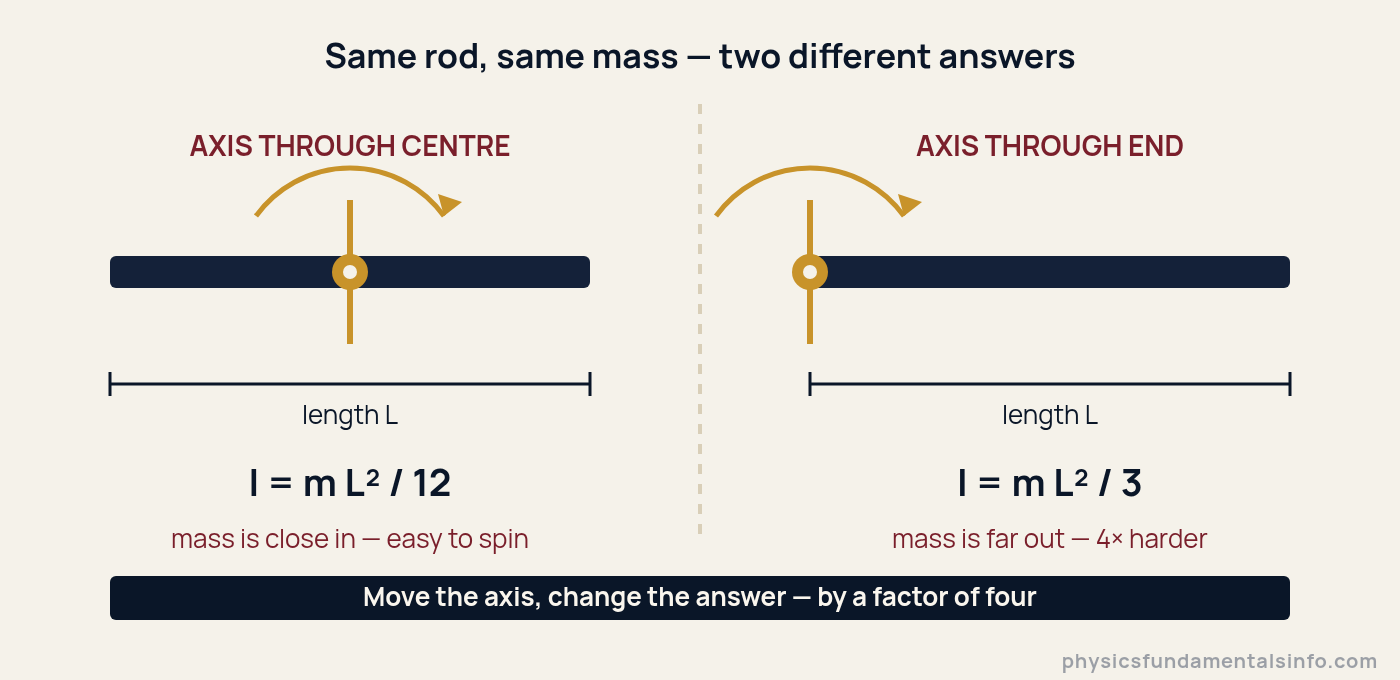
Moment of inertia of a thin rod depends entirely on where the axis sits.
The Parallel Axis Theorem
The parallel axis theorem lets you find the moment of inertia about any axis, provided you already know it about a parallel axis through the centre of mass. It is the single most useful shortcut in rotational mechanics.
- I — moment of inertia about the new, offset axis, in kg·m2
- I(cm) — moment of inertia about a parallel axis through the centre of mass, in kg·m2
- m — total mass, in kilograms (kg)
- d — perpendicular distance between the two parallel axes, in metres (m)
Test it on the rod. About its centre, I = m L2 / 12; shift the axis to the end, a distance d = L/2 away, and the theorem predicts m L2 / 12 + m L2 / 4, which is m L2 / 3. That is exactly the value in the table.
Notice that the correction term m d2 is always positive. The centre-of-mass axis is therefore always the easiest axis to spin about — every other parallel axis costs you more.
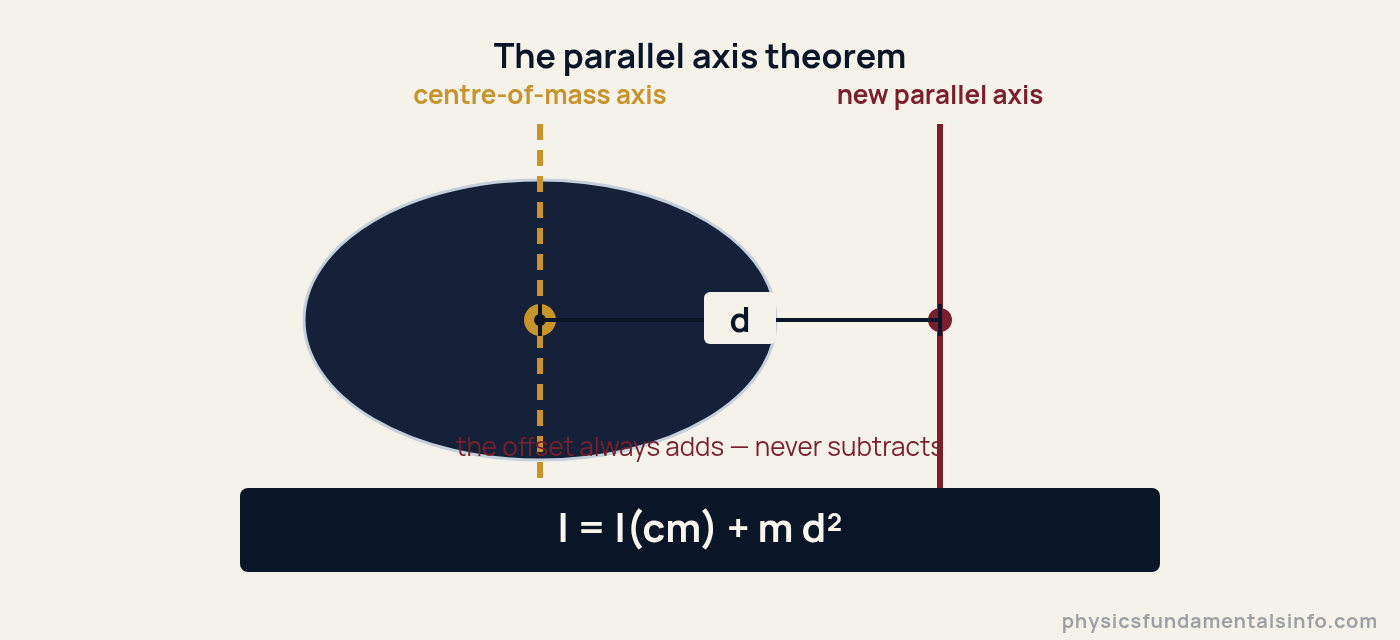
The parallel axis theorem shifts a known moment of inertia to any parallel axis.
One condition people forget
The theorem only works when your starting value is measured about an axis through the centre of mass. You cannot hop from the rod’s end-axis to some other axis in one step.
In practice, always travel back through the centre of mass. Go from the known axis to the centre, then out to the axis you actually want.
Real-World Examples of Moment of Inertia
Rotational inertia is not an exam abstraction — it is the reason several very different machines and bodies are built the way they are.
1. The spinning skater
A skater starts a spin with arms outstretched, then pulls them in and accelerates dramatically. No one pushes them. Angular momentum, the product of I and ω, stays constant, so cutting I roughly in half must roughly double ω.

2. Flywheels and engine crankshafts
A car engine delivers power in violent pulses, not a smooth stream. A heavy flywheel bolted to the crankshaft has a large moment of inertia, so it absorbs each pulse and releases it gradually — which is why the engine idles smoothly instead of shuddering.
3. Spacecraft that turn without fuel
The Hubble Space Telescope has no thrusters for routine pointing. Instead, four 45 kg reaction wheels sit near its centre of gravity; spinning one up forces the telescope to rotate the other way, conserving total angular momentum.
4. Tightrope walkers and their poles
The long pole is not for balance in the intuitive sense — it is a moment-of-inertia amplifier. By putting mass a long way from the walker’s centre line, it makes any unwanted rotation build up slowly enough to correct.
5. The rolling race
Release a solid sphere and a hoop together from the top of a ramp and the sphere always wins. Not sometimes — always, regardless of their masses or radii, which cancel out of the problem completely.
The reason is that a rolling object has to split the gravitational energy it gains between moving forwards and spinning. A hoop, with its k of 1, diverts half that energy into rotation; a solid sphere, with k of 0.4, spends only about 29 per cent and arrives faster.
Common Misconceptions About Moment of Inertia
Myth 1: an object has one moment of inertia
It has one for every axis. The 1.8 m, 3.0 kg rod in the worked problems below scores 0.81 kg·m2 about its centre and 3.24 kg·m2 about its end — the same object, four times the resistance.
Always name the axis before you quote a number. An answer without an axis is not wrong so much as incomplete.
Myth 2: heavier always means harder to spin
Mass matters, but placement can easily overwhelm it. A 5 kg hoop of radius 0.4 m has I = 0.80 kg·m2, while a 10 kg solid disc of radius 0.3 m has only 0.45 kg·m2 — double the mass, barely half the rotational resistance.
Myth 3: moment of inertia and moment of a force are the same thing
They share a word and nothing else. A moment of a force is a turning effect measured in newton metres; moment of inertia is a resistance to turning measured in kilogram metres squared.
The units alone should settle it. If your working produces N·m where you expected kg·m2, you have mixed the two up.
Myth 4: the parallel axis theorem works from any axis
It starts from the centre-of-mass axis and nowhere else. Applying it from an arbitrary axis is one of the most common ways to lose marks on a rotational dynamics question, and the error is invisible in the final answer — it just quietly comes out wrong.
How Moment of Inertia Relates to Torque, Energy and Angular Momentum
Moment of inertia is the bridge between the linear mechanics you already know and the rotational version. Every familiar equation has a twin.
| Quantity | Linear motion | Rotational motion |
|---|---|---|
| Resistance to change | mass, m (kg) | moment of inertia, I (kg·m2) |
| Newton’s second law | F = m a | τ = I α |
| Kinetic energy | KE = m v2 / 2 | KE = I ω2 / 2 |
| Momentum | p = m v | L = I ω |
The rotational form of Newton’s second law is the workhorse. Apply a torque τ to a body of moment of inertia I and it picks up angular acceleration α, exactly as a force produces linear acceleration.
Angular momentum L = I ω behaves just as linear momentum does, and it obeys its own conservation law. That is the principle running quietly behind the skater, the gyroscope and every satellite that turns itself without spending fuel.
Worked Problems
Show Solution
Solution:
Step 1: For a point mass, I = m r2.
Step 2: Substitute m = 0.50 kg and r = 1.2 m, so I = 0.50 × (1.2)2.
Step 3: (1.2)2 = 1.44 m2, so I = 0.50 × 1.44 = 0.72 kg·m2.
Answer: I = 0.72 kg·m2
Show Solution
Solution:
Step 1: For a solid disc about its central axis, I = m r2 / 2.
Step 2: Substitute m = 12 kg and r = 0.25 m, so I = 12 × (0.25)2 / 2.
Step 3: (0.25)2 = 0.0625 m2, giving I = 12 × 0.0625 / 2 = 0.75 / 2.
Answer: I = 0.375 kg·m2
Show Solution
Solution:
Step 1: For a thin hoop about its central axis, I = m r2, since all the mass sits at radius r.
Step 2: Substitute: I = 12 × (0.25)2 = 12 × 0.0625.
Step 3: I = 0.75 kg·m2. Comparing with the disc, 0.75 / 0.375 = 2.
Answer: I = 0.75 kg·m2, exactly twice the disc’s value
Show Solution
Solution:
Step 1: About the centre, I = m L2 / 12. About the end, I = m L2 / 3.
Step 2: L2 = (1.8)2 = 3.24 m2.
Step 3 (a): I = 3.0 × 3.24 / 12 = 9.72 / 12 = 0.81 kg·m2.
Step 4 (b): I = 3.0 × 3.24 / 3 = 9.72 / 3 = 3.24 kg·m2.
Answer: (a) 0.81 kg·m2 (b) 3.24 kg·m2 — a factor of 4
Show Solution
Solution:
Step 1: The parallel axis theorem gives I = I(cm) + m d2, with d = r = 0.30 m here.
Step 2: I(cm) = m r2 / 2 = 2.0 × (0.30)2 / 2 = 2.0 × 0.09 / 2 = 0.09 kg·m2.
Step 3: m d2 = 2.0 × 0.09 = 0.18 kg·m2.
Step 4: I = 0.09 + 0.18 = 0.27 kg·m2.
Answer: I = 0.27 kg·m2 (equal to 3 m r2 / 2)
Show Solution
Solution:
Step 1: Use the rotational form of Newton’s second law, τ = I α, so α = τ / I.
Step 2: I = m r2 / 2 = 5.0 × (0.20)2 / 2 = 5.0 × 0.04 / 2 = 0.10 kg·m2.
Step 3: α = 2.5 / 0.10.
Answer: α = 25 rad/s2
Show Solution
Solution:
Step 1: Convert to rad/s: ω = 1500 × 2π / 60.
Step 2: ω = 1500 × 0.10472 = 157.08 rad/s.
Step 3: KE = I ω2 / 2 = 0.375 × (157.08)2 / 2.
Step 4: (157.08)2 = 24674 rad2/s2, so KE = 0.375 × 24674 / 2 = 4626 J.
Answer: KE ≈ 4.63 kJ (about 4600 J)
Show Solution
Solution:
Step 1: Energy conservation gives m g h = m v2 / 2 + I ω2 / 2, with I = k m r2 and ω = v / r for rolling.
Step 2: Substituting, I ω2 / 2 = k m v2 / 2, so m g h = m v2 (1 + k) / 2. The mass m cancels, and r never appears.
Step 3: Rearranging, v = the square root of 2 g h / (1 + k).
Step 4 (sphere, k = 0.4): v = sqrt(2 × 9.81 × 1.5 / 1.4) = sqrt(21.02) = 4.58 m/s.
Step 5 (hoop, k = 1): v = sqrt(29.43 / 2) = sqrt(14.72) = 3.84 m/s.
Answer: sphere 4.58 m/s, hoop 3.84 m/s — independent of mass and radius
Frequently Asked Questions
What is moment of inertia in simple terms?
What is the SI unit of moment of inertia?
What is the formula for moment of inertia?
Does moment of inertia depend on mass or shape?
What is the difference between moment of inertia and moment of a force?
Why does a solid sphere roll down a slope faster than a hoop?
What is the parallel axis theorem?
Key Takeaways
- Moment of inertia is rotational mass: it measures resistance to a change in spin, in kg·m2.
- It always depends on the axis — the same object has many different values.
- Distance from the axis counts twice over, since the formula squares it.
- For uniform shapes, I = k m r2, with k running from 0.083 for a rod about its centre to 1 for a hoop.
- The parallel axis theorem, I = I(cm) + m d2, moves a known value to any parallel axis.
For a full university-level treatment, including video derivations of the rod, disc and sphere results, MIT OpenCourseWare’s Classical Mechanics rotational motion unit covers the same ground with calculus.