Moment of inertia (I = k m r²) measures how hard a body is to spin about a chosen axis. Two bodies of the same mass sit side by side below; change the shape, the size and the axis position and watch their I values pull apart while the mass stays locked together.
Moment of Inertia — Same Mass, Different I
Two bodies of identical mass spin about the same axis. Only the shape factor k and the axis position differ, so every change you see in I = k m r² comes from where the mass sits — never from how much of it there is.
What Is the Moment of Inertia Simulator?
The moment of inertia simulator is a free interactive physics lab that runs in your browser — nothing to install and no sign-up. Change mass, radius, shape and axis position, and watch I = k m r squared update live with the readouts. It reports Parallel axis term m d² as you drag the sliders.
| Control | Range | Step |
|---|---|---|
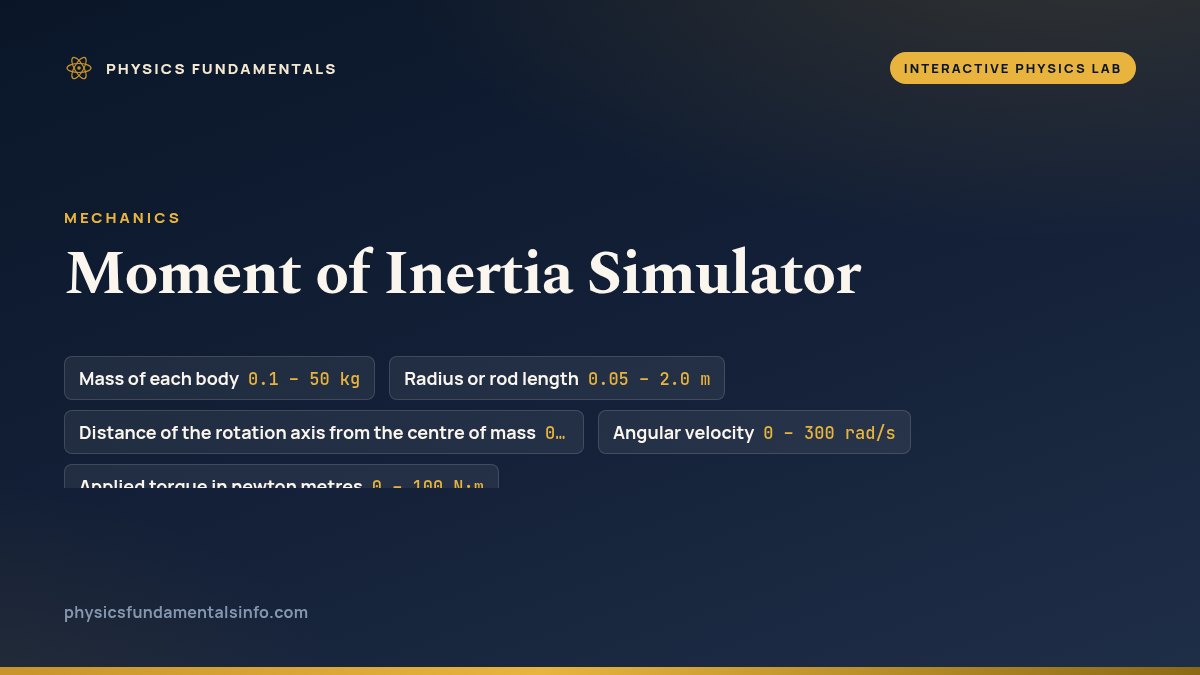
| Mass of each body | 0.1 – 50 kg | 0.1 |
| Radius or rod length | 0.05 – 2.0 m | 0.01 |
| Distance of the rotation axis from the centre of mass | 0 – 2.0 m | 0.01 |
| Angular velocity | 0 – 300 rad/s | 1 |
| Applied torque in newton metres | 0 – 100 N·m | 0.5 |
How to use the moment of inertia simulator
The mass and size sliders feed both bodies at once, and that is the whole design. Drag mass and each I reading grows in step — double the kilograms and you double the number. Drag the radius and something much more dramatic happens: the readings climb four times as fast, because the radius is squared in the formula and the mass is not. Set the radius to 0.5 m, note the values, then take it to 1.0 m: nothing has changed but how far the mass sits from the axis, and I has quadrupled. That single asymmetry is why a wide, light flywheel beats a compact, heavy one.
The axis offset slider is the parallel axis theorem made visible. Push it off zero and a dashed circle appears: the path each centre of mass now traces around the displaced axis. Watch the offset-term readout, which is exactly m d², and notice it only ever adds. No offset, in either direction, makes a body easier to spin than about its own centre of mass. To confirm it, put body A on Rod ctr and body B on Rod end, note B's reading at zero offset, then slide the offset to half the rod length — A climbs to precisely that number. For the turning force on the other side of the equation, the torque physics guide picks it up, and centre of mass explains where that zero-offset point is.
The shape buttons change one thing only: the factor k. Mass and size are held fixed, so any movement in I when you switch from hoop to disc is purely about where the material sits. Hoop to disc at identical mass and radius halves the number exactly, every time, because a hoop parks all its mass at full radius while a disc spreads it inward. The moment of inertia calculator runs the same arithmetic for a case you need to write down.
The misconception worth killing is that the heavier object is always the harder one to spin. It is not. Give the two bodies the same mass, put one on Hoop and the other on Sphere, and apply the same torque: the sphere accelerates two and a half times harder, despite weighing precisely the same. Mass tells you how hard something is to push in a straight line; for spinning, where that mass sits matters just as much.
Frequently asked questions
How do I use the simulator?
Pick a shape for each of the two bodies using the buttons, then drag the sliders. Mass and size are deliberately shared, so both bodies always weigh the same and measure the same across; only the shape factor k and the axis position can differ between them. Read the two I values at the top of the panel and the ratio line underneath, which tells you how many times larger body A is than body B. The energy and angular acceleration readouts then show what that difference actually costs you when you try to spin each one.
Why does doubling the radius quadruple I?
Because the radius is squared in I = k m r^2, while the mass is not. Every particle of the body contributes its mass multiplied by the square of its distance from the axis, so moving all of that mass twice as far out multiplies each contribution by four. Try it: set the radius to 0.5 m, note the value, then set it to 1.0 m. The mass readout has not moved and neither has k, but I is four times bigger. Reading it the other way, the radius you need for a target I is r = sqrt(I / (k m)).
What does the shape factor k mean?
k is a pure number that records how the mass is spread relative to the axis, with no units at all. A hoop keeps all its mass at the full radius, so it scores the maximum k = 1. A solid disc has mass spread all the way in to the centre, so k = 0.5. A solid sphere is more tightly packed still at k = 0.4, a thin shell sits at 2/3, and a rod is k = 1/12 about its centre or 1/3 about its end. Switch between shapes at fixed mass and radius and only k changes, which is exactly why the I readout moves.
Why does moving the axis only ever increase I?
The parallel axis theorem says I = Icm + m d^2, where d is the distance from the centre of mass. The added term is a mass multiplied by a squared distance, and a square is never negative, so the total can only rise or stay put. It stays put only when d = 0, which is the axis through the centre of mass. That makes the centre of mass the single easiest axis to spin any body about, and the simulator shows it: slide the offset in either direction and the value climbs, never falls.
What units does the simulator use?
Everything is SI. Mass is in kilograms, the radius or rod length and the axis offset are in metres, and moment of inertia comes out in kilogram metres squared. The spin rate is in radians per second rather than rpm, so the rotational energy readout lands in joules directly. Applied torque is in newton metres, which divided by I gives the angular acceleration in radians per second squared. Keeping every input in SI is what lets the readouts combine without any conversion factors.
References & formula source
- Young & Freedman — University Physics with Modern Physics, §9.4-9.5 (Rotation of Rigid Bodies), moment of inertia and the parallel-axis theorem.
- Halliday, Resnick & Walker — Fundamentals of Physics, Chapter 10 (Rotation), table of rotational inertias for common shapes.
- R. Nave — HyperPhysics, Georgia State University, "Moment of Inertia" / common shapes section.
- Further reading: Moment of inertia — Wikipedia