The moment of a force is the turning effect it produces about a pivot, calculated by multiplying the force by the perpendicular distance from the pivot to the force’s line of action (M = F × d). Moments are measured in newton-metres (N·m) and explain how levers, spanners and seesaws work.
Look at the nearest door. Its handle sits as far from the hinges as the designer could push it — and that choice is doing quiet physics for you every single day. Push near the hinges instead and the same door suddenly feels stubborn, as though it doubled in weight overnight.
Nothing about the door changed except where you pushed. That is the moment of a force at work — the turning effect that decides whether a push swings, tips or twists an object, or does nothing at all. One short formula explains the door, the spanner, the seesaw and the wheelbarrow.
What Is the Moment of a Force?
A force can do two jobs. It can shove an object bodily from one place to another, or — if the object is pinned at some point — it can rotate the object around that pin. The moment of a force measures the second job: how effective the force is at turning.
Formally, the moment of a force about a pivot is the product of the force and the perpendicular distance from the pivot to the force’s line of action. Double the force and the turning effect doubles. Double the distance and it doubles again — which is why long handles feel so effortless.
Every moment also carries a sense: it tries to turn the object either clockwise or anticlockwise about the pivot. Keeping track of that direction is half the skill in moments problems.
Three terms worth pinning down
- Pivot (or fulcrum): the fixed point the object can rotate about — the hinge, the nut, the knife-edge under a seesaw.
- Line of action: the straight line along which the force acts, extended as far as needed in both directions.
- Perpendicular distance (d): the shortest distance from the pivot to that line of action, measured at 90°. Its SI unit is the metre (m).
Notice what the definition does not say: it never mentions the distance to the point where you happen to grip. Only the perpendicular distance to the line of action counts — a detail examiners love.
The Moment of a Force Formula: M = F × d
Here is the whole calculation, and it is refreshingly small.
- M — moment of the force, in newton-metres (N·m)
- F — the applied force, in newtons (N)
- d — the perpendicular distance from the pivot to the force’s line of action, in metres (m)
A quick feel for the size: pressing 10 N on a handle 0.8 m from a door’s hinges produces a moment of 8 N·m. Matching that from 0.1 m away would take a full 80 N — an eight-fold penalty for pushing in the wrong place. You can check numbers like these instantly with our Torque Calculator.
When the force acts at an angle
Real pushes are rarely perfectly perpendicular. If the force meets the arm at an angle θ, only its perpendicular component does any turning, so the moment shrinks accordingly.
- L — distance along the object from the pivot to the point where the force is applied, in metres (m)
- θ — angle between the force and the object’s arm, in degrees or radians
At θ = 90°, sin θ = 1 and the formula collapses back to M = F × L: the whole length works for you. At θ = 0°, the line of action passes straight through the pivot, sin θ = 0, and no amount of force produces any turning at all.
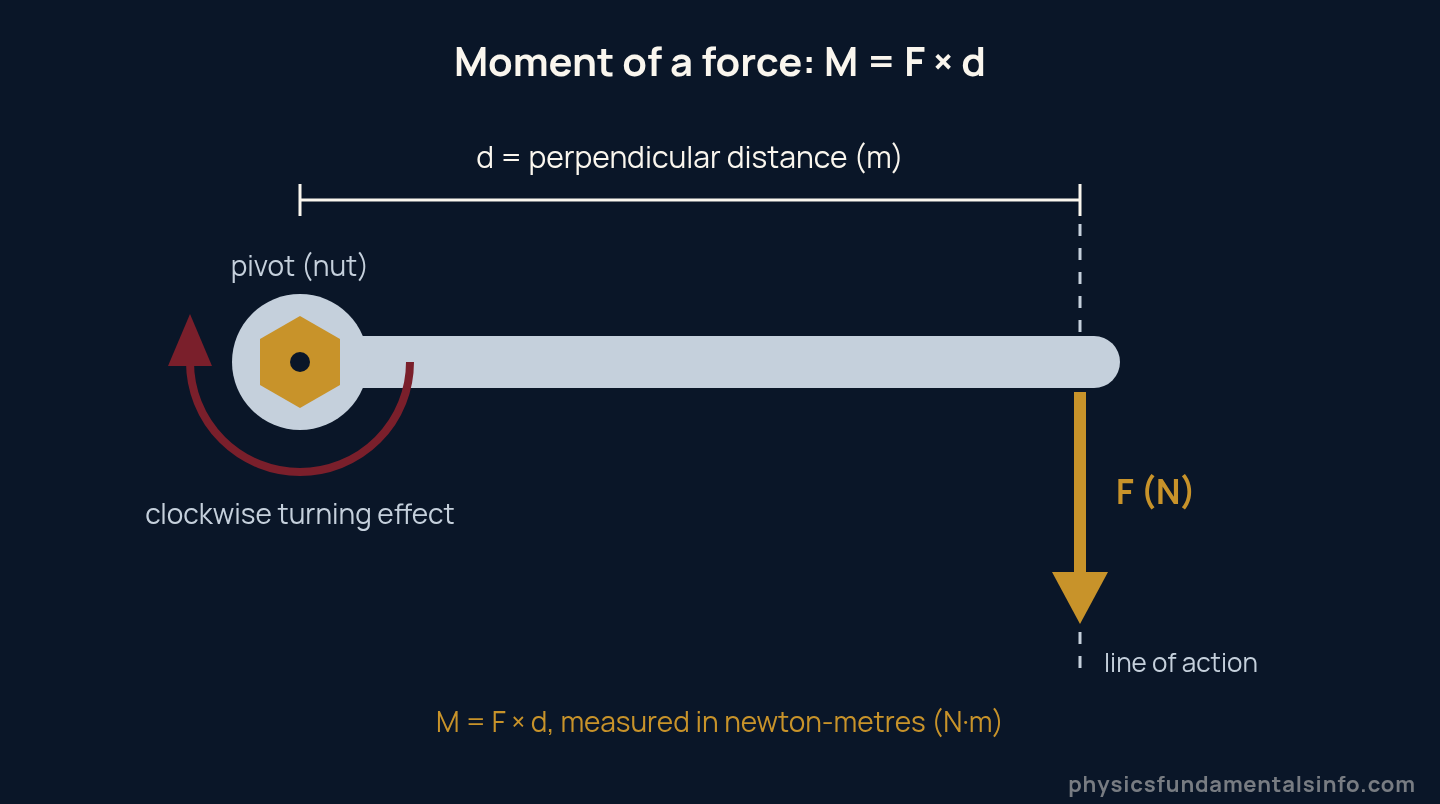
The moment of a force about the nut equals the force F multiplied by the perpendicular distance d from the pivot to F’s line of action.
How the Turning Effect Works
Why should distance multiply a force’s effect rather than merely add to it? Think about what a long lever obliges you to do: to swing a spanner through the same angle, a hand at the far end sweeps a much longer arc than a hand near the nut would.
Energy keeps honest books here. The work you supply equals force times the distance your hand moves, so a small force sweeping a long arc delivers just as much as a big force sweeping a short one. A lever never creates anything for free — it trades movement for force, the same honest accounting that runs through all of energy in physics.
How to calculate a moment in four steps
- Mark the pivot. Decide the point the object turns about — hinge, nut, knife-edge or support.
- Draw the line of action. Sketch the force as an arrow and extend its line in both directions.
- Measure the perpendicular distance. Find the shortest, 90° distance from the pivot to that line — not to the hand or the hook.
- Multiply and state the sense. Compute M = F × d in newton-metres and record clockwise or anticlockwise.
In practice, step 3 is where marks are won and lost. Sketch first, calculate second — a common student slip is grabbing the slant length of the object instead of the true perpendicular distance.
The fastest way to build intuition, though, is to move the numbers yourself. Drag the force and lever arm in the lab below and watch the turning effect respond.
The Principle of Moments: When Turning Effects Balance
Sit two children of different weights on a seesaw and something elegant happens: they can balance perfectly, provided the lighter one sits further out. Physics states the condition precisely.
The principle of moments: when an object is in equilibrium, the sum of the clockwise moments about any point equals the sum of the anticlockwise moments about that same point.
Try it with numbers. A 400 N child sitting 1.5 m left of the pivot supplies an anticlockwise moment of 400 × 1.5 = 600 N·m. A 600 N child at 1.0 m on the right supplies a clockwise 600 × 1.0 = 600 N·m — equal and opposite, so the beam rests level.
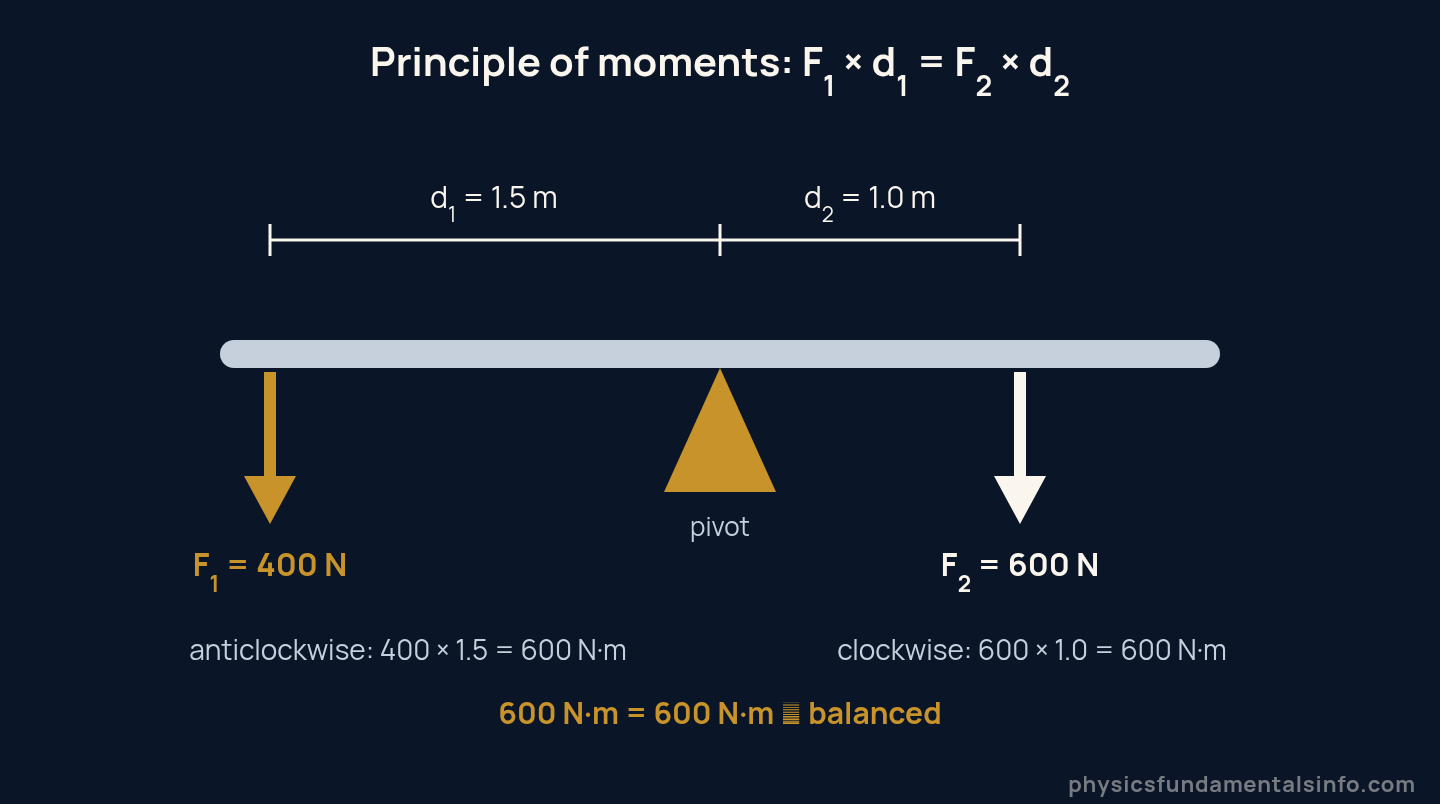
A balanced seesaw: the 400 N child’s anticlockwise moment exactly cancels the 600 N child’s clockwise moment about the pivot.
Two fine points keep the principle rigorous. Full equilibrium demands that the forces balance as well as the moments — a beam can be moment-balanced yet still accelerate bodily if the net force is not zero. And both totals must be taken about the same point; mixing pivots mid-calculation is a classic route to nonsense.
The balance-beam lab below lets you load each side and hunt for equilibrium yourself.
Real-World Examples of the Moment of a Force
Once you know the pattern — force, pivot, perpendicular distance — you start spotting the moment of a force everywhere. Five favourites follow.
Door handles. Handles sit at the far edge to maximise d, so a light pull creates a healthy moment about the hinges. Push beside the hinges and d collapses — and your leverage with it.
Spanners and breaker bars. A seized nut resists with a large frictional moment, so mechanics reach for a longer handle rather than a stronger arm — slipping a pipe over the spanner can double d and halve the force required. The friction gripping the threads has not changed; the leverage has.
Wheelbarrows. The load sits close to the wheel (the pivot) while your hands grip far from it. A 300 N load 0.5 m from the axle needs only 125 N of lift at handles 1.2 m out — the barrow multiplies your effective strength almost two-and-a-half times.
Seesaws and balance scales. Both run on the principle of moments. Traditional market scales compared an unknown weight against a standard mass slid along a graduated arm — changing distance instead of changing mass, exactly as M = F × d suggests.
Steering wheels and taps. Your two hands push in opposite directions on opposite sides — a couple, delivering a pure turning effect with no net shove. More on couples in a moment.
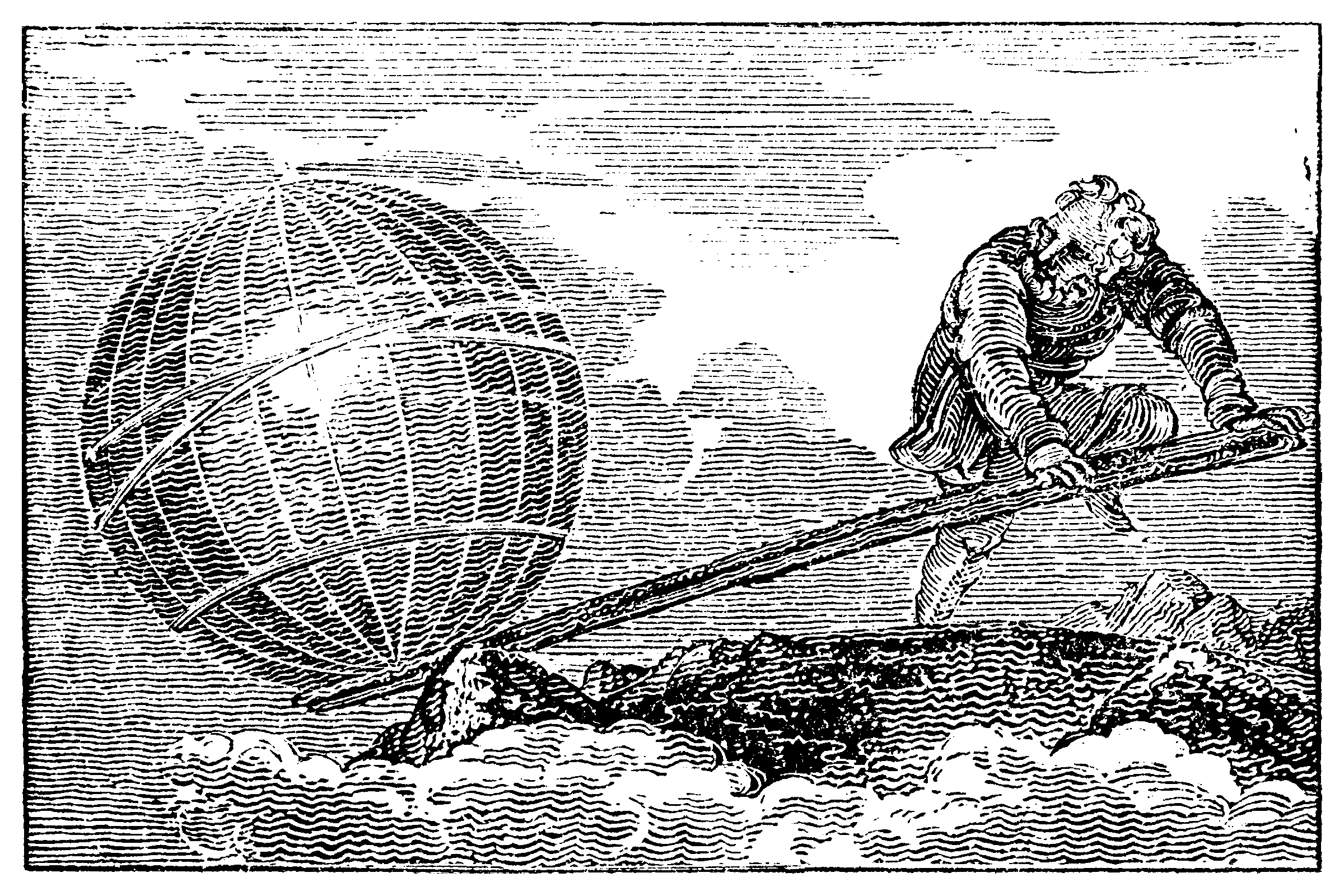
None of this is new. Archimedes grasped the lever’s power more than twenty-two centuries ago — “give me a place to stand,” runs the boast attributed to him, “and I shall move the Earth.”
Moment vs Torque vs Couple: What’s the Difference?
Students meet three closely related words and often suspect three different quantities. Relax — the physics is shared, and the vocabulary mostly signals context. Even NASA’s guide to torque and moments treats the two main terms as one quantity: force times perpendicular distance, whichever name you give it.
| Quantity | What it measures | Formula | SI unit | Where you’ll meet it |
|---|---|---|---|---|
| Moment of a force | Turning effect of one force about a chosen pivot | M = F × d | newton-metre (N·m) | Levers, beams, seesaws; GCSE and IGCSE statics |
| Torque | The same quantity — the preferred word for rotating machinery; in advanced work, the vector τ = r × F | τ = F × d | newton-metre (N·m) | Engines, motors, wheel nuts; A-level and beyond |
| Moment of a couple | Combined turning effect of two equal, opposite, parallel forces | M = F × s (s = separation of the two lines of action) | newton-metre (N·m) | Steering wheels, taps, wing nuts |
| Work done (for contrast) | Energy transferred when a force moves something along its own direction | W = F × distance moved | joule (J) | Energy calculations — never turning effects |
A couple hides one lovely subtlety: because its two forces cancel, it produces no net push at all — only rotation — and its moment works out the same about every point you choose. That is why a steering wheel turns the column without yanking it sideways.
Common Misconceptions About Moments
“Any distance will do”
The single most expensive error in this topic. The d in M = F × d is the perpendicular distance from the pivot to the force’s line of action — not the distance to wherever the force happens to touch the object. If the force is angled, drop a true 90° perpendicular or use M = F × L × sin θ; anything else quietly inflates your answer.
“Newton-metres are just joules in disguise”
Multiply newtons by metres and you get N·m either way, so the confusion is understandable — but the two quantities are genuinely different. Work done in physics uses distance moved along the force’s direction; a moment uses distance measured across it, at 90°. The SI system deliberately keeps the names apart: NIST’s guide to the SI specifies the newton-metre, never the joule, as the unit of moment of force.
“The bigger force always wins”
Not on a lever it doesn’t. A 400 N child at 1.5 m calmly balances a 600 N child at 1.0 m, because 600 N·m meets 600 N·m. Moments reward the product, not the force alone — which is precisely what makes levers useful.
“No rotation means no moments”
A moment is a tendency to rotate, not rotation itself. A shelf bracket, a parked seesaw and a crane holding its load steady are all saturated with moments — the moments simply cancel. Engineers spend entire careers making sure they keep cancelling.
How Moments Connect to Other Physics Concepts
Moments sit at a crossroads of ideas you may already know. Each connection makes both topics easier.
Forces and Newton’s laws. A moment is what a force does when geometry pins the object down. Everything you know about pushes and pulls from Newton’s laws of motion still applies; the moment simply reports their turning consequence.
Rotation has its own second law. Just as Newton’s second law links force to acceleration through F = ma, a net moment links to angular acceleration through τ = Iα, where I is the body’s moment of inertia. Same logic, rotated.
Circular motion. Once a net moment has set something spinning, keeping each part of it on its circular path becomes a job for centripetal force. Moments start the rotation; centripetal forces maintain the circling.
Centre of gravity. For moment purposes, the weight of a uniform beam behaves as a single force acting at its midpoint. That one idea unlocks every “heavy beam” question you will meet — including two in the set below.
Worked Problems
Work through these in order — each adds a single new idea. Cover the solutions and attempt them first; every answer carries full units and sensible significant figures.
Show Solution
Solution:
Step 1: The turning effect of a single force is M = F × d, where d is the perpendicular distance from the pivot to the force’s line of action.
Step 2: Substitute with units: M = 50 N × 0.30 m.
Step 3: M = 15.0 N·m, in the direction the mechanic pushes.
Answer: M = 15 N·m (2 s.f.)
Show Solution
Solution:
Step 1: Equal turning effects means equal moments about the hinge: F1 × d1 = F2 × d2.
Step 2: Moment at the handle: M = 12 N × 0.75 m = 9.0 N·m.
Step 3: Force needed near the hinge: F2 = M ÷ d2 = 9.0 N·m ÷ 0.05 m = 180 N.
Answer: F2 = 180 N — fifteen times the original force (2 s.f.)
Show Solution
Solution:
Step 1: Balance requires anticlockwise moment = clockwise moment (the principle of moments): W1 × d1 = W2 × d2.
Step 2: Weights: W1 = 40 kg × 9.81 m/s2 = 392.4 N and W2 = 60 kg × 9.81 m/s2 = 588.6 N.
Step 3: d2 = (392.4 N × 1.5 m) ÷ 588.6 N = 588.6 N·m ÷ 588.6 N = 1.0 m. Notice g cancels: 40 × 1.5 = 60 × d2 gives the same answer directly.
Answer: d2 = 1.0 m from the pivot (2 s.f.)
Show Solution
Solution:
Step 1: Take moments about the wheel axle (the pivot). At the point of lifting: F × 1.20 m = 300 N × 0.50 m.
Step 2: F = (300 N × 0.50 m) ÷ 1.20 m = 150 N·m ÷ 1.20 m.
Step 3: F = 125 N.
Answer: F = 125 N (3 s.f.) — the barrow lets 125 N raise a 300 N load
Show Solution
Solution:
Step 1: A uniform plank’s weight acts at its centre, 1.0 m from the hinge. Take moments about the hinge.
Step 2: For equilibrium: F × 2.0 m = 120 N × 1.0 m.
Step 3: F = 120 N·m ÷ 2.0 m = 60 N.
Answer: F = 60 N (2 s.f.)
Show Solution
Solution:
Step 1: Only the perpendicular component of the force turns the crank: M = F × L × sin θ.
Step 2: M = 80 N × 0.25 m × sin 60° = 80 N × 0.25 m × 0.8660.
Step 3: M = 17.32 N·m.
Answer: M ≈ 17.3 N·m (3 s.f.)
Show Solution
Solution:
Step 1: A couple’s moment is one force multiplied by the perpendicular separation of the two lines of action: M = F × s.
Step 2: The tangential forces act on opposite sides of the rim, so s equals the wheel’s diameter: M = 15 N × 0.36 m.
Step 3: M = 5.4 N·m — and a couple’s moment is the same about every point.
Answer: M = 5.4 N·m (2 s.f.)
Show Solution
Solution:
Step 1: Take moments about A to eliminate its unknown reaction. Clockwise: (200 N × 2.0 m) + (500 N × 1.0 m). Anticlockwise: R_B × 4.0 m.
Step 2: R_B × 4.0 m = 400 N·m + 500 N·m = 900 N·m, so R_B = 900 N·m ÷ 4.0 m = 225 N.
Step 3: Vertical forces must also balance: R_A + R_B = 200 N + 500 N = 700 N, so R_A = 700 N − 225 N = 475 N.
Answer: R_A = 475 N and R_B = 225 N (3 s.f.)