Torque in physics is the turning effect of a force about a pivot or axis, calculated as τ = rF sinθ — the force (F) multiplied by its distance from the axis (r) and the sine of the angle (θ) between them. Measured in newton-metres (N·m), torque is larger when the force is applied farther out and closer to a right angle.
Reach for a stubborn bolt with a short spanner and you strain at it; swap in a longer one and it suddenly gives way. Same bolt, same hand, the same muscles — so what changed? You changed the torque.
Torque is the physics of turning things, and it is quietly everywhere: in the door you just pushed open, the pedals you press on a bike, the steering wheel in your hands, even the curve a footballer bends into a free kick. Grasp it and you see why where you push matters just as much as how hard.
What Is Torque?
Picture a see-saw. A small child on the far end can lift a much heavier adult sitting close to the middle. Nobody got stronger — the child simply sits farther from the pivot. That is torque in one image: the turning power of a force depends on distance, not just strength.
More precisely, torque is the measure of how effectively a force twists an object around an axis of rotation. It is also called the moment of a force, or simply the moment. A force makes things move in a straight line; a torque makes them rotate.
Three things decide how much torque you get: how hard you push (the force), how far from the pivot you push (the distance), and the direction of your push (the angle). Change any one of them and the turning effect changes too.
That last ingredient — the angle — is the part students most often overlook. A push aimed straight at the hinge of a door does nothing at all, no matter how strong it is. Only the part of the force that acts across the lever does any turning.
The Torque Formula: τ = rF sinθ
The size of a torque is captured by a single, elegant equation:
Each symbol has a precise meaning and a fixed SI unit:
- τ (Greek letter tau) — the torque, measured in newton-metres (N·m).
- r — the distance from the axis of rotation to the point where the force is applied, in metres (m).
- F — the magnitude of the applied force, in newtons (N).
- θ (theta) — the angle between the line of r and the line of the force F, measured in degrees or radians.
The term F sinθ is the secret to the whole formula. It is the slice of the force that points perpendicular to the lever — the only slice that actually turns anything. So you can also write the torque two equivalent ways:
The first grouping, r × F⊥, multiplies the distance by the perpendicular force. The second, r⊥ × F, multiplies the full force by the lever arm (also called the moment arm) — the perpendicular distance from the axis to the line along which the force acts. Both give the same answer, and both are widely used.
Want the number without the algebra? You can work any case out instantly with our Torque Calculator, which solves for the torque, the force, the lever arm or the angle.
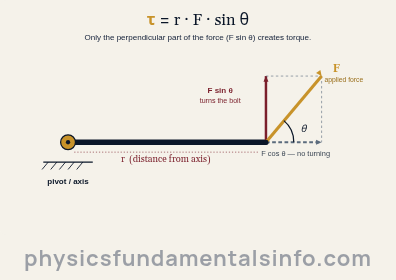
A force applied to a lever splits into a turning part (F sin θ) and a useless radial part (F cos θ). Torque uses only the turning part.
How Torque Works: Why the Angle Matters
Why does the formula carry a sinθ at all? Resolve the applied force into two parts and the mystery dissolves.
Splitting the force in two
Any force on a lever can be broken into a piece that points along the arm and a piece that points across it. The along-the-arm piece, F cosθ, simply pulls or pushes toward the axis — it stretches the lever, but it cannot spin it. The across-the-arm piece, F sinθ, is the part that swings the lever round.
So torque only ever counts the perpendicular part of the force. That is exactly what τ = rF sinθ says. The Georgia State HyperPhysics resource sets out the same lever-arm reasoning in detail.
The angle’s grip on the result
Because sinθ runs from 0 up to 1 and back to 0, the angle has total control over the outcome. Push at 90° and you get every last newton-metre the force can deliver. Push at a shallow angle and you waste most of it. Push dead along the arm and you get nothing.
| Angle θ (arm to force) | sin θ | Torque (% of max) | What it means |
|---|---|---|---|
| 0° | 0.00 | 0 % | Push straight along the arm — no turning at all |
| 30° | 0.50 | 50 % | Half the maximum turning effect |
| 45° | 0.71 | 71 % | A useful diagonal push |
| 60° | 0.87 | 87 % | Nearly at full strength |
| 90° | 1.00 | 100 % | Force at right angles — maximum torque |
| 180° | 0.00 | 0 % | Push back along the arm — no turning |
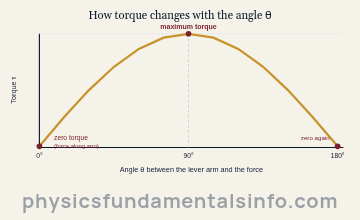
Torque traces a sine curve as the angle changes — peaking at 90° and vanishing when the force lines up with the arm.
Which way does it turn?
Torque has a direction as well as a size. By convention, a torque that would spin an object anticlockwise is taken as positive, and a clockwise one as negative. In three dimensions the direction is found with the right-hand rule: curl the fingers of your right hand in the direction of the turn and your thumb points along the torque vector.
Torque and rotation: the rotational Newton’s second law
Just as a net force produces acceleration, a net torque produces angular acceleration. The rotational version of Newton’s second law is:
Here I is the moment of inertia (an object’s resistance to being spun, the rotational cousin of mass) and α is the angular acceleration in rad/s2. If the torques cancel so that the net torque is zero, there is no angular acceleration — the object stays still or keeps spinning steadily. That balanced state, Στ = 0, is the condition for rotational equilibrium that keeps a see-saw level and a ladder from swinging out.
Torque Physics in the Real World
Once you start looking for torque, it shows up in almost every machine and many everyday actions. Here are five clear ones.

1. Loosening a bolt with a spanner
This is the textbook case. A longer spanner puts your hand farther from the bolt — a bigger r — so the same effort delivers more torque. Mechanics keep a breaker bar precisely for the seized bolts a short wrench can’t shift.
2. Opening a door
Handles live on the edge of a door, as far from the hinges as possible, to maximise r. Try pushing close to the hinge and the door barely budges. Push toward the hinge and it doesn’t move at all — that push has θ = 0°.
3. A balanced see-saw
A see-saw is rotational equilibrium you can sit on. A lighter person on the long end balances a heavier one near the middle because torque, not weight alone, has to match on both sides.

4. Bicycle pedals and gears
Pressing a pedal applies a force at the end of the crank arm, twisting the chainring. Standing up on the pedals pushes harder; a longer crank pushes farther out. Gears then trade this torque against speed at the back wheel.
5. Aircraft control and engine “torque”
Pilots balance the turning effects of the wings and tail to keep a plane trimmed in flight — NASA’s Glenn Research Center guide shows how the Wright brothers used exactly this. A car’s quoted engine torque is the same idea: the twisting force the crankshaft can deliver, which is what you feel as pulling power.
Common Misconceptions About Torque
Torque trips up a lot of learners, almost always in the same few ways. Clear these up and the topic becomes much simpler.
Misconception 1: “Torque is just another word for force”
It isn’t. Force is a straight push or pull; torque is the rotational effect that force creates. The very same force can produce a huge torque, a tiny one, or none — it all depends on where and at what angle it acts.
Misconception 2: “Torque is measured in joules”
A newton-metre and a joule share the same base units, which tempts people to swap them. But torque is never written in joules. A joule measures energy; torque measures the turning effect of a force, a different physical idea — the link between forces, distance and energy is set out in our guide to work done in physics.
Misconception 3: “More force always means more torque”
Not necessarily. Apply the force right at the pivot (r = 0) and the torque is zero however hard you push. Apply it straight along the arm (θ = 0°) and again you get nothing, because sinθ = 0. Placement beats brute force.
Misconception 4: “θ is the angle to the ground”
A frequent slip in exams. In τ = rF sinθ, the angle θ is measured between the lever arm (the line from the pivot to where the force acts) and the force itself — not between the force and the horizontal. Read the geometry of the problem, not just the picture’s orientation.
How Torque Relates to Force, Inertia and Momentum
Torque doesn’t sit alone. It is the rotational twin of the straight-line mechanics you already know, and the parallels run deep.
Where a force obeys Newton’s second law as F = ma, a torque obeys τ = Iα. In fact, every one of Newton’s laws of motion has a rotational version, with torque playing the role of force and moment of inertia the role of mass.
The same partnership shows up in momentum. When the net torque on a system is zero, its angular momentum is conserved — the spinning analogue of how linear momentum is conserved without a net force, explained in our piece on the conservation of momentum. It is why a spinning skater speeds up by pulling their arms in.
Torque also underpins circular motion, where a turning effect can change how fast something orbits a centre, connecting it to centripetal force. The table below lines up the two worlds side by side.
| Idea | Straight-line motion | Turning (rotational) motion |
|---|---|---|
| Cause of motion | Force, F (N) | Torque, τ = rF sinθ (N·m) |
| Resistance to change | Mass, m (kg) | Moment of inertia, I (kg·m2) |
| How fast it changes | Acceleration, a (m/s2) | Angular acceleration, α (rad/s2) |
| Newton’s second law | F = ma | τ = Iα |
| “Quantity of motion” | Momentum, p = mv | Angular momentum, L = Iω |
| Work done | W = Fd | W = τθ |
Worked Problems
Show Solution
Solution:
Step 1: Use the torque formula, τ = rF sinθ.
Step 2: Substitute with units — r = 0.30 m, F = 40 N, θ = 90° so sinθ = 1: τ = (0.30 m)(40 N)(1).
Step 3: Solve: τ = 12 N·m.
Answer: τ = 12 N·m
Show Solution
Solution:
Step 1: τ = rF sinθ.
Step 2: Substitute — sin 30° = 0.50: τ = (0.30 m)(40 N)(0.50).
Step 3: Solve: τ = 6.0 N·m.
Answer: τ = 6.0 N·m — exactly half the perpendicular case, because the angle has cut the useful force in half.
Show Solution
Solution:
Step 1: τ = rF sinθ, with θ = 90° so sinθ = 1.
Step 2 (a): τ = (0.90 m)(25 N)(1) = 22.5 N·m.
Step 3 (b): τ = (0.45 m)(25 N)(1) = 11.25 N·m.
Answer: (a) 22.5 N·m, (b) 11.3 N·m — halving the distance halves the torque.
Show Solution
Solution:
Step 1: Rearrange the formula for force — F = τ / (r sinθ).
Step 2: Substitute — θ = 90°, sinθ = 1: F = 18 N·m / [(0.24 m)(1)].
Step 3: Solve: F = 75 N.
Answer: F = 75 N — note a 0.48 m wrench would need only 37.5 N, which is why breaker bars exist.
Show Solution
Solution:
Step 1: Rearrange for the angle — sinθ = τ / (rF).
Step 2: Substitute: sinθ = 10 N·m / [(0.40 m)(50 N)] = 10 / 20 = 0.50.
Step 3: Solve: θ = sin−1(0.50) = 30°.
Answer: θ = 30° (an angle of 150° gives the same torque magnitude).
Show Solution
Solution:
Step 1: For balance, the anticlockwise and clockwise torques are equal — F1r1 = F2r2 (both forces vertical, sinθ = 1).
Step 2: Substitute: (300 N)(1.5 m) = (450 N)(r2) → 450 N·m = (450 N)(r2).
Step 3: Solve: r2 = 450 / 450 = 1.0 m.
Answer: r2 = 1.0 m — the heavier child sits closer, so their shorter lever arm balances the lighter child’s longer one.
Show Solution
Solution:
Step 1: Use the rotational form of Newton’s second law — τ_net = Iα, so α = τ_net / I.
Step 2: Substitute: α = 10 N·m / 2.0 kg·m2.
Step 3: Solve: α = 5.0 rad/s2.
Answer: α = 5.0 rad/s2