Center of mass is the point where a system’s whole mass can be treated as concentrated: the mass-weighted average of every particle’s position, found by summing each mass times its position and dividing by the total mass. In uniform gravity it coincides with the center of gravity, but the two are conceptually different.
Toss a hammer across a room and watch it tumble. Every part of it seems to fly on its own wild path — head over handle, spinning end over end. Yet one invisible point drifts through the air in a smooth, boring arc, as calm as a gently thrown ball.
That point is the center of mass. Divers rotate around it, dancers leap around it, and the Moon and Earth swing around it. Pin it down and a messy, spinning object suddenly obeys one clean rule — which is exactly why physicists reach for it first.
What Is Center of Mass?
The center of mass is the average position of all the mass in a system, weighted so that heavier parts count for more. It is the single balance point that stands in for the whole object when you care about how it moves.
Think of a mobile hanging over a cot. Slide a heavy shape outward and the balance point shifts toward it; add a feather-light one and barely anything changes. The center of mass leans toward mass, always.
Mass-weighted, not just the middle
Here is the key idea students often miss: the center of mass is not simply the geometric middle. It is an average of positions, but each position is weighted by how much mass sits there. Put more mass on one side and the average slides that way.
Two children of equal weight on a see-saw balance at the centre. Swap one for a heavier friend and the pivot must move toward the heavier child. Same physics, different weighting.
Center of mass and center of gravity
In everyday gravity these two points sit in the same place, so people use the terms interchangeably. Strictly, though, they answer different questions: the center of mass depends only on how mass is spread out, while the center of gravity also depends on the gravitational field. Near Earth’s surface, where gravity is effectively uniform, they coincide exactly.
The Center of Mass Formula
For a set of point masses along a line, the center of mass is the sum of each mass times its position, divided by the total mass.
Written compactly with the summation sign Σ (meaning “add up over every particle”), the same relation is:
Real objects live in three dimensions, so the position becomes a vector r and you compute each axis the same way:
Every symbol, with its SI unit:
- xcm (or rcm) — position of the center of mass, in metres (m)
- mi — mass of the i-th particle, in kilograms (kg)
- xi (or ri) — position of that particle, in metres (m)
- M = Σ mi — total mass of the whole system, in kilograms (kg)
- Σ — instruction to add the quantity over every particle in the system
For a solid body the sum becomes an integral over tiny mass elements dm, written rcm = (1/M) ∫ r dm — but the recipe is identical: weight each bit of mass by where it is, then average.
The arithmetic is quick for two masses and tedious for many, so you can also skip it and drop your values straight into our Center of Mass Calculator, which applies the mass weighting and returns the coordinates for you.
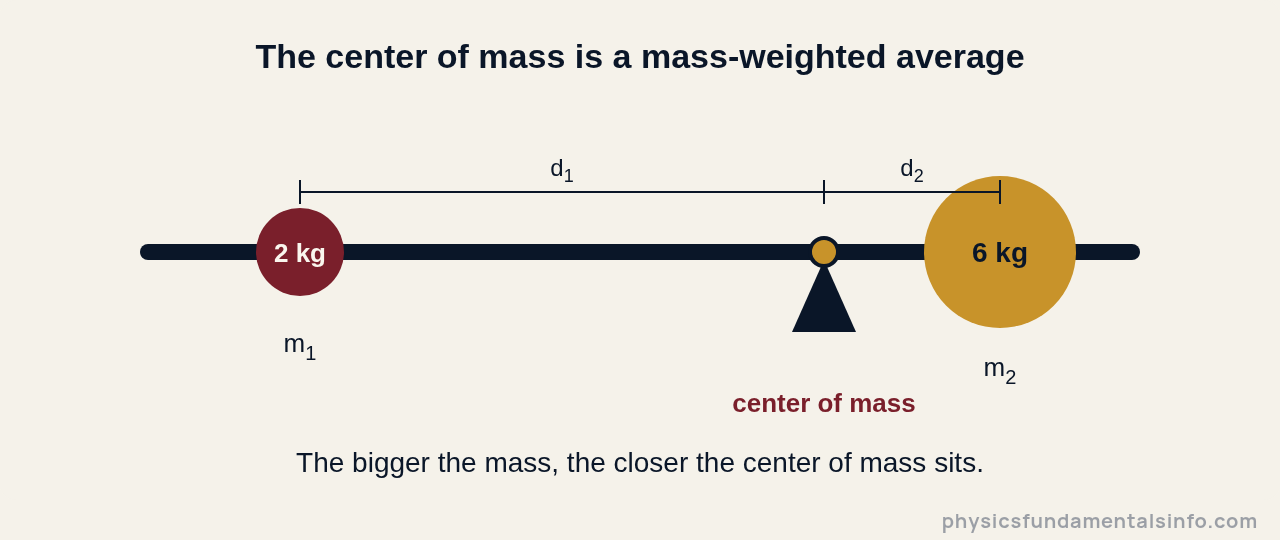
The center of mass of two masses obeys m1d1 = m2d2, so it always lands closer to the heavier mass.
How to Find the Center of Mass
To find the center of mass, multiply each mass by its position, add the products, and divide by the total mass — then repeat for every axis you need. That single procedure handles everything from two blocks on a track to a whole galaxy.
The five-step method
- Choose an origin and axis. Any point works; a clever choice (one mass at zero) kills half the arithmetic.
- List each mass and its position along that axis.
- Form Σ mixi — multiply, then add.
- Divide by the total mass M = Σ mi.
- Repeat for y (and z) if the problem is two- or three-dimensional.
Notice that the answer never depends on where you put the origin — shift it, and every coordinate shifts by the same amount. The center of mass is a real physical point, not an artefact of your axes.
Shortcut: let symmetry do the work
For a uniform, symmetric object, the center of mass sits at the geometric centre — no calculation required. A uniform rod balances at its midpoint; a uniform disc balances at its hub; a uniform sphere balances dead centre.
Spot the symmetry first. It turns a scary integral into a one-line answer.
Composite shapes and the subtraction trick
Awkward objects yield to a simple move: split them into easy pieces, treat each piece as a single mass sitting at its own center of mass, then average those. An L-bracket becomes two rectangles; a hammer becomes a rod plus a block.
Got a hole? Treat the missing material as negative mass. Compute the solid shape, subtract the cut-out weighted at its own centre, and the center of mass shifts away from the gap. It is the same formula, run in reverse.
Real-World Examples of Center of Mass
Real examples of center of mass run from a wobbling spanner to the Earth–Moon system pivoting around a point buried inside our planet. Once you look for it, it is everywhere.
The high jumper who beats their own body
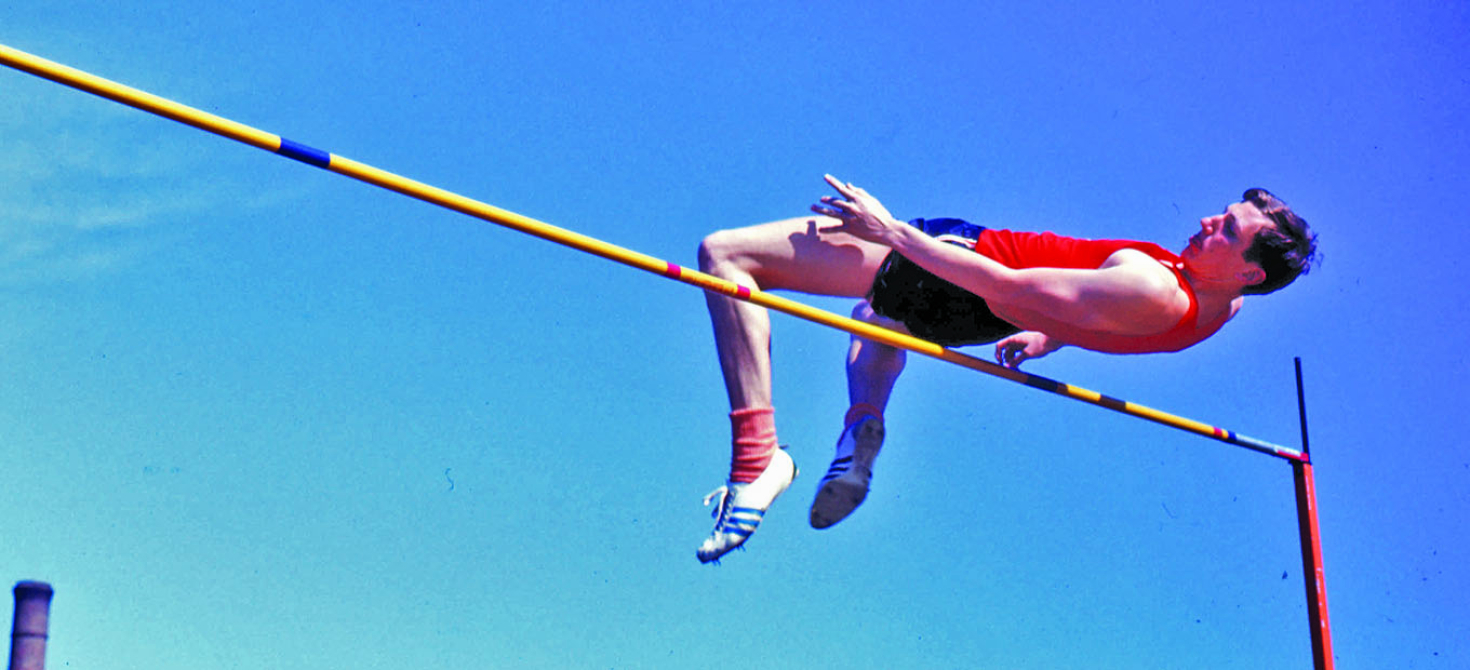
An elite high jumper using the Fosbury flop arches backward over the bar. Done well, the body clears the bar while the center of mass — the average of all that mass — actually passes beneath it. The athlete raises less “average height,” so the same leap clears a higher bar.
The thrown hammer
Launch a hammer and its head, handle and everything between tumble chaotically. But the center of mass ignores the spin and traces a clean parabola, exactly like a point projectile. That is why projectile motion works even for objects that are wildly rotating in flight.
The Earth–Moon barycenter
We say the Moon orbits Earth, but both bodies actually orbit their common center of mass, called the barycenter. Because Earth is about 81 times heavier, that point lies roughly 4,670 km from Earth’s centre — beneath the surface, since Earth’s radius is 6,371 km. Earth doesn’t sit still; it wobbles around this buried point, a fact NASA uses to hunt for planets around distant stars.
The ring with no centre
A uniform ring, boomerang or doughnut carries its center of mass in empty air. There is no material at the point at all — proof that the center of mass is a location in space, not a lump you can touch.
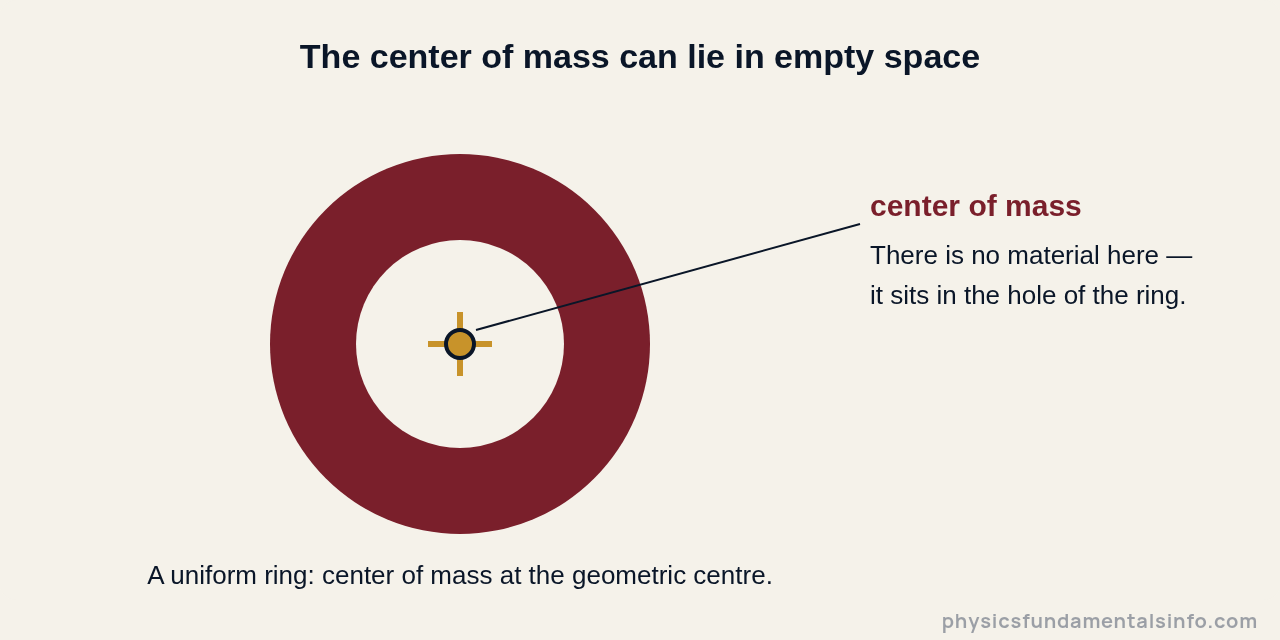
For a uniform ring, the center of mass lies exactly at the middle of the hole, where there is no material at all.
Common Misconceptions About Center of Mass
The most common misconception is that the center of mass must lie inside the object. As the ring and the arched high jumper show, it frequently sits in empty space. Here are the slips worth unlearning.
“It has to be inside the object”
It does not. Rings, horseshoes, boomerangs and arched gymnasts all place their center of mass off the material. The point is defined by an average, and averages don’t have to land on anything solid.
“It’s the same as the geometric centre”
Only for uniform density. Load one end of a bar with lead and the center of mass slides toward the lead, even though the geometric middle hasn’t moved. Mass distribution is what counts, not shape alone.
“Center of mass and center of gravity are always identical”
They match in a uniform gravitational field — which covers essentially every laboratory and sports field. In a field that varies across the object (a very tall structure, or an object near a strong source), the center of gravity shifts slightly toward the region of stronger gravity while the center of mass stays put.
“It just sits where most of the material is”
The center of mass is a weighted average, not the address of the biggest chunk. Two unequal masses always place it between them, closer to the heavier one but never on top of it, unless the other mass is zero.
How Center of Mass Relates to Momentum, Gravity and Rotation
The center of mass ties straight to momentum: a system’s total momentum equals its total mass times the velocity of its center of mass, p = M vcm. Track that one point and you have captured the motion of the entire system.
Momentum and Newton’s second law
Because internal forces between the parts cancel in pairs, only external forces move the center of mass. That gives a clean system-wide version of Newton’s second law: Fext = M acm. It also means that with no net external force, the center of mass glides at constant velocity — the everyday face of the conservation of momentum.
This is why an exploding firework’s fragments still average out along the original path, and why studying momentum and collisions becomes far simpler when you switch to the center-of-mass frame.
Rotation happens about it
A free object that isn’t pushed off-centre spins about its center of mass, not about some other point. Divers, thrown phones and tumbling satellites all rotate around it, which is why it anchors the study of rotational motion and moment of inertia.
| Property | Center of mass | Center of gravity | Centroid (geometric centre) |
|---|---|---|---|
| Averages positions weighted by | mass | weight (mass × local g) | nothing — equal weighting |
| Depends on | mass distribution only | mass distribution + gravitational field | shape only |
| Coincides with center of mass when | — | gravity is uniform | density is uniform |
| Mainly used for | motion, momentum, collisions | balance and stability | geometry and design |
Worked Problems
Show Solution
Step 1: Apply xcm = (m1x1 + m2x2) / (m1 + m2).
Step 2: Substitute with units: xcm = (2 kg × 0 m + 6 kg × 4 m) / (2 kg + 6 kg).
Step 3: Solve: xcm = (0 + 24) / 8 = 3 m.
Answer: 3 m from the origin — three-quarters of the way toward the heavier 6 kg mass.Show Solution
Step 1: Inverse-ratio rule — the center of mass divides the gap in the inverse ratio of the masses, 1 : 3, so the 3 kg mass claims 3 of every 4 parts of the “pull.” Distance from the 1 kg mass = (3/4) × 8 m = 6 m.
Step 2: Check with the formula, taking the 1 kg mass at x = 0 and the 3 kg mass at x = 8 m: xcm = (1 × 0 + 3 × 8) / (1 + 3) = 24 / 4 = 6 m.
Step 3: Both methods agree.
Answer: 6 m from the 1 kg mass (2 m from the 3 kg mass) — closer to the heavier one, as expected.Show Solution
Step 1: Total mass M = 1 + 2 + 3 = 6 kg. Handle each axis separately.
Step 2: xcm = (1×0 + 2×4 + 3×2) / 6 = (0 + 8 + 6) / 6 = 14/6 ≈ 2.33 m.
Step 3: ycm = (1×0 + 2×0 + 3×3) / 6 = 9/6 = 1.5 m.
Answer: The center of mass is at approximately (2.33 m, 1.5 m).Show Solution
Step 1: Replace the rod with its own center of mass — a uniform rod balances at its midpoint, x = 1 m. The point mass sits at x = 2 m.
Step 2: xcm = (mrodxrod + mpointxpoint) / (mrod + mpoint) = (3 kg × 1 m + 2 kg × 2 m) / (3 kg + 2 kg).
Step 3: xcm = (3 + 4) / 5 = 7/5 = 1.4 m.
Answer: 1.4 m from the rod’s free end — shifted toward the loaded end.Show Solution
Step 1: Treat the hole as negative mass. For uniform thickness, mass is proportional to area. Full disc: area ∝ πR2 at x = 0. Hole: area ∝ π(R/2)2 = πR2/4 at x = R/2.
Step 2: xcm = [πR2(0) − (πR2/4)(R/2)] / [πR2 − πR2/4] = [−πR3/8] / [3πR2/4].
Step 3: Simplify: xcm = −(R3/8) × (4 / 3R2) = −R/6 = −(12 cm)/6 = −2 cm.
Answer: 2 cm from the disc’s centre, on the side opposite the hole.Show Solution
Step 1: Put Earth at x = 0 and the Moon at x = d. The center of mass from Earth’s centre is xcm = (MMoon × d) / (MEarth + MMoon).
Step 2: Substitute: xcm = (7.35 × 1022 × 3.84 × 108) / (5.97 × 1024 + 7.35 × 10²²) = (2.82 × 1031) / (6.04 × 1024).
Step 3: xcm ≈ 4.67 × 10⁶ m ≈ 4,670 km. Earth’s radius is 6,371 km.
Answer: About 4,670 km from Earth’s centre — roughly 1,700 km below the surface, so the barycenter lies inside the Earth.Show Solution
Step 1: No horizontal external force acts, so the center of mass cannot move. Let the boat slide a distance Δ opposite to the walk; the person’s displacement over the ground is (4 − Δ).
Step 2: Keep the center of mass fixed: mperson(4 − Δ) = mboatΔ, i.e. 60(4 − Δ) = 40Δ.
Step 3: Solve: 240 − 60Δ = 40Δ → 240 = 100Δ → Δ = 2.4 m. (Check: 60 × 1.6 m = 96 = 40 × 2.4 m.)
Answer: The boat slides 2.4 m; the person moves 1.6 m over the ground.