Circular motion physics describes an object travelling along a circular path, where the velocity always points along the tangent and a centripetal acceleration of a = v2/r points constantly toward the centre. Even at a perfectly constant speed the object is accelerating, because its direction changes every instant, so a net inward force is always required.
Take a roundabout at a steady 36 km/h and your speedometer will not budge. Your body will. You feel yourself pressed toward the door, your coffee slides across the cup holder, and something deep in you insists you are being flung outwards.
Nothing is flinging you anywhere. You are simply trying to go straight while the car turns out from under you — and once that clicks, it unlocks everything from a hammer throw to why the Moon has not yet fallen on us.
What Is Circular Motion?
Circular motion is the movement of an object along a circular path, in which its velocity stays tangent to the circle while a net force pulls it continuously toward the centre. That definition hides a trap — and the trap is where most marks are lost.
Speed and velocity are not the same thing. Speed is just a number; velocity is a number and a direction. Ride that roundabout at a steady 10 m/s and your speed is pinned, but your velocity is being rewritten every instant, because the direction keeps turning.
A changing velocity is precisely what acceleration means. So an object in uniform circular motion accelerates without ever going faster.
That is the whole subject in one sentence.
Uniform vs non-uniform circular motion
- Uniform circular motion — the speed is constant, so only the direction changes. The acceleration points purely at the centre and its size is fixed at v2/r.
- Non-uniform circular motion — the object also speeds up or slows down, adding a tangential acceleration along the direction of travel. The total acceleration is the vector sum of the two, and it no longer aims at the centre.
A car holding a steady speed round a bend is uniform. The same car braking mid-bend is not — which is exactly why braking hard in a corner is how you lose grip.
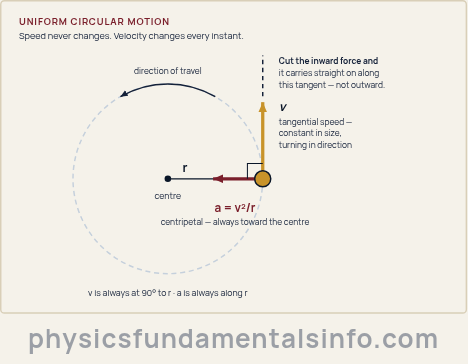
The anatomy of uniform circular motion: velocity along the tangent, acceleration toward the centre, always at right angles.
The Circular Motion Formula
The formula for uniform circular motion is a = v2/r: the centripetal acceleration equals the square of the tangential speed divided by the radius of the path.
- a — centripetal acceleration, in metres per second squared (m/s2). Always directed toward the centre.
- v — tangential speed, in metres per second (m/s), measured along the path.
- r — radius of the circular path, in metres (m).
Multiply by mass and Newton’s second law hands you the force needed to sustain the turn.
- F — centripetal force, in newtons (N).
- m — mass of the object, in kilograms (kg).
Notice the square. Radius matters, but speed matters twice over: double your speed round the same bend and you do not need twice the grip — you need four times it. You can feel that exponent by dragging the speed slider in the lab below, or by running your own numbers through our Circular Motion Calculator.
The related quantities
Circular motion is usually described with a small family of linked quantities. Any one of them can be traded for another.
| Quantity | Symbol | Equation | SI unit |
|---|---|---|---|
| Tangential speed | v | v = 2πr / T = ωr | m/s |
| Period (one full lap) | T | T = 2πr / v | s |
| Frequency | f | f = 1 / T | Hz |
| Angular velocity | ω | ω = 2πf = v / r | rad/s |
| Centripetal acceleration | a | a = v2/r = ω2r = 4π2r / T2 | m/s2 |
| Centripetal force | F | F = mv2/r = mω2r | N |
In practice, a common student slip is letting degrees creep in. Every one of these assumes radians. Leave your calculator in degree mode and the answers will look plausible and be wrong.
How Circular Motion Works
Circular motion works because a sideways force bends the object’s straight-line path into a curve without ever speeding it up. The force acts perpendicular to the motion, so it changes direction only.
That perpendicularity is the key. A force pulling forwards would make the object faster; a force pulling backwards would slow it. A force pulling exactly sideways can do neither, so it has no choice but to steer.
It also explains a tidy result: the centripetal force does no work. Work needs a force component along the motion, and there isn’t one. The Moon has orbited for billions of years without gravity spending a single joule on it.
Where a = v2/r comes from
Take two snapshots of the object a small angle Δθ apart. Because the velocity always sits at 90° to the radius, the velocity vector turns through exactly the same angle Δθ that the radius does.
Now draw both velocities tail to tail. You get a triangle with two equal sides — the speed hasn’t changed — separated by that same Δθ. It is similar to the triangle made by the two radii and the chord between the positions.
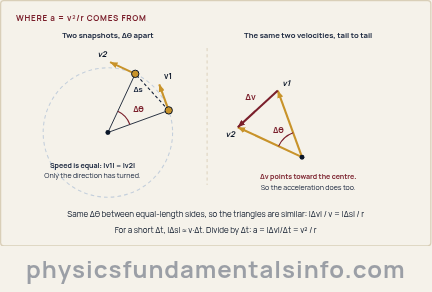
Two similar triangles are all it takes to derive the circular motion formula.
Similar triangles give |Δv| / v = |Δs| / r. Over a short interval the chord is nearly the arc, so |Δs| ≈ v·Δt. Substitute and divide by Δt, and the result falls out: a = v2/r — pointing wherever Δv points, which is toward the centre.
If you want the same derivation with the geometry drawn out step by step, Georgia State’s HyperPhysics circular motion pages work through it carefully.
Circular Motion Physics in the Real World
The formula never changes. Only the identity of the inward force does.
1. A car on a roundabout — friction
At 10 m/s round a 25 m roundabout, a = 102/25 = 4.0 m/s2. The road must supply that sideways pull through friction, needing a coefficient of at least 4.0/9.81 ≈ 0.41.
Dry asphalt offers roughly 0.7–0.9, so you sail round without thinking about it. Ice offers perhaps 0.1. The physics did not change — the supplier defaulted.
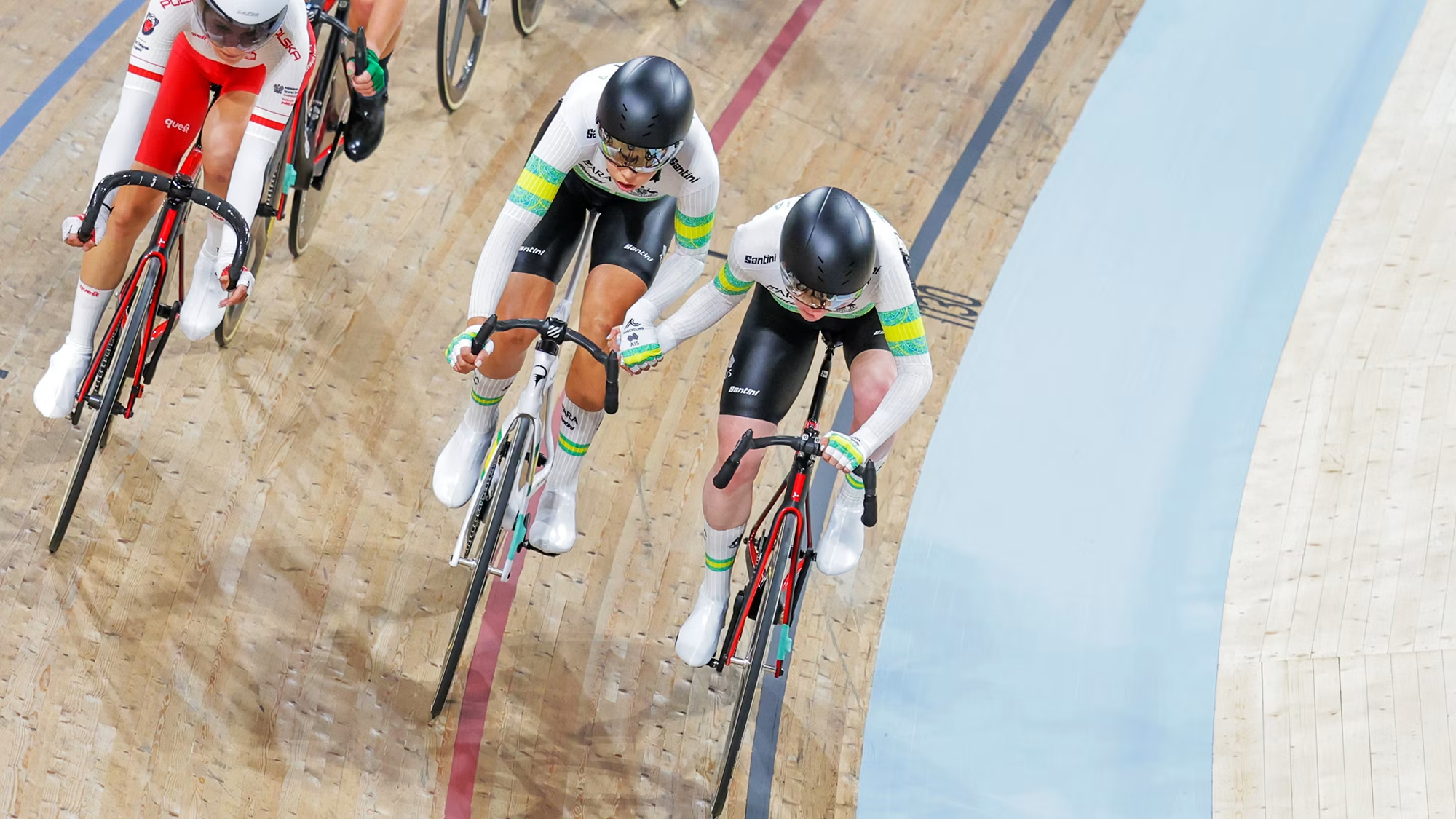
2. A hammer throw — tension
An elite thrower whirls a 7.26 kg hammer at a radius near 1.7 m, releasing at roughly 29 m/s. That demands a = 292/1.7 ≈ 495 m/s2, about 50g.
The wire must therefore pull with F = 7.26 × 495 ≈ 3.6 kN — comparable to the weight of a small car, held through the arms. Release, and the hammer leaves along the tangent, not radially outward.
3. A washing machine spin cycle — the drum wall
A 0.25 m drum at 1400 rpm gives ω = 146.6 rad/s and a = ω2r ≈ 5,370 m/s2. That is roughly 550g.
Water is not “thrown out” of your clothes. The drum wall simply stops providing the inward force at the perforations, so the water carries straight on and leaves.
4. The International Space Station — gravity
The ISS orbits about 400 km up, so r ≈ 6.771 × 10⁶ m from Earth’s centre, moving at roughly 7.67 km/s. Its centripetal acceleration is a = v2/r ≈ 8.69 m/s2.
Now compare local gravity at that same altitude: also 8.69 m/s2, which is about 89% of surface gravity. The match is no coincidence — gravity is the centripetal force, and it is entirely spent on turning. One lap takes 92 minutes.
5. The Moon — Newton’s original sanity check
The Moon sits 3.844 × 10⁸ m away and takes 27.3 days per orbit, giving a = 4π2r/T2 ≈ 2.72 × 10⁻³ m/s2.
Newton’s inverse-square law independently predicts 2.70 × 10⁻³ m/s2 at that distance. Agreement to within about 1%, from two completely separate routes, is what convinced him that the force holding the Moon and the force dropping an apple were the same force.
Common Misconceptions About Circular Motion
“Constant speed means no acceleration”
This is the big one. Acceleration is the rate of change of velocity, and velocity carries a direction. Turning at a fixed speed is still accelerating — hard.
Your body already agrees, even if your intuition doesn’t: that pressure against the car door is you being accelerated.
“Centrifugal force flings you outward”
In the ground frame, no outward force acts on you at all. Your body tries to continue in a straight line, the door gets in the way and pushes you inward, and you read that squeeze as an outward pull.
Centrifugal force is a bookkeeping device that exists only if you insist on doing the physics in the rotating frame. Useful there — but it is not what is pushing you.
“Cut the string and the ball flies straight out from the centre”
It leaves along the tangent, at 90° to the radius, not along it. With the inward force gone, Newton’s first law takes over and the ball simply keeps the velocity it already had.
“Centripetal force is a special new force”
It is a job description, not a new entry in the force catalogue. Tension does the job for a hammer, friction for a car, gravity for the ISS, the normal force for a drum wall.
Always ask “what is providing the centripetal force here?” — never “where do I add the centripetal force?” It is never an extra arrow on a free-body diagram; it is the name for the resultant that already points inward.
Circular Motion vs Centripetal Force
Circular motion is the description of the path; centripetal force is the cause that keeps the object on it. One is kinematics — what is happening. The other is dynamics — why.
| Feature | Circular motion | Centripetal force |
|---|---|---|
| What it is | The motion itself — travel along a circular path | The net inward force that causes that motion |
| Branch | Kinematics — the description | Dynamics — the cause |
| Key equation | a = v2/r | F = mv2/r |
| SI unit | m/s2 (its acceleration) | N |
| Direction | Velocity tangent; acceleration inward | Always toward the centre |
| A force in its own right? | Not a force at all | No — a role played by tension, friction, gravity or the normal force |
Put simply: circular motion is the effect, and centripetal force is the reason you get it.
How Circular Motion Relates to Orbits, Oscillations and Newton’s Laws
Circular motion is the bridge between Newton’s laws, orbital mechanics and oscillations — the same a = v2/r turns up in all three.
Newton’s laws
The first law supplies the tangent: with no net force, the object goes straight. The second law supplies the size: F = ma becomes F = mv2/r the moment the acceleration is centripetal.
Simple harmonic motion
Shine a light sideways at a ball in uniform circular motion and its shadow on the wall performs simple harmonic motion exactly. The ω in circular motion and the ω in SHM are the same quantity — which is why one is often taught as the shadow of the other.
Orbits and planets
Orbits are genuinely ellipses, not circles. But Earth’s orbital eccentricity is only 0.0167, so its path is out of round by just 0.014% — visually, a circle.
The catch is that the Sun sits about 1.67% off-centre, which is enough to swing our distance from 147.1 to 152.1 million km and to make Earth measurably faster in January than in July. So uniform circular motion is an excellent approximation here, and an honest one only if you say so.
Worked Problems
Show Solution
Solution:
Step 1: Use the definition of centripetal acceleration, a = v2/r.
Step 2: Substitute with units: a = (4.0 m/s)2 / 0.80 m = 16 m2/s2 / 0.80 m.
Step 3: Solve: a = 20 m/s2, directed toward the centre.
Answer: a = 20 m/s2 (2 s.f.), toward the centre
Show Solution
Solution:
Step 1: Acceleration first: a = v2/r.
Step 2: a = (15 m/s)2 / 45 m = 225 / 45 = 5.0 m/s2.
Step 3: Then Newton’s second law: F = ma = 1200 kg × 5.0 m/s2 = 6000 N.
Answer: a = 5.0 m/s2, F = 6.0 kN supplied by friction, pointing toward the centre of the bend
Show Solution
Solution:
Step 1: One lap is a circumference, so v = 2πr / T.
Step 2: v = 2π(6.0 m) / 4.0 s = 37.70 m / 4.0 s = 9.42 m/s.
Step 3: a = v2/r = (9.42)2 / 6.0 = 88.8 / 6.0 = 14.8 m/s2. (Check with a = 4π2r/T2 = 14.8 m/s2. ✓)
Answer: v = 9.4 m/s, a = 15 m/s2 — about 1.5g
Show Solution
Solution:
Step 1: Convert rpm to rad/s: ω = 1200 × 2π / 60.
Step 2: ω = 125.7 rad/s. Then use a = ω2r = (125.7 rad/s)2 × 0.22 m.
Step 3: a = 15790 × 0.22 = 3474 m/s2. Divide by g: 3474 / 9.81 = 354.
Answer: ω = 126 rad/s, a = 3.47 × 10³ m/s2, about 354g
Show Solution
Solution:
Step 1: At the minimum speed the track pushes with N = 0, so gravity alone supplies the centripetal force: mg = mv2/r.
Step 2: Mass cancels — the answer is the same for every rider. So v2 = gr = 9.81 m/s2 × 2.5 m = 24.5 m2/s2.
Step 3: v = √24.5 = 4.95 m/s.
Answer: v(min) = 5.0 m/s (2 s.f.), independent of mass
Show Solution
Solution:
Step 1: Friction supplies the centripetal force, and it maxes out at μ(s)N = μ(s)mg. Set that equal to the requirement: μ(s)mg = mv2/r.
Step 2: Mass cancels again, leaving v2 = μ(s)·g·r = 0.70 × 9.81 m/s2 × 60 m = 412 m2/s2.
Step 3: v = √412 = 20.3 m/s.
Answer: v(max) = 20 m/s (about 73 km/h) — and note it does not depend on the car’s mass
Show Solution
Solution:
Step 1: The radius is not the string length: r = L·sin θ = 1.2 m × sin 30° = 0.60 m. Resolve the tension. Vertically there is no acceleration, so T·cos θ = mg.
Step 2: T = mg / cos θ = (0.15 kg × 9.81 m/s2) / cos 30° = 1.4715 N / 0.8660 = 1.70 N.
Step 3: Horizontally, the tension component is the centripetal force: T·sin θ = mv2/r, so 1.70 N × 0.5 = (0.15 kg) v2 / 0.60 m, giving v2 = 3.40 m2/s2 and v = 1.84 m/s.
Answer: T = 1.70 N, v = 1.84 m/s. (Sanity check: a = v2/r = 5.66 m/s2, which equals g·tan 30° = 5.66 m/s2. ✓)