The impulse formula is J = F Δt: impulse equals the average force acting on an object multiplied by the time interval over which that force acts. Because force is the rate of change of momentum, the same impulse also equals the momentum change, J = Δp = mv – mu. Impulse is a vector measured in newton-seconds (N·s).
Drop your phone on a tiled floor and it shatters. Drop it on a thick rug from the same height and it survives. The phone hits the ground with exactly the same momentum both times — so the change in momentum, and therefore the impulse, is identical.
What changes is how long the stop takes. The rug stretches that stop over maybe ten times longer, and the force collapses by the same factor. That single trade-off is what the impulse formula lets you put a number on.
What Is the Impulse Formula?
The impulse formula is J = F Δt, where F is the average force in newtons and Δt is the contact time in seconds. Multiply the two and you get impulse in newton-seconds.
There is a second version of the same equation, and you will use it just as often. Since a force acting for a time is exactly what changes an object’s momentum, impulse can also be worked out from mass and velocity alone: J = mv – mu.
Which version you reach for depends entirely on what the question hands you. Force and a time? Use F Δt.
Mass and two velocities? Use the momentum difference. Both routes give the same number in the same units.
One detail that trips people up in the first line of their working: impulse is a vector. It points in the direction of the force, and in one-dimensional problems that means it carries a sign.
The Impulse Formula and Every Rearrangement You Need
Here are the two forms of the impulse equation, followed by every rearrangement an exam or a lab report will ask for.
Every symbol, with its SI unit:
| Symbol | Quantity | SI unit | Notes |
|---|---|---|---|
| J | Impulse | newton-second (N·s) | Vector. Some textbooks write it as I or Δp. |
| F | Average resultant force | newton (N) | The time-average, not the peak value. |
| Δt | Time interval | second (s) | Convert milliseconds first: 5 ms = 0.005 s. |
| m | Mass | kilogram (kg) | Assumed constant during the interaction. |
| u, v | Initial and final velocity | metre per second (m/s) | Signed. A rebound flips the sign. |
Rearranging for force or time
- Average force: F = J / Δt
- Contact time: Δt = J / F
- Final velocity: v = u + J / m
- Mass: m = J / (v – u)
Those four rearrangements cover essentially every impulse question you will meet. If you would rather check your algebra against a machine than trust it, our Impulse Calculator solves for impulse, force or time and shows the substitution line by line.
Why N·s and kg·m/s are the same unit
A newton is a kg·m/s2, so a newton-second is kg·m/s2 × s = kg·m/s. The two units are dimensionally identical, and both describe impulse.
In practice, use N·s when you calculated from force and time, and kg·m/s when you calculated from mass and velocity. Neither is wrong — examiners accept both.
How to Calculate Impulse in 4 Steps
To calculate impulse, pick the form of the formula that matches your data, convert everything to SI units, multiply while keeping track of sign, then quote the answer with a direction. Here is the routine in full.
- Decide which pair you have. Force plus a time means J = F Δt. Mass plus two velocities means J = mv – mu. If you have all four, you can do it either way and cross-check.
- Convert to SI and choose a positive direction. Grams to kilograms, milliseconds to seconds, km/h to m/s. Write down which way you are calling positive before any numbers go in.
- Multiply or subtract, carrying the signs. A rebound means u and v have opposite signs, so the subtraction becomes an addition of magnitudes.
- Quote units and direction, then sanity-check. An impulse of 4 N·s on a tennis ball is reasonable; 4000 N·s is not. Divide by the mass — if the implied velocity change is absurd, hunt for the slipped decimal point.
Step 4 is the one students skip and the one that catches real errors. A quick division by mass turns an abstract answer back into a velocity you can judge by eye.
Try it live below. Drag the change-in-momentum slider to fix the impulse, then stretch the contact time and watch the average force fall while the shaded area stays exactly the same.
How to Find Impulse from a Force-Time Graph
Impulse is the area under a force-time graph. That one sentence replaces the whole formula, because it works whether the force is constant, spiky or wildly irregular.
When the force is constant, the area is a rectangle and you are back to J = F Δt. When it is not constant, you break the shape into pieces you can measure — and the answer is still in N·s, because the axes are newtons and seconds.
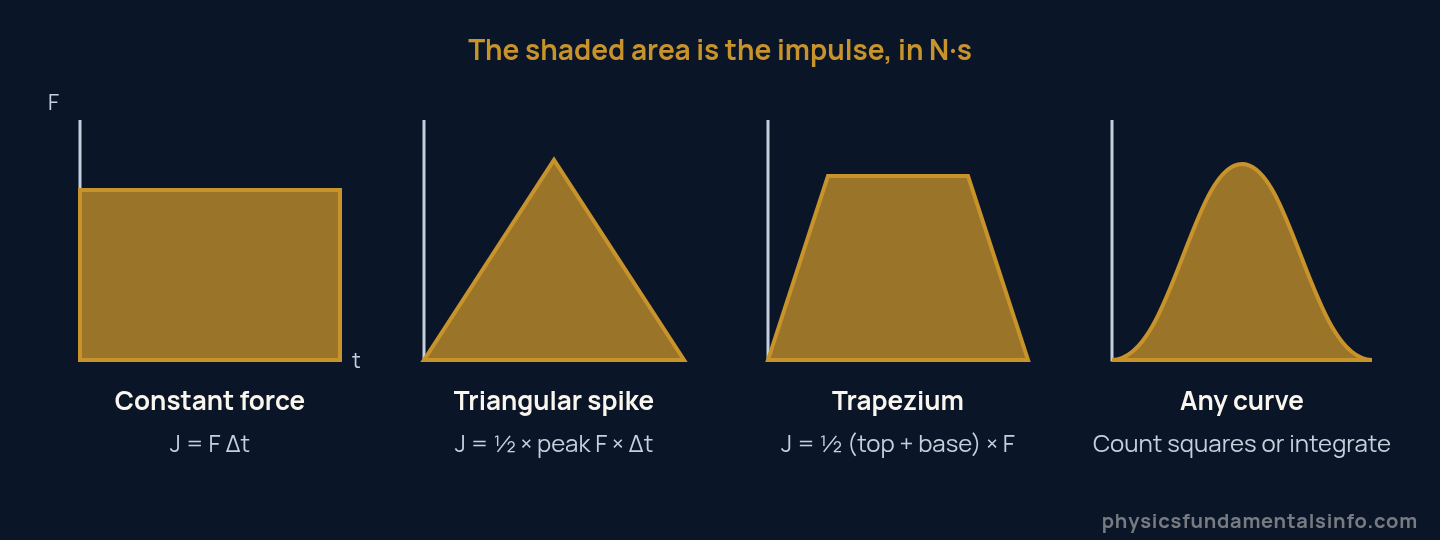
Four common force-time shapes. Whatever the outline, the shaded area under it is the impulse in newton-seconds.
Working with an irregular curve
Real collisions produce a lopsided bump, not a neat triangle. Two methods handle it without calculus.
- Count squares. Work out the impulse of one grid square (its width in seconds × its height in newtons), count the squares under the curve, and multiply. Half-covered squares count as a half.
- Split into strips. Chop the curve into trapezium slices, find each area, and add them. Narrower strips give a closer answer.
If you have already met the area-under-a-graph trick in motion graphs, this is the same skill on different axes — velocity-time gives displacement, force-time gives impulse.
Average Force vs Peak Force: The Number Students Get Wrong
The F in J = F Δt is the average force over the contact, never the peak force. Substituting the peak value is the single most common way an otherwise correct impulse calculation ends up wrong.
Picture a symmetric triangular spike — force climbing from zero to a maximum and back down. Its area is ½ × peak × Δt, so the average force is exactly half the peak.
Use the peak instead and your answer is out by a factor of two. In a crash-safety context, that is the difference between a survivable deceleration and a fatal one.
This is also the reason impulse is the practical way to estimate collision forces at all. As Georgia State University’s HyperPhysics notes on the impulse of force point out, the force during an impact is almost never measurable directly — but the momentum change and the contact time usually are.
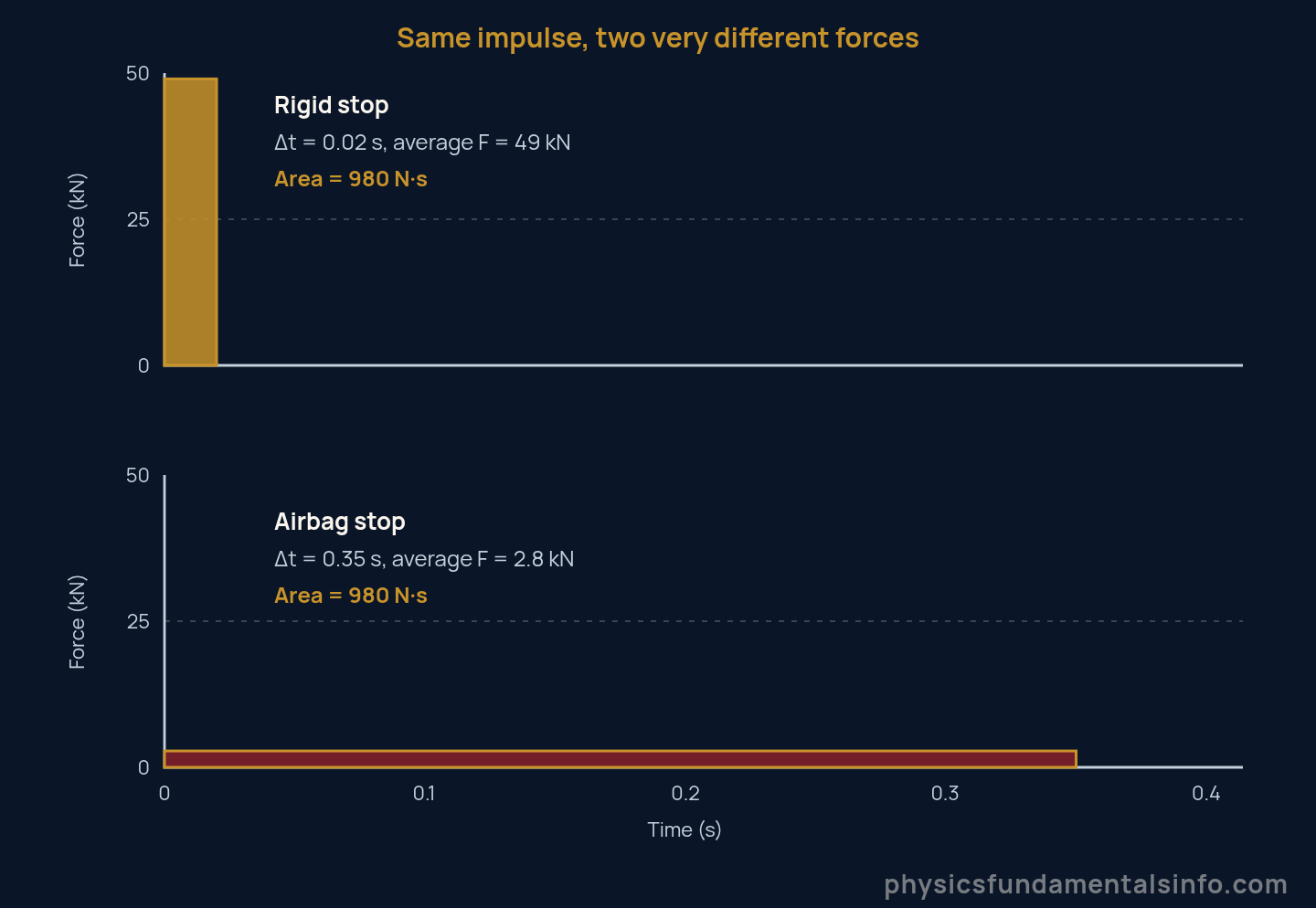
Both shaded blocks have the same area, so both deliver the same 980 N·s impulse to a 70 kg driver stopping from 14 m/s. Stretching the stop from 0.02 s to 0.35 s cuts the force by a factor of 17.5.
That is the whole design brief for an airbag, a crash mat and a climbing rope. None of them reduces the impulse — the momentum change is fixed by the crash. They only stretch Δt.
Where the Impulse Formula Gets Used in Practice
The impulse formula turns up wherever a force acts briefly and you need a number for it. These are worked from the assumptions in each row, so you can follow the arithmetic rather than take it on trust.
| Situation | Mass and velocity change | Contact time Δt | Impulse J | Average force F = J / Δt |
|---|---|---|---|---|
| Football kicked from rest | 0.42 kg, 0 to 24 m/s | 0.012 s | 10.1 N·s | 840 N |
| Tennis return (ball reverses) | 0.058 kg, 30 m/s in to 40 m/s out | 0.005 s | 4.06 N·s | 810 N |
| Driver stopped, rigid column | 70 kg, 14 m/s to 0 | 0.020 s | 980 N·s | 49,000 N |
| Same driver, airbag deployed | 70 kg, 14 m/s to 0 | 0.35 s | 980 N·s | 2,800 N |
| Model rocket motor burn | Thrust profile, peak 90 N | 1.70 s | 126 N·s | 74.1 N |
| Ball bouncing off the floor | 0.20 kg, 6.0 m/s down to 4.0 m/s up | 0.025 s | 2.0 N·s | 80 N (net) |
Rockets: impulse you can buy off a shelf
Rocket engineers care about impulse more than thrust, because thrust alone says nothing about how long it lasts. NASA defines the total impulse of a rocket as the average thrust multiplied by the total firing time — J = F Δt with a rocket motor in place of a tennis racket.
That is why motors are sold by total impulse in newton-seconds. It is the honest measure of how much momentum the motor can hand the vehicle.
Continuous jets: impulse per second
A hose firing 12 kg of water per second at 20 m/s onto a wall delivers 240 kg·m/s of momentum change every second. Divide impulse by time and you have a steady 240 N force.
Same formula, rearranged. This rate form is how fire hoses kick back and how jet engines push aircraft forward.

4 Mistakes That Wreck Impulse Calculations
Most lost marks on impulse questions come from four specific slips, and none of them is about understanding the physics. They are all about the substitution line.
Mistake 1: using the peak force
J = F Δt needs the time-averaged force. Read the peak off a graph and you will typically double your answer, because a symmetric spike averages half its maximum.
Mistake 2: forgetting the sign flip on a rebound
If a ball arrives at 30 m/s and leaves at 40 m/s the other way, the velocity change is 70 m/s, not 10 m/s. Set your positive direction first, write u = -30 m/s and v = +40 m/s, and let the algebra handle it.
Writing the sign convention down before you substitute costs one line and removes the error entirely.
Mistake 3: leaving time in milliseconds
A contact time of 5 ms is 0.005 s. Substitute 5 instead and any force from F = J / Δt lands a thousand times too small, while any impulse from J = F Δt lands a thousand times too big.
Both wrong answers look tidy enough to survive an unchecked script. Convert the units on the line where you write them down, not later.
Mistake 4: confusing net impulse with the contact force
J = Δp gives the impulse of the resultant force. If a question asks for the force from the floor on a bouncing ball, weight acts during the contact too, so the floor’s force is the net impulse divided by Δt plus the weight.
For a brief, violent impact the weight term is often tiny. Ignore it silently and you will still lose the mark for method.
How the Impulse Formula Connects to Momentum, Force and Energy
The impulse formula is Newton’s second law with the time multiplied through. Newton’s law says force is the rate of change of momentum, F = Δp / Δt, and rearranging that single line gives F Δt = Δp — the impulse-momentum theorem.
If you want the concepts behind that step rather than the arithmetic, our guide to momentum and impulse derives the theorem and explains why it matters, and the write-up on Newton’s second law covers the F = ma form you probably met first.
Impulse and collisions
In a collision, the two objects exert equal and opposite forces on each other for exactly the same length of time. Equal force, equal time, so equal and opposite impulses — which is precisely why momentum is conserved.
That holds whether the collision is bouncy or sticky. The distinction between elastic and inelastic collisions is about kinetic energy, not impulse.
Impulse is not energy
Here is a case worth remembering. A ball bounces off a wall with the same speed it arrived at, so its kinetic energy is unchanged — zero energy transfer.
Its impulse, though, is 2mv, the largest it could possibly be. Momentum depends on velocity linearly and carries direction; energy depends on speed squared and does not. They are different quantities and they behave differently.
Worked Problems
Show Solution
Solution:
Step 1: Force and time are given, so use the impulse formula J = F Δt.
Step 2: Substitute with units: J = 25 N × 4.0 s.
Step 3: Solve: J = 100 N·s, in the direction of the force.
Answer: J = 100 N·s (2 s.f.), along the direction of the applied force.
Show Solution
Solution:
Step 1: Mass and two velocities are given, so use J = mv – mu with u = 0.
Step 2: Substitute with units: J = 0.42 kg × 24 m/s – 0.42 kg × 0 = 10.08 kg·m/s.
Step 3: Rearrange the impulse formula for force: F = J / Δt = 10.08 N·s / 0.012 s = 840 N.
Answer: J = 10.1 N·s (3 s.f.) and F = 840 N (2 s.f.), both forward.
Show Solution
Solution:
Step 1: Take the outgoing direction as positive, so u = -30 m/s and v = +40 m/s.
Step 2: Velocity change: v – u = 40 – (-30) = 70 m/s.
Step 3: Impulse: J = m(v – u) = 0.058 kg × 70 m/s = 4.06 kg·m/s.
Step 4: Convert the time, 5.0 ms = 0.0050 s, then F = J / Δt = 4.06 / 0.0050 = 812 N.
Answer: J = 4.1 N·s and F = 810 N (2 s.f.), both in the return direction.
Show Solution
Solution:
Step 1: The impulse is fixed by the momentum change: J = mv – mu = 0 – 70 kg × 14 m/s = -980 kg·m/s, so the magnitude is 980 N·s.
Step 2: Rigid column: F = J / Δt = 980 / 0.020 = 49,000 N.
Step 3: Airbag: F = J / Δt = 980 / 0.35 = 2,800 N.
Step 4: Sanity check by dividing by mass: 49,000 / 70 = 700 m/s2, about 71 g. The airbag gives 40 m/s2, about 4 g.
Answer: (a) 49 kN, about 71 g. (b) 2.8 kN, about 4 g — a 17.5-fold reduction from stretching Δt alone.
Show Solution
Solution:
Step 1: Impulse is the area under the graph, and this shape is a triangle of base 0.060 s and height 600 N.
Step 2: Substitute: J = ½ × base × height = ½ × 0.060 s × 600 N.
Step 3: Solve: J = 18 N·s.
Step 4: Average force: F = J / Δt = 18 / 0.060 = 300 N, exactly half the 600 N peak.
Answer: J = 18 N·s and average F = 300 N (the peak is 600 N).
Show Solution
Solution:
Step 1: Split the area under the thrust-time graph into three pieces.
Step 2: Ramp up (triangle): ½ × 0.20 s × 90 N = 9.0 N·s.
Step 3: Steady burn (rectangle): 90 N × 1.10 s = 99.0 N·s.
Step 4: Ramp down (triangle): ½ × 0.40 s × 90 N = 18.0 N·s.
Step 5: Total impulse: J = 9.0 + 99.0 + 18.0 = 126.0 N·s over a burn of 0.20 + 1.10 + 0.40 = 1.70 s.
Step 6: Average thrust: F = J / Δt = 126.0 / 1.70 = 74.1 N.
Answer: total impulse J = 126 N·s and average thrust F = 74.1 N (3 s.f.).
Show Solution
Solution:
Step 1: Take upwards as positive, so u = -6.0 m/s and v = +4.0 m/s.
Step 2: Net impulse: J = m(v – u) = 0.20 kg × (4.0 – (-6.0)) m/s = 0.20 × 10.0 = 2.0 kg·m/s upwards.
Step 3: The net impulse comes from the normal force minus the weight, so J = (N – mg)Δt.
Step 4: Rearrange for N: N = J / Δt + mg = 2.0 / 0.025 + 0.20 × 9.81.
Step 5: Solve: N = 80.0 + 1.96 = 81.96 N.
Answer: (a) net impulse J = 2.0 N·s upwards. (b) average normal force N = 82 N (2 s.f.). The weight contributes under 3% here, but the method still needs it.