Motion graphs are diagrams that plot an object’s position, velocity, or acceleration against time, showing exactly how its motion changes from moment to moment. The slope (gradient) of a position–time graph gives velocity, the slope of a velocity–time graph gives acceleration, and the area under a velocity–time graph gives displacement.
Pull out your phone after a run and look at the pace trace. That jagged line — climbing where you sped up, dipping where you walked — is a motion graph, and it tells the whole story of the run without a single row of numbers.
Physics leans on these pictures constantly. One glance at the right graph reveals whether something is speeding up, slowing down, standing still or reversing — and, with a little slope and area, exactly how fast and how far. Learn to read them and the equations of motion suddenly make sense.
What Are Motion Graphs?
Imagine describing a 20-minute drive without using any numbers. You might say “I sped up, cruised, braked at the lights, then crawled in traffic.” A motion graph turns that story into a precise line you can actually measure.
Motion graphs are line graphs with time along the horizontal axis and one motion quantity — position, velocity, or acceleration — up the vertical axis. Each type answers a different question: where something is, how fast it is going, or how quickly its speed is changing.
Time always runs along the bottom, because in everyday physics it only moves forward. The real physics lives on the vertical axis, and reading the line means reading two things at once: its height and its steepness.
Distance–time vs displacement–time
One quick distinction trips up beginners. A distance–time graph tracks the total ground covered, so its line can only rise or stay flat. A displacement–time graph tracks position relative to a starting point, so it can fall back toward zero — or go negative — the moment you turn around.
The difference mirrors the gap between speed and velocity: distance and speed ignore direction, while displacement and velocity respect it. For a full breakdown, see our guide on velocity vs speed.
The Three Types of Motion Graphs
Three graphs show up again and again, and they are linked like a chain. The slope of one becomes the graph below it.
Displacement–time (x–t) graphs
Height shows position; steepness shows velocity. A flat line means the object sits still, a straight slope means steady velocity, and any curve means the velocity is changing.
Velocity–time (v–t) graphs
Height shows velocity; steepness shows acceleration. Here a flat line no longer means “stopped” — it means constant velocity. The area trapped between the line and the time axis is the displacement.
Acceleration–time (a–t) graphs
Height shows acceleration, and for most school problems this line is simply flat, meaning constant acceleration. The area underneath gives the change in velocity over that time interval.
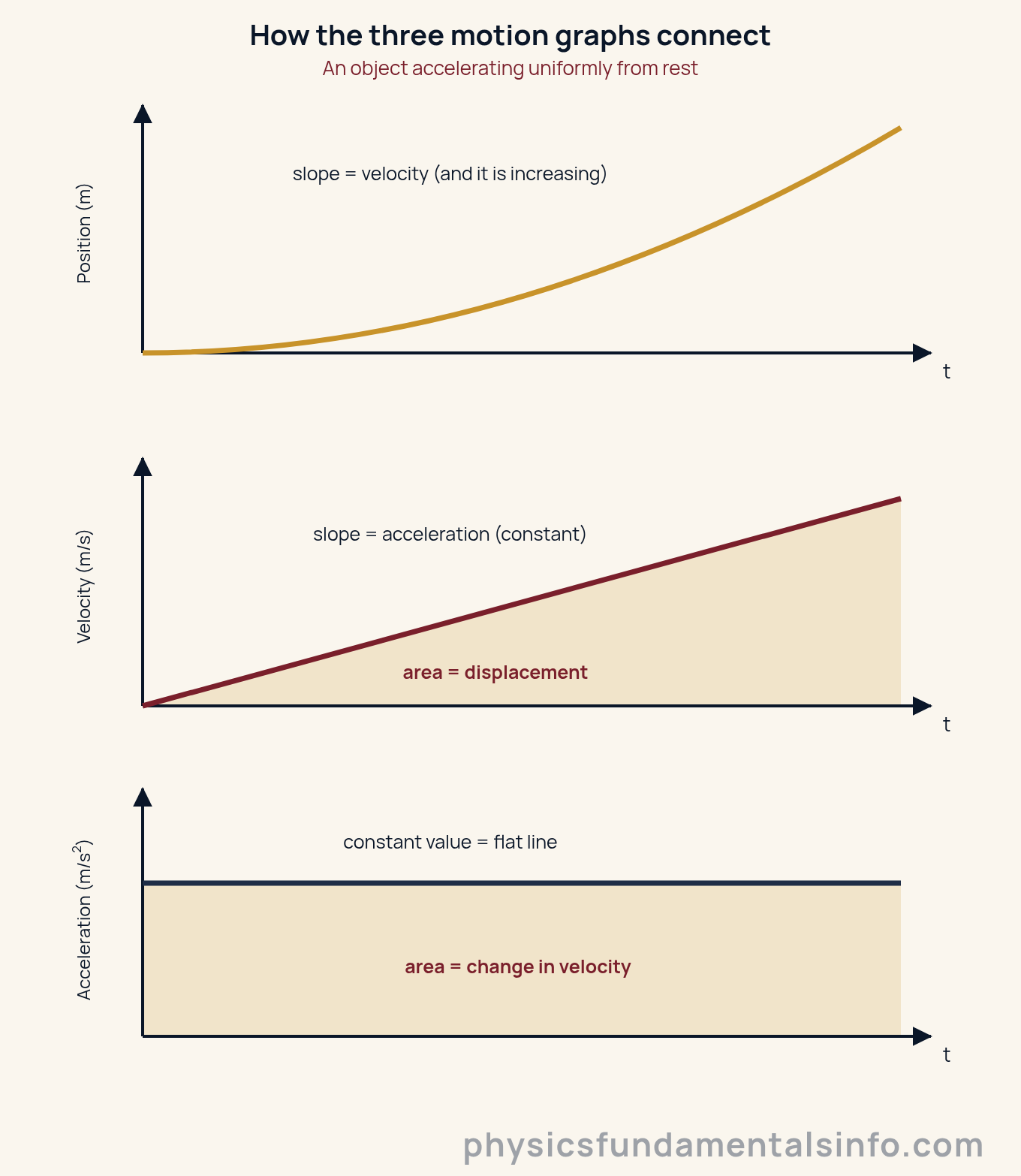
The three graphs form a chain: take the slope to move down it (position → velocity → acceleration), and take the area to move back up (acceleration → velocity → position).
| Graph type | Slope (gradient) gives | Area underneath gives | A flat horizontal line means |
|---|---|---|---|
| Displacement–time (x–t) | Velocity | No standard physical meaning | Object is at rest (stationary) |
| Velocity–time (v–t) | Acceleration | Displacement | Constant velocity (zero acceleration) |
| Acceleration–time (a–t) | Jerk (rate of change of acceleration) | Change in velocity (Δv) | Constant acceleration |
Read the table across and a pattern jumps out: moving down the chain you take the slope, moving up the chain you take the area. That single idea unlocks almost every motion-graph question.
The Motion Graph Formulas: Slope and Area
Two operations do all the heavy lifting — gradient and area. Everything else is just reading the axes carefully.
The gradient of a displacement–time graph is the velocity.
The gradient of a velocity–time graph is the acceleration — which, by Newton’s second law, is exactly what a net force produces.
When a velocity–time line is straight, that area is just a trapezium, which gives one of the standard equations of motion:
Here is what each symbol means, with its SI unit:
- s or x — displacement, in metres (m)
- t — time, in seconds (s)
- u — initial velocity, in metres per second (m/s)
- v — final velocity, in metres per second (m/s)
- a — acceleration, in metres per second squared (m/s2)
- Δ — “change in” (the final value minus the initial value)
These two slope rules are the backbone of the whole topic. Georgia State University’s HyperPhysics reference on motion graphs states them the same way.
One note for A-level and beyond: when a line is curved, slope and area become calculus. The instantaneous velocity is the derivative v = dx/dt, and displacement is the integral of velocity, s = ∫v dt.
How to Read a Motion Graph Step by Step
Before anything else, check the vertical axis label. Treating a velocity–time graph as if it were a displacement–time graph is the single most common exam slip — and it is entirely avoidable.
Then work through it in order:
- Identify the graph from its vertical axis: position, velocity, or acceleration.
- Read the height at the instant you care about — that is the value of that quantity right then.
- Read the slope to get the next quantity down the chain (velocity from x–t, acceleration from v–t).
- Find the area under the line if you need displacement (from v–t) or change in velocity (from a–t).
- Check the sign: below the time axis means the negative direction, not “nothing happening”.
For a curved displacement–time graph, you cannot use one rise-over-run for the whole line. Draw a tangent at the instant you want and measure the slope of that tangent — that gives the instantaneous velocity.
The four shapes below cover almost every displacement–time graph you will be asked to read.
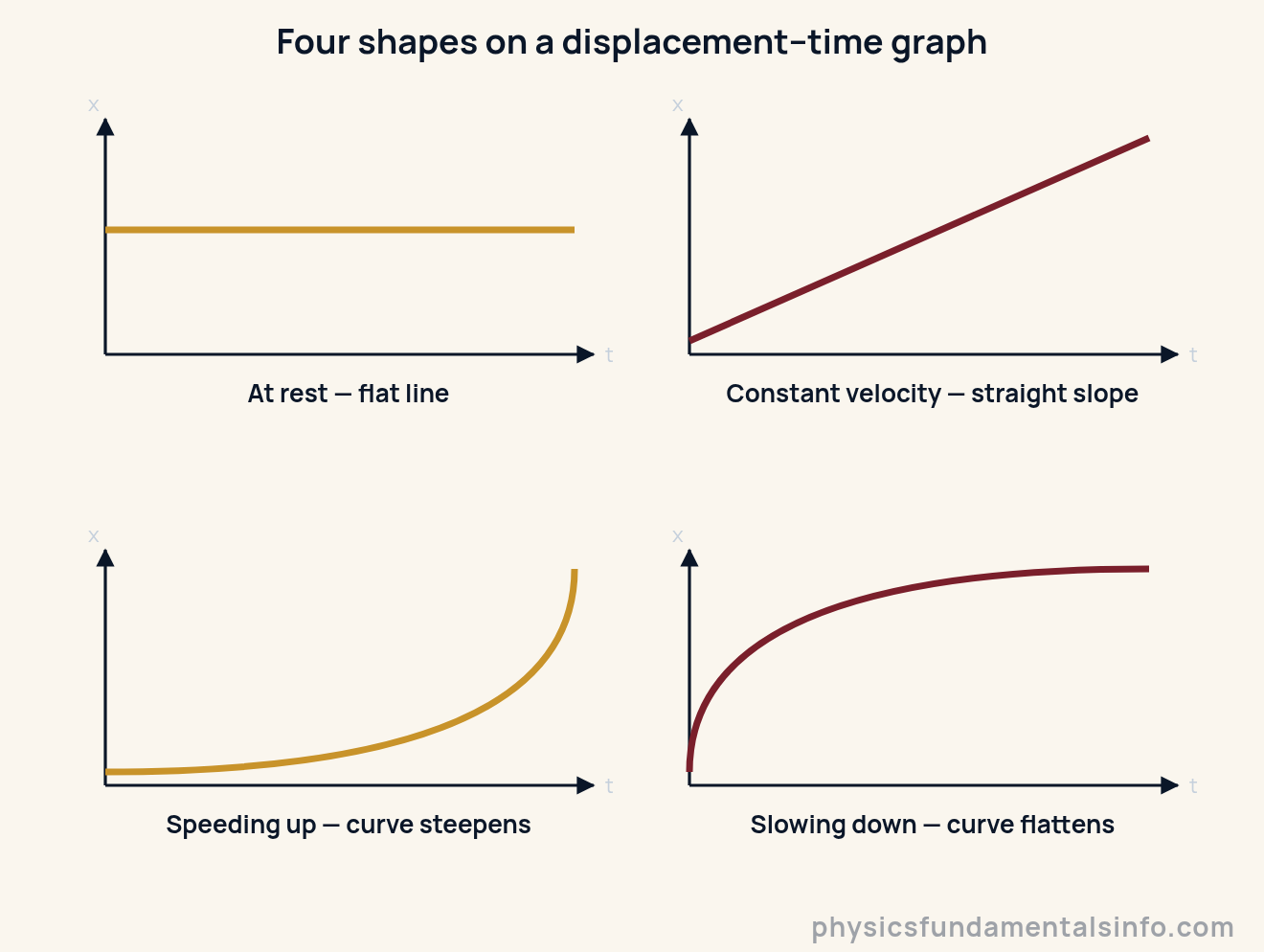
In every box the vertical axis is position and the horizontal axis is time. The flatter the line, the slower the motion; any curve means the velocity is changing.
Theory clicks faster when you can wiggle the sliders yourself. In the lab below, set an initial velocity and an acceleration, press play, and watch all three graphs draw at once.
Try this: set the acceleration to zero and watch the velocity–time line go flat while the position–time line stays straight. Then add a little acceleration and see the position line bend into a curve.
Real-World Examples of Motion Graphs
A lift starting and stopping
Step into a lift and its velocity–time graph is a tidy trapezium: a slope up as it accelerates, a flat top as it cruises, a slope down as it stops. That lurch in your stomach at the start, and the lightness as it halts? That is the slope — the acceleration — not the speed itself.

Your sat-nav or fitness app
The speed trace on a running app or a car’s trip computer is a velocity–time graph in disguise. Flat stretches are steady cruising, spikes are sprints, and the dips are junctions and hills.
A 100 m sprint
Plot a sprinter’s position against time and you get a curve: steep through the middle, then gently bending as they approach top speed. The slope of that curve at any instant is their speed at that instant, and the early steepening is the acceleration out of the blocks.
A bouncing ball
A bouncing ball’s velocity–time graph flips sign at every bounce: velocity grows negative as the ball falls, snaps to positive the instant it rebounds, then shrinks again on the way up. Each straight segment has the same slope — the acceleration of gravity, about 9.81 m/s2. Projectiles behave the same way in two dimensions; see our projectile motion guide.
Common Misconceptions About Motion Graphs
“The line shows the path the object takes”
A rising displacement–time line does not mean the object is climbing a hill. The vertical axis is position along one direction, not height above the ground. A motion graph is a record of motion, never a map of the route.
“Steeper means faster”
On a velocity–time graph, steepness is acceleration, not speed. The height tells you how fast something is moving; the slope tells you how quickly that speed is changing. A steep but low line means slow yet rapidly accelerating.
“A flat line always means stopped”
Only on a displacement–time graph does flat mean at rest. On a velocity–time graph, a flat line above the axis means constant, non-zero velocity — cruising, not parked.
“Where velocity is zero, nothing is happening”
The instant a velocity–time line crosses zero, the object is momentarily at rest — but if the line is sloping through that point, the acceleration is not zero. That is exactly what happens at the top of a ball’s flight: zero velocity, full gravitational acceleration.
How Motion Graphs Connect to the Equations of Motion
Motion graphs and the SUVAT equations are two views of the same thing. The trapezium area under a straight velocity–time line is literally s = ½(u + v)t — by counting that area, you have been doing an equation of motion all along.
The slope relationships are the other half. Velocity is the rate of change of position, and acceleration is the rate of change of velocity, which is why a constant net force shows up as a straight, sloping velocity–time line.
Once you are comfortable here, the wider toolkit opens up: the full set of Newton’s laws of motion, two-dimensional projectile paths, and the calculus that treats slope as a derivative and area as an integral. Graphs are often the quickest way in.
Worked Problems
Show Solution
Solution:
Step 1: On a displacement–time graph, velocity is the gradient: v = Δx / Δt.
Step 2: Substitute the two points: v = (40 m − 0 m) / (8 s − 0 s).
Step 3: v = 40 m ÷ 8 s = 5 m/s.
Answer: 5 m/s (constant, in the positive direction).
Show Solution
Solution:
Step 1: Acceleration is the gradient of a velocity–time graph: a = Δv / Δt.
Step 2: a = (28 m/s − 4 m/s) / (6 s − 0 s).
Step 3: a = 24 m/s ÷ 6 s = 4 m/s2.
Answer: 4 m/s2.
Show Solution
Solution:
Step 1: Use the gradient: v = Δx / Δt.
Step 2: v = (0 m − 30 m) / (10 s − 4 s) = −30 m ÷ 6 s.
Step 3: v = −5 m/s.
Answer: −5 m/s — the object travels back toward the start at a speed of 5 m/s.
Show Solution
Solution:
Step 1: Displacement is the area under the velocity–time graph. The line is horizontal, so the area is a rectangle: s = v × t.
Step 2: s = 18 m/s × 12 s.
Step 3: s = 216 m.
Answer: 216 m.
Show Solution
Solution:
Step 1: From rest, the velocity–time line is a triangle, so area = ½ × base × height = ½ × t × v.
Step 2: s = ½ × 6 s × 12 m/s.
Step 3: s = 36 m. (Check with s = ½(u + v)t = ½(0 + 12)(6) = 36 m.)
Answer: 36 m.
Show Solution
Solution:
Step 1: Change in velocity is the area under the acceleration–time graph (a rectangle): Δv = a × t.
Step 2: Δv = 3 m/s2 × 4 s = 12 m/s.
Step 3: Final velocity v = u + Δv = 5 m/s + 12 m/s = 17 m/s.
Answer: Δv = 12 m/s; final velocity = 17 m/s.
Show Solution
Solution:
Step 1: Split the area into a triangle (acceleration phase) and a rectangle (constant phase).
Step 2: Triangle = ½ × 5 s × 20 m/s = 50 m. Rectangle = 20 m/s × 10 s = 200 m.
Step 3: Total displacement = 50 m +200 m = 250 m.
Answer: 250 m.