Physics symbols are the single letters and marks that stand for measurable quantities, their units and the operations performed on them — v for velocity, Ω for the ohm, Δ for a change. Quantity symbols are printed in italic, unit symbols upright, and the same letter routinely means different things in different branches.
Open any physics page and you meet a wall of letters before you meet a single idea. Half of them are Greek, several are wearing tiny numbers, and one of them — μ — turns up three times on the same page meaning three unrelated things.
That wall is not decoration. Every symbol is a compressed sentence, and once you can unpack it, an unfamiliar equation stops being intimidating and starts being readable. This page is the decoder.
What Are Physics Symbols?
Physics symbols are shorthand: a letter or mark that stands for a physical quantity, a unit, a constant or a mathematical operation. Rather than writing “the rate of change of velocity”, you write a, and every physicist on the planet knows what you mean.
They fall into four families, and mixing them up is where most confusion starts.
- Quantity symbols — the thing being measured: m (mass), v (velocity), T (temperature). Always italic.
- Unit symbols — what it is measured in: kg, m/s, K. Always upright, never pluralised.
- Constant symbols — fixed values of nature: c, h, G, ε0.
- Operator and notation symbols — instructions: Δ, ∑, the arrow or bold type that marks a vector.
Here is the crucial point most students never get told: symbols are conventions, not laws. Unit symbols are fixed by international agreement, but quantity symbols are only recommendations — which is exactly why one letter can be recycled across topics.
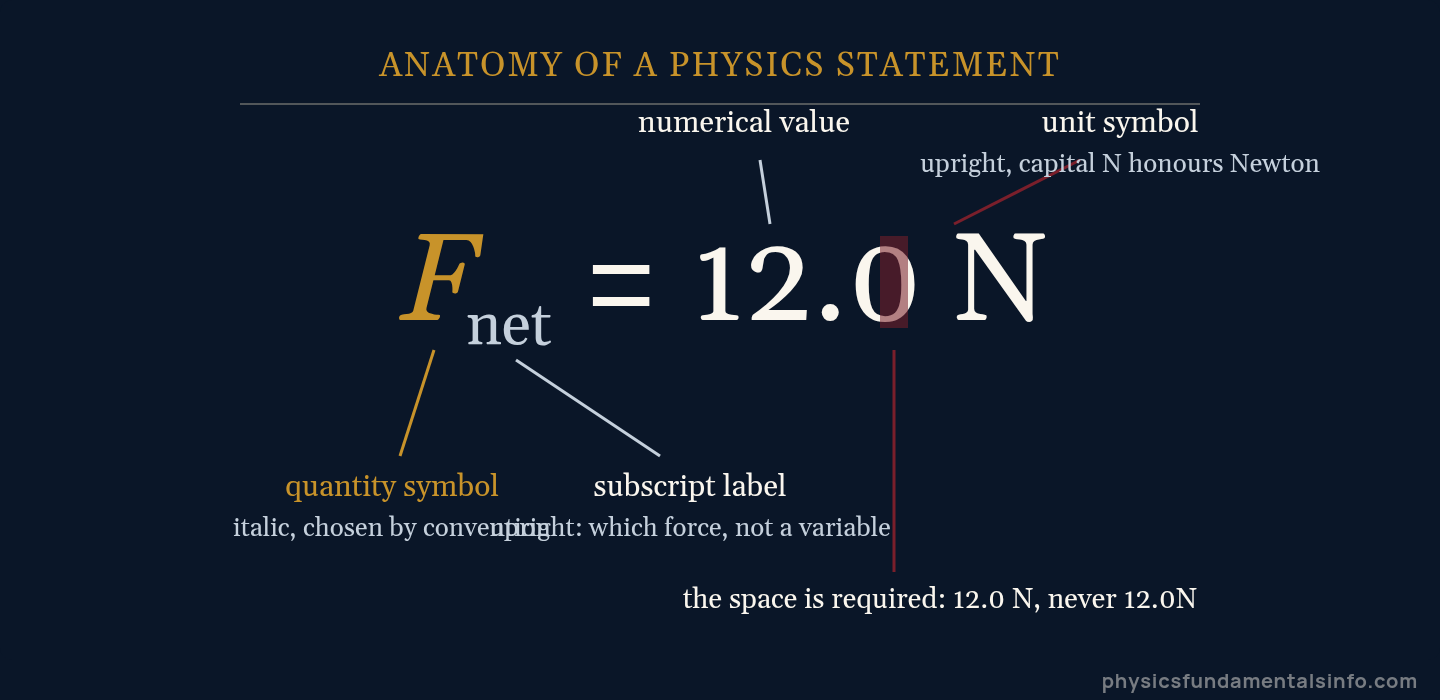
Every physics statement carries four separate pieces of information. Reading them apart is the whole skill.
Greek Letters in Physics: The Complete Table
Greek letters appear in physics because the Latin alphabet ran out. There are only 26 Latin letters and thousands of quantities, so borrowing a second alphabet roughly doubled the supply — and by long habit certain Greek letters became permanently attached to certain ideas.
All 24 lowercase Greek letters are listed below, including the three that physics almost never uses.
Lowercase Greek Letters
| Symbol | Name | Main meanings in physics | Typical SI unit |
|---|---|---|---|
| α | alpha | Angular acceleration; coefficient of linear thermal expansion; alpha particle; fine-structure constant | rad/s2; K-1 |
| β | beta | Speed as a fraction of light speed (v/c); beta particle; sound-level exponent in some texts | dimensionless |
| γ | gamma | Lorentz factor; gamma ray; surface tension; ratio of specific heats | dimensionless; N/m |
| δ | delta | A very small change; inexact differential (δQ); Dirac delta function; skin depth | varies |
| ε | epsilon | Permittivity; strain; emissivity; sometimes electromotive force | F/m; dimensionless |
| ζ | zeta | Damping ratio in oscillations | dimensionless |
| η | eta | Efficiency; dynamic viscosity | dimensionless; Pa s |
| θ | theta | Angle or angular displacement; occasionally temperature | rad or degrees |
| ι | iota | Rarely used — too close to Latin i | — |
| κ | kappa | Thermal conductivity; dielectric constant; compressibility | W m-1 K-1 |
| λ | lambda | Wavelength; radioactive decay constant; linear charge density; mean free path | m; s-1; C/m |
| μ | mu | Coefficient of friction; the prefix micro (10-6); magnetic permeability; reduced mass | dimensionless; N A-2 |
| ν | nu | Frequency (common in quantum work); kinematic viscosity; neutrino; Poisson’s ratio | Hz; m2/s |
| ξ | xi | Correlation length; a generic small displacement | m |
| ο | omicron | Never used — indistinguishable from the letter o | — |
| π | pi | The circle constant 3.14159…; osmotic pressure; the pion | dimensionless |
| ρ | rho | Density; electrical resistivity; volume charge density | kg/m3; Ω m; C/m3 |
| σ | sigma | Stefan-Boltzmann constant; electrical conductivity; surface charge density; stress; standard deviation | W m-2 K-4; S/m; Pa |
| τ | tau | Torque; time constant; shear stress; proper time | N m; s; Pa |
| υ | upsilon | Rarely used — too close to Latin v and u | — |
| φ | phi | Phase angle; work function in the photoelectric effect; electric potential; a second angle in 3D | rad; J or eV; V |
| χ | chi | Electric or magnetic susceptibility | dimensionless |
| ψ | psi | Quantum wavefunction | varies |
| ω | omega | Angular velocity; angular frequency | rad/s |
Capital Greek Letters
Only ten Greek capitals look different from Latin capitals, so those ten are the only ones physics bothers with. The rest — Α, Β, Ε, Ζ, Η, Ι, Κ, Μ, Ν, Ο, Ρ, Τ, Υ, Χ — are visually identical to A, B, E, Z, H, I, K, M, N, O, P, T, Y, X and would be hopelessly ambiguous.
| Symbol | Name | Main meanings in physics | Typical SI unit |
|---|---|---|---|
| Γ | Gamma | Decay width of an unstable state; circulation in fluid flow | eV; m2/s |
| Δ | Delta | “Change in” — the most common symbol in all of physics | same as the quantity |
| Θ | Theta | Debye temperature; the dimension of temperature | K |
| Λ | Lambda | Cosmological constant; the Lambda baryon; an energy scale in particle physics | m-2; eV |
| Ξ | Xi | The Xi baryon; grand partition function | varies |
| Π | Pi | “Multiply all of these together” | operator |
| Σ | Sigma | “Add all of these together” — as in ΣF for the resultant force | operator |
| Φ | Phi | Magnetic flux; electric flux; luminous flux | Wb; V m; lm |
| Ψ | Psi | Time-dependent wavefunction | varies |
| Ω | Omega | The ohm (a unit); solid angle; number of microstates in statistical mechanics | Ω; sr |
Latin Letters: The Everyday Symbols
Latin symbols do the heavy lifting in school and first-year physics, and they are worse offenders than Greek for double meanings. A capital C can be capacitance, heat capacity or the coulomb, all within one chapter.
The table below gives the standard reading of each letter, with the alternatives that most often catch people out.
| Symbol | Usual quantity | SI unit | Also used for |
|---|---|---|---|
| a | Acceleration | m/s2 | Amplitude; the unit “annum” |
| A | Area | m2 | Amplitude; A is also the unit ampere |
| B | Magnetic flux density | T (tesla) | — |
| c | Speed of light in vacuum | m/s | Specific heat capacity (J kg-1 K-1) |
| C | Capacitance | F (farad) | Heat capacity; C is also the unit coulomb |
| d | Distance or separation | m | Slit spacing; differential operator |
| E | Energy | J (joule) | Electric field strength (V/m or N/C) |
| f | Frequency | Hz | Focal length; friction force |
| F | Force | N (newton) | F is also the unit farad |
| g | Gravitational field strength | N/kg or m/s2 | g is also the unit gram |
| h | Height | m | Planck constant; h is also the unit hour |
| I | Electric current | A (ampere) | Moment of inertia (kg m2); intensity (W/m2) |
| k | Spring constant | N/m | Boltzmann constant; Coulomb constant; wavenumber |
| L | Length | m | Angular momentum (kg m2 s-1); inductance (H) |
| m | Mass | kg | m is also the unit metre; also the prefix milli |
| n | Amount of substance | mol | Refractive index; number density; the prefix nano |
| p | Momentum | kg m/s | Pressure (Pa); the prefix pico |
| P | Power | W (watt) | Pressure (Pa) |
| Q | Electric charge | C (coulomb) | Heat transferred (J); quality factor |
| r | Radius or separation | m | — |
| R | Electrical resistance | Ω (ohm) | Molar gas constant; resultant; radius of a large body |
| s | Displacement | m | s is also the unit second |
| t | Time | s | Celsius temperature; thickness |
| T | Thermodynamic temperature | K (kelvin) | Period (s); tension (N); T is also the unit tesla |
| u | Initial velocity | m/s | Internal energy; u is also the atomic mass unit |
| v | Velocity or speed | m/s | V is the unit volt |
| V | Potential difference | V (volt) | Volume (m3) |
| W | Work done | J (joule) | Weight; W is also the unit watt |
Notice the pattern in the last column: nearly every clash is between a quantity symbol and a unit symbol. That is precisely what the italic rule exists to prevent.
Unit and Prefix Symbols, and the μ Problem
Unit symbols are the strictest part of the whole system: they are fixed by international agreement, printed upright, and never take a plural s. Write 75 cm, never 75 cms — that exact example comes straight from NIST’s rules for printing unit symbols. Quantity symbols, by contrast, are only recommendations that authors may override as long as they say so.
Capitalisation is not decorative either. A unit symbol starts with a capital only when the unit honours a person — N for Newton, K for Kelvin, Pa for Pascal — which is why it is m for metre but W for watt.
Then come the prefixes, and this is where μ earns its reputation.
| Prefix | Symbol | Multiplier | Seen in |
|---|---|---|---|
| tera | T | 1012 | TW of global power demand |
| giga | G | 109 | GHz processor clock |
| mega | M | 106 | MW power station output |
| kilo | k | 103 | kJ, km, kΩ |
| deci | d | 10-1 | dB (decibel) |
| centi | c | 10-2 | cm, cm3 |
| milli | m | 10-3 | mA, ms, mm |
| micro | μ | 10-6 | μF, μm, μs |
| nano | n | 10-9 | nm of visible light |
| pico | p | 10-12 | pF, ps |
| femto | f | 10-15 | fm, the scale of a nucleus |
Those are the eleven you will meet most; the full SI set now runs to 24 prefixes, after ronna, quetta, ronto and quecto were added in 2022. If you need to move a value between them, our SI Prefix Converter re-expresses any number in a different prefix and shows the power of ten it used, which is far safer than shifting a decimal point by hand at 1 a.m.
One rule here catches almost everyone: prefixes cannot be stacked, and the kilogram already contains one. So a millionth of a kilogram is written 1 mg, never 1 μkg.
So: μ as a prefix means multiply by 10-6. μ as a quantity symbol means the coefficient of friction. μ with a subscript zero means the magnetic permeability of free space. Same glyph, three unrelated jobs.
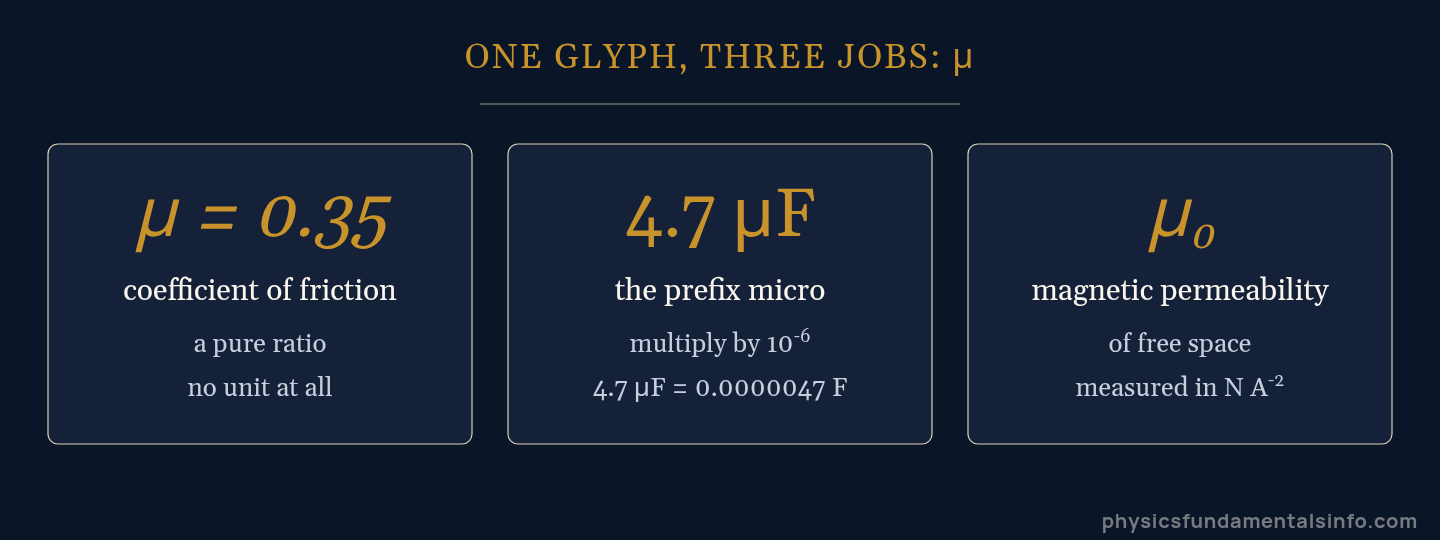
Context, not the glyph, tells you which μ you are looking at.
The trick is not memorising which is which. It is noticing that a prefix always sits glued to a unit, while a quantity symbol stands alone — and the friction coefficient never carries a unit at all, which is discussed further in our guide to friction and its coefficients.
Notation: Italic, Upright, Deltas and Operators
Beyond the letters themselves sits a second layer of meaning: typeface, subscripts, bars, hats and operators. This layer carries real information, and skipping it is how students end up solving the wrong equation.
The single most important rule is the typeface one, set out by NIST in the US edition of the SI brochure: quantity symbols are printed in italic and unit symbols upright. So m is a mass and m is a metre, and the difference is a slant.
Delta is the workhorse. Capital Δ always means a change, computed as final minus initial:
- Δx — the change in position (displacement), in metres (m)
- x2 — the final position, in metres (m)
- x1 — the initial position, in metres (m)
Because Δ subtracts, it can be negative even when the quantity itself cannot. A temperature of −5 K is impossible; a temperature change of −5 K happens every autumn evening.
| Notation | Read it as | Example |
|---|---|---|
| Δ | Change in (final minus initial) | ΔT = 20 K |
| δ | A very small change, or a path-dependent one | δQ, a small quantity of heat |
| d | An infinitesimal change (a derivative) | dv/dt is acceleration |
| ∂ | Partial derivative: vary one thing, freeze the rest | Wave and heat equations |
| ∑ | Add all of these together | ΣF = ma |
| ∏ | Multiply all of these together | Probability chains |
| ∫ | Integral: the area under a curve, added continuously | Work from a varying force |
| ∇ | Del or nabla: how steeply a field changes in space | Maxwell’s equations |
| ∝ | Proportional to | F ∝ 1/r2 |
| bold v | A vector: magnitude and direction | Momentum p = mv |
| |v| | The magnitude only, direction discarded | Speed is |v| |
| subscript 0 | The initial or reference value | v0, ε0, L0 |
| subscript word | A label, not a variable — so it stays upright | Fnet, vmax |
Two of these deserve a warning. Bold type marks a vector, so v and v are genuinely different objects — a point covered in our explainer on scalar and vector quantities.
And a subscript is not always the same kind of thing. In v1 the 1 counts objects; in Fnet the “net” is a description; in ε0 the zero is part of the constant’s name.
Symbols for the Physical Constants
Constants get their own symbols, and unlike quantity symbols these are near-universal — c means the speed of light in every textbook on Earth. The values below are the CODATA 2022 set recommended by NIST; several are now exact by definition rather than measured.
| Symbol | Constant | Value | Status |
|---|---|---|---|
| c | Speed of light in vacuum | 299,792,458 m s−1 | Exact by definition |
| h | Planck constant | 6.626 070 15 × 10−34 J Hz−1 | Exact by definition |
| e | Elementary charge | 1.602 176 634 × 10−19 C | Exact by definition |
| kB | Boltzmann constant | 1.380 649 × 10−23 J K−1 | Exact by definition |
| NA | Avogadro constant | 6.022 140 76 × 1023 mol−1 | Exact by definition |
| R | Molar gas constant | 8.314 462 618… J mol−1 K−1 | Exact by definition |
| σ | Stefan–Boltzmann constant | 5.670 374 419… × 10−8 W m−2 K−4 | Exact by definition |
| G | Newtonian constant of gravitation | 6.674 30 × 10−11 m3 kg−1 s−2 | Measured (CODATA 2022) |
| me | Electron mass | 9.109 383 7139 × 10−31 kg | Measured (CODATA 2022) |
| mp | Proton mass | 1.672 621 925 95 × 10−27 kg | Measured (CODATA 2022) |
| ε0 | Vacuum electric permittivity | 8.854 187 8188 × 10−12 F m−1 | Measured (CODATA 2022) |
| μ0 | Vacuum magnetic permeability | 1.256 637 061 27 × 10−6 N A−2 | Measured (CODATA 2022) |
| α | Fine-structure constant | 7.297 352 5643 × 10−3 (about 1/137.036) | Measured (CODATA 2022) |
The seven exact constants are the ones that now define the SI base units: since the 2019 redefinition their values are fixed by agreement, and it is the kilogram, kelvin, ampere and mole that are derived from them rather than the other way round.