An elastic and inelastic collision both obey conservation of momentum; only the elastic one also conserves kinetic energy. In an inelastic collision, part of the kinetic energy converts into heat, sound and permanent deformation. When the objects stick together and move as one, the collision is perfectly inelastic and the kinetic-energy loss is the largest possible.
Rack up a fresh set of snooker balls and drive the cue ball into them. The crack is sharp, the pack scatters, and almost every scrap of speed you handed the cue ball reappears somewhere on the table. Now picture the last motorway pile-up you saw on the news: two cars meet and fold into a single mangled shape, going nowhere.
Both events obey exactly the same conservation law, with no exceptions and no fine print. What separates them is what happened to the energy, and that one difference is the whole of this article.
What Is the Difference Between an Elastic and an Inelastic Collision?
The difference is kinetic energy: an elastic collision conserves it, and an inelastic collision does not. Momentum is conserved in both, so momentum can never be the thing that tells them apart.
That last point trips up more students than any other. Total momentum survives every collision in an isolated system because the two objects push on each other with equal and opposite forces for exactly the same length of time, so whatever momentum one gains, the other loses. Our guide to conservation of momentum works through that proof in full.
Kinetic energy enjoys no such protection. Nothing in physics forbids energy from sliding quietly out of the “motion” account and into heat, sound or a bent bumper. So the test is blunt: add up ½mv2 for every object before and after, and see whether the total survived.
An elastic collision
In an elastic collision, the total kinetic energy after the collision equals the total kinetic energy before it. The objects bounce apart and keep every joule they started with. Nothing is permanently deformed, nothing warms up, and nothing makes a sound worth mentioning.
An inelastic collision
In an inelastic collision, momentum is conserved but some kinetic energy is not. It has not vanished; it has been converted into heat, sound, and the work needed to permanently bend metal or squash clay. Almost every collision you will ever witness is this kind.
A perfectly inelastic collision
A perfectly inelastic collision is the extreme case: the objects stick together and move off as one lump. This is where the kinetic-energy loss is as large as momentum conservation will permit. Note the word permit — the objects cannot lose all their kinetic energy unless the total momentum happened to be zero to begin with.
Elastic vs Inelastic Collisions: The Full Comparison
Line the two extremes up side by side and the pattern is easy to read. The middle column is where reality actually lives.
| Property | Perfectly elastic | Partially inelastic (the real world) | Perfectly inelastic |
|---|---|---|---|
| Momentum conserved? | Yes | Yes | Yes |
| Total energy conserved? | Yes | Yes | Yes |
| Kinetic energy conserved? | Yes — all of it | No — some is lost | No — the most that momentum allows |
| Coefficient of restitution | e = 1 | 0 < e < 1 | e = 0 |
| What the objects do | Bounce cleanly apart | Bounce apart, but sluggishly | Stick and travel as one body |
| Speed they separate at | Equal to the speed they approached at | Slower than they approached at | Zero — they never separate |
| Kinetic energy lost | None | ½ × μ × (1 – e2) × (approach speed)2 | ½ × μ × (approach speed)2 |
| Where you meet it | Gas molecules; a Newton’s cradle comes close | A tennis ball on a court; most car crashes | Railway wagons coupling; a bullet in a block |
The symbol μ in the last-but-one row is the reduced mass, m1m2 / (m1 + m2). We will put it to work shortly.
Numbers make the contrast land harder than any table. Send a 2 kg cart at 4 m/s into a stationary 1 kg cart and run the same collision twice: once perfectly elastic, once perfectly inelastic.
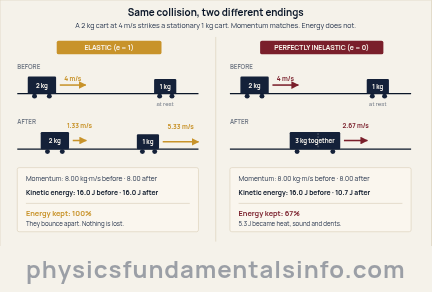
The same elastic and inelastic collision, side by side: momentum reads 8.00 kg·m/s after impact in both cases, while kinetic energy holds at 16.0 J on the left and drops to 10.7 J on the right.
Look carefully at the two momentum lines. They are identical. Only the energy row moved, which is precisely why momentum can never be your diagnostic tool.
The Elastic and Inelastic Collision Formulas
Every collision starts from the same equation. For two objects moving along a straight line, initial velocities written as u and final velocities as v:
- m1, m2 — the masses of the two objects, in kilograms (kg)
- u1, u2 — their velocities before the collision, in metres per second (m/s)
- v1, v2 — their velocities after the collision, in metres per second (m/s)
Velocity is a vector, so pick one direction as positive and enter anything travelling the other way as a negative number. Get the signs right and the algebra takes care of itself.
One equation, two unknowns. To finish the job you need a second equation, and which one you reach for is exactly the elastic-or-inelastic decision.
The perfectly inelastic collision formula
Here the second condition is handed to you for free: the objects end up stuck together, so they share one velocity.
Total momentum on top, total mass underneath. That is the entire calculation, with no energy equation required, which is why perfectly inelastic problems are usually the quickest ones on the paper.
The elastic collision formulas
For an elastic collision the second condition is conservation of kinetic energy, ½m1u12 + ½m2u22 = ½m1v12 + ½m2v22. Solving that alongside momentum conservation is fiddly, because the energy equation is quadratic. The standard results are worth memorising:
There is a shortcut hiding in that algebra, and it is far easier to remember than either formula. In any elastic collision the relative velocity simply reverses: the speed at which the two objects separate equals the speed at which they approached.
Pair that one line with momentum conservation and you have two linear equations: no quadratic, no sign traps. It is the fastest route through any elastic-collision problem, and it generalises beautifully, as the next section shows.
If you would rather check an answer than grind through it, our Collision Calculator takes both masses and both starting velocities and returns the elastic and the perfectly inelastic results side by side, with every substitution shown.
The Coefficient of Restitution: The Dial Between Elastic and Inelastic
The coefficient of restitution, e, is the number that measures how elastic a collision actually is: the separation speed divided by the approach speed. It runs from 0 for a perfectly inelastic collision to 1 for a perfectly elastic one, and every real collision sits somewhere between.
- e — coefficient of restitution, a pure number with no units
- |u1 – u2| — the speed the objects approach each other at, in m/s
- |v2 – v1| — the speed they separate at, in m/s
Notice what this does to the “elastic versus inelastic” question. It stops being two boxes to sort collisions into and becomes a dial you can read off a measurement.
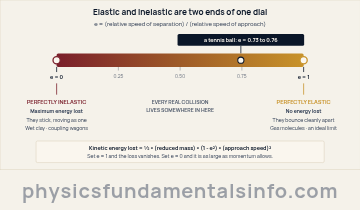
Elastic and inelastic collisions are the two ends of a single scale: the coefficient of restitution sets how much kinetic energy survives the impact.
Set e = 1 and the separation speed matches the approach speed, which is the relative-velocity reversal from the last section, so the elastic formulas fall out automatically. Set e = 0 and the objects never separate at all, which is the perfectly inelastic case. One equation now covers the whole range:
Substitute e = 1 and you recover the elastic formulas exactly. Substitute e = 0 and both expressions collapse to the same shared velocity. Those two checks are worth doing once by hand: they turn three formulas you were memorising into one you understand.
How to measure e with a ball and a tape measure
You do not need a laboratory to find a coefficient of restitution. Drop a ball onto a hard floor, measure how high it comes back, and take the square root of the ratio of the heights.
Why the square root? Because the drop height fixes the impact speed through v2 = 2gh, and the rebound height fixes the leaving speed the same way. Height goes as speed squared, so the ratio of heights is e2, not e. The Institute of Physics builds a classroom experiment around exactly this measurement in its bounce efficiency activity.
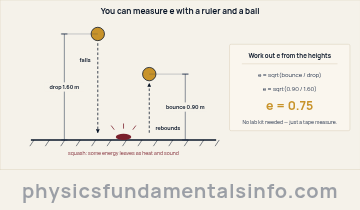
A drop test turns an abstract elastic-versus-inelastic question into two ruler readings: a ball released from 1.60 m that rebounds to 0.90 m has e = 0.75.
Here is the detail worth savouring. Tennis quietly legislates a coefficient of restitution.
The International Tennis Federation’s technical specifications for approved balls require a Type 2 ball dropped from 254 cm onto concrete to rebound between 135 cm and 147 cm. Run those numbers through the drop-test formula and the permitted band is e = sqrt(135/254) to sqrt(147/254), or roughly 0.73 to 0.76. The rulebook never mentions restitution — but that is what it is fixing, to about three per cent.
The lab below is the same dial, made movable. Set the masses and starting speeds, then drag the restitution slider from 1.00 down to 0 and watch the two readouts diverge: momentum holds rock steady while kinetic energy bleeds away into the “lost to heat / sound” line. Its default setup is the 2 kg into 1 kg collision from the diagram above, so you can reproduce those numbers first and then break them.
Where Does the Lost Kinetic Energy Go in an Inelastic Collision?
The kinetic energy lost in an inelastic collision is converted into heat, sound and the permanent deformation of the colliding objects, plus any spin or vibration they are left with. It is never destroyed; total energy is conserved in every collision, elastic or not. Only the kinetic share of the books changes.
The bookkeeping goes like this. Each destination is real, measurable, and irreversible in the sense that the motion is not coming back:
- Heat — the impact raises the internal energy of the materials. A crushed bumper is measurably warmer, though the temperature rise is often tiny and quickly shared with the surroundings. Our explainer on heat versus temperature is worth a look if that distinction feels slippery.
- Sound — the bang is energy radiating away as a pressure wave. It is usually a very small slice of the total, despite being the part you notice most.
- Permanent deformation — bending metal or squashing clay takes work, and that work comes out of the kinetic-energy budget. This is the big one in a car crash.
- Rotation and vibration — a struck object that leaves the impact spinning or ringing has carried energy off into a form your simple ½mv2 sum for its centre of mass never counted.
Why a spring gives the energy back and clay does not
During any impact, both objects deform and briefly store energy as elastic potential energy — the compression phase. What happens next decides everything.
A steel ball springs back to its original shape and hands that stored energy straight back to the motion. A lump of wet clay does not. Its molecules slide past each other and stay where they land, so the energy that went into deforming it never returns. That, at bottom, is the physical difference between e = 1 and e = 0.
The formula for the energy lost
There is a single expression that covers the entire range, and it is more elegant than most textbooks let on:
- μ — the reduced mass, m1m2 / (m1 + m2), in kilograms (kg)
- e — the coefficient of restitution, no units
- (u1 – u2) — the relative velocity of approach, in metres per second (m/s)
- KE lost — the kinetic energy converted to other forms, in joules (J)
Three things fall out of it immediately. Put e = 1 and the loss is zero, as it must be. Put e = 0 and you get the largest loss any collision between those two masses can produce. And notice what is absent: the individual velocities never appear, only the difference between them.
That last point is the sanity check worth carrying into an exam. Two cars doing 50 km/h side by side in the same lane have enormous kinetic energy and lose none of it, because their approach speed is zero. Energy loss is driven by relative motion, never by how fast the pair happens to be moving past you.
Real-World Examples of Elastic and Inelastic Collisions
Nothing you can hold in your hand collides perfectly elastically. Some things get close enough to be useful, and some are engineered to be as inelastic as possible.
1. Gas molecules — the only genuinely elastic collisions
Two molecules in the air around you meet, bounce and separate with — to an extremely good approximation — the kinetic energy they arrived with. There is nothing to squash permanently and no surface to scuff, so the energy has nowhere to go and stay. That assumption sits at the foundation of kinetic theory, and it is why a sealed flask of gas does not quietly cool itself to a standstill.
2. Snooker balls and Newton’s cradle — close enough
Phenolic resin and hardened steel spring back so nearly perfectly that, to the eye, the collisions look elastic. Almost. Lift one ball on a cradle and let it swing for a few minutes: the arc dies away, and it dies away because every click is a slightly inelastic collision surrendering a sliver of energy to sound and warmth.
3. Car crumple zones — deliberately inelastic
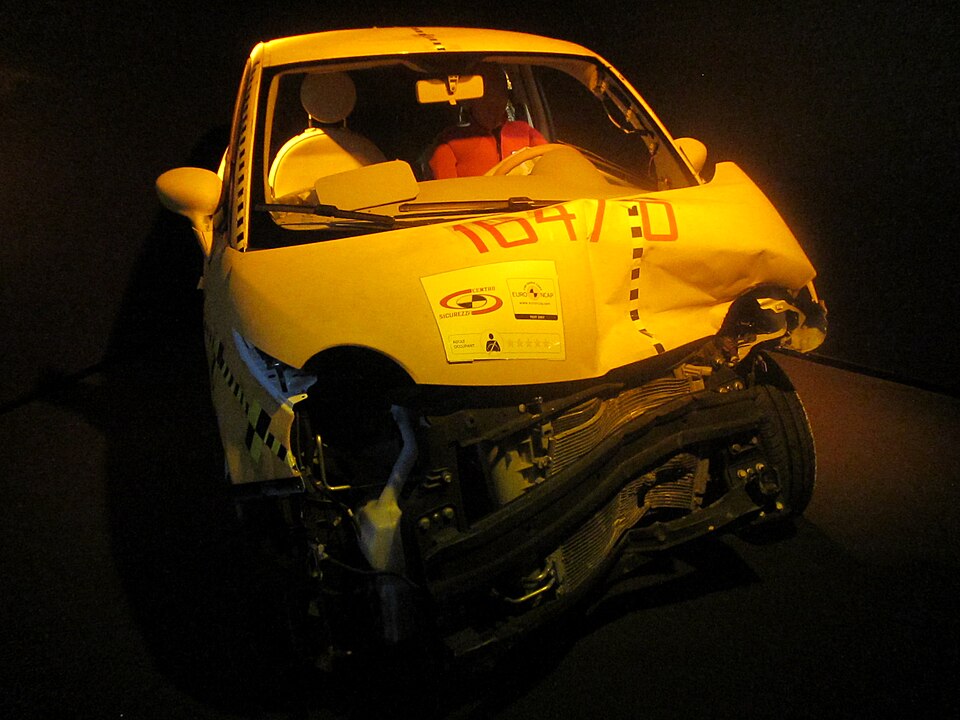
Here is the counter-intuitive one. Engineers work hard to make cars worse at bouncing, because a car that rebounds off a wall has changed its momentum far more than one that stops dead, and a bigger momentum change means a bigger force on the people inside.
The crumple zone is a machine for converting kinetic energy into bent metal, and every joule it eats is a joule that never reaches the passenger compartment. Sticking together is the safe outcome.
4. Railway wagons coupling — perfectly inelastic by design
A rolling wagon nudges a stationary one, the couplers latch, and the pair moves off together at a single shared velocity. This is the textbook definition made of steel: e = 0, one final velocity, maximum energy loss. That energy is exactly what the draft gear and buffers are built to absorb.
5. Sports balls — the middle of the dial
A tennis ball, a football and a cricket ball all live in the partially inelastic band: bouncy, but never perfectly so. Change a ball’s restitution and you change the game: a livelier ball rebounds faster, rallies shorten, and the whole sport shifts. Which is why the rules of tennis, as we saw above, pin e to roughly 0.73 to 0.76 without ever naming it.
Common Misconceptions About Elastic and Inelastic Collisions
“Momentum is lost in an inelastic collision.”
It is not. Momentum is conserved in every collision in an isolated system, inelastic ones included. The word “inelastic” refers to kinetic energy and nothing else. If a marker scheme ever asks which quantity distinguishes the two types, the answer is never momentum.
“The lost kinetic energy is destroyed.”
Energy is never destroyed — it changes form. In an inelastic collision the kinetic share drops while heat, sound and deformation energy rise by precisely the same amount. Saying “energy is lost” is a convenient shorthand that means “lost from the kinetic column”, and it is worth being strict about that in an exam answer.
“Elastic means the objects are made of something stretchy.”
The everyday sense of the word actively misleads here. A rubber band is elastic in the shop; two steel ball bearings collide far more elastically than two rubber balls do. What earns the label is whether the material returns its stored energy to the motion, not whether it feels soft.
“A moving object can never push a target faster than it was going.”
Intuition says a ball cannot come off faster than the thing that hit it. Run the elastic formula with a heavy object striking a much lighter one, and v2 approaches 2u1 — double the striker’s speed. This is why a golf ball leaves the tee faster than the club head that struck it, and momentum is conserved throughout because the ball is so light. It is the clearest sign that the elastic formulas are telling you something your gut is not.
How Elastic and Inelastic Collisions Relate to Impulse and Newton’s Laws
Collisions are not an isolated topic; they are the meeting point of four ideas you have already met, which is exactly why examiners like them so much.
Newton’s third law is the reason momentum survives
The two objects push on each other with equal and opposite forces for the same contact time, so the momentum one gains is the momentum the other loses. That symmetry is written directly into Newton’s laws of motion, and it holds whether the collision is elastic or inelastic. Nothing about squashing, heating or sticking touches it.
Impulse is what each object actually feels
Impulse — force multiplied by contact time — equals the change in momentum, and it is the quantity that decides whether a crash is survivable. An elastic collision reverses your velocity and therefore demands a far bigger impulse than one that merely stops you; that is the physics an airbag exploits, as our guide to momentum and impulse explains.
Kinetic energy is the independent bookkeeper
Momentum and kinetic energy are separate accounts that happen to be kept in the same collision. One is a vector that always balances; the other is a scalar that only balances when e = 1. Treating them as two names for the same thing is the single most expensive error in this topic.
Worked Problems
Show Solution
Solution:
Step 1: The cars stick together, so this is perfectly inelastic. Momentum is conserved: m1u1 + m2u2 = (m1 + m2)v
Step 2: Substitute, taking the direction of travel as positive: (1200 kg)(15 m/s) + (800 kg)(0 m/s) = (1200 kg + 800 kg)v
Step 3: 18 000 kg·m/s = (2000 kg)v, so v = 18 000 / 2000 = 9.0 m/s
Answer: 9.0 m/s in the original direction of travel
Show Solution
Solution:
Step 1: Use the relative-velocity shortcut for an elastic collision: u1 – u2 = v2 – v1, so 2.5 – 0 = v2 – v1
Step 2: Conservation of momentum: (0.20)(2.5) + (0.20)(0) = (0.20)v1 + (0.20)v2, which simplifies to v1 + v2 = 2.5 m/s
Step 3: Solve the pair: adding v2 – v1 = 2.5 to v1 + v2 = 2.5 gives 2v2 = 5.0, so v2 = 2.5 m/s and v1 = 0
Step 4: Check the energy: before = ½(0.20)(2.5)2 = 0.625 J; after = ½(0.20)(2.5)2 = 0.625 J. Conserved, as an elastic collision requires.
Answer: v1 = 0 and v2 = 2.5 m/s — equal masses simply exchange velocities
Show Solution
Solution:
Step 1: With the target at rest, the elastic formulas reduce to v1 = [(m1 – m2)/(m1 + m2)]u1 and v2 = [2m1/(m1 + m2)]u1
Step 2: v1 = [(5.0 – 1.5)/(5.0 + 1.5)](6.0) = (3.5/6.5)(6.0) = 3.23 m/s
Step 3: v2 = [2(5.0)/(6.5)](6.0) = (10/6.5)(6.0) = 9.23 m/s
Step 4: Momentum check: before = (5.0)(6.0) = 30 kg·m/s; after = (5.0)(3.23) + (1.5)(9.23) = 16.2 + 13.8 = 30 kg·m/s
Step 5: Energy check: before = ½(5.0)(6.0)2 = 90 J; after = ½(5.0)(3.23)2 + ½(1.5)(9.23)2 = 26.1 + 63.9 = 90 J
Answer: v1 = 3.2 m/s and v2 = 9.2 m/s — the pin leaves faster than the ball ever moved, and both laws still balance
Show Solution
Solution:
Step 1: For a drop onto a fixed floor, e = sqrt(h_bounce / h_drop). The floor does not move, so the approach and separation speeds are just the ball’s.
Step 2: Substitute: e = sqrt(0.90 m / 1.60 m) = sqrt(0.5625)
Step 3: Solve: e = 0.75
Answer: e = 0.75 — a partially inelastic collision, since 0 < e < 1
Show Solution
Solution:
Step 1: Kinetic energy before: KE = ½(1200 kg)(15 m/s)2 = 135 000 J = 135 kJ
Step 2: Kinetic energy after, using v = 9.0 m/s for the combined 2000 kg: KE = ½(2000 kg)(9.0 m/s)2 = 81 000 J = 81 kJ
Step 3: Energy lost = 135 kJ – 81 kJ = 54 kJ, which is 54/135 = 0.40 of the original
Step 4: Verify with the reduced-mass formula. μ = (1200)(800)/2000 = 480 kg, and with e = 0: KE lost = ½(480)(1 – 0)(15)2 = 54 000 J. It agrees.
Answer: 54 kJ lost, or 40% of the original kinetic energy — while every kg·m/s of momentum survived
Show Solution
Solution:
Step 1: Use the general restitution formulas: v1 = [m1u1 + m2u2 + m2e(u2 – u1)]/(m1 + m2)
Step 2: v1 = [(2.0)(4.0) + 0 + (3.0)(0.60)(0 – 4.0)]/5.0 = [8.0 – 7.2]/5.0 = 0.16 m/s
Step 3: v2 = [m1u1 + m2u2 + m1e(u1 – u2)]/(m1 + m2) = [8.0 + (2.0)(0.60)(4.0)]/5.0 = [8.0 + 4.8]/5.0 = 2.56 m/s
Step 4: Momentum check: after = (2.0)(0.16) + (3.0)(2.56) = 0.32 + 7.68 = 8.0 kg·m/s, matching the 8.0 kg·m/s before.
Step 5: Energy: before = ½(2.0)(4.0)2 = 16.0 J; after = ½(2.0)(0.16)2 + ½(3.0)(2.56)2 = 0.026 + 9.83 = 9.86 J, so 6.14 J was lost.
Answer: v1 = 0.16 m/s, v2 = 2.6 m/s, and 6.1 J of kinetic energy became heat and sound
Show Solution
Solution:
Step 1: The bullet embeds, so the collision is perfectly inelastic. Momentum is conserved: m_b·u_b = (m_b + m_B)v
Step 2: (0.010 kg)(400 m/s) = (0.010 + 2.49)v, so 4.0 kg·m/s = (2.50 kg)v, giving v = 1.6 m/s
Step 3: The swing is a separate stage. Once the bullet is embedded nothing more is lost, so mechanical energy is conserved on the way up: ½(m_b + m_B)v2 = (m_b + m_B)gh, which reduces to h = v2/2g
Step 4: h = (1.6 m/s)2 / (2 × 9.81 m/s2) = 2.56/19.62 = 0.130 m
Step 5: Energy before = ½(0.010)(400)2 = 800 J. Energy just after = ½(2.50)(1.6)2 = 3.2 J. Retained = 3.2/800 = 0.004
Answer: v = 1.6 m/s, h = 0.130 m, and only 0.4% of the kinetic energy survives — 99.6% went into splintering and heating the wood