A banked curve is a road or track tilted inward around a bend so that the surface’s normal force supplies part or all of the centripetal force needed to turn. For the ideal, friction-free case the banking angle satisfies tan θ = v2 / (r · g), where v is speed, r is the radius of the bend and g is gravitational field strength.
Take a motorway slip road a shade too fast and something odd happens: the car presses you down into the seat rather than flinging you at the door. That is the banking earning its keep. The road is tilted, and the tilt converts part of the surface’s push into a sideways shove aimed straight at the centre of the bend.
Racetracks push the same trick to extremes — Daytona’s turns lean over at 31°, a velodrome bend at 42°, and an airliner does it in mid-air by simply rolling its wings. Three wildly different machines, one equation.
What Is a Banked Curve?
A banked curve is a bend whose surface is tilted inward, so the road’s normal force gains a horizontal component that pushes the vehicle toward the centre of the turn. Engineers call the tilt superelevation; physicists call the tilt angle the banking angle, θ.
Picture a flat roundabout on a wet morning. The only thing dragging your car into the curve is the grip between four rubber patches and the tarmac — and grip is the first thing to vanish in rain, oil or ice. Tilt that same surface and the road starts doing the work itself.
The reason is geometry, not magic. A surface always pushes perpendicular to itself, so tilting the surface tilts the push. Part of that push still holds the car up; the rest now points sideways, into the bend.
That sideways part is the centripetal force. Every object moving in a circle needs one, whether it comes from friction, tension, gravity or — here — a slanted road. If the idea of a force that constantly turns you without speeding you up is still slippery, our guide to circular motion in physics lays the groundwork this article builds on.
The Banked Curve Formula: tanθ = v2/rg
The banking angle for a frictionless curve is given by tan θ = v2 / (r · g). This single relation is the whole topic in one line.
Rearranged for the two other things you are usually asked to find:
| Symbol | Quantity | SI unit |
|---|---|---|
| θ | Banking angle of the surface from the horizontal | degree or radian (dimensionless) |
| v | Speed of the vehicle along the bend | metre per second (m/s) |
| r | Radius of the circular path | metre (m) |
| g | Gravitational field strength (9.81 on Earth) | newton per kilogram (N/kg), or m/s2 |
| m | Mass of the vehicle — does not appear in the formula | kilogram (kg) |
Notice what is missing. There is no m anywhere on the right-hand side, so a 900 kg hatchback and a 40-tonne articulated lorry need the identical banking angle at the same speed and radius. Mass cancels — we will see exactly where in the derivation below.
Because v is squared and r sits on the bottom, the angle is brutally sensitive to speed and radius: double the speed and tan θ quadruples; halve the radius and tan θ doubles. If you would rather feed in your own numbers than push a calculator around, our Banked Curve Calculator solves for the angle, the ideal speed or the radius and shows the working line by line.
How a Banked Curve Works: Deriving tanθ = v2/rg
The derivation comes from applying Newton’s second law separately to the vertical and horizontal directions. Only two forces act in the ideal case: the weight mg pulling straight down, and the normal force N pressing perpendicular to the tilted road.
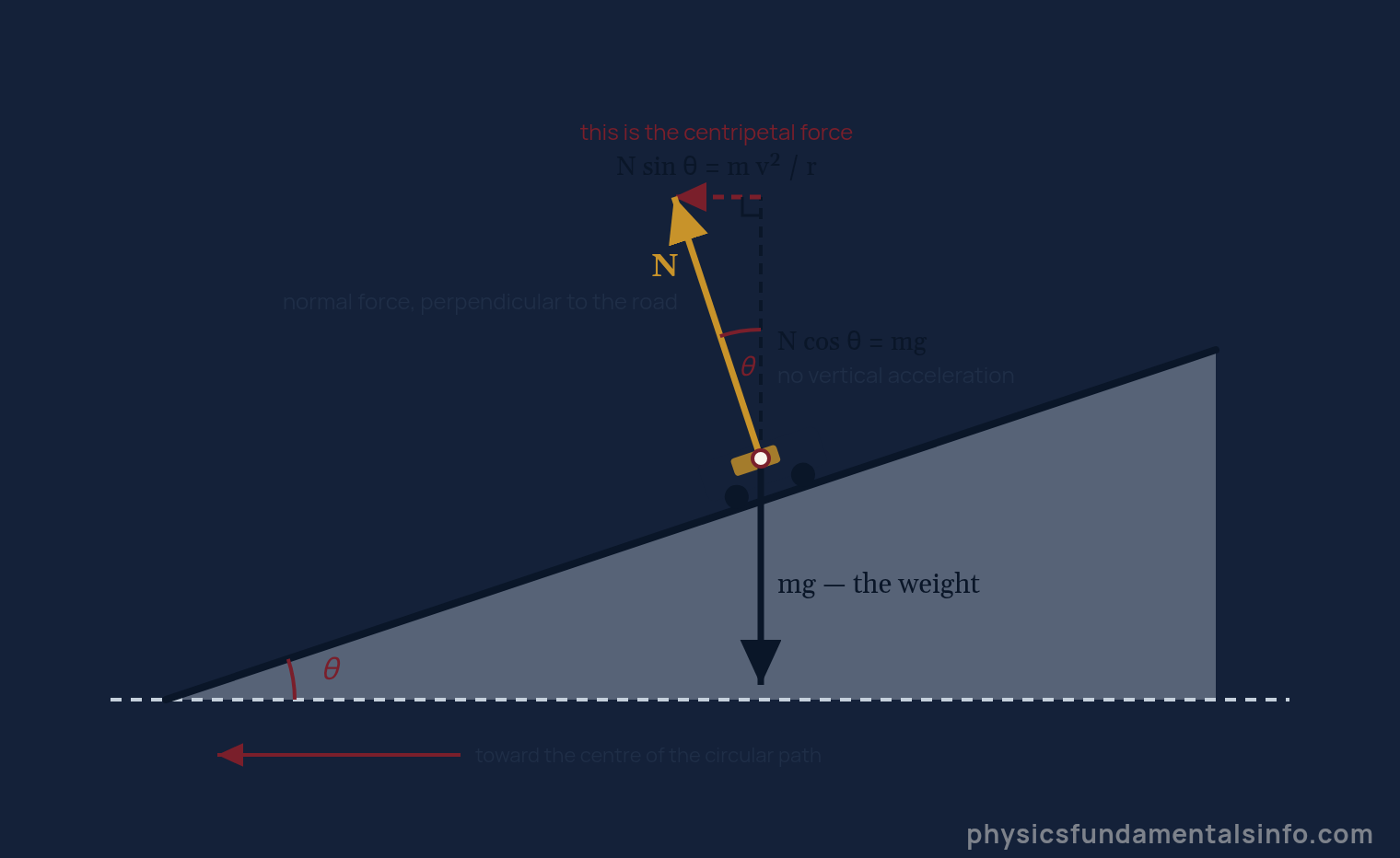
Free-body diagram of a banked curve. The normal force N splits into a vertical part that balances the weight and a horizontal part that supplies the centripetal force; dividing one by the other gives tan θ = v2 / (r · g).
Step 1 — Resolve vertically
Nothing accelerates up or down, so the vertical forces must cancel exactly. The upward slice of N has to match the full weight:
Step 2 — Resolve horizontally
Horizontally there is an acceleration — the centripetal acceleration v2/r, pointing at the centre of the bend. The sideways slice of N is the only force available to cause it, which is Newton’s second law applied along a single axis:
Step 3 — Divide, and watch things vanish
Divide the horizontal equation by the vertical one. Both N and m appear on both sides, so both cancel, and sin θ over cos θ collapses to tan θ:
That is why mass never enters the answer. A heavier vehicle needs more centripetal force, but it also presses harder into the road and gets a proportionally bigger N in return — the two effects cancel perfectly.
One consequence catches almost everyone out. Rearranging Step 1 gives N = mg / cos θ, which is larger than the weight, not smaller. On a 12° bank the road pushes about 2% harder than mg; at 42° in a velodrome it pushes roughly 35% harder, which is exactly why sprinters feel crushed into their pedals through the bend.
Banked Curves With Friction: the Safe Speed Range
Add friction and a single ideal speed becomes a band of safe speeds, bounded by a minimum and a maximum. The frictionless answer is the one speed at which the tyres need do nothing sideways at all — every other speed leans on grip.
Go faster than the ideal speed and the car tends to ride up the bank, so static friction acts down the slope to hold it in. Go slower and it tends to slide down, so friction flips and acts up the slope.
- μs — coefficient of static friction between tyre and surface (dimensionless)
- If μs ≥ tan θ, the bracket in v_min goes negative or zero: there is no minimum speed, and the vehicle can sit still without sliding.
- If μs · tan θ ≥ 1, the denominator in v_max vanishes: the model predicts no upper limit, and the real limit becomes rollover, not skidding.
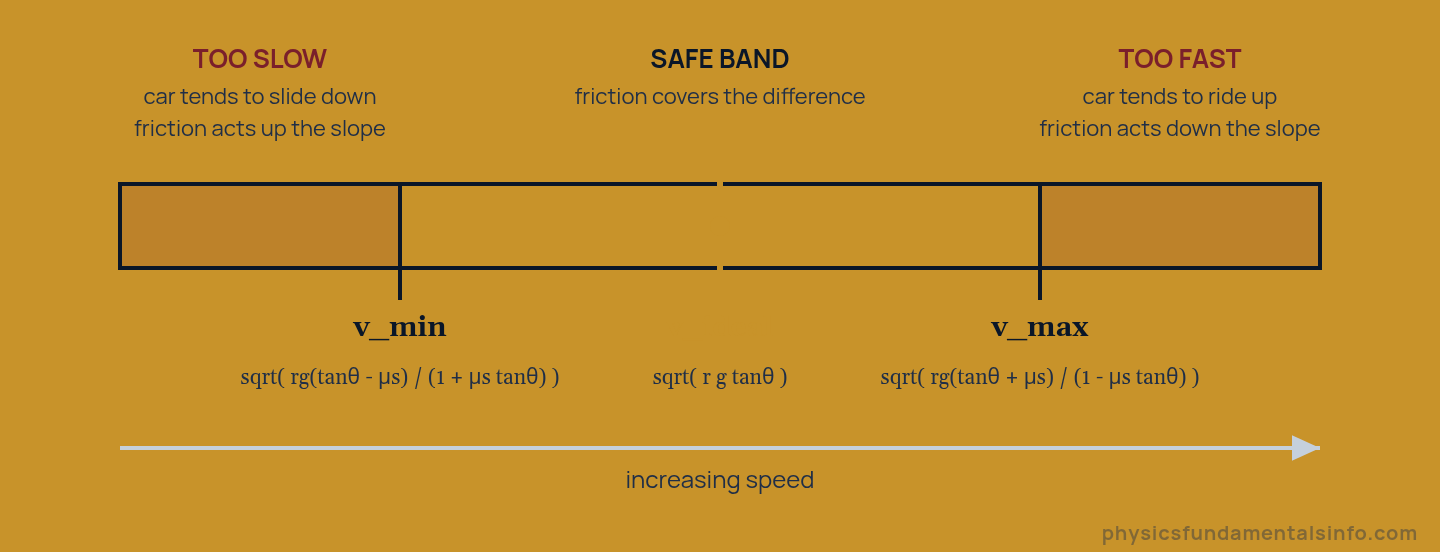
On a real banked curve friction turns one ideal speed into a safe band. Only at v_ideal does the tyre need no sideways grip at all.
The size of that band is why banking is worth building. A 120 m curve banked at just 8.00° with μs = 0.60 holds up to 30.9 m/s (111 km/h); flatten it out and the same tyres let go at 26.6 m/s (95.7 km/h). Eight degrees buys roughly 16% more speed — and, more importantly, a margin for when it rains.
Real-World Examples of Banked Curves
Banked curves appear anywhere something heavy has to change direction quickly, from motorway slip roads to airliners at cruise. What changes between them is how much of the job the tilt does and how much is left to grip.
| Setting | Bank angle θ | Bend radius r | Ideal speed from tanθ = v2/rg | What actually happens |
|---|---|---|---|---|
| Urban road curve (4% superelevation) | about 2.3° | about 60 m | about 17 km/h | Almost all the cornering force comes from tyre grip |
| Rural highway curve (8% superelevation) | about 4.6° | about 400 m | about 64 km/h | Friction supplies the rest up to the design speed |
| Daytona International Speedway, turns | 31° | about 305 m (1000 ft) | about 153 km/h | Cars race far faster, so tyres still carry a big share |
| Velodrome bend (250 m Olympic track) | 42° to 45° | about 22 m | about 50 km/h | Race speeds of 50 to 70 km/h sit right at the design point |
| Airliner in a steady 30° bank | 30° | about 11 km | about 900 km/h (250 m/s) | No friction exists at all, so the match is exact |
Highways: the tilt is deliberately too shallow
Here is the number that surprises people. A 400 m motorway curve taken at 108 km/h would need a frictionless bank of 12.9° — a cross-slope of about 23%, steep enough that a parked lorry would slither off it in the wet.
So designers never build the frictionless angle. They split the load between superelevation e and side friction f using e + f = v2 / (gR), and cap e at roughly 4% to 10% depending on climate and terrain. The Federal Highway Administration’s summary of the AASHTO guidelines sets out that range and why agencies pick different values.
Oval racetracks: banking as a speed multiplier
Daytona’s 31° turns and Talladega’s 33° are the steepest in NASCAR, and the payoff is blunt. At Daytona’s roughly 305 m corner radius the frictionless design speed is only about 153 km/h — yet cars circulate at well over twice that, which tells you the tyres are still doing enormous work even on the steepest banking in the sport.
Velodromes: the one place the formula is nearly exact
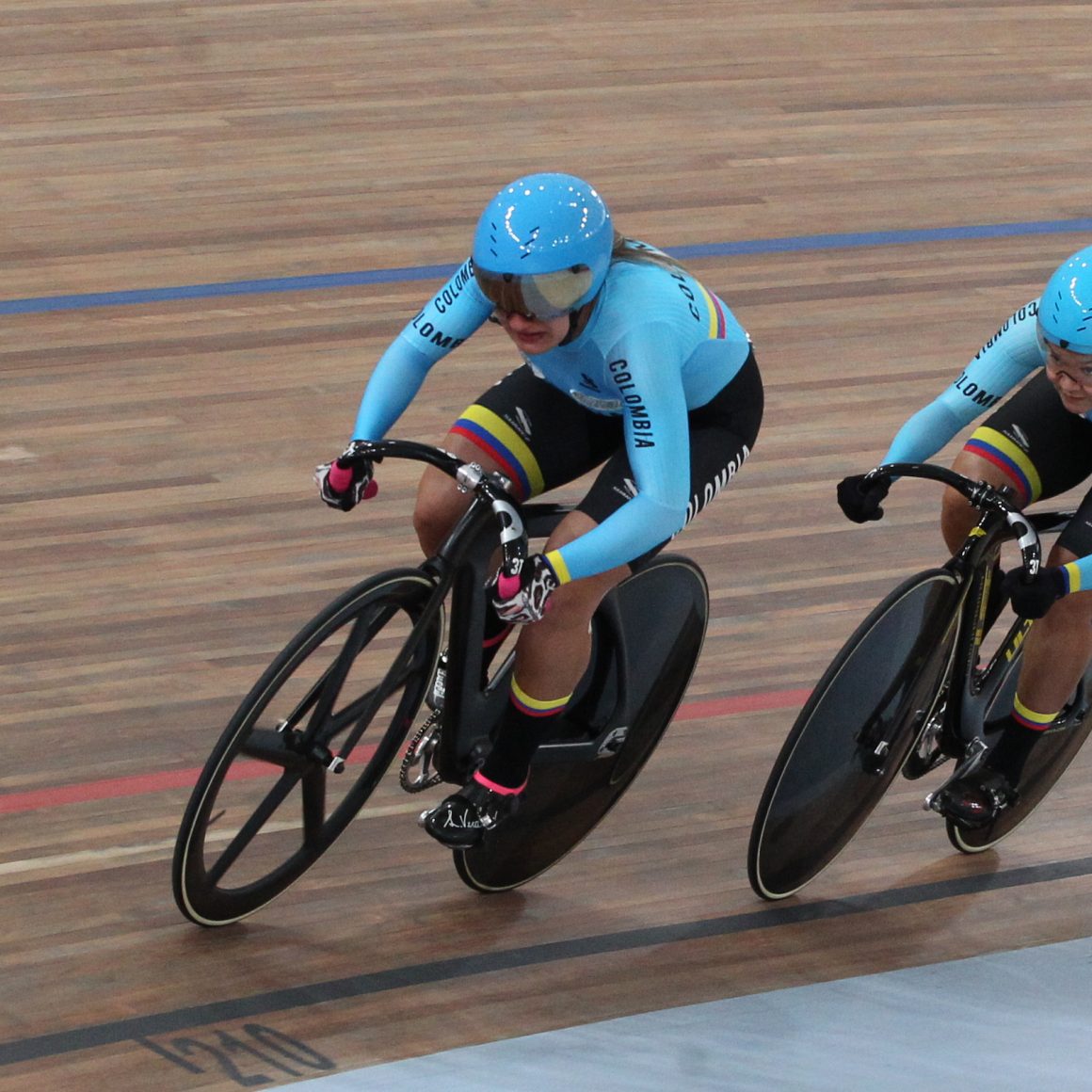
A 250 m Olympic velodrome banks its bends at roughly 42° to 45°, with a bend radius near 22 m. Plug those in and tan θ = v2/rg predicts an ideal speed of about 50 km/h — squarely inside the 50 to 70 km/h band riders actually hold. Track builders are, in effect, solving this equation for a living.
Aircraft: banking without a road
An aeroplane has no surface to push against, so it tilts the lift vector instead by rolling its wings. NASA’s explainer on banking turns describes the same split we derived: one component of lift opposes the weight, the other becomes an unopposed sideways force that curves the flight path.
The maths is identical with L in place of N, which is why tan θ = v2/(rg) also gives an aircraft’s turn radius. It also explains the load factor: at a 30° bank the wings must generate about 1.15 times the aircraft’s weight, and at 60° exactly double it.
Common Misconceptions About Banked Curves
Four errors account for most of the marks lost on banked-curve questions. Each one is easy to spot once you know its signature.
1. “Centrifugal force pushes the car outward”
In the ground frame there is no outward force at all. The net force on the car points inward, toward the centre of the bend — that is the entire reason the car turns instead of carrying straight on.
What you feel pressing you against the door is your own inertia plus the seat pushing you inward. Adding a phantom outward force to a free-body diagram drawn in the ground frame will wreck the equations every time.
2. “The normal force is mg cos θ”
This is the single most expensive slip in the topic, imported wholesale from inclined-plane problems. On a stationary inclined plane the block does not accelerate, so N = mg cos θ.
On a banked curve the vehicle is accelerating — horizontally, toward the centre. Resolving vertically gives N cos θ = mg, so N = mg / cos θ, which is bigger than the weight rather than smaller. If your N comes out less than mg, you have used the wrong diagram.
3. “Heavier vehicles need a steeper bank”
Mass cancels in the derivation, so a scooter and a loaded lorry need exactly the same angle for the same speed and radius. It feels wrong because a lorry obviously needs more force — but it also generates more normal force in proportion, and the two effects divide out.
4. “A steeper bank is always safer”
Steeper banking raises the maximum speed, but it also creates a minimum speed. Once tan θ exceeds μs, a vehicle moving too slowly simply slides down the slope — which is precisely why highway engineers cap superelevation in regions where snow and ice are likely and traffic sometimes crawls.
How Banked Curves Relate to Circular Motion, Friction and Inclined Planes
A banked curve is where three earlier topics collide, which is why it usually appears late in a mechanics course. It is a circular-motion problem, solved with an inclined-plane geometry, refereed by friction.
- Circular motion supplies the requirement: any object on a circular path needs a centripetal force of magnitude mv2/r aimed at the centre. Banking is simply one way of sourcing it.
- Inclined planes supply the geometry — the same sin θ and cos θ resolution — but with a crucial difference: here the acceleration is horizontal, not along the slope, so the axes are chosen differently.
- Friction supplies the tolerance. It converts a single ideal speed into a workable range, and its role in the wider family of contact forces is what makes real roads usable at any speed.
Get comfortable with the two-axis resolution here and the same technique carries straight over to conical pendulums, loop-the-loops and satellite orbits. The forces change; the method does not.
Worked Problems
Show Solution
Solution:
Step 1: For the ideal frictionless case, tan θ = v2 / (r · g).
Step 2: tan θ = (15.0 m/s)2 / (80.0 m × 9.81 m/s2) = 225 / 784.8
Step 3: tan θ = 0.2867, so θ = arctan(0.2867) = 16.0°
Answer: θ = 16.0° (3 s.f.)
Show Solution
Solution:
Step 1: Rearranging tan θ = v2/(r·g) gives v = sqrt( r · g · tan θ ).
Step 2: tan 12.0° = 0.2126, so v2 = 200 m × 9.81 m/s2 × 0.2126 = 417.0 m2/s2
Step 3: v = sqrt(417.0) = 20.4 m/s
Answer: v = 20.4 m/s (73.5 km/h, 3 s.f.)
Show Solution
Solution:
Step 1: Resolving vertically, N cos θ = mg, so N = mg / cos θ.
Step 2: N = (1200 kg × 9.81 m/s2) / cos 12.0° = 11772 N / 0.9781
Step 3: N = 12035 N; the weight itself is mg = 11772 N.
Answer: N = 1.20 × 10⁴ N, which is 2.2% larger than the weight — not smaller, as mg cos θ would wrongly suggest.
Show Solution
Solution:
Step 1: Rearranging tan θ = v2/(r·g) for r gives r = v2 / (g · tan θ).
Step 2: tan 42.0° = 0.9004, so g · tan θ = 9.81 m/s2 × 0.9004 = 8.833 m/s2
Step 3: r = (14.0 m/s)2 / 8.833 m/s2 = 196 / 8.833 = 22.2 m
Answer: r = 22.2 m — close to the real bend radius of a 250 m Olympic velodrome.
Show Solution
Solution:
Step 1: v_max = sqrt( r · g · (tan θ + μs) / (1 – μs · tan θ) ), with tan 8.00° = 0.1405.
Step 2: numerator bracket = 0.1405 + 0.60 = 0.7405; denominator bracket = 1 – (0.60 × 0.1405) = 0.9157
Step 3: v_max2 = 120 m × 9.81 m/s2 × (0.7405 / 0.9157) = 1177.2 × 0.8087 = 951.9 m2/s2, so v_max = 30.9 m/s
Step 4: On a flat curve, v = sqrt(μs · g · r) = sqrt(0.60 × 9.81 × 120) = sqrt(706.3) = 26.6 m/s
Answer: 30.9 m/s (111 km/h) banked against 26.6 m/s (95.7 km/h) flat — about 16% more speed from just 8° of tilt.
Show Solution
Solution:
Step 1 (a): v = sqrt( r · g · tan θ ) with tan 31.0° = 0.6009.
Step 2 (a): v2 = 305 m × 9.81 m/s2 × 0.6009 = 1798 m2/s2, so v = 42.4 m/s
Step 3 (b): v_max2 = r·g·(tan θ + μs)/(1 – μs·tan θ) = 2992 × (1.5009 / 0.4592) = 2992 × 3.268
Step 4 (b): v_max2 = 9779 m2/s2, so v_max = 98.9 m/s
Answer: (a) 42.4 m/s (153 km/h). (b) 98.9 m/s (356 km/h) — the skid limit, well above the aerodynamic and regulatory limits that actually govern race speeds.
Show Solution
Solution:
Step 1: tan 25.0° = 0.4663, and r · g = 60.0 m × 9.81 m/s2 = 588.6 m2/s2.
Step 2: v_max2 = 588.6 × (0.4663 + 0.15) / (1 – 0.15 × 0.4663) = 588.6 × (0.6163 / 0.9301) = 390.0, so v_max = 19.7 m/s
Step 3: v_min2 = 588.6 × (0.4663 – 0.15) / (1 + 0.15 × 0.4663) = 588.6 × (0.3163 / 1.0700) = 174.0, so v_min = 13.2 m/s
Answer: safe range 13.2 m/s to 19.7 m/s (47.5 to 71.1 km/h). Below 13.2 m/s the car slides down the bank — on a steep, slippery curve, going too slowly is a real hazard.