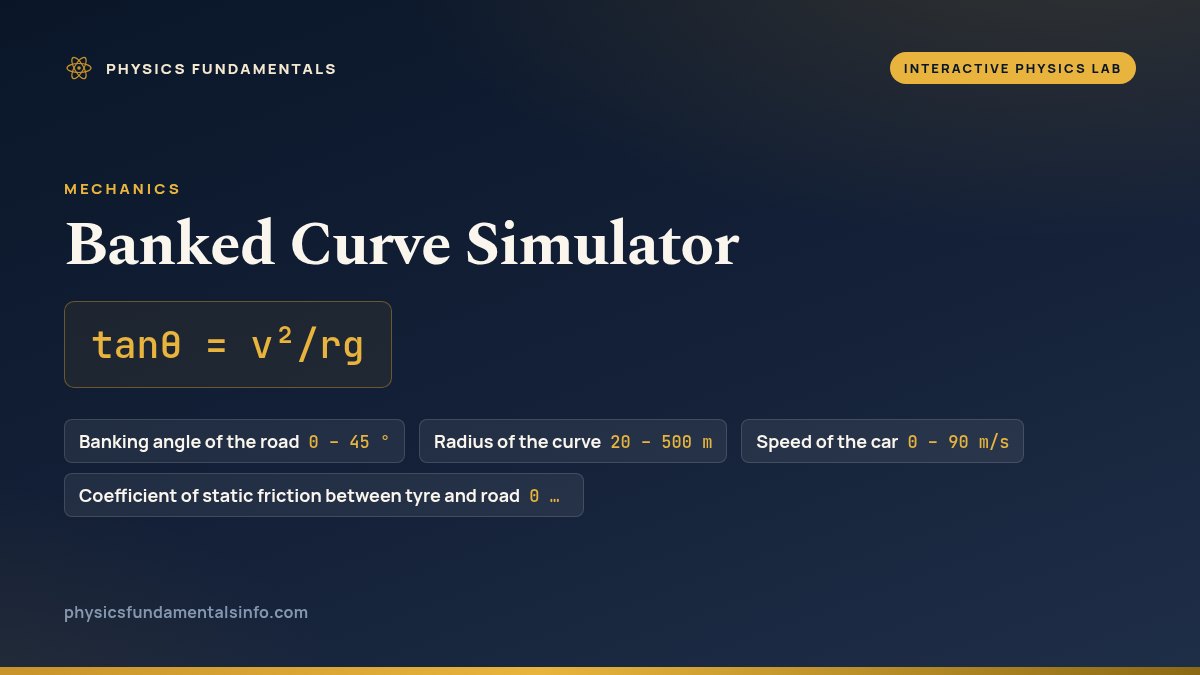
A banked curve turns a vehicle by tilting the road so that part of the normal force aims at the centre of the bend: tanθ = v²/rg. Move the angle, radius, speed and friction sliders below and watch the ideal speed, the required coefficient of friction and the safe speed band respond.
The Banked Curve
Tilt the road and part of the normal force starts aiming at the centre of the bend. At one speed the tilt does the whole job on its own. Move away from it and the friction readout comes off zero — and changes sign.
What Is the Banked Curve Simulator?
The banked curve simulator is a free interactive physics lab that runs in your browser — nothing to install and no sign-up. Move the angle, radius, speed and friction sliders and watch tanθ = v²/rg set the ideal no-friction speed live. It reports design speed, friction required μ, Centripetal acceleration and Status as you drag the sliders.
| Control | Range | Step |
|---|---|---|
| Banking angle of the road | 0 – 45 ° | 0.5 |
| Radius of the curve | 20 – 500 m | 5 |
| Speed of the car | 0 – 90 m/s | 0.5 |
| Coefficient of static friction between tyre and road | 0 – 1.5 | 0.05 |
How to use the banked curve simulator
Start with the two sliders that describe the road itself. Banking angle tilts the cross-section on screen, from flat out to a velodrome-steep 45°, and radius sets how tight the bend is, from a 20 m car park loop to a 500 m motorway sweeper. The ideal-speed readout answers to both, but not in the same way. Radius enters under a square root, so quadrupling it merely doubles the speed. The angle enters through a tangent, which climbs without limit, so the last five degrees of bank buy far more speed than the first five ever did.
Now move the speed slider and watch the friction readout rather than the picture. It reports a required coefficient rather than a force, and it carries a sign. Below the ideal speed it reads negative: the car is trying to slide down towards the inside of the bend, so friction has to act up the slope, and the arrow on the road points that way. Above the ideal speed it turns positive, the car is trying to ride up and out, and the arrow reverses. Press Set design speed and it lands on exactly zero rather than merely getting small. When you want that crossing point as a figure rather than a slider position, the Banked Curve Calculator solves it directly.
The friction slider is what turns one usable speed into a range of them. Raise it from zero and the minimum and maximum speeds pull away from the ideal speed in both directions; drop it back to zero and they collapse onto it, because with no grip at all exactly one speed works. That is the misconception this simulator exists to kill. Banking does not remove the need for friction at every speed, only at one speed, and everywhere else the tyres are still working — the readout tells you how hard. The full derivation behind that claim is in the banked curve physics guide.
The centripetal-acceleration readout is there to keep the rest honest. It reports v²/r in m/s² and again as a multiple of g, so you can tell at a glance when a combination has stopped describing a road and started describing a test track. It is the same quantity that drives every other problem in circular motion, arriving here by a different route.
Frequently asked questions
What does the ideal-speed readout mean?
It is the one speed at which the tilt of the road does the whole job of turning the car, so the tyres carry no sideways load at all. It comes straight from the design condition, tan of the banking angle equals v squared divided by r times g, rearranged to v = sqrt(r g tan of the angle). At exactly that speed the required-friction readout is zero and the car would hold its line on sheet ice. Every other speed needs friction to make up the difference, which is why one ideal figure turns into a band of usable speeds as soon as you give the tyres some grip.
Why does mass have no slider?
Because mass cancels out of every speed the panel reports. Writing the vertical and horizontal force equations and dividing one by the other removes both the normal force and the mass in a single step, leaving an expression in the angle, the radius and g alone. A heavier vehicle needs more centripetal force to hold the same line, but it also presses harder into the road and gets a proportionally larger reaction back, so the two effects cancel exactly. Mass would change how big the forces are without changing which speeds work, so a slider for it would move nothing on this panel. The force arrows are drawn as multiples of the weight for the same reason.
Why does the friction arrow reverse?
Friction on a banked curve is whatever is left over after the banking has done what it can, so its direction depends on which way the car is trying to slip. Below the ideal speed the banking supplies too much inward force, the car tends to slide down towards the inside of the bend, and static friction points up the slope to hold it. Above the ideal speed the banking supplies too little, the car tends to ride up and out, and friction reverses to point down the slope. Exactly at the ideal speed there is nothing left over, so the required coefficient passes through zero and the arrow disappears rather than merely shrinking.
What does "no slip limit" mean at steep angles?
The maximum-speed formula divides by 1 minus the friction coefficient times tan of the angle. Once that product reaches 1, the denominator vanishes and the sliding model claims there is no upper speed at all. That is not a physical prediction, it is the model running out of validity: with that much grip on that steep a bank, a real vehicle rolls over sideways long before its tyres let go. The simulator prints "no slip limit (rollover governs)" instead of an enormous number, because a number there would be more misleading than no answer.
Does the simulator model rollover?
No. It models sliding only, which is the standard treatment: the car is a point mass, and the only question asked is whether static friction can supply the shortfall between what the banking provides and what the corner demands. Rollover depends on things this model does not carry, chiefly the track width and the height of the centre of mass, and it becomes the binding limit long before the sliding formula does at steep angles with high grip. Where that happens the panel says so rather than quoting a speed it cannot justify.
References & formula source
- Halliday, Resnick & Walker — Fundamentals of Physics, ch. 6 (Force and Motion II), banked curves and the friction range.
- Young & Freedman — University Physics with Modern Physics, §5.4 (Dynamics of Circular Motion), the banked-curve worked example.
- AASHTO — A Policy on Geometric Design of Highways and Streets: superelevation and side-friction factors, e + f = v²/(gR).
- Further reading: Banked turn — Wikipedia