Dimensional analysis physics is the method of writing every quantity as a triple of exponents over the base dimensions mass, length and time: [M], [L] and [T]. An equation is admissible only if those exponents agree on both sides, and with three ingredients the same rule derives the shape of a law, never its constant.
Make a pendulum four times as long and its small swings take exactly twice as long. That factor of two is not measured and not looked up: it falls out of the exponents of mass, length and time, and nothing else about the pendulum gets a say.
This is the cheapest tool in physics and the most underrated one. It will tell you that a pendulum’s period cannot depend on the mass of the bob, that an orbital period has to go as the three-halves power of the radius, and that the third term in your working is in the wrong place — all before you solve anything. It also has a hard limit, and this page measures that limit rather than asserting it.
What Is Dimensional Analysis in Physics?
Dimensional analysis is the arithmetic of a quantity’s exponents: every mechanical quantity is mass to some power times length to some power times time to some power, and physics only lets you equate quantities whose three powers agree.
A dimension is not a unit, and the difference is the reason the method works. Measure a speed in metres per second, in miles per hour or in furlongs per fortnight and the number changes every time, while the exponents — one of length, minus one of time — never budge. The three dimensions do get their numbers from the SI base units, and the guide to SI units is where that scaffolding is set up.
Neither the idea nor the notation is new: Joseph Fourier introduced dimensional analysis and the dimension of a quantity in 1822.
Everything below rests on three claims, and each section is the evidence for one of them.
- Claim 1. A dimensional formula is a vector of three exponents, and the algebra is addition. Multiplying two quantities adds their vectors; raising one to a power scales its vector.
- Claim 2. Homogeneity does more than audit an equation. Three base dimensions give three equations, so three ingredients usually pin down exactly one set of exponents — which makes this a derivation, not a check.
- Claim 3. The method is necessary and nowhere near sufficient. A dimensionless factor is invisible to it, a dimensionally perfect equation can still be false, and when the ingredients are dimensionally dependent it cannot even choose between three different answers.
Claim 3 is the one most accounts leave out. It is also the most valuable of the three, because knowing precisely what a check cannot see is what stops you trusting it further than it goes.
The Dimensional Formula: [M], [L] and [T]
A quantity’s dimensional formula is its exponent triple — the powers a, b and c below, one for mass, one for length and one for time.
- a, b, c — the dimensional exponents of the quantity Q: the powers of mass, length and time in its dimensional formula. Pure numbers, with no unit of their own.
- [M], [L], [T] — the three base dimensions this page works in: mass, length and time. Their SI base units are the kilogram (kg), the metre (m) and the second (s).
- p, q, r — the trial exponents: the powers of the three ingredients in a trial law. Pure numbers, and what the method solves for.
- k — the dimensionless constant a law carries. A pure number, and never a dimensional result.
- residual — one number per base dimension: the trial’s exponent in that row minus the target’s. All three zero means homogeneous.
- n — a scaling exponent, the single power in Q2 / Q1 = (X2 / X1)n. Dimensionless.
Two rules do all of the work, and both are arithmetic on the triple.
Force is mass times acceleration, so add the vectors: (1, 0, 0) + (0, 1, -2) = (1, 1, -2). Force is [M1.00 L1.00 T-2.00], and no table was consulted to get there.
Energy is force times length, which adds (0, 1, 0) and lands on (1, 2, -2). Reach it the other way, as mass times the square of a speed, and the second rule gives (1, 0, 0) + 2 × (0, 1, -1) — the identical triple. Two routes, one answer: that is the first sign this is algebra rather than bookkeeping.
Pressure is energy per unit volume, and division subtracts: (1, 2, -2) − (0, 3, 0) = (1, -1, -2). Every quantity below was built this way.
Here is the whole mechanical vocabulary this page needs. The unit in the third column is a consequence of the exponents rather than an input to them, and if you want the finished laws these quantities appear in, the physics formulas reference is the list.
| Quantity | Dimensional formula (the exponent triple) | Coherent SI unit, which follows from the exponents |
|---|---|---|
| mass | [M1.00 L0.00 T0.00] | kg |
| length | [M0.00 L1.00 T0.00] | m |
| time | [M0.00 L0.00 T1.00] | s |
| area | [M0.00 L2.00 T0.00] | m2 |
| volume | [M0.00 L3.00 T0.00] | m3 |
| velocity | [M0.00 L1.00 T-1.00] | m/s |
| acceleration | [M0.00 L1.00 T-2.00] | m/s2 |
| force | [M1.00 L1.00 T-2.00] | kg·m/s2 |
| energy | [M1.00 L2.00 T-2.00] | kg·m2/s2 |
| power | [M1.00 L2.00 T-3.00] | kg·m2/s3 |
| pressure | [M1.00 L-1.00 T-2.00] | kg/(m·s2) |
| density | [M1.00 L-3.00 T0.00] | kg/m3 |
| momentum | [M1.00 L1.00 T-1.00] | kg·m/s |
| frequency | [M0.00 L0.00 T-1.00] | 1/s |
| linear density (mass per unit length) | [M1.00 L-1.00 T0.00] | kg/m |
| gravitational parameter GM | [M0.00 L3.00 T-2.00] | m3/s2 |
| dynamic viscosity | [M1.00 L-1.00 T-1.00] | kg/(m·s) |
| surface tension | [M1.00 L0.00 T-2.00] | kg/s2 |
| any pure number | [M0.00 L0.00 T0.00] | 1 (dimensionless) |
Read any row backwards and you have a sanity check worth having. A quantity with a mass exponent of zero cannot depend on a mass, however the algebra is dressed up.
Dimensional Homogeneity: Why a Balanced Equation Can Still Be Wrong
An equation is dimensionally homogeneous when every exponent on the left matches the exponent on the right — and homogeneity is necessary for a correct equation without being anywhere near sufficient.
The rule itself is as strong as rules in physics get: any physically meaningful equation must carry the same dimensions on both sides, which is what dimensional homogeneity means, and checking it is usually described as a plausibility test on a derived result. Two quantities of the same dimension can be compared even when they are written in different units; two of different dimensions cannot be compared at all, in any units whatever.
Try it on energy = mass × speed2. The left side is (1, 2, -2). On the right, (1, 0, 0) + 2 × (0, 1, -1) = (1, 2, -2), so the residual is zero in all three rows and the equation passes.
Now the part that matters. Write 2 m v2 instead of 1/2 m v2 and the check passes exactly as happily, because a pure number has no exponents to contribute. At m = 2.000 kg and v = 3.000 m/s, 1/2 m v2 gives 9.000 J while 2 m v2 gives 36.00 J: one of them is four times too big and dimensionally perfect. The mechanics formulas guide states that conclusion about the unit check; this is the page that measures it.
Three separate things are wrong with reading a successful check as a proof, and they are independent of each other.
- A dimensionless factor is invisible. One half, two, pi, and even a function of an angle all pass through unchanged, because none of them has a dimension to contribute.
- A balanced equation can simply be false. Energy = m v2 balances in every row and is wrong by a factor of two. No amount of checking will find that.
- Sometimes the check cannot even choose. When the ingredients are dimensionally dependent, three different exponent triples can all balance perfectly — the last section walks through exactly that case.
So the honest reading of a passed check is narrow: the equation is still in the running, and nothing more has been established.
How to Derive a Formula From Dimensions Alone
Write the quantity you want as a constant times three ingredients raised to unknown powers, demand that the exponents agree in every base dimension, and you have three linear equations for three unknowns.
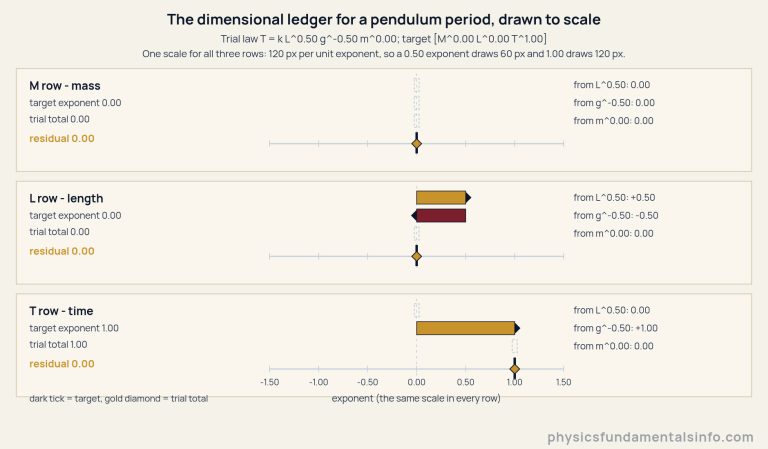
Take a pendulum. The quantity wanted is a period, so the target triple is (0, 0, 1), and the three ingredients offered are the length L, the gravitational acceleration g and the mass m of the bob.
One row per base dimension, and each row is an equation:
- M row. Of the three ingredients only the mass carries a mass dimension, so r = 0.
- L row. Length and gravity each carry one power of length, so p + q = 0.
- T row. Only gravity carries a time, and it carries two inverse powers of it, so −2q = 1.
Solve from the bottom up. The T row gives q = −0.50; the L row then gives p = 0.50; and the M row has already sent r to 0.00. Substituting those back reproduces the target exactly: 0.50 × (0, 1, 0) − 0.50 × (0, 1, -2) = (0, 0, 1).
The mass has dropped out of the problem altogether, and that is the method saying something physical. A heavy bob and a light one of the same length keep the same period.
What the working has earned is this, and dimensions stop here.
Those exponents are exact. No constant is available anywhere in that working: at small amplitude it happens to be 2 pi, which comes out of solving the equation of motion, and the pendulum period formula is where that constant and its conditions belong.
Three ingredients and three base dimensions make a three-by-three system, which is why it usually has exactly one answer. The word “usually” is carrying real weight there: when the ingredient matrix is singular, the system has either no solution or infinitely many, and both of those turn up further down this page.
The lab below is the same ledger with the exponents under your control. Each row is one base dimension, the bars are what the three ingredients contribute to it, and the gap between where they finish and where the target sits is the residual — the number that tells you which ingredient is wrong rather than merely that something is. Underneath, a log-log panel sets what your trial law predicts against what the exact physics does.
Why Dimensions Can Never Give You the Constant
Dimensions fix every exponent in a law and say nothing whatever about the dimensionless number in front of it.
The cleanest demonstration is three problems that come out with the identical exponent triple and have constants that are nothing like each other. A pendulum’s period from length and gravity, the time to fall from rest through a height, and the speed of a wave on a stretched string: all three land on (0.50, −0.50, 0.00).
| Problem | The law dimensions give | What k turns out to be — from the exact physics, never from the dimensions | k to four figures |
|---|---|---|---|
| period of a pendulum, from its length and gravity | T = k L0.50 g-0.50 | 2 pi, from solving the equation of motion at small amplitude | 6.283 |
| time to fall from rest through a height | t = k h0.50 g-0.50 | the square root of two, from the constant-acceleration solution | 1.414 |
| speed of a wave on a string, from its tension and linear density | v = k F0.50 mu-0.50 | exactly 1, from solving the wave equation on a string | 1.000 |
Read the last column. Across three problems whose dimensional answer is identical, the constants span a factor of 6.283 — so calling an exponent triple “the formula” can leave you wrong by more than six times.
The third row is the honest counterweight. For the string, k is exactly 1, so the dimensional answer happens to be the whole answer. The reach of this method is not uniform, and it would be just as misleading to claim it never gets you all the way.
There is a sharper version of the same blindness. A real pendulum’s period depends on how far back you pull it, and that dependence is invisible here, because an angle is a pure number: T = k sqrt(L / g) multiplied by any function of the angle you like is dimensionally identical. Work the exact series and you can see the size of what is being missed — at 30 degrees the true period runs 1.741 per cent above the small-amplitude value, and at 5 degrees it runs 0.04762 per cent above it.
That is why every appearance of 2 pi on this page carries the words “small amplitude”. The usual statement of the condition is an angle much less than one radian, often quoted as under 0.1 radians or about 6 degrees, and what goes as the cube of that angle is the error in the small-angle step itself, where sin theta is replaced by theta in radians. The period error that step produces goes as the square instead, which is what the two percentages above already show: cutting the amplitude sixfold divides the error by roughly six squared, not six cubed.
Where Scaling Works Without Any Formula at All
Because the constant cancels when you divide one instance of a power law by another, an exponent on its own predicts exactly how a quantity changes.
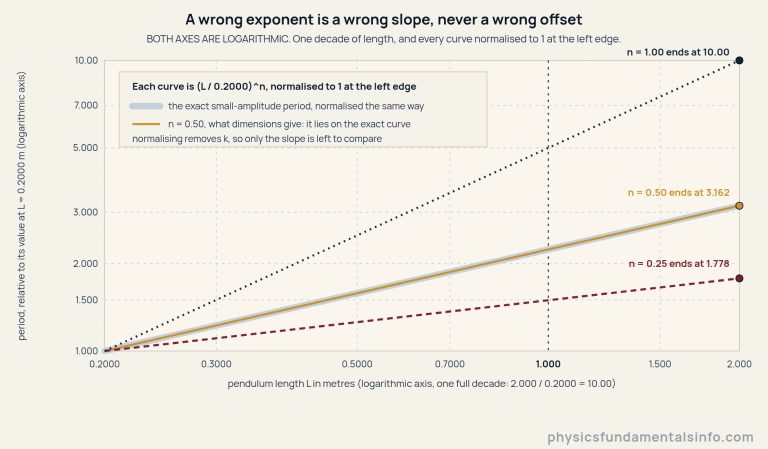
Divide Q = k Xn at two values of X and the k disappears — not approximately, and not only for small changes. What is left is a ratio raised to the exponent dimensions handed you, which you can do in your head or hand to the Dimensional Scaling Calculator, which also runs the relation backwards and returns the exponent itself.
The pendulum again, this time with no constant anywhere in sight. Four times the length is a length ratio of 4.000, and 4.0000.50 = 2.000, so the period doubles. Evaluate the exact small-amplitude formula separately at each length, with g at its defined standard value of 9.80665 m/s2, and it returns 1.419 s at 0.5000 m and 2.837 s at 2.000 m — two figures each rounded once from full precision, with an underlying ratio of 2.000.
Notice what you never had to do: convert anything. Both ratios are pure numbers, so whatever unit you measured in divides out of its own ratio and leaves no trace, and seconds with metres gives the identical factor to milliseconds with centimetres. The SI prefix converter is the tool for the conversion job proper; this calculation simply does not have one.
The same relation runs the other way, and that direction needs no theory at all. Take two satellites around one planet: the first at a radius of 7.000e+06 m with a period of 5829 s, the second at 4.200e+07 m with a period of 8.566e+04 s. Their periods stand in the ratio 14.70 and their radii in the ratio 6.000, so n = ln(14.70) / ln(6.000) = 2.688 / 1.792 = 1.500 — the exponent dimensions predict for an orbit, recovered from two observations with the constant cancelling out of the arithmetic.
Square that statement and you have the familiar one: the square of the period goes as the cube of the radius, which is Kepler’s third law. Dimensions got the three-halves out of a radius and a gravitational parameter with no theory of gravitation in sight; the constant is what they could not get, and the Kepler third law calculator is where that lives.
A wrong exponent does not shift a prediction up or down — it tilts the whole trend. Normalise two curves at one point and the constant is gone from both, which leaves the slope on a log-log plot as the only thing left to disagree about.
When the Method Refuses, and When It Cannot Choose
Two things can go wrong with those three equations, and neither is a failure of the method: they can have no solution, which means an ingredient is missing, or infinitely many, which means the ingredients are not independent.
Ask for a period from a length, a mass and an area. The M row sends the mass exponent to zero, the L row ties the length and area exponents together, and then the T row reads 0 = 1 — not one of the three ingredients carries a time, and the target is a time.
A brute-force sweep settles it more convincingly than the algebra does. Scan every exponent triple on a quarter-step grid from −4 to 4, which is 35,937 of them, and the smallest the T residual ever gets is exactly 1 in size, never 0. Nothing has broken: the method is telling you that an ingredient carrying a time is missing, and if you put gravity back the pendulum answer appears at once.
The second case is subtler and rather more interesting. Ask for a speed from a length, a gravitational acceleration and a time, and three different exponent triples all balance perfectly:
- (1.00, 0.00, −1.00), which reads v = L / t
- (0.50, 0.50, 0.00), which reads v = sqrt(L g)
- (0.00, 1.00, 1.00), which reads v = g t
All three are dimensionally perfect, and they are three physically different laws. The reason is that these ingredients are dimensionally dependent — an acceleration is already a length over a time squared — so the three equations are not independent and the system has no single answer. Homogeneity has not been violated here; it has run out of information.
The residual is therefore worth reading one dimension at a time, rather than as a single pass or fail. Nudge the pendulum’s mass exponent up to 0.25 and the M row breaks by 0.25 while the L and T rows stay at exactly zero. Nudge the gravity exponent to −0.25 instead and two rows break at once: the L row by 0.25 and the T row by −0.50. Which rows fail is what tells you which ingredient to look at.
Finally, the honest edge of the page. Three base dimensions are a choice rather than the whole system, and several neighbouring subjects are deliberately not here.
- Four more base dimensions exist. The International System of Quantities has seven base quantities — length, mass, time, electric current, thermodynamic temperature, amount of substance and luminous intensity — and a quantity’s dimension is a product of all seven raised to positive, negative or zero exponents. Charge, current, voltage and resistance need the electric-current one; entropy and specific heat need temperature; molar mass needs amount of substance. The same elimination runs in seven dimensions completely unchanged.
- Counting dimensionless groups is a different subject. That is the Buckingham pi theorem, which counts how many independent dimensionless groups a problem has, and nothing on this page computes or implies any part of it. For those groups in practice, and for dynamic similarity, the Reynolds number guide is the place to go.
- Nothing here is about natural units. Planck or geometrised units, directed dimensions and dimensional regularisation are all real physics and all out of scope; no figure above depends on any of them.