Angular momentum is how much rotation an object carries about a stated axis: the moment of inertia about that axis times the spin rate, L = Iω, which for a single mass on a circle comes to L = mvr. This free angular momentum calculator evaluates both forms at one state, rearranges them for the spin rate, the moment of inertia or the speed, and prints the rotational energy and the turn time beside the answer.
Load a real rotating system
Each button puts the Calculate toggle on the arrangement it needs, sets every unit menu back to SI and fills only that arrangement's boxes. Whatever the widget then works out is read back into the line underneath, so nothing there is stored text.
Pick a case above, or type your own numbers.
What Is the Angular Momentum Calculator?
The angular momentum calculator is a free online tool built on the formula L = Iω, which for a single mass going round a circle is the same quantity written L = mvr. Enter a moment of inertia and a spin rate, or a mass, a speed and a radius, and it returns the angular momentum with every step of the substitution; three more arrangements give back the spin rate, the moment of inertia or the speed instead. Beside the answer it prints the moment of inertia behind it, that spin rate in both rad/s and rpm, the kinetic energy of the rotation and the time for one turn.
| Symbol | Quantity | Default unit | Also accepts | Example value |
|---|---|---|---|---|
| L | Angular momentum | kg·m²/s | g·cm²/s | 14.6 |
| I | Moment of inertia | kg·m² | g·cm² | 5.84 |
| ω | Angular velocity | rad/s | rev/s, rpm, deg/s | 2.5 |
| m | Mass | kg | g, t | 3 |
| v | Speed | m/s | km/h, cm/s | 2 |
| r | Radius | m | cm, mm, km | 0.8 |
How to use the angular momentum calculator
- Pick an arrangement. The Calculate buttons open on L from inertia and spin. The other four are L from mass, speed, radius; Spin rate; Moment of inertia; and Speed. Only the boxes that arrangement needs stay on screen, so nothing hidden can steer the answer.
- Enter the quantities you have. Each box carries its own unit menu. A moment of inertia can go in as kg·m2 or g·cm2, a spin rate as rad/s, rev/s, rpm or deg/s, and a radius as m, cm, mm or km.
- Measure every radius from the axis you are quoting. Angular momentum has no meaning until an axis is named, and the same motion gives a different answer about a different point. Keep the axis fixed while you change anything else.
- Read the headline and the four extras. The headline is always in SI. Moment of inertia behind it is L divided by the spin rate, Spin rate behind it gives that rate in rad/s and rpm, Kinetic energy of the rotation is half of L times the spin rate, and Rotation period is the time for one turn.
- Open Show working. The steps restate the arrangement and substitute your figures in SI, whatever the menus are set to, so the arithmetic can be checked by hand.
The moment of inertia is the input most people have to find first, because it depends on shape as well as mass. A ring, a disc and a sphere of the same mass and radius all have different values, which is what the moment of inertia calculator is for; the guide to moment of inertia sets out where each shape factor comes from. Feed its answer straight into the first box here.
The spin rate has to be in radians per second before it multiplies anything, which is the second common stumble. A wheel quoted at 500 rpm is not turning at 500 rad/s, so either pick rpm from the menu and let the tool convert, or convert first with the angular velocity calculator; the angular velocity formula explained covers the radian-per-second convention in full. The extras always report the rate both ways so the conversion is visible.
The third slip is mixing the two arrangements in one sum. L from inertia and spin describes a whole body about its axis; L from mass, speed, radius describes one point mass on one circle. Adding a whole system's L to one of its own parts double-counts that part, and the worked table below shows the two figures side by side so the difference is obvious.
Worked example: change one thing at a time
The table below starts at the defaults and moves one thing at a time: the arrangement, then the units, then which quantity is the unknown. Each Result and Rotation energy cell was copied out of the running widget rather than worked out by hand, so where a cell and the tool ever part company, believe the tool. A dash marks a box the chosen arrangement does not show.
| Step | What the toggle is on | Moment of inertia | Spin rate | Mass, speed and radius | Angular momentum | Result | Rotation energy |
|---|---|---|---|---|---|---|---|
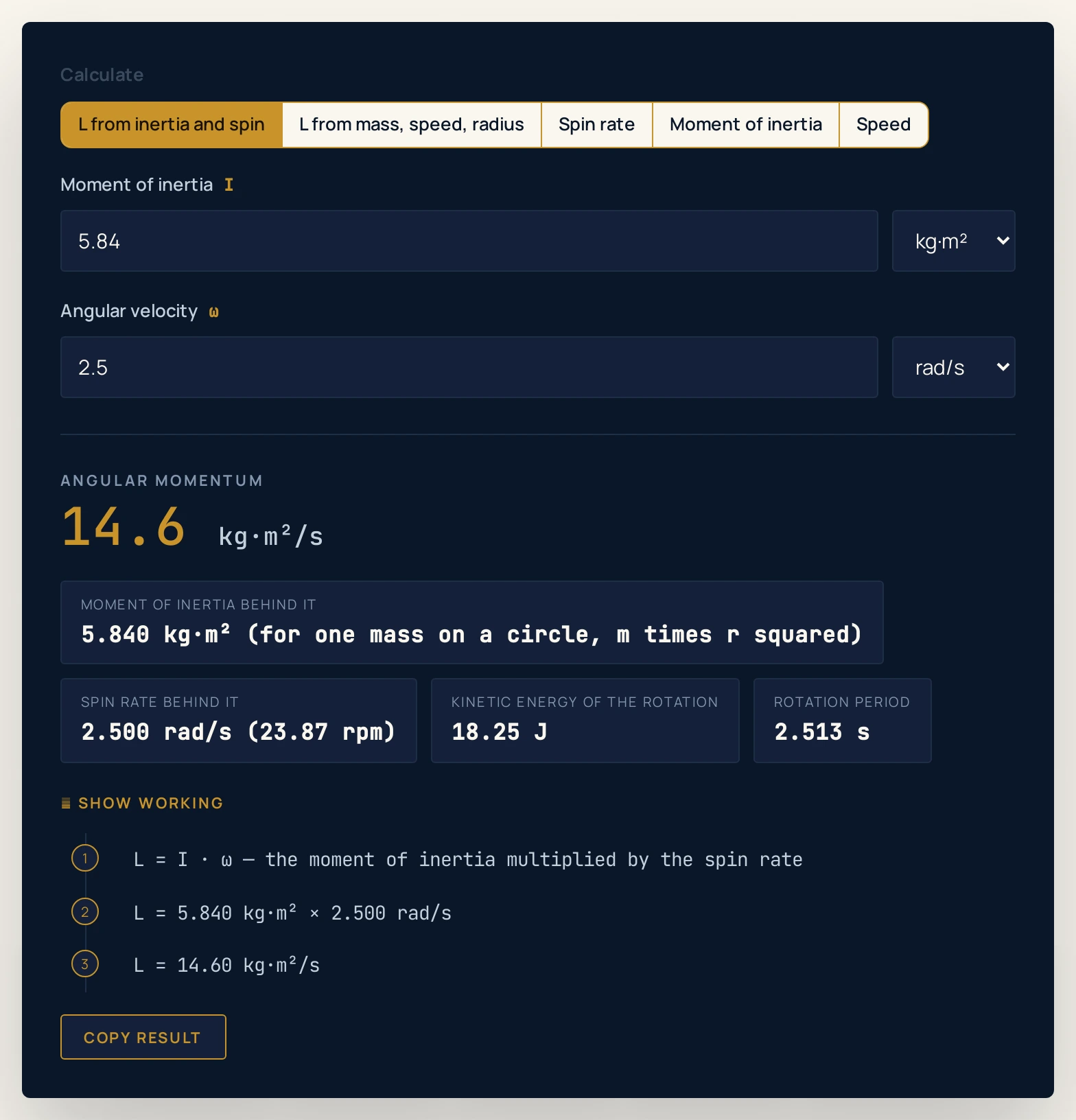
| Open the page on its defaults | L from inertia and spin | 5.84 kg·m² | 2.5 rad/s | — | — | 14.6 kg·m²/s | 18.25 J |
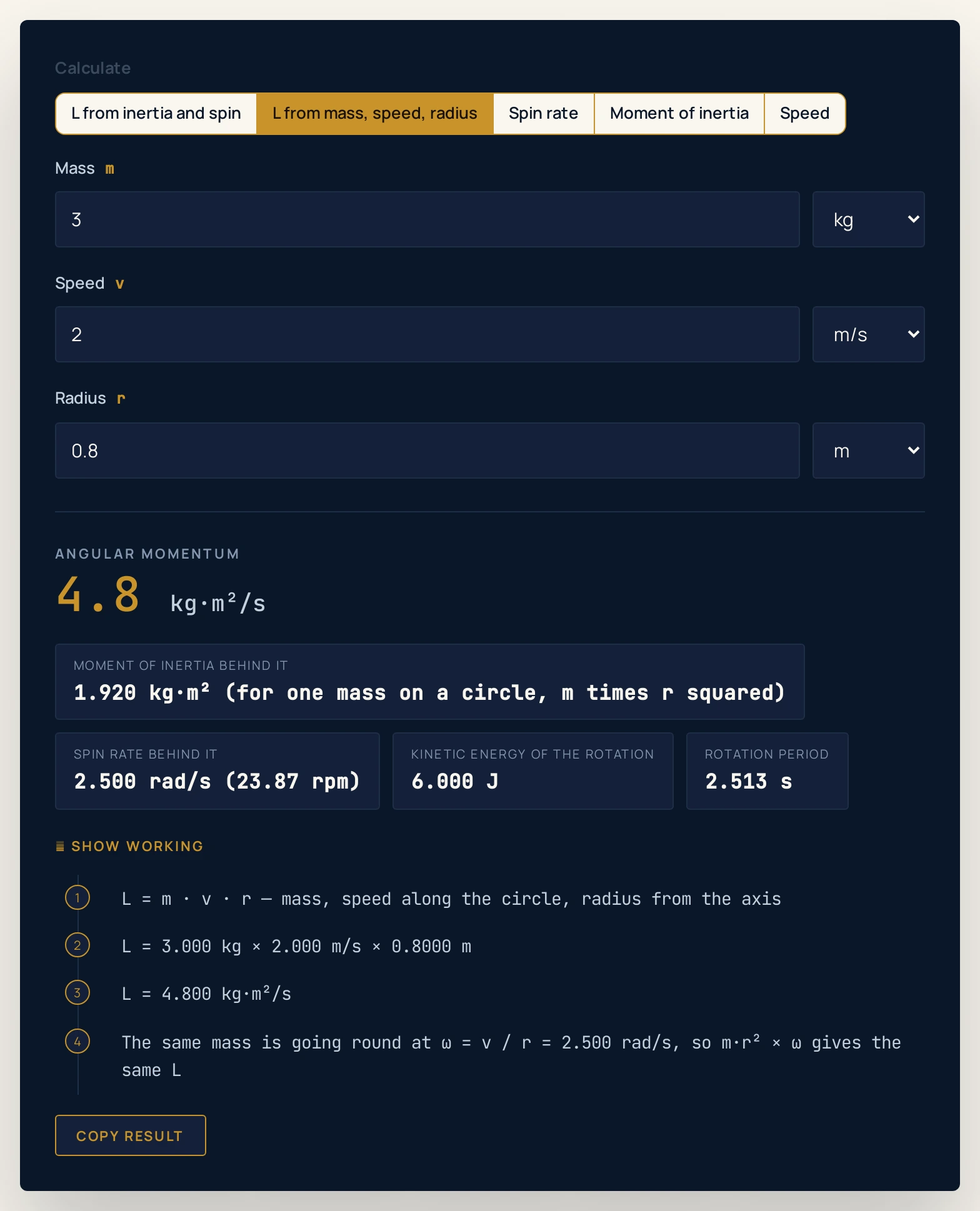
| Switch to one mass on a circle | L from mass, speed, radius | — | — | 3 kg, 2 m/s, 0.8 m | — | 4.8 kg·m²/s | 6.000 J |
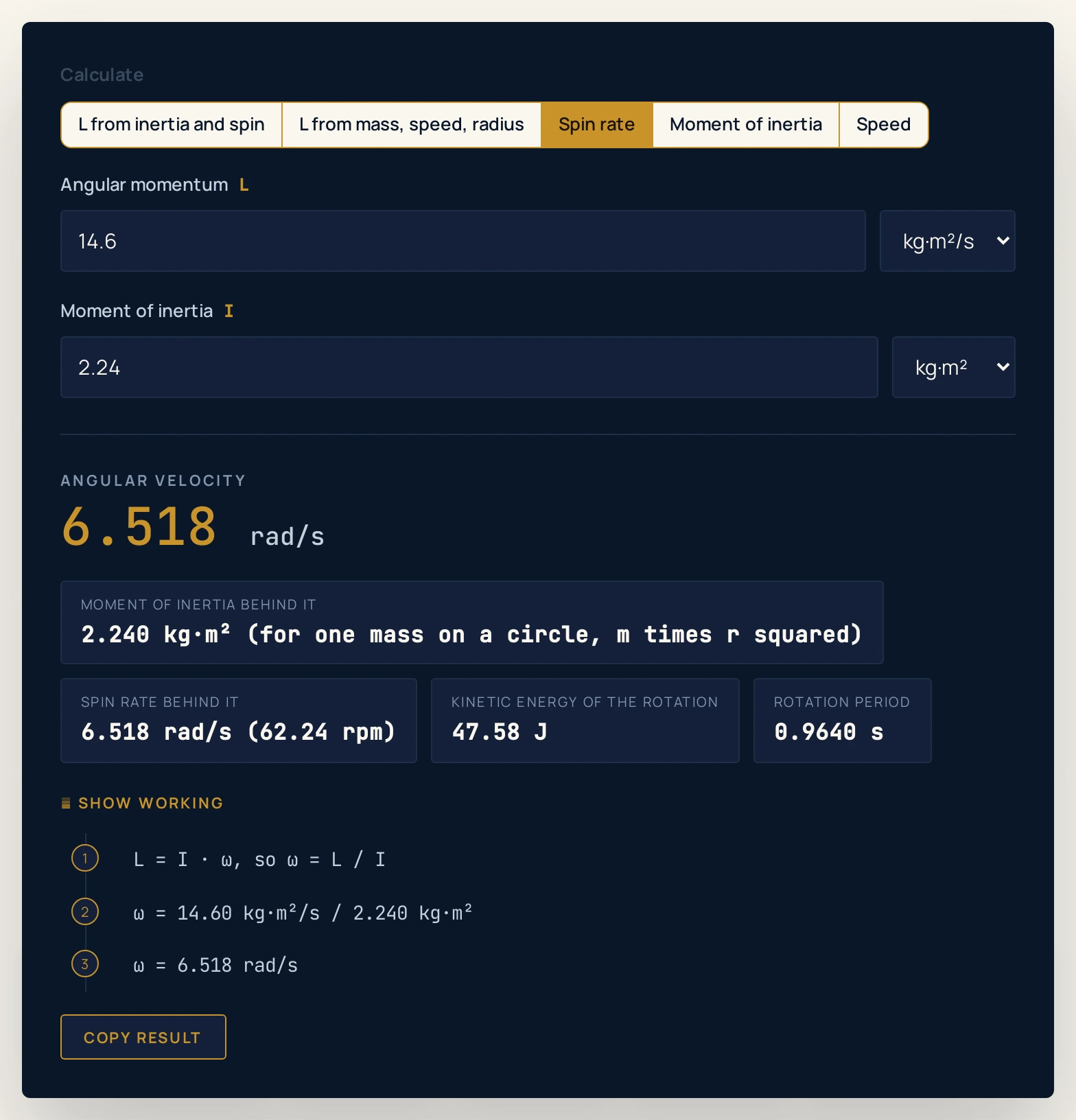
| Ask for the spin rate with the arms in | Spin rate | 2.24 kg·m² | — | — | 14.6 kg·m²/s | 6.518 rad/s | 47.58 J |
| Retype the same inertia in g·cm² | L from inertia and spin | 5.84e7 g·cm² | 2.5 rad/s | — | — | 14.6 kg·m²/s | 18.25 J |
| Ask for the speed of that one mass | Speed | — | — | 3 kg, 0.8 m | 4.8 kg·m²/s | 2 m/s | 6.000 J |
| Ask for the inertia that spin implies | Moment of inertia | — | 6.518 rad/s | — | 14.6 kg·m²/s | 2.24 kg·m² | 47.58 J |
| Put the arms-in state back in the first arrangement | L from inertia and spin | 2.24 kg·m² | 6.518 rad/s | — | — | 14.6 kg·m²/s | 47.58 J |
| Feed the one-mass extras back in | Spin rate | 1.920 kg·m² | — | — | 4.8 kg·m²/s | 2.5 rad/s | 6.000 J |
Rows 1 and 2 are the two ways of writing the same idea, applied to two different objects. The whole system carries 14.6 kg·m2/s; one of the two 3 kg masses on its rim carries 4.8 kg·m2/s of that total. Two such masses account for 9.600 kg·m2/s of it, and the turntable underneath them carries the remaining 5.000.
Rows 3 and 4 change the question and then the units. Asking for the spin rate that 14.6 kg·m2/s implies on 2.24 kg·m2 returns 6.518 rad/s, the figure the simulator reaches when the masses come in to 0.2 m. Retyping the original 5.84 kg·m2 as 5.84e7 g·cm2 changes nothing at all, because the menu converts and the physics does not care which unit you thought in.
Rows 5 and 6 solve backwards and land exactly where rows 1 and 2 started: 2 m/s for the mass, and 2.24 kg·m2 for the inertia. That round trip is the check worth doing whenever an answer looks surprising. Rows 7 and 8 close the last two loops — the arms-in pair multiplied out gives 14.6 kg·m2/s again, and the 1.920 kg·m2 the extras report as the inertia behind one mass, typed back in beside that mass's own 4.8 kg·m2/s, returns it to 2.5 rad/s.
Rotation energy is the column that does not stay put. The whole system reads 18.25 J at 2.5 rad/s and 47.58 J at 6.518 rad/s, for the same 14.6 kg·m2/s in both rows, and the difference of 29.33 J is work that has to be done by something. Watching where that work comes from is the job of the Angular Momentum Simulator, which moves the masses for you; this page only ever evaluates one state at a time, and those two rows were typed separately.
Formula and symbol reference
The calculator uses one relation in five arrangements: L = Iω, L = mvr, ω = L/I, I = L/ω and v = L/(mr). The extras come from L/ω, from ω itself, from ½Lω and from 2π/ω. No measured constant of nature enters any of them: apart from π in the period and in the rpm conversion, every figure here is arithmetic on the numbers you type.
| Symbol | Meaning | SI unit | Values used on this page |
|---|---|---|---|
| L | Angular momentum about the axis you name. The one quantity this page computes, however it is written | kilogram metre squared per second, kg·m2/s | Boxes take kg·m2/s or g·cm2/s: 14.6 for the whole system in the opening case, 4.8 for one mass on its rim. |
| I | Moment of inertia about that same axis: how the mass is spread out around it, not how much there is | kilogram metre squared, kg·m2 | Boxes take kg·m2 or g·cm2: 5.84 with the masses out at 0.8 m, 2.24 with them in at 0.2 m, 1.92 for one 3 kg mass at 0.8 m. |
| ω | Angular velocity, the spin rate. Radians per second internally, whatever the menu is set to | radian per second, rad/s | Boxes take rad/s, rev/s, rpm or deg/s: 2.5 rad/s in the opening case, which is 23.87 rpm, and 6.518 rad/s with the masses pulled in. |
| m | The mass being treated as a point on a circle, in the mass, speed and radius arrangement only | kilogram, kg | Boxes take kg, g or t: 3 kg for each of the two masses in the opening case. |
| v | Its speed along that circle. Related to the spin rate by v = ωr, which the working prints | metre per second, m/s | Boxes take m/s, km/h or cm/s: 2 m/s for a mass at 0.8 m turning at 2.5 rad/s. |
| r | The radius of that circle, measured from the axis the answer is quoted about | metre, m | Boxes take m, cm, mm or km: 0.8 m with the masses out, 0.2 m with them in. |
The physics: how L = Iω and L = mvr say the same thing
Take one mass m going round a circle of radius r at speed v. Its angular momentum about the centre is L = mvr, and its speed is tied to the spin rate by v = ωr. Substitute the second into the first and you get L = m(ωr)r = (mr2)ω, where mr2 is the moment of inertia of a point mass at radius r — so the two formulae are one formula written twice.
A real body is a great many such masses at a great many radii, so its moment of inertia is the sum of all their mr2 terms. That single number is what I stands for, and it is why the shape matters as much as the mass: move material outward and I grows as the square of the distance. The turntable in the opening case reads 5.84 kg·m2 with its two masses at 0.8 m and 2.24 kg·m2 with them at 0.2 m: only the masses move, so their 2mr2 share falls 16-fold from 3.84 to 0.24 kg·m2 while the 2.00 kg·m2 of the turntable itself stays put, which is why the total drops by 2.607 and not by 16.
What makes the quantity worth defining is that it only changes when something twists the object. With no net external torque about the axis, L stays put whatever the object does to itself — which is the argument behind every spinning-up skater, and the whole point of the full guide to angular momentum. Because I and ω must then trade off exactly, halving the moment of inertia doubles the spin rate.
The energy does not follow suit. KE = ½Iω2 = ½Lω, so at fixed L the energy rises in step with ω: the 2.607-fold spin-up between the two states above costs a 2.607-fold rise in rotational energy, from 18.25 to 47.58 J.
That extra 29.33 J is work done pulling the masses inward against the force that was holding them on their circles, and letting them back out returns it. Nothing is created, and the Angular Momentum Simulator is where you can watch the two bars move while the total stays where it was.
One more thing is worth saying plainly. Conservation is a statement about the net external torque being zero, not a promise about real objects: a real chair has bearing friction and a real skater has friction and air drag, and both slow down. This page never claims otherwise, because it never models a change at all.
mr2, and the spin rate and the period match the default state exactly, because it is the same turntable.Where the angular momentum calculator breaks down
Multiplying two numbers is hard to get wrong. What fails is the axis the numbers were measured about, the model the object is being squeezed into, or an expectation the arithmetic was never making.
- An axis that moved between the two numbers
- A moment of inertia is about one axis and a radius is from one point. Take I about the centre of mass and r from the pivot and the answer is a mixture of two different problems. Fix the axis first, then take every quantity about it.
- Symptom: an answer that changes when you re-derive it a second way.
- Rotation that is not about a symmetry axis
- L = Iω is the scalar form for spinning about a symmetry axis. In general angular momentum is a vector, it need not point along the rotation axis, and the moment of inertia is a tensor rather than a single number. This tool handles the scalar case only, and says so rather than pretending to the general one.
- Treating a real object as a point mass
- The mass, speed and radius arrangement uses
mr2, which treats whatever you are holding as a point at distance r. A real dumbbell also has a moment of inertia of its own about its own centre, which this model ignores. The error is small while r is much larger than the object, and not otherwise. - Expecting it to conserve anything
- The calculator evaluates one state. It never asks for a second radius and it never compares two states, so it cannot show angular momentum being conserved and does not claim to. Changing a radius and watching what happens is what the simulator does.
- Assuming no torque is acting
- Angular momentum is constant only for as long as the net external torque about that axis stays zero. Friction in a bearing, drag through the air and a hand on the rim are all torques, and each of them changes L. Working out how much takes a torque and a time, which is what the torque calculator is for.
- Rounded figures in, rounded figures out
- The working prints every operand to four significant figures while the answer is carried unrounded, so re-multiplying the printed operands can differ from the printed answer in the last digit. Type a value already cut to four figures and the answer inherits that rounding too.
- Speeds approaching the speed of light
- Everything here is classical. Near light speed the relation between momentum and speed changes and these formulae stop describing the motion. Nothing in the ranges this page uses goes anywhere near that, and no figure on the page should be read as covering it.
Where angular momentum is actually used
- Flywheels and energy storage
- A flywheel is chosen for its moment of inertia, and what it stores is the
½Iω2this page reports as the rotational energy. Doubling the spin rate quadruples the stored energy while only doubling the angular momentum, which is why the spin rate is the design lever. - Gyroscopes and attitude control
- A spinning rotor resists having its axis turned, because turning it means changing a vector angular momentum, which takes a torque. Reaction wheels on spacecraft use the same fact in reverse: driving a wheel one way turns the body the other way, and nothing outside has to push.
- Rotating machinery run-up and run-down
- How long a motor takes to bring a load to speed, and how long that load takes to coast to a stop, are set by the angular momentum it has to gain or lose divided by the torque doing the work. The moment of inertia behind it extra is the number a drive sizing calculation starts from; the torque available is the other half of the sum, and neither time follows from the angular momentum on its own.
- Sport and human movement
- A diver leaves the board with an angular momentum that nothing in the air can change much, and sets the rotation rate by tucking or opening out. Nothing on this page measures a diver; you supply the moment of inertia and the arithmetic does the rest.
- Orbits and spinning astronomical bodies
- A planet keeps the same angular momentum about its star all the way round, which is why it moves fastest where it is closest; at the nearest and furthest points, where its motion is square to the line to the star, that angular momentum is exactly
mvr. The same idea applied to a collapsing cloud is why compact remnants spin quickly. Momentump = mvobeys a rule of the same shape when no outside force acts, which the conservation of momentum guide works through in a straight line. - Laboratory turntable and rotating-stool experiments
- The standard demonstration measures a spin rate before and after weights are pulled in, and checks that Iω is unchanged. Enter each state here and the two angular momenta should agree to within your measurement error; the rotational energies will not, and setting them beside the straight-line
½mv2from the kinetic energy calculator is a good way to see why that is not a contradiction.
Where to go next
For what the quantity means, why it is conserved and a set of worked problems, read Angular Momentum Explained. Take a shape to the moment of inertia calculator, a spin rate to the angular velocity calculator, or a twist to the torque calculator. To watch the trade-off happen instead of typing it, the Angular Momentum Simulator moves the masses for you, and the whole physics lab library is open beside it.
Frequently asked questions
What is the formula for angular momentum?
L = Iω for a body spinning about a symmetry axis, where I is the moment of inertia about that axis and ω is the angular velocity in radians per second. For a single mass going round a circle the same quantity is L = mvr, with v the speed along the circle and r the radius from the axis. They are not two laws: m·v·r = m·(ωr)·r = (m·r²)·ω, and m·r² is exactly the moment of inertia of a point mass at radius r.
What are the units of angular momentum?
Kilogram metre squared per second, kg·m²/s, in SI. A torque multiplied by a time, and an energy multiplied by a time, both land on that same combination, so N·m·s and J·s are the identical unit under other names. The calculator works in kg·m²/s throughout and also accepts g·cm²/s, which is 1e-7 of it. The joule second is also the unit of the Planck constant, which is a fact about units and not a quantum claim.
Does the calculator show angular momentum being conserved?
No, and it is worth being clear about that. This tool evaluates L at one state from the numbers you type; it never asks for a radius change and it conserves nothing. Conservation is what the simulator demonstrates, by moving two masses to a new radius and showing the same L coming out. A figure from this page and a figure from the simulator are the same arithmetic on the same numbers, not two independent results.
Why does the moment of inertia behind it change when I switch arrangements?
Because the two arrangements describe different objects. With 5.84 kg·m² at 2.5 rad/s you are describing a whole turntable and everything on it. With 3 kg at 2 m/s on 0.8 m you are describing one mass on that same turntable, whose own moment of inertia about the axis is m·r² = 1.920 kg·m². The extra always reports L divided by ω, so it answers for whatever object you just entered.
Does angular momentum depend on where I measure it from?
Yes, completely. One motion carries as many different angular momenta as there are points to measure it about, so a radius taken from the wrong point answers a different question from the one you asked. Every radius in the mass, speed and radius arrangement therefore has to come from the axis the answer is quoted about, and that axis belongs beside the value whenever you write it down.
Why does a zero or a negative entry give no answer?
All six quantities here are positive magnitudes, and four of them sit underneath a division in at least one arrangement, so a zero or a negative returns the message that the combination has no valid solution rather than an infinity. Text is handled differently, because every box is a number field: characters that cannot belong to a number are dropped as you type, so 2abc lands in the box as a plain 2 and is answered as 5 kg·m²/s against the default 2.5 rad/s. Anything with no number left in it, such as abc or a lone full stop, and anything pasted in that is not a number from end to end, empties the box instead, and the page asks you to fill it rather than answering. Check what the box is actually holding before you trust the answer; for the opposite sense of rotation, carry the sign yourself.
Can I use this for a skater, a diver or an office chair?
You can, provided you supply the moment of inertia yourself. Nothing on this page measures the moment of inertia of a person, a chair or a stool, and no number here is attached to a named real object. Enter a value you have measured or estimated and the arithmetic is exact; the answer is then only as good as that input.
References & formula source
- Halliday, Resnick & Walker — Fundamentals of Physics, the chapters on rotation and on rolling, torque and angular momentum.
- Young & Freedman — University Physics, the chapter on the dynamics of rotational motion.
- Kleppner & Kolenkow — An Introduction to Mechanics, the chapter on angular momentum and fixed-axis rotation.
- BIPM — The International System of Units (SI brochure): the definitions of the second, the metre and the kilogram that every unit on this page is built from.
- Further reading: Angular momentum — Wikipedia