Angular momentum is the rotational counterpart of momentum: for a body turning about a fixed axis it is L = Iω, and for one mass going round a circle it is L = mvr — the same quantity written two ways. This lab draws the turntable twice over, before and after, and moves two equal masses from one radius to another while nothing outside exerts a torque about the axis. Five sliders set the turntable's own inertia, the mass at each radius, the two radii and the starting spin rate; two bars then show how the total is split between the turntable and the masses. Every figure on this page is a string the running simulation printed.
Angular Momentum: Why Pulling In Speeds You Up
A turntable seen from above, free to spin about a fixed axis, carrying two equal masses — one on each side. Move them from the starting radius to the finishing radius while nothing outside exerts a torque about the axis: the moment of inertia changes, the spin rate changes to compensate, and the angular momentum does not change at all. The two bars in the drawing show how that unchanged total is split between the turntable and the two masses — the split moves, the end of the bar does not. The rotational energy is a different story, and the note under the drawing says where it goes.
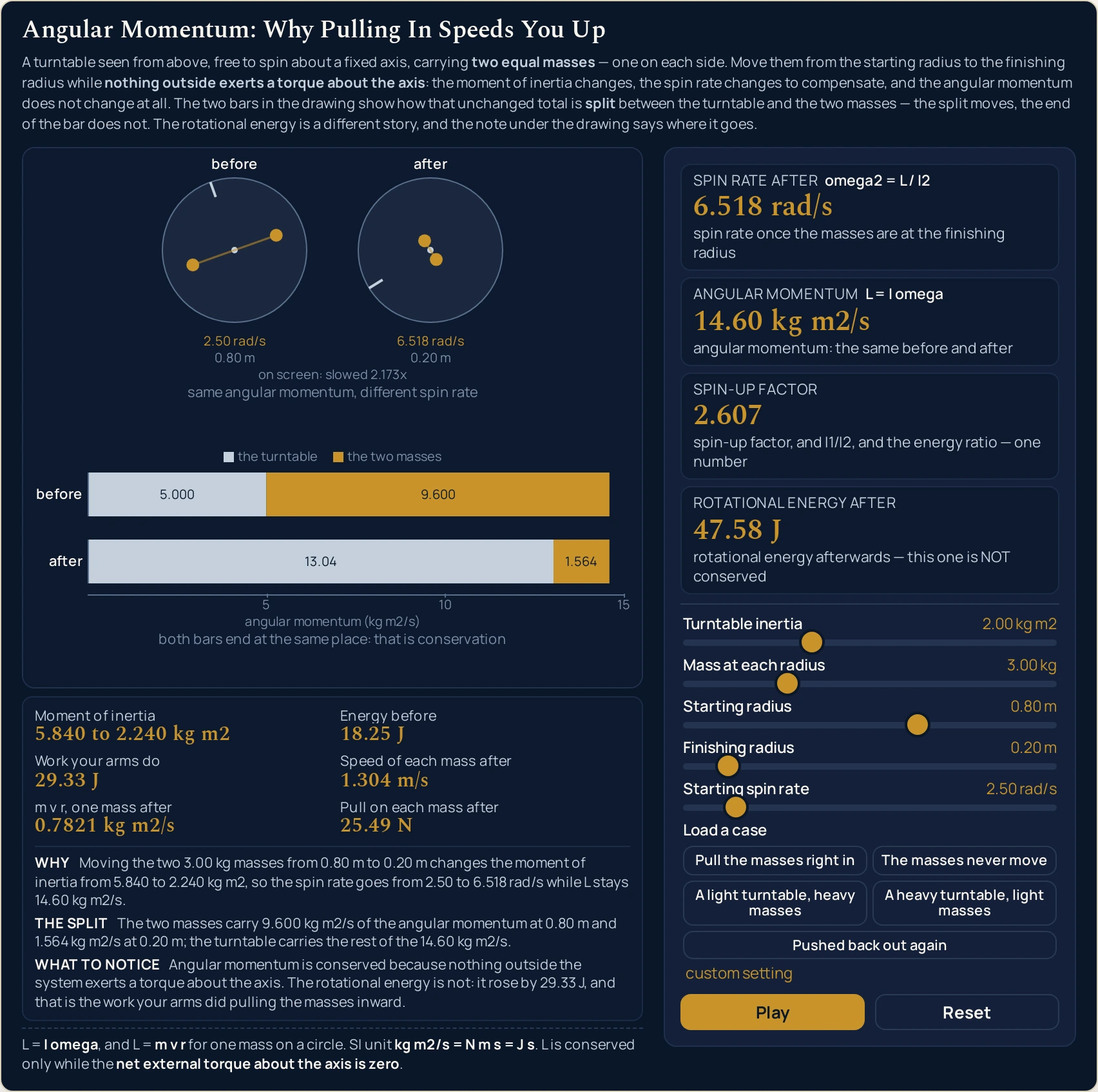
Moment of inertia5.840 to 2.240 kg m2
Energy before18.25 J
Work your arms do29.33 J
Speed of each mass after1.304 m/s
m v r, one mass after0.7821 kg m2/s
Pull on each mass after25.49 N
WhyMoving the two 3.00 kg masses from 0.80 m to 0.20 m changes the moment of inertia from 5.840 to 2.240 kg m2, so the spin rate goes from 2.50 to 6.518 rad/s while L stays 14.60 kg m2/s.
The split
What to noticeAngular momentum is conserved because nothing outside the system exerts a torque about the axis. The rotational energy is not: it rose by 29.33 J, and that is the work your arms did pulling the masses inward.
L = I omega, and L = m v r for one mass on a circle. SI unit kg m2/s = N m s = J s. L is conserved only while the net external torque about the axis is zero.
Spin rate after omega2 = L / I2
6.518 rad/s
spin rate once the masses are at the finishing radius
Angular momentum L = I omega
14.60 kg m2/s
angular momentum: the same before and after
Spin-up factor
2.607
spin-up factor, and I1/I2, and the energy ratio — one number
Rotational energy after
47.58 J
rotational energy afterwards — this one is NOT conserved
Turntable inertia2.00 kg m2
Mass at each radius3.00 kg
Starting radius0.80 m
Finishing radius0.20 m
Starting spin rate2.50 rad/s
Load a case
custom setting
Load a real change of shape
The first five buttons press the lab's own case buttons, which write all five sliders at once and name the case on the line beneath them. The last four write the sliders directly, so that line stays at custom setting. Watch the Angular momentum card as you move between them: it changes from case to case, because each case is a different system, and never changes when only the finishing radius moves.
Pick a case above, or drag the sliders yourself.
What Is the Angular Momentum Simulator?
The angular momentum simulator is a free interactive physics lab that runs in your browser — nothing to install and no sign-up. A turntable seen from above carries two equal masses, one on each side: you set its own moment of inertia from 0 to 6.00 kg·m2, the mass at each radius from 0.50 to 10.00 kg, the two radii between 0.10 and 1.20 m, and the starting spin rate from 0.20 to 20.00 rad/s. The panel answers with the spin rate afterwards, the angular momentum L = Iω, the spin-up factor and the rotational energy. Dragging the finishing radius moves every one of those except the angular momentum, which is the point of the lab.
| Control | Range | Step |
|---|---|---|
| Turntable inertia | 0 to 6.00 kg·m² | 0.01 kg·m² |
| Mass at each radius | 0.50 to 10.00 kg | 0.05 kg |
| Starting radius | 0.10 to 1.20 m | 0.01 m |
| Finishing radius | 0.10 to 1.20 m | 0.01 m |
| Starting spin rate | 0.20 to 20.00 rad/s | 0.01 rad/s |
| Load a case | five worked cases | five buttons |
How to use the angular momentum simulator
- Load a case, or start from Reset. The five buttons under Load a case — Pull the masses right in, The masses never move, A light turntable, heavy masses, A heavy turntable, light masses and Pushed back out again — write all five sliders together and print the button's own words on the case line. Move any slider and that line reverts to “custom setting”. Reset returns to 2.00 kg m2, 3.00 kg, 0.80 m, 0.20 m and 2.50 rad/s, and restarts the spin.
- Choose how much inertia the turntable has of its own. Turntable inertia runs from 0 to 6.00 in steps of 0.01 and reads back as “2.00 kg m2”. It is a number you pick rather than a measurement of anything, so if you want a defensible figure for a real disc or ring, work it out in the moment of inertia calculator from a mass, a radius and a shape factor first, and type the answer in here.
- Set the mass and the starting radius. Mass at each radius covers 0.50 to 10.00 kg in 0.05 kg steps, and Starting radius covers 0.10 to 1.20 m in 0.01 m steps. Both move Angular momentum, because both change the moment of inertia the system begins with; the radius does it faster, since it enters as a square.
- Drag the finishing radius and watch what stays still. Finishing radius has the same 0.10 to 1.20 m grid. Take it anywhere you like and Angular momentum does not stir, while Spin rate after, Spin-up factor, Rotational energy after and Work your arms do all follow it. Set it equal to the starting radius and the factor reads exactly “1.000”.
- Choose how fast it is turning to begin with. Starting spin rate runs 0.20 to 20.00 rad/s in 0.01 steps. Radians per second is the only unit this lab will accept, which is worth remembering if your figure came off a nameplate in rpm; the angular velocity simulator prints its own disc's rate in rad/s with the rpm on the line underneath, and will do that conversion for you.
- Read the four headline cards, the six stats and the three sentence lines. The cards give Spin rate after, Angular momentum, Spin-up factor and Rotational energy after; the stats add the moment of inertia in both states, the energy before, the work, the speed of each mass, the one-mass m v r and the pull each mass needs. Why restates the setting in words, The split reports the two masses' share, and What to notice changes as you cross the landmarks. Pause stops the discs without moving a number.
Worked example: change one thing at a time
Every row below starts from the state the lab boots in. Row 2 moves one slider and nothing else; rows 3 and 4 press a case button, which writes all five sliders at once. Each cell is a string the running lab printed at those control positions, and where a cell and the lab disagree, the lab is right. The setting column lists the five sliders in panel order.
| Change from the start | Turntable, mass, radii and spin | Angular momentum | Spin rate after | Spin-up factor | Rotational energy after | Work your arms do | Pull on each mass after |
|---|---|---|---|---|---|---|---|
| Start: the state Reset leaves | 2.00 kg m2 · 3.00 kg · 0.80 m to 0.20 m · 2.50 rad/s | 14.60 kg m2/s | 6.518 rad/s | 2.607 | 47.58 J | 29.33 J | 25.49 N |
| Finishing radius dragged back to 0.80 m | 2.00 kg m2 · 3.00 kg · 0.80 m to 0.80 m · 2.50 rad/s | 14.60 kg m2/s | 2.500 rad/s | 1.000 | 18.25 J | 0.000 J | 15.00 N |
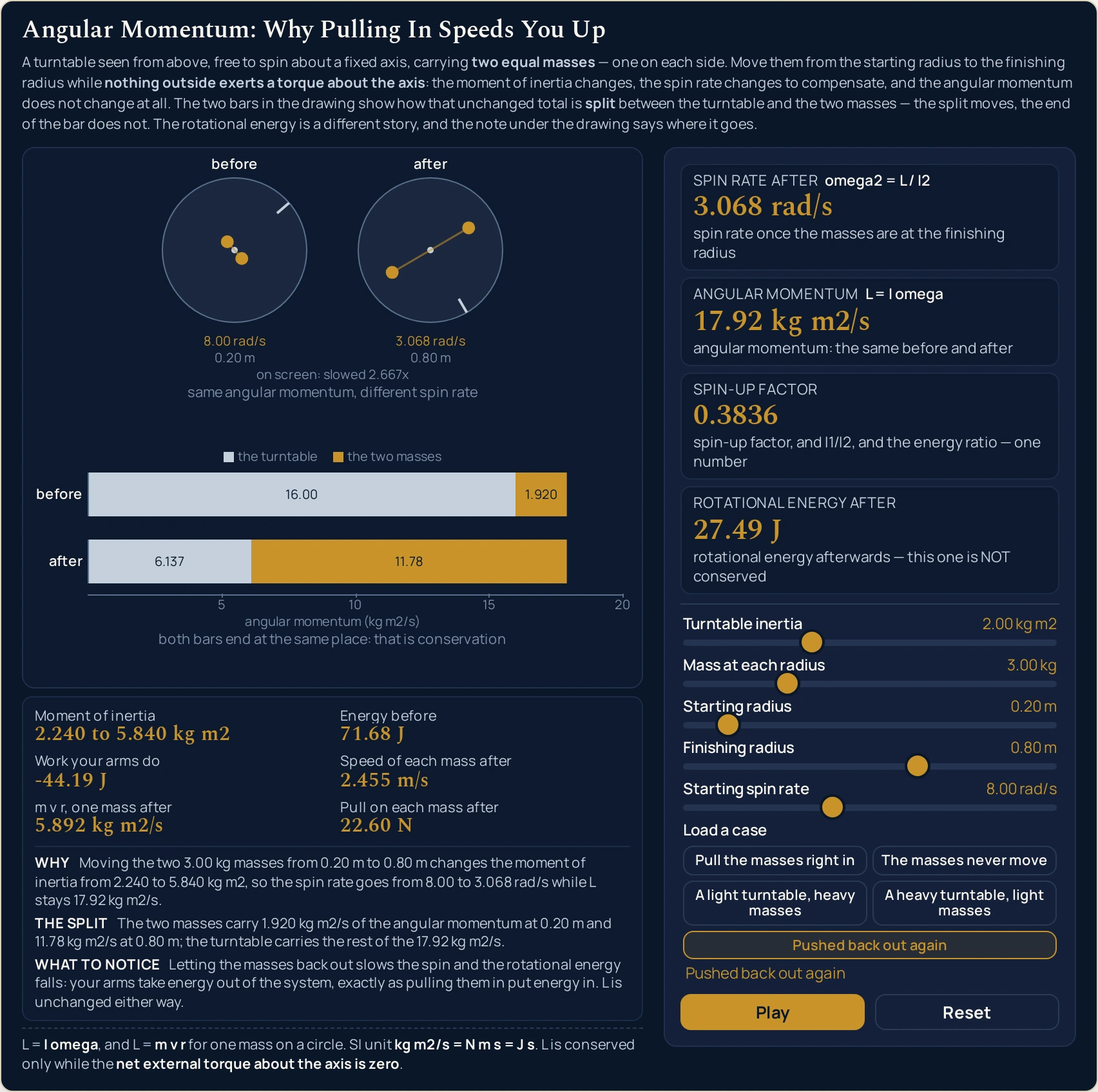
| Press Pushed back out again | 2.00 kg m2 · 3.00 kg · 0.20 m to 0.80 m · 8.00 rad/s | 17.92 kg m2/s | 3.068 rad/s | 0.3836 | 27.49 J | -44.19 J | 22.60 N |
| Press A light turntable, heavy masses | 0.40 kg m2 · 8.00 kg · 1.00 m to 0.20 m · 3.00 rad/s | 49.20 kg m2/s | 47.31 rad/s | 15.77 | 1164 J | 1090 J | 3581 N |
Row 2 is the reason this lab exists. One slider moved, and the only column that did not budge is the one the page is named after: 14.60 kg m2/s in both rows. Everything else moved a long way — the spin rate back down to 2.500 rad/s, the factor to 1.000, the energy to 18.25 J, the work to 0.000 J. Do the same to any of the other four sliders and the angular momentum moves with them.
Row 3 flips the sign of the work. Starting at 0.20 m and letting the masses out to 0.80 m turns 71.68 J of rotational energy into 27.49 J, and Work your arms do reads “-44.19 J”: the energy is coming back out through your arms instead of going in. Spin-up factor reads “0.3836”, which is a slow-down, and the What to notice line switches to the branch that says so. The angular momentum is 17.92 kg m2/s either way.
Row 4 is where the lab stops describing a person. Eight-kilogram masses on a light turntable give a fifteen-fold spin-up, and Pull on each mass after reads “3581 N” — far more than a person could hold, which is what the note under the drawing says in those words. The arithmetic is exact; what it describes is a machine. If you would rather check one of these states on your own figures, the angular momentum calculator evaluates L = Iω at a single state; it is the same arithmetic on the same numbers, not a second opinion.
Formula and symbol reference
The lab builds the moment of inertia of the whole system as I = Ib + 2mr2 at each radius, multiplies the first of those by the starting spin rate to get the angular momentum, and divides that same angular momentum by the second to get the finishing spin rate. Everything else on the panel hangs off those four numbers. Ranges marked “in this lab” are the controls' own ends and the strings the lab prints there.
| Symbol | Meaning | SI unit | In this lab |
|---|---|---|---|
| L | Angular momentum about the turntable's spin axis — the headline card, and the one reading the finishing radius cannot touch | kilogram metre squared per second, kg·m2/s | Four significant figures: “14.60 kg m2/s” after Reset, “1.168 kg m2/s” at the slowest start, and “616.0 kg m2/s” with 10.00 kg masses at 1.20 m spinning at 20.00 rad/s. The card carries the equation line L = I omega. |
| I | Moment of inertia of the whole system about that axis, before and after the move | kilogram metre squared, kg·m2 | One stat prints both states: “5.840 to 2.240 kg m2” after Reset, “30.80 to 2.200 kg m2” with 10.00 kg masses going from 1.20 m to 0.10 m, and “28.80 to 0.2000 kg m2” with the turntable inertia at zero. |
| Ib | Moment of inertia of the turntable itself — a setting you choose, never a measurement of any real object | kilogram metre squared, kg·m2 | 0 to 6.00 in steps of 0.01, reading back as “2.00 kg m2” after Reset. Zero is deliberately reachable, and at 0.02 or below the What to notice line switches to the point-mass branch at modest radii. |
| m | The mass held at each radius. There are two of them, one on each side, and they are always equal | kilogram, kg | 0.50 to 10.00 in steps of 0.05; “3.00 kg” after Reset. It moves the angular momentum, both bar ends and every reading that depends on them. |
| r1 | Starting radius: how far each mass sits from the axis before the move | metre, m | 0.10 to 1.20 in steps of 0.01; “0.80 m” after Reset. It changes the angular momentum, because it changes the moment of inertia the system starts with. |
| r2 | Finishing radius — the only control that leaves the angular momentum alone | metre, m | The same 0.10 to 1.20 grid; “0.20 m” after Reset. Setting it equal to the starting radius gives a spin-up factor of exactly “1.000” and work of “0.000 J” at every other setting of the panel. |
| ω | Angular velocity: the starting spin rate you set, and the finishing one the lab works out | radian per second, rad/s | The slider runs 0.20 to 20.00 in steps of 0.01 and reads “2.50 rad/s” after Reset. Spin rate after is computed, not set: with the turntable inertia at zero and the two radii and the starting rate at their own ends it runs from “0.001389 rad/s” to “2880 rad/s”, whatever the mass slider says. |
| v | Speed of each mass along its circle once it is at the finishing radius | metre per second, m/s | Four significant figures: “1.304 m/s” after Reset, “0.2500 m/s” with both radii at the minimum, and “9.462 m/s” in the light-turntable case. |
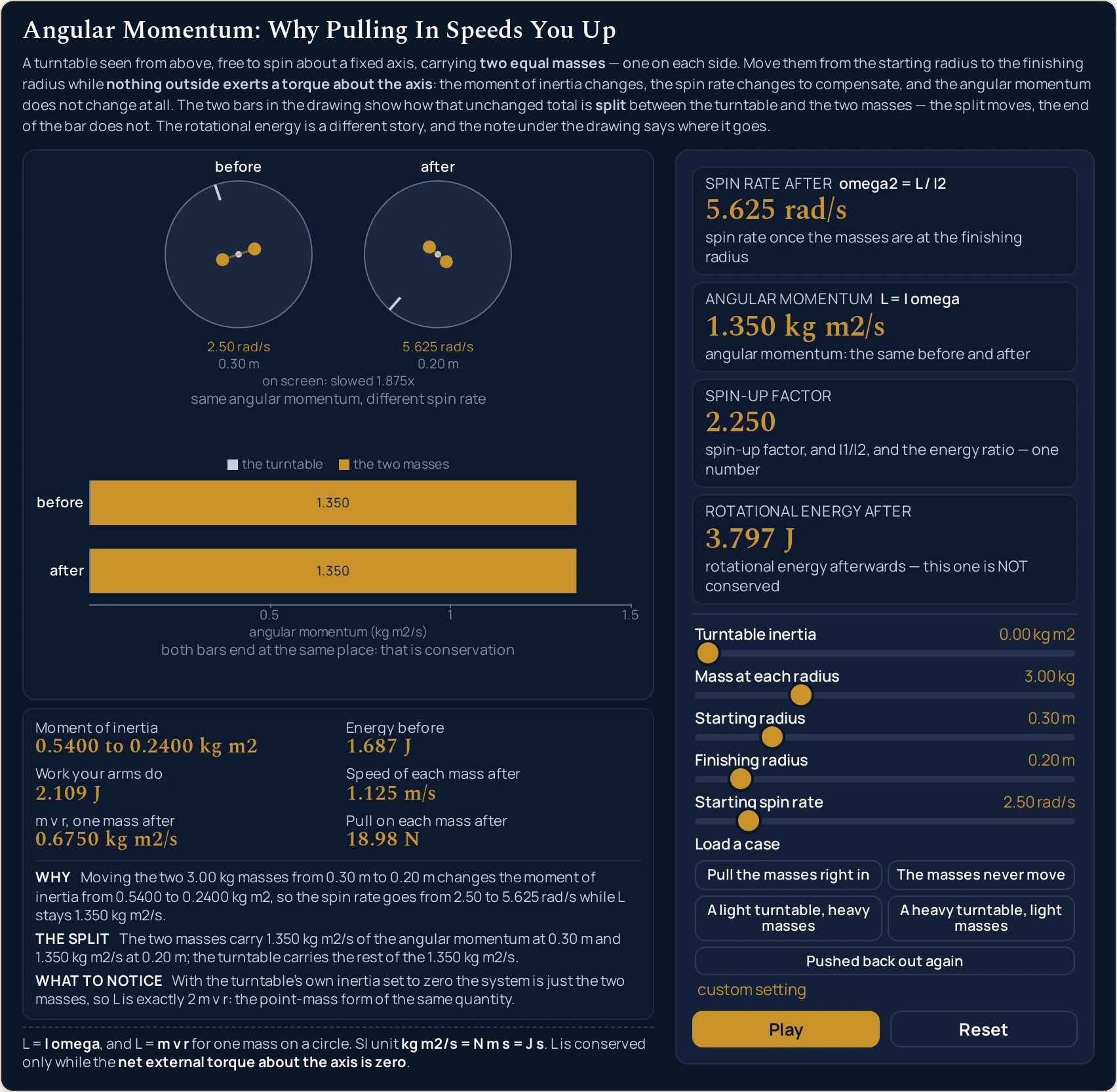
| m v r | The point-mass form for ONE of the two masses at the finishing radius, in the same unit as the headline | kilogram metre squared per second, kg·m2/s | “0.7821 kg m2/s” after Reset. With the turntable inertia at zero it becomes exactly half the whole reading — “0.6750 kg m2/s” against “1.350 kg m2/s”. |
| KE | Rotational energy, before the move and after it. This is the quantity that is not conserved | joule, J | Two stats and one card: “18.25 J” before and “47.58 J” after at Reset, rising to “8.624e+4 J” in the A machine, not a skater setting. |
| W | Work your arms do: the energy after minus the energy before, signed | joule, J | Positive pulling in, “29.33 J” after Reset; exactly “0.000 J” when the radii match; and negative letting out, “-44.19 J” in the Pushed back out again case. |
| F | Pull on each mass after: the centripetal force needed to hold one mass on its finishing circle | newton, N | “25.49 N” after Reset, “0.1631 N” at the slowest start, and “1225 N” with 10.00 kg masses pulled in to 0.10 m. When the masses move inward and that pull reaches 500 N, the What to notice line names the figure and calls the setting a machine. |
Two things in that table are worth a second look on screen. The lab writes its equations without Greek letters, so the cards read L = I omega and omega2 = L / I2 rather than using the symbol; and the unit is printed as “kg m2/s” throughout — a quantity you will also meet written as a joule second, or as a newton metre second. What the turntable-inertia slider stands for — why the same mass arranged as a ring and as a disc needs two different numbers — is the subject of the guide to moment of inertia, and why the spin-rate slider insists on radians per second is set out in the angular velocity formula.
The physics: why pulling in speeds you up
Each mass contributes mr2 to the moment of inertia, so where it sits matters far more than what it weighs. At the opening setting the Moment of inertia stat reads “5.840 to 2.240 kg m2” while the turntable's own contribution stays at the 2.00 kg m2 on its slider: the masses are the only thing that moved, and dropping their radius by a factor of four took most of the total with it. That is the square in mr2 doing the work.
Nothing outside the system is twisting it, so the product of the moment of inertia and the spin rate has to come out the same afterwards. The panel does that division for you: 14.60 divided by 2.240 kg m2 is the 6.518 rad/s on the first card. Spin-up factor reports the same thing as a ratio, and at this setting you can see where it comes from in the Moment of inertia stat — 5.840 divided by 2.240 is 2.607. The lab computes it from the unrounded values, so do not lean on that division at other settings.
The two bars are the bookkeeping. The upper one splits 14.60 kg m2/s into the turntable's 5.000 and the two masses' 9.600, which add to the printed total exactly; in the lower one the turntable's share has risen to 13.04 and the masses' has fallen to 1.564. Each bar is built from its own state's numbers rather than copied from the other, which is why the two ending level is a result and not a drawing convention. The lower pair is printed to four figures each, so adding those two will not give the printed total back — read the total off the card.
What does not survive the move is the energy. KE = ½Lω, so at a fixed angular momentum the energy rises in step with the spin rate: 18.25 J becomes 47.58 J, and 47.58 minus 18.25 is the 29.33 J in Work your arms do. That work is done pulling each mass inward against the force holding it on its circle, and Pull on each mass after is exactly that force at the finishing radius. The full guide to angular momentum takes the derivation further than a control panel usefully can.
One caution about the animation. Both discs turn while the lab is playing, and the caption under them says whether you are watching real time or a slowed version; the absolute rate is capped so that a 2880 rad/s setting is still watchable. What the drawing always keeps exact is the ratio of the two discs' rates, which is the spin-up factor on the third card. Treat the moving picture as a comparison between the two states, not as a clock.
If you want to see the other half of this story — the same mass rearranged into different shapes, and the same shape spun about a different axis — the moment of inertia simulator puts two bodies of equal mass side by side and lets you slide the axis away from the centre. That lab varies the I this one takes as a setting.
Where angular momentum conservation breaks down
The lab solves its own model exactly, so nothing on screen ever fails. Every limit below is a limit of that model, of the situation it stands for, or of the drawing, and each item says what the lab does about it.
- There is no friction anywhere in it
- The constants line under the canvas ends with the condition, in the lab's own words: “L is conserved only while the net external torque about the axis is zero.” Nothing here supplies one. Bearings rub, ice is not frictionless and air pushes back on a moving arm, so a stool, a chair or a skater all lose spin; how fast they lose it is not a question this lab can answer, because it keeps the total fixed by assuming the torque away rather than by showing there is none. Putting a number on what a real torque would take out needs a twist and a time, which is what the guide to torque covers.
- The rotational energy is not conserved, and nothing here pretends it is
- Two of the readings exist to make that impossible to miss. Energy before and Rotational energy after disagree at every setting where the radii differ, and Work your arms do is the difference between them with a sign on it. The commonest mistake on this topic is to read a rising spin rate as free energy; it is not, and the lab prices it for you in joules every time.
- This is the scalar form, for a symmetry axis
- Multiplying a moment of inertia by a spin rate gives the right answer here because the turntable is symmetric about the axis it turns on. Away from that case the quantity has a direction of its own, which need not line up with the axis at all, and one number will no longer stand in for the moment of inertia — a tensor is needed instead. Everything on this panel belongs to the scalar, fixed-axis case, and nothing here should be read as covering the general one.
- Every value is about one axis, and only that axis
- The axis here is the turntable's own, running through the hub. Change the point you measure about and every angular momentum on the panel changes with it: even a mass travelling dead straight carries some about any point its track misses, and none at all about a point the track runs through. None of the panel's readings is labelled with the axis it belongs to, so quote it yourself beside any figure you take away — the first row of the symbol table above names this one. Forgetting to do that is the commonest source of a wrong answer on this topic.
- The two masses are treated as points
- The
mr2each mass contributes is the formula for a point at distance r from the axis. A real hand weight is not a point: it turns about its own centre as well, and that extra share of the inertia is simply absent from this model. The omission hardly matters while the radius dwarfs the object, and it grows as the finishing radius comes down towards its 0.10 m minimum. - The sliders reach forces no person could exert
- Take the mass to 10.00 kg, the radii from 1.20 m to 0.10 m and the spin to 20.00 rad/s and Pull on each mass after reads “7.840e+4 N”; with the turntable inertia at zero as well it reaches “8.294e+6 N”. Whenever the masses move inward and that pull reaches 500 N, the What to notice line names the figure and calls the setting a machine rather than a skater; let them out instead and a different branch of that line wins however big the pull is. Nothing about those numbers is wrong; they simply do not describe a body.
- The turntable inertia is a setting, not a measurement
- Nothing in this lab measures the moment of inertia of a person, a chair, a stool or a skater, and none of the five case buttons is named after a real object for exactly that reason. They are named after what they demonstrate. Whatever you put on the slider is what the arithmetic uses, so the answer is only ever as good as that number.
- What the drawing leaves out when there is no room
- Every string on the canvas is measured before it is drawn, then shortened or dropped rather than overprinted, and what survives depends on the width of its own band, not the width of your screen. In the bars' band the smallest segment's value goes first, then the caption shortens from “both bars end at the same place: that is conservation” to “both bars end together”, then the colour legend goes, and narrower still the short caption too. In the discs' band the caption shortens from “same angular momentum, different spin rate” to “same L, different spin”. The two bands need not be the same width, so neither order predicts the other; The split prints the same figures in words.
- The lab's own arithmetic and display
- Four significant figures on almost everything, two decimals on the slider labels. A number that looks exact on the panel has usually been rounded to get there, so a ratio or a difference worked out from two printed readings is not always the one the physics gives. Take the ratio from Spin-up factor, which is computed from the unrounded values, rather than dividing the two figures in the Moment of inertia stat.
Where angular momentum is actually used
- Skaters, divers and gymnasts changing shape mid-rotation
- Once a diver has left the board, nothing much can twist them, so the rotation rate is set entirely by how tightly they are tucked. A gentle pull-in is the setting that shows the effect with no violence in it: 0.60 m to 0.40 m at 1.50 rad/s takes the spin to 2.108 rad/s for a Pull on each mass after of 5.333 N. Nothing here measures a diver, and the inertia on the slider is a number you chose rather than anybody's body. Opening out again is the Pushed back out again case with the sign of the work reversed.
- A helicopter's tail rotor
- Spin a main rotor one way and the airframe underneath it wants to turn the other, because the two shares have to add up to what the machine started with. The tail rotor exists to supply the outside torque that stops it happening. The two bars on this canvas are the same bookkeeping drawn in a straight line: move some of the total from one segment to the other and the bar still reaches exactly as far.
- Reaction wheels on a spacecraft
- With nothing outside to push against, a satellite turns itself by spinning a wheel inside it in the opposite sense. The total stays where it was, exactly as the lower bar's end does here when you drag the finishing radius. It is the closest real system to this lab's assumption, because in orbit the external torques really are very small.
- Flywheels, and why the spin rate is the design lever
- A flywheel stores rotational energy, and the lab prices the trade-off directly: hold the angular momentum where it is and the energy rises in step with the spin rate. The light-turntable case shows it plainly — a 15.77-fold spin-up, and Rotational energy after at “1164 J”. Getting that energy back out means slowing the wheel down, which is the negative work the Pushed back out again case shows.
- The inward pull a rotating machine has to survive
- Every one of these systems needs something to hold the moving mass on its circle, and that is the reading this lab puts in newtons. A centrifuge rotor, a turbine blade root and a spinning tether are all designed around it. Setting a mass on a circle and varying the speed and radius on their own, without any conservation in the picture, is what the circular motion simulator is for.
- The rotating-stool demonstration in a teaching laboratory
- Somebody sits on a stool holding a weight in each hand, is set turning, and pulls the weights in. The measurement worth making is the spin rate before and after, and the check is that the product of the moment of inertia and the spin rate agrees. This lab is that experiment with the friction removed and the arithmetic done for you; a real stool will always give a slightly smaller answer afterwards.
- Orbits, and why planets keep going round
- There is no torque about the Sun on a planet's orbit, so its angular momentum about the Sun is fixed, which is why it moves fastest when it is closest. For the straight-line partner of this bookkeeping, and what survives a collision, read how momentum is conserved in a collision. No figure in this lab describes a planet.
Where to go next
The full account — what the quantity is, why the two formulas are one quantity, the axis it depends on and a set of worked problems — is in Angular Momentum Explained. To put your own figures through the same two formulas at a single state, the angular momentum calculator shows every step of the substitution and converts the units for you.
The two quantities this lab multiplies together each have a page of their own: moment of inertia, with the moment of inertia calculator and the moment of inertia simulator beside it, and the angular velocity formula, with the angular velocity calculator and the angular velocity simulator. For what happens when something does twist the system, read torque; the rest are in the library of physics simulations.
Frequently asked questions
Why does the finishing radius never move the angular momentum reading?
Because it is the one control that changes how the mass is arranged without adding anything to the system. Drag it across its whole 0.10 to 1.20 m range at the opening setting and Angular momentum sits at 14.60 kg m2/s the entire time, while Spin rate after, Spin-up factor, Rotational energy after and Work your arms do all travel with it. The other four sliders move the total as well as the split.
Where does the extra rotational energy come from when the spin rises?
From your arms. At the opening setting Energy before reads 18.25 J and Rotational energy after reads 47.58 J, and the difference of 29.33 J appears in the Work your arms do stat. Pulling a mass inward means pulling against the force that was keeping it on its circle, through a distance, and that is work. Press Pushed back out again and the same stat reads -44.19 J, because the arms take energy back out.
Can I get the Spin-up factor by dividing the two moment-of-inertia figures?
At the opening setting, yes: Moment of inertia reads 5.840 to 2.240 kg m2 and 5.840 divided by 2.240 is 2.607, exactly what Spin-up factor shows. Do not rely on it elsewhere. Both figures are printed to four significant figures, so their quotient can differ from the panel by a few units in the last place at extreme settings. The lab computes the factor from the unrounded values.
Is the turntable on screen really turning at the rate the panel reports?
Usually not, and the drawing says so. The caption under the discs reads "on screen: slowed 2.173x" at the opening setting, because the animation caps the faster disc at 3 radians a second so it stays watchable. What the drawing does keep exactly is the ratio between the two discs, which is the Spin-up factor. Treat the animation as a comparison, never as a stopwatch.
Why does the case line say custom setting after I move a slider?
Because a named case is one exact position of all five sliders, so touching any of them means you have left it. The line under the case buttons reads a name such as Pushed back out again only while the sliders are where that button put them. Move the turntable inertia, either radius, the mass or the spin rate and it reverts to custom setting, as it also does at first load and after Reset.
What happens if I take the turntable inertia all the way to zero?
The system becomes nothing but the two masses, and the point-mass form of the quantity becomes exact. Set 0 with 3.00 kg masses going from 0.30 m to 0.20 m at 2.50 rad/s: Angular momentum reads 1.350 kg m2/s, the m v r, one mass after stat reads 0.6750 kg m2/s, and two of those make the whole of it. The turntable segment of both bars is then zero length.
Why does the What to notice line sometimes call the setting a machine?
Because it is watching the Pull on each mass after reading. Whenever the masses move inward and that pull reaches 500 N, the line names the figure and says it describes a machine rather than a skater; let them out instead and another branch wins however big the pull is. The light turntable case needs 3581 N on each mass, and the arithmetic is still right there; what it describes is not a person.
Does pausing the animation change any of the readings?
No. Nothing this lab reports depends on time, so Pause simply rests the loop and leaves both discs where they are. Every readout, both drawn angles, every mass position and both bar ends are identical across a pause. The sliders and the case buttons carry on working while it is paused, and pressing Play again resumes the same single loop rather than starting a second one.
References & formula source
- Halliday, Resnick and Walker, Fundamentals of Physics: Rotation, and Rolling, Torque and Angular Momentum, for the moment of inertia of a system of point masses and the condition under which angular momentum about an axis stays constant.
- Young and Freedman, University Physics: Dynamics of Rotational Motion, for the scalar form of angular momentum about a fixed axis and the work-energy accounting that goes with a change of shape.
- Kleppner and Kolenkow, An Introduction to Mechanics: Angular Momentum and Fixed Axis Rotation, for the vector definition and the reason the scalar form needs a symmetry axis.
- No constant of nature is used anywhere in this lab: every figure on this page is an output of the model at the control positions named beside it, and none of them is a measurement of a real turntable, chair or person. Verify against your own apparatus before use.
- Further reading: Angular momentum — Wikipedia